Three New Cosmic Ghosts Found
In this post
One Hundred Hours of Staring at Nothing
Picture a long, cold night of watching. Not watching a screen. Not watching a show. Just watching one small patch of sky, the same patch, hour after hour, while the stars barely seem to move.
Now stretch that night into many nights. Stretch it until the total reaches about one hundred hours of patient observing. That is what a small team of astrophotographers did, pointing their equipment at a corner of the constellation Cassiopeia and refusing to look away.
For most of that time, there was nothing new to see. The familiar stars shone. The familiar clouds of gas glowed faintly. Anyone walking past might have asked what on Earth they were waiting for.
They were waiting for ghosts.
Not the kind from scary stories. These ghosts are made of gas, dust and light so faint that a quick look misses them completely. They only surrender their shapes to people willing to gather their light slowly, patiently, photon by photon, the way you might fill a bucket one drop at a time from a nearly dry tap.
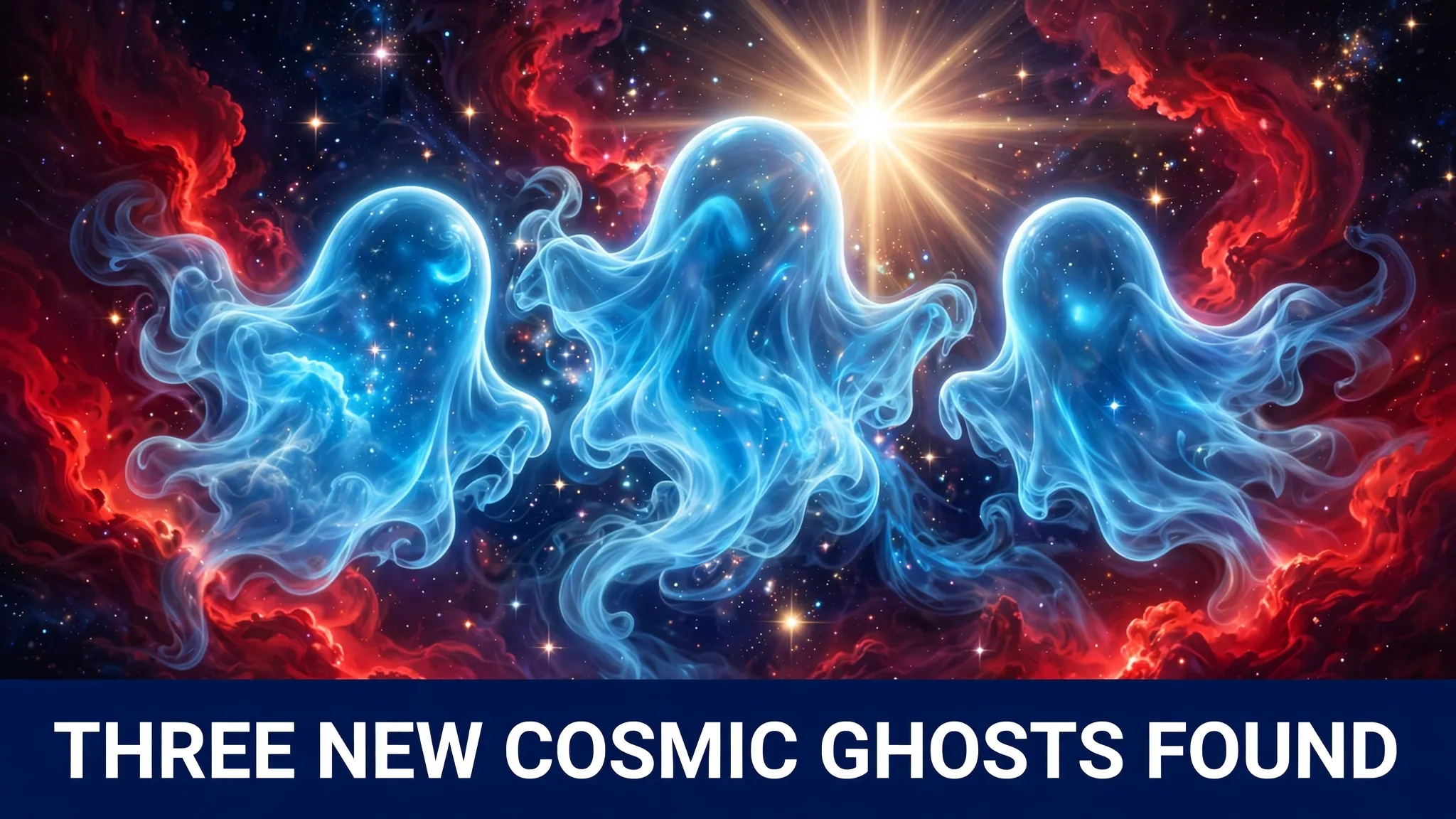
And then, at last, the waiting paid off. In the gathered light, three soft blue shapes appeared where no shapes had been recorded before. Three strangers. Three quiet figures standing in the dark.
NASA liked the result so much that it featured the image in its Astronomy Picture of the Day on 21 October 2026. The whole world got to meet the new ghosts. But almost nobody knew the size of the stakeout behind the picture.
The Filter That Sees What Eyes Cannot
There is a trick in this story, and the trick is a filter.
Human eyes are wonderful, but they are built for daylight on Earth, not for the whisper-faint glow of distant gas. Some of the light in deep space is simply too shy for us. It arrives weakly, spread thin across enormous distances, and our eyes let it slip past unnoticed.
So the observing team used a special filter that catches light given off by ionised oxygen. Ionised just means the oxygen atoms have been energised, knocked into an excited state by powerful radiation nearby, and as they settle down they release light of a particular kind. Block out almost everything else, keep only that special glow, and a hidden layer of the sky suddenly becomes visible.
Think of it like listening for one instrument in a full orchestra. The music is always there, all mixed together. But if you could mute every violin, drum and horn except one flute, you would hear a melody you never knew existed.
That is what the filter did. It muted the sky’s noise and let the oxygen sing. And in that quiet, three formations showed themselves, so new to science that they do not even have real names yet. For now, astronomers are calling them, simply and honestly, Object 1, Object 2 and Object 3.
The Famous Ghosts Who Already Lived There
The funny thing is that this neighbourhood already had ghosts. Two of them, in fact, and they are quite famous.
The constellation Cassiopeia holds two nebulas known as IC 59 and IC 63. A nebula is a vast cloud of gas and dust floating between the stars, and these two have shapes that remind people of drifting, ghostly figures. So, naturally, sky-watchers gave them a nickname that stuck: the Ghosts of Cassiopeia.
They hang in space near a bright star called Gamma Cassiopeiae. One of them, IC 63, lies roughly 550 light-years from Earth. A light-year is the distance light travels in a whole year, and light is the fastest thing there is, so 550 of them is a distance almost too large to imagine. The light entering those cameras left its home centuries before anyone alive today was born.
So the team was not exploring an empty street. They were watching a haunted house that everyone thought they already knew, room by room. And in the corner of the frame, three more figures were standing there the whole time, unseen.
Personally, that is the detail I cannot stop thinking about: the new ghosts were not hiding far away in some unreachable place. They were right beside the famous ones, in one of the most photographed neighbourhoods in the sky, waiting for somebody patient enough to notice them.
A Star Thirty-Four Thousand Times Stronger Than the Sun
Every good ghost story needs a source of eerie light, and this one has a monster.
Gamma Cassiopeiae, the bright star near these nebulas, is no gentle lamp. Its energy output may exceed the Sun’s by about 34,000 times. Read that number again slowly. Our Sun is so fierce that staring at it for even a moment can damage your eyes. Now multiply that fury by tens of thousands, and you begin to understand the neighbourhood these clouds live in.
That star is constantly blasting its surroundings with energetic ultraviolet light, a kind of light our eyes cannot see but which carries real power. When that radiation slams into the hydrogen gas of the nebulas, it energises the gas until it glows red. That deep red shine in the image is hydrogen, lit up like a neon sign by its overpowering neighbour.
At the same time, dust in the clouds does something softer. It reflects and scatters the starlight, spreading a blueish-white glow through the scene. Red fire from the gas. Pale blue shimmer from the dust. That is the whole colour palette of the picture, and both colours trace back to the same brilliant bully of a star.
The three new objects glow blue in the special oxygen light. They are not lit the same way as their red cousins, and that difference is one of the clues scientists are now picking through, trying to work out what these things actually are.
The Speedboat Theory
So what are Object 1, Object 2 and Object 3? Here the story becomes a detective case, because honestly, nobody knows yet. But there is a leading idea, and it is a beautiful one.
Gamma Cassiopeiae and its system are not sitting still. They are moving through the thin gas and dust between the stars. And when something moves through a medium, it pushes that medium aside and piles it up in front, exactly the way the bow of a speeding boat shoves water upward into a wave.
Astronomers suspect the same thing may be happening here. As the star system ploughs through interstellar material, gas may be compressing and heating at its front edge, the bow wave of a boat made of starlight and motion. Object 3, they suggest, might be exactly that: a heap of squeezed, heated oxygen, glowing where the pressure is greatest.
Object 1 raises a different possibility. It might be a planetary nebula, which is the cast-off outer shell of a dying star, a bubble of gas drifting away from the small, hot core left behind. But that idea comes with a condition. To confirm it, astronomers would need to identify a central white dwarf, the dense leftover heart of the dead star, sitting at the bubble’s centre. Find the heart, and the case is solved. Until then, it stays a maybe.
And Object 2? For now, it mostly just stands there being mysterious, which, for a ghost, is fairly appropriate behaviour.
Meet the Ghost Hunters
Behind the image is a team of four observers working at Starfront Observatories: Louis Leroux-Gérès, Thibault Ruyé, Vincent Martin and Cedric de Decker.
It is worth pausing on what their achievement really involved. There was no single dramatic moment, no lucky snapshot. There was a decision to spend about a hundred hours on one target, using the right filter, trusting that something invisible was worth the effort. Most discoveries announce themselves loudly. This one had to be waited out, like a shy animal that only approaches people who stay perfectly still.
That is a hopeful thought for the rest of us. The sky is not finished. Familiar constellations, photographed for generations, can still keep secrets, and sometimes all it takes to uncover one is patience plus a clever way of looking.
A Mystery That Refuses to Be Solved Yet
The honest ending of this story is that there is no ending yet. The origins of the three objects remain a mystery still to be solved, and astronomers are quite open about that. More observing, more analysis and more debate will be needed before Object 1, Object 2 and Object 3 graduate into proper names with proper explanations.
Some people find unsolved mysteries frustrating. But consider what these three faint smudges of blue light are really telling us. They are proof that the universe does not give up its secrets all at once, not even the ones close to home, not even the ones standing in plain sight beside famous landmarks.
Somewhere above us tonight, in the constellation Cassiopeia, three quiet ghosts are glowing in oxygen light too faint for any eye to catch. They were there long before us. They will be there long after us. And now, thanks to four patient watchers and one clever filter, we finally know to wave back.
Frequently Asked Questions
What exactly did the photographers find in Cassiopeia?
They revealed three faint formations that nobody had recorded before, now provisionally labelled Object 1, Object 2 and Object 3. The formations appeared after about 100 hours of observation using a special filter that detects light from ionised oxygen.
Why are IC 59 and IC 63 called the Ghosts of Cassiopeia?
These two well-known nebulas have drifting, wispy shapes that remind people of ghostly figures. They float near the bright star Gamma Cassiopeiae, and their eerie appearance earned them the nickname.
How far away is the ghost nebula IC 63?
IC 63 lies roughly 550 light-years from Earth, which means the light from it that reaches our cameras began its journey centuries ago.
Why do the nebulas glow red and blue?
The red glow comes from hydrogen gas energised by powerful ultraviolet light from Gamma Cassiopeiae, a star whose energy output may exceed the Sun’s by about 34,000 times. The blueish-white tones come from dust that reflects and scatters the star’s light.
What might the three new objects actually be?
One theory says Object 3 could be oxygen gas compressed and heated like the bow wave of a speeding boat, created as the star system moves through interstellar material. Object 1 could be a planetary nebula, but only if a central white dwarf is identified inside it. For now, the origins of all three remain unsolved.
Who took the image that NASA featured?
The observing team behind the image works at Starfront Observatories and consists of Louis Leroux-Gérès, Thibault Ruyé, Vincent Martin and Cedric de Decker. NASA featured their work as its Astronomy Picture of the Day on 21 October 2026.
Sources
- NASA Science (Astronomy Picture of the Day, 21 October 2026) https://science.nasa.gov/image-article/apod-2026-october-21-new-ghosts-revealed-in-cassiopeia/
- UkrMedia News (NASA reveals three mysterious ghosts in space) https://ukrmedia.news/en/science-tech/pryvydy-kassiopei-nasa-novi-tumannosti/