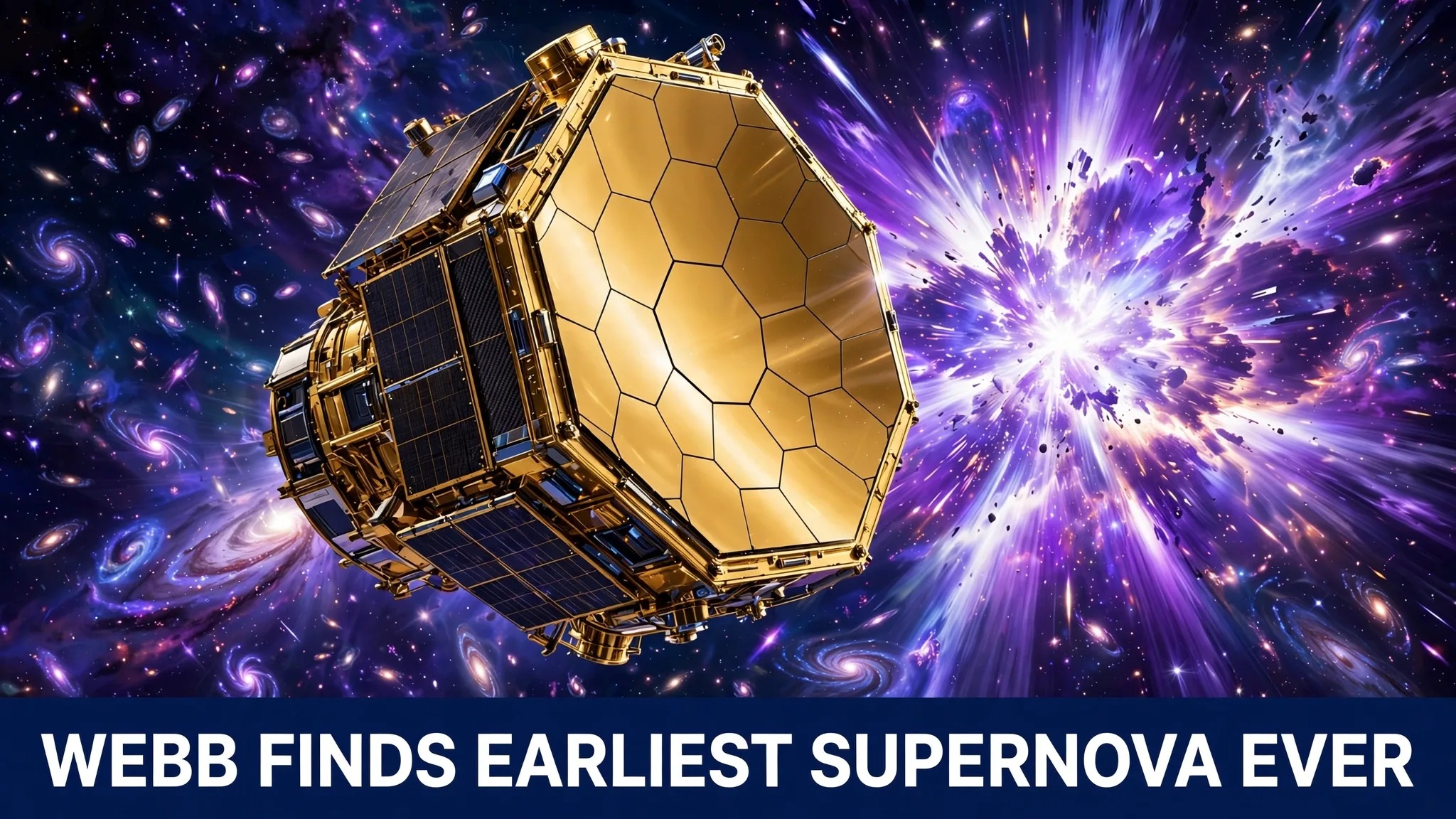
Webb Finds Earliest Supernova Ever
In this post
Some evidence takes a long time to reach the detective. A fingerprint might wait in a drawer for years. A witness might stay silent for a decade. But the case in this story makes every earthly cold case look fresh, because the evidence here spent almost the entire lifetime of the universe on the road. A star exploded in the deep darkness of the young cosmos, and its final flash of light set off on a journey so long that no words we use for travel really fit it. The light crossed space while galaxies were still young and rough. It kept going while the universe stretched and cooled and slowly built the crowded sky we know today. And then, at last, it arrived here, where a group of patient astronomers were waiting with the finest telescope humanity has ever built, ready to read the message and work out what had died, and when.
What they found has now been confirmed. A supernova that exploded when the universe was only 730 million years old has been identified by NASA’s James Webb Space Telescope. It is the earliest stellar death ever observed, a star’s final moment caught from a time when the cosmos was still in its childhood.
A Crime Scene Older Than Everything We Know
To understand why astronomers are so excited, it helps to picture the scene of the event. The universe today is a busy, mature place, filled with galaxies that have had billions of years to grow, collide, settle and shine. The universe at 730 million years old was nothing like that. It was a rougher, simpler place, still early in the long job of building the structures we see around us now. Stars of that era lived in a cosmos that had barely begun.
Somewhere in that young darkness, a massive star reached the end of its life. Massive stars burn fast and die dramatically, and this one collapsed and tore itself apart in one of the most violent events nature allows: a core-collapse supernova. For a brief moment, a single dying star can blaze with a brilliance that rivals whole galaxies. Then the light begins its long escape into space, carrying with it a kind of fingerprint of the star that made it.
Nobody was there to see it, of course. Nobody existed. The flash simply travelled, year after year, age after age, through a universe that kept expanding around it. Every detective story needs the evidence to survive the journey, and light is the toughest evidence there is. It does not rot, it does not forget, and it does not stop. It only grows fainter and more stretched as the expanding universe pulls at it, shifting its colour toward the red and then beyond red, into the infrared, where human eyes cannot follow. To catch a signal that old and that stretched, you need a detective built for exactly that job.
The Alarm That Rang In March 2025
Every investigation starts with an alarm, and this one rang in mid-March 2025. A small X-ray telescope called the Space Variable Objects Monitor, developed by China and France, picked up a sudden burst of gamma rays from deep space. The event was catalogued as GRB 250314A. Gamma-ray bursts are the universe’s loudest alarms. They are brief, ferociously energetic flashes, and they often mark the moment a massive star collapses, sometimes sending out a jet of energy that announces the death across billions of light-years.
Most bursts, once examined, turn out to come from distances that are large but familiar to astronomers. This one behaved differently. Within days, the early measurements were flagging something odd: the burst looked unusually distant, far beyond the usual crowd of events. That single hint changed everything. A very distant gamma-ray burst can mean something precious is hiding inside the flash: the light of a supernova from the early universe, the kind of event astronomers dream about catching because each one is a direct look at how the first generations of stars lived and died.
But suspicion is not proof. The small telescope that raised the alarm had done its job; it had pointed at the right patch of sky and shouted. Confirming what the burst really was would take a far more powerful instrument, one that could gather the faint, stretched, infrared remains of that ancient light and read them carefully. There was only one machine on call for work like that.
Calling In The Golden Detective
The James Webb Space Telescope is the detective this case had been waiting for, even if nobody knew it. Its enormous mirror, made of gold-coated segments, was designed to collect exactly the kind of light this story is about: faint infrared signals from the most distant objects in existence, whose light has been stretched by the expansion of the universe during its long journey to reach us.
On 1 July 2025, Webb turned its attention to the scene and carried out follow-up imaging in the near-infrared. This was the slow, careful part of the investigation, the equivalent of dusting the scene for prints. The question hanging over the work was simple to ask and hard to answer: was GRB 250314A truly the death cry of a massive star in the young universe, or something else wearing a disguise?
The evidence came back clear. Webb’s observations confirmed that the burst had been produced by a collapsing massive star, a genuine core-collapse supernova, shining from a time when the universe was only 730 million years old. The alarm from March had been telling the truth. A star had died in the cosmic dawn, and its light had survived the whole journey to be read by human beings. Personally, I find something quietly moving in that: a star that vanished before our galaxy had taken shape still managed to send us its last message, and we were finally clever enough to catch it.
A Record Beaten By More Than A Billion Years
Records in astronomy tend to fall slowly, nudged back step by step as instruments improve. This one did not fall slowly at all. Before this confirmation, the earliest supernova Webb itself had identified dated to a time 1.8 billion years after the Big Bang. That was already an extraordinary reach into the past. The new event, at 730 million years, breaks that record by more than a billion years in a single jump.
A billion years is not a small margin in this business. It is the difference between looking at a universe that had started to settle down and looking at one that was still being assembled. Each step further back brings astronomers closer to the era of the very first stars, the pioneers that lit up the darkness for the first time and forged the earliest heavy elements, the raw ingredients from which later stars, planets and eventually people would be made.
The team behind the work was led by Andrew Levan of Radboud University and the University of Warwick, and their analysis was published in Astronomy & Astrophysics Letters in October 2026. Like any good detective report, the paper lays out the chain of evidence: the burst, the early suspicion of great distance, the infrared follow-up, and the confirmation. The verdict is that humanity has now seen a stellar death from deeper in time than ever before.
The Clue Nobody Expected
Here is where the case takes its strangest turn, the kind of twist that makes experienced investigators sit up in their chairs. The team expected the ancient supernova to look exotic. There were good reasons for that expectation. Stars in the early universe were thought to be different beasts from the stars of today: likely more massive, built from simpler material with far fewer heavy elements, and living shorter, more violent lives. A death in that era, many assumed, might look noticeably different from the supernovae astronomers study in nearby galaxies.
Instead, when the researchers examined the spectrum of the distant event, the pattern of light left behind by the explosion, it looked remarkably similar to modern, nearby Type II supernovae, the familiar class of exploding massive stars that observatories have been watching for decades. The oldest stellar death ever seen turned out to look, in its essential character, surprisingly ordinary.
That twist carries a gift hidden inside it. If early supernovae behave much like the ones nearby, then the tools astronomers have spent decades building and refining to study local explosions can be carried far across cosmic history and applied there with confidence. The measuring sticks still work at the edge of time. One confirmed event does not settle every question about the first stars, and the team is careful about that, but it opens a door. The early universe may be strange in many ways, yet at least one of its most dramatic events follows rules we already understand.
Why One Ancient Explosion Matters So Much
It is fair to ask why a single distant flash deserves this much attention. The answer is that supernovae are not just fireworks. They are the universe’s delivery system. When a massive star explodes, it scatters the elements built inside it across space, seeding the darkness with the material that future stars and planets will gather up. Understanding when these explosions began, and how the earliest ones behaved, is part of understanding how a universe of mostly simple gas became a universe with rocky worlds and living things on at least one of them.
This detection also proves the method works. A small monitoring telescope catches the alarm, flags the events that look unusually far away, and the great observatory follows up to read the faint evidence. That is how more of these ancient deaths will be found, each one another witness statement from the universe’s first billion years.
The light from GRB 250314A has finished its journey now. The star is long gone. The story it carried is not.
Frequently Asked Questions
What exactly did the James Webb Telescope confirm?
Webb confirmed that a gamma-ray burst known as GRB 250314A was produced by a collapsing massive star, a core-collapse supernova, which exploded when the universe was only 730 million years old. That makes it the earliest stellar death ever observed.
Who first detected the flash?
The flash was first picked up in mid-March 2025 by the Space Variable Objects Monitor, a small X-ray telescope developed by China and France. It was flagged as unusually distant within days, which is why Webb was called in to investigate.
When did Webb examine the event?
Webb carried out its follow-up near-infrared imaging on 1 July 2025. Those observations provided the confirmation that the burst came from a supernova in the early universe.
How big was the new record?
The previous record, also set by Webb, was a supernova from 1.8 billion years after the Big Bang. The new event, at 730 million years after the Big Bang, breaks that record by more than a billion years.
What surprised the scientists most?
The spectrum of the ancient supernova looked remarkably similar to modern, nearby Type II supernovae. Because of that similarity, the tools used to study supernovae close to home can also be applied across most of cosmic history.
Who led the research team?
The team was led by Andrew Levan of Radboud University and the University of Warwick. Their analysis was published in Astronomy & Astrophysics Letters in October 2026.
Sources
- JNP Travel science report (Webb supernova discovery, October 2026): https://jnptravel.com/blog/james-webb-supernova-discovery-october-2026-early-universe