Tomasz Kot: The Life Story Behind Poland's Cold War Star
In this post
Some actors become famous in one night, and some become famous slowly, one role at a time, until the world finally sees them. Tomasz Kot belongs to the second group. He worked in the theatre for many years, he played strong roles in Polish films, and he built a reputation as one of the finest actors in Poland. Then, in 2018, he played Wiktor in Cold War, a film by Paweł Pawlikowski, and suddenly the whole world knew his name. It was not sudden luck. It was the reward for nearly twenty years of hard and honest work.
Kot was born in Legnica, a city in the south-west of Poland, and he trained as an actor in Kraków, one of the oldest and most respected theatre schools in Poland. He is an actor who works quietly, without shouting for attention, and his performances are full of small details, of a look, of a pause, and of a feeling that the audience can sense without words. That quiet way of acting is rare, and it is why directors trust him with their most difficult roles.
This is the story of Tomasz Kot, from a boy in Legnica to a student in Kraków, from the stages of Polish theatre to the films that made him famous at home, and from Cold War to a Netflix film with some of the biggest stars in Hollywood. It is a story about patience, about craft, and about an actor who kept working until the world was ready to see him. It is also a story about Poland, and about how a Polish actor can carry his country’s stories to the whole world.
What makes Kot special is his stillness. He does not act with large gestures or with loud speeches. He acts with his eyes, with his face, and with the way he stands in a room, and the audience understands what his character feels without being told. That kind of acting takes great skill, and it takes great confidence, because it trusts the audience to pay attention. Kot trusts his audience, and his audience trusts him.
There is also something hopeful in the story of Kot, because it shows that a long career built on good work will eventually be recognised. He did not become famous young, and he did not chase fame. He worked in the theatre, he took the roles that mattered to him, and he waited. When Cold War came, he was ready, and the world saw what Polish audiences had known for years, that Tomasz Kot is an actor of rare talent.
A Boy From Legnica
Tomasz Kot was born on 21 April 1977 in Legnica, a city in the south-west of Poland, with a long history and a strong tradition of theatre. Legnica is not one of the largest cities in Poland, but it has a proud cultural life, and the young Tomasz grew up in a place where the theatre mattered. He was a bright boy, and he loved stories, films, and plays, and he began to dream of becoming an actor while he was still at school.
As a teenager, Kot was drawn to the stage, because the theatre offered a way to become someone else for a time, and to tell stories that mattered. He watched plays, he read about acting, and he decided that he wanted to study it seriously. Acting is not an easy career, and it requires patience, hard work, and a willingness to face rejection, but Kot was determined. He believed that he had something to give, and he was willing to work for it.
He studied at the Ludwik Solski Academy for the Dramatic Arts in Kraków, one of the best theatre schools in Poland, and he graduated in 2001. Kraków is a beautiful old city, and its theatre school has trained many of Poland’s finest actors. At the school, Kot learned the craft of acting, how to use his voice, how to move on a stage, and how to understand a character from the inside. His teachers saw his talent, and they encouraged him to keep going, because they knew he had the patience and the discipline to succeed.
After graduating, Kot began to work in the theatre, first in Legnica, at the Helena Modrzejewska Theatre, and then in Kraków, where he played many roles on stage. Theatre work is hard, because an actor must perform live every night, in front of an audience that can see every mistake, and Kot learned to be strong, to be focused, and to be honest in his performances. The theatre taught him that acting is not about showing off. It is about telling the truth, night after night, for people who have come to listen.
The years in Legnica and in Kraków mattered, because they gave Kot a deep foundation as an actor. He was not a star who came from nowhere. He was a theatre actor who had worked hard, who had learned his craft on a stage, and who had earned the respect of his fellow actors. That foundation would carry him through his film career, and it is one reason his film performances feel so real. A theatre actor knows how to be still, how to listen, and how to let a moment breathe, and Kot does all three beautifully.
Theatre Years and the First Films
Kot spent his early career working in the theatre, and he became known in Poland as a strong and reliable stage actor. He played many roles, from classical plays to modern dramas, and he learned how to build a character over weeks of rehearsal, and how to keep that character alive night after night. Theatre audiences in Legnica and in Kraków knew his name, and they respected his work, because he gave every role his full attention, whether it was large or small.
He also began to work in film and in television during these years, taking small roles and learning how to act in front of a camera. Film acting is different from theatre acting, because the camera is close, and it sees everything, and an actor must be quieter, more careful, and more precise. Kot learned this quickly, because his theatre training had already taught him to listen and to be still. He adapted to the camera, and his film performances began to attract attention.
One of his early film roles was in Skazany na bluesa, released in 2005, a film about Ryszard Riedel, the lead singer of the Polish rock band Dżem. Kot played Riedel, a singer whose life was marked by talent, by fame, and by addiction, and the role required him to sing, to perform, and to show a man falling apart. Kot gave a powerful performance, and the film showed that he could carry a leading role in a film, not only on a stage. It was an important step, and it gave him confidence.
In the years that followed, Kot took more film roles, including Erratum in 2010, a film about a man who returns to his home town and faces his past. Each role taught him something new, and each one added to his reputation. He was not yet a star, but he was a respected actor, and directors in Poland knew that they could trust him with a difficult part. He was building a career one role at a time, and he was doing it with patience and with care.
By the early 2010s, Kot was one of the best known actors in Polish theatre and film, but he was still not famous outside Poland. He had the talent, he had the experience, and he had the respect of his colleagues, but he had not yet had the role that would carry him to the world. That role was coming, and when it arrived, it would change his life. But first, there was another film, one that would make him a star in Poland.
Bogowie and a Star in Poland
In 2014, Kot played the leading role in Bogowie, a film about Zbigniew Religa, a Polish heart surgeon who performed the first successful heart transplant in Poland. The film was a large success in Poland, and it became one of the most watched Polish films of the year. Kot played Religa with great skill, showing a man who was brilliant, stubborn, and difficult, but who was driven by a desire to save lives. The performance won him awards, including the Polish Film Award for Best Actor, and it made him a star in his own country.
Bogowie was an important film for Kot, because it showed that he could play a real person, a man who was known to millions of Poles, and make him feel human. Religa was a hero in Poland, but he was also a difficult man, and Kot did not hide that difficulty. He showed the surgeon’s brilliance, his temper, and his determination, and the audience loved him for it. The film was a tribute to Polish medicine, and Kot’s performance was at its heart.
The success of Bogowie gave Kot a new level of fame in Poland, and he was offered more leading roles. He became one of the most sought-after actors in the country, and directors wanted to work with him because they knew he would give a performance that was honest and strong. He did not let the fame change him. He kept working in the theatre, he kept taking roles that mattered to him, and he kept his focus on the work, not on the attention.
Bogowie also showed Kot’s range as an actor, because playing a surgeon is very different from playing a rock singer, and Kot did both with equal skill. He could play a man of science, a man of music, and a man of the theatre, and each performance felt true. That range is rare, and it is one reason directors trust him. An actor who can play many kinds of people is an actor who can carry any film, and Kot proved that with Bogowie.
By the end of 2014, Kot was a star in Poland, but he was still waiting for the role that would take him beyond Poland. He had the talent, he had the awards, and he had the experience, but the world had not yet seen him. That would change in 2018, when a director named Paweł Pawlikowski offered him a role in a film called Cold War, and the world finally saw what Poland had known for years.
The years between Bogowie and Cold War were also years in which Kot kept returning to the theatre, because the stage kept him grounded. A film set can make an actor feel important, but a theatre stage reminds an actor that the work is the same every night, that the audience is live, and that honesty cannot be faked. Kot has said that the theatre is his home, and he has kept that home even as his film career grew, and that loyalty is a part of why his film performances feel so true.
Cold War and the World Sees Him
In 2018, Kot played Wiktor in Cold War, a film by Paweł Pawlikowski, and the role changed his life. Wiktor was a musician in Poland in the 1950s, who falls in love with a young singer named Zula, played by Joanna Kulig, and whose love takes him to Paris, to Berlin, and back to Poland, over fifteen years. The film was shot in black and white, it was beautiful, and it was one of the most praised films of the year. It won the Best Director prize at Cannes, and it was nominated for three Academy Awards.
Kot’s performance as Wiktor was quiet, restrained, and deeply moving. Wiktor was a man who loved deeply but who could not express his love in words, and Kot played him with a stillness that made the audience feel his pain. He did not shout, and he did not cry loudly. He stood, he watched, and he let the audience see the love and the loss in his eyes. That performance was praised by critics around the world, and it made Kot known to audiences in many countries.
Cold War was a deeply personal film for Pawlikowski, because it was based on the relationship of his own parents, and Kot understood that. He played Wiktor with respect, and with care, because he knew that the character was based on a real person. That respect showed in the performance, which was gentle, honest, and full of feeling. The film was a love story, but it was also a story about Poland, about exile, and about the difficulty of belonging, and Kot carried all of that in his performance.
The film’s success brought Kot to the attention of the world, and he began to receive offers from outside Poland. He was invited to festivals, he gave interviews in many languages, and he was praised by critics who had never seen a Polish film before. For an actor who had worked for nearly twenty years in Poland, it was a dream come true, and he handled it with humility. He thanked Pawlikowski, he thanked his fellow actors, and he kept working, because he knew that one film was not enough.
Cold War also gave Kot a new kind of fame, because it showed the world that Polish actors could stand with the best in the world. He had carried a film that was nominated for three Oscars, and he had done it with a quiet and honest performance. That is a remarkable achievement, and it is one that he earned through years of hard work in the theatre and in Polish film. The world had finally seen him, and it would not forget him.
Leave the World Behind and Hollywood
After Cold War, Kot began to work internationally, and in 2023 he appeared in Leave the World Behind, a Netflix film directed by Sam Esmail, starring Julia Roberts, Mahershala Ali, and Ethan Hawke. Kot played Danny, a contractor who lives near the family’s holiday home, and who becomes an important part of the story. The film was a large production, and it was watched by millions of people around the world, and it gave Kot a chance to work with some of the biggest stars in Hollywood.
Working on Leave the World Behind was a new experience for Kot, because it was an American film, made in English, with a large budget and a large crew. He had to act in English, which was not his first language, and he had to work with actors who were famous around the world. He did it with the same calm and professionalism that he had shown in Poland, and his performance was praised. He did not try to be louder or bigger to fit Hollywood. He stayed himself, and that was enough.
The film’s success showed that Kot could work in any country, and that his talent was not limited to Polish stories. He had played a Polish surgeon, a Polish musician, and now an American contractor, and each performance felt true. That range is rare, and it is one reason directors in many countries want to work with him. An actor who can cross borders, languages, and cultures is an actor who can tell any story, and Kot has proven that he can.
Leave the World Behind also brought Kot a new audience, because millions of people watched the film on Netflix, and many of them had never seen Cold War. They saw a quiet and strong actor, and they wanted to know who he was. That curiosity led many of them to Cold War, and to Bogowie, and to his other films, and his work found new viewers around the world. A single film on Netflix can open doors, and Leave the World Behind opened many doors for Kot.
Today, Kot continues to work in Poland and internationally, taking roles that matter to him, and building on the success of Cold War and Leave the World Behind. He is still the same actor he was in Legnica, quiet, careful, and honest, but now the world knows his name. His story is still being written, and the next chapter is yet to come.
What Tomasz Kot Means for Polish Acting
Tomasz Kot means a great deal for Polish acting, because he has shown that a Polish actor can reach the world without leaving his home behind. He worked in Polish theatre, he made Polish films, and he carried Polish stories to Cannes, to the Oscars, and to Netflix. He did not need to move to Hollywood to be known. He stayed in Poland, he worked with Polish directors, and the world came to him. That is a hopeful lesson for young Polish actors.
He also means a great deal for the craft of acting itself, because he has shown that quiet acting can be powerful. In a world where many actors shout and gesture to be noticed, Kot acts with stillness, with his eyes, and with small details, and the audience feels more because of it. That way of acting is hard to learn, and it takes great confidence, but Kot has mastered it, and his performances are a lesson for any actor who wants to learn.
For Poland, Kot is a source of pride, because he has represented his country on the largest stages in film. He has walked the red carpet at Cannes, he has been nominated for Oscars through his films, and he has worked with Hollywood stars, all as a Polish actor. Young actors in Poland look to him as an example, and they learn from his patience, his discipline, and his honesty. That example is a gift, and it will last for many years.
Kot’s career also shows the value of the theatre, because he learned his craft on a stage, and he has never left the theatre behind. Many film actors forget the stage, but Kot returns to it, and he says that the theatre keeps him honest. That loyalty to the theatre is admirable, because it shows that he cares about the art itself, not only about fame. A theatre actor who becomes a film star and still returns to the stage is an actor who loves acting, not only success.
Today, Kot’s films are still watched, still praised, and still discovered by new viewers, and his name is known in many countries. A person who watches Cold War today feels the same stillness that audiences felt in 2018, and a person who watches Leave the World Behind feels the same quiet strength. That is the mark of performances that last, and it is the mark of an actor who made something true.
My Take:
When I think about Tomasz Kot, the first thing I feel is respect, because he worked for nearly twenty years before the world noticed him. That is a very long time to work without fame, and most people would have given up. Kot did not. He worked in the theatre, he played strong roles in Polish films, and he waited. When Cold War came, he was ready, and the world saw what Polish audiences had known for years. I admire that patience, because it shows that he loved the work itself, not only the fame that work can bring.
I think about his performance as Wiktor in Cold War, and I am moved by it, because it is so quiet. Wiktor loves Zula, but he cannot say it in a simple way, and Kot shows that love in his eyes, in the way he stands, and in the way he listens to her sing. That is a difficult thing to act, because it requires the actor to trust the audience to see what is not said. Kot trusts his audience, and his audience trusts him, and that trust makes the film work. I have rarely seen a love story told with such stillness, and I think it is one of the finest performances I have seen.
What I love most about Kot is his stillness. He does not act with large gestures or with loud speeches. He acts with small details, with a look, with a pause, and with the way he holds himself in a room. That kind of acting takes great skill, and it takes great confidence, because it asks the audience to pay attention. In a world where many actors shout to be heard, Kot whispers, and the whisper is more powerful than the shout. I admire that, and I think it is a lesson for all actors.
I also think about his role in Bogowie, and about how different it was from Wiktor. Religa was a surgeon who was brilliant, stubborn, and difficult, and Kot played him with energy and with force. Wiktor was quiet, sad, and restrained, and Kot played him with stillness. That range is remarkable, because it shows that Kot can play many kinds of people, and that he can make each one feel true. An actor who can play both a loud surgeon and a quiet musician is an actor of great talent, and Kot is one of those actors.
I feel a little sad when I think about how long it took for the world to see him, because he deserved to be known sooner. He was a star in Poland for many years, but the world did not know his name until Cold War, and that is a shame, because his earlier films are also beautiful. But I am also glad that the world finally saw him, because it means that his work will now be seen by millions of people, and that is a good thing. A late recognition is still a recognition, and Kot has earned it.
I think about his work in the theatre, and I respect it, because the theatre is where an actor learns to be honest. On a stage, there is no camera to hide behind, and no second take. An actor must be true every night, in front of a live audience, and Kot did that for many years. That training is in every film performance he gives, because he knows how to be still, how to listen, and how to let a moment breathe. I think every film actor should work in the theatre, because it teaches them what Kot already knows.
There is a lesson here for young actors, and it is a simple one. Do not chase fame. Work hard, learn your craft, and take the roles that matter to you. Kot did not chase fame. He worked in the theatre, he made Polish films, and he waited. When fame came, he was ready, and he handled it with humility. That is the right way to build a career, and it is a lesson that young actors should hear. Fame that comes too early can break a person, but fame that comes after years of work is a reward, not a danger.
I also think about his role in Leave the World Behind, and I am glad that he took it, because it showed that he could work in Hollywood without losing himself. He played Danny, a quiet contractor, and he did it with the same calm and honesty that he brings to every role. He did not try to be bigger or louder to fit Hollywood. He stayed himself, and that was enough. That is a brave choice, because Hollywood often asks actors to change, and Kot did not change. He trusted his own way of acting, and it worked.
If I have one hope for Kot, it is that he keeps taking roles that matter to him, and that he does not let Hollywood change him. He is at his best when he plays complex and quiet people, and I hope he keeps finding those roles, in Poland and in the world. He has a rare gift, and the world needs more actors like him, actors who trust the audience, who act with stillness, and who tell the truth. I will be watching for his next film, whatever it is.
For a reader who has never seen his films, I would say this. Start with Cold War, and watch it slowly, in a quiet room, and pay attention to Kot’s face. Watch the way he looks at Zula, the way he listens to her sing, and the way he stands when he is alone. Then watch Bogowie, and see how different he can be, as a surgeon who is loud and stubborn. If those two performances speak to you, then you have found an actor who will stay with you for a long time, and you will be glad you met him.
In the end, I think Kot teaches us that patience is a form of strength. He waited nearly twenty years for the world to see him, and he did not become bitter. He worked, he learned, and he grew, and when his moment came, he was ready. That is a hopeful lesson, because it tells us that good work will eventually be recognised, even if it takes a long time. I hope every reader who is waiting for their own moment hears that lesson, and I hope they believe it, because Kot is the proof that it is true.
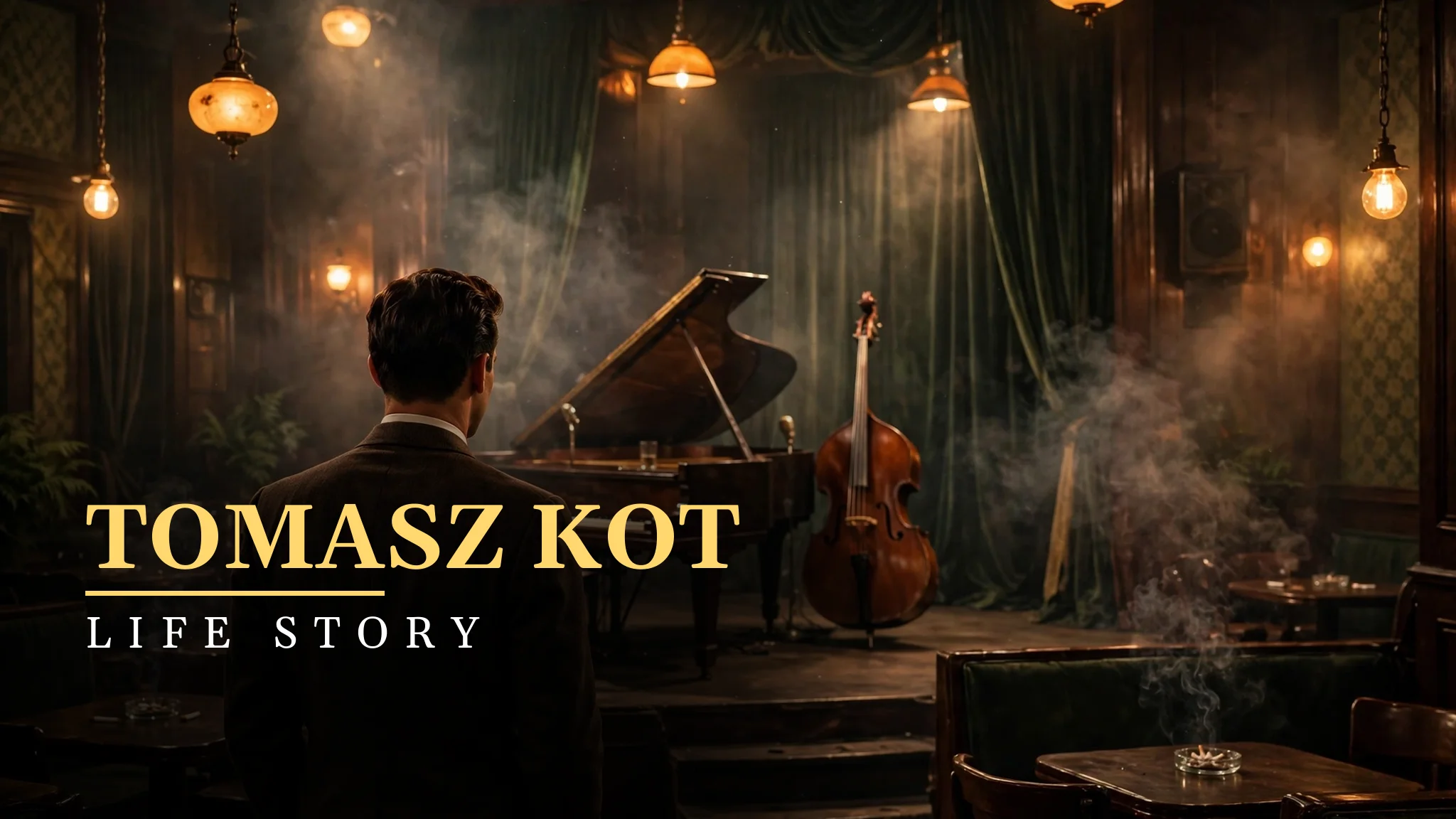
I keep thinking about the jazz club in the cover image, with the piano and the double bass on a small stage, and about how well it fits Kot. His acting is like jazz, quiet, careful, and full of feeling, with notes that are not played as well as notes that are. A jazz musician knows when to play and when to wait, and Kot knows the same thing as an actor. That image stays with me, because it captures the heart of his work, a man who listens, who waits, and who speaks only when the moment is right.
One more thought stays with me, and it is about Poland. Kot has carried Polish stories to the world, from a heart surgeon in Warsaw to a musician in the 1950s, and he has done it with pride. He did not need to leave Poland to be known. He stayed, he worked with Polish directors, and the world came to him. That is a hopeful story for any actor in a small country, because it says that your home is not a limit. It is a starting point, and it can carry you to the world.
I also want to say that I respect Kot for returning to the theatre, even after becoming famous in film. Many actors leave the stage when they become film stars, because film pays more and brings more fame. Kot returns to the stage, because he loves acting, and because the theatre keeps him honest. That loyalty is rare, and it is admirable. An actor who loves the stage will always be an actor, not only a star, and Kot is an actor first, and a star second. I think that order matters, and I am glad he keeps it.
I think about the future of Kot’s career, and I feel hopeful, because he is still working, still learning, and still taking roles that challenge him. He may make more films in Poland, he may work more in Hollywood, or he may do something entirely new, and whatever he does, I believe he will do it with the same calm and honesty that have marked his work so far. I will be watching, and I think many other people will be watching too, because his performances matter, and his voice matters.
Finally, I want to say that I am grateful for Kot’s work, because it taught me to slow down, to look carefully, and to listen. His performances ask me to pay attention, and attention is a gift in a fast world. I hope every reader of this story watches at least one of his films, and I hope they feel what I felt when I first saw Cold War, a mix of sadness and of beauty, and a deep respect for an actor who tells the truth with his eyes. That is a gift, and it is one I do not take lightly.
I will end with a simple wish. I hope Kot keeps acting, I hope he keeps returning to the theatre, and I hope the world keeps discovering his work. The world needs more actors like him, actors who are patient, honest, and still, and who trust their audience to see what is not said. Tomasz Kot is one of those actors, and I am glad he exists. His story is not finished, and I look forward to the next chapter, whatever it may be.
When I finish thinking about Kot, I feel calm, and I feel hopeful, and I feel a little more patient myself. Calm, because his performances slow me down. Hopeful, because his story shows that good work will be recognised, even if it takes twenty years. Patient, because his career teaches me that waiting is not wasting time, if the waiting is spent working. That is a lot for one actor to give, and I will carry those feelings with me for a long time.
I also think his story has a message for people who feel that they are not seen. Kot worked for years without fame, and he could have felt invisible, but he kept working, because he believed in the work itself. That belief is a gift, and it is one I hope every reader carries with them. You do not need to be seen to matter. You need to do good work, and to do it with honesty, and the seeing will come in its own time. Kot is the proof, and his story is the evidence, and I hope it gives hope to everyone who is still waiting to be seen.
I want to add one more thought about the way Kot listens on screen, because listening is the hardest part of acting, and he does it better than almost anyone. In Cold War, he listens to Zula sing, and the camera stays on his face, and the audience sees a man hearing something beautiful and painful at the same time. That listening is not passive. It is active, and it is full of feeling, and it tells us more about Wiktor than any line of dialogue could. An actor who can listen like that is an actor who understands that a scene belongs to everyone in it, not only to the person speaking.
I also want to say that I admire the way Kot has handled fame since Cold War, because fame can change a person, and it did not change him. He still works in the theatre, he still takes roles that matter to him, and he still speaks about his work with humility. That steadiness is rare, and it tells me that his values are strong. A person who stays the same after success is a person who knows who they are, and Kot knows who he is, an actor from Legnica who loves his craft and who is grateful for the chance to do it.
Frequently Asked Questions
When was Tomasz Kot born and where is he from?
Tomasz Kot was born on 21 April 1977 in Legnica, Poland, a city in the south-west of the country with a strong theatre tradition. He studied acting at the Ludwik Solski Academy for the Dramatic Arts in Kraków, graduating in 2001, and he worked in the theatre in Legnica and Kraków.
What are Tomasz Kot’s most famous films?
His most famous films include Bogowie from 2014, in which he played the heart surgeon Zbigniew Religa, Cold War from 2018, in which he played Wiktor, and Leave the World Behind from 2023, a Netflix film in which he played Danny. He also played Ryszard Riedel in Skazany na bluesa from 2005.
What is Cold War about and who did Kot play?
Cold War, released in 2018 and directed by Paweł Pawlikowski, tells the love story of Wiktor, a musician played by Kot, and Zula, a young singer played by Joanna Kulig, over fifteen years from Poland to Paris and back. The film won Best Director at Cannes and was nominated for three Academy Awards.
What is Bogowie about?
Bogowie, released in 2014, tells the story of Zbigniew Religa, a Polish heart surgeon who performed the first successful heart transplant in Poland. Kot played Religa, and his performance won him the Polish Film Award for Best Actor, making him a star in Poland.
Did Tomasz Kot work in Hollywood?
Yes, Kot appeared in the Netflix film Leave the World Behind in 2023, directed by Sam Esmail and starring Julia Roberts, Mahershala Ali, and Ethan Hawke. He played Danny, a contractor, and the film was watched by millions of people around the world.
Is Tomasz Kot still acting?
Yes, Kot continues to work in film and in theatre, in Poland and internationally, after the success of Cold War and Leave the World Behind. He remains one of Poland’s most respected actors, known for his quiet and honest performances.


