Triton Targeted Plant Safety Systems
In this post
Every dangerous factory in the world has a guardian. It is not a person. It is a quiet little computer that sits in the corner, watching the pipes, the pressure, the heat and the gas, day and night, without sleeping. Its job is very simple, and it has only one job: if anything ever goes wrong, it slams the whole plant shut before anyone gets hurt. Engineers trust this guardian with their lives. Now imagine someone breaking into that factory in the dark — not to steal anything, not to break the machines — but to walk straight past everything else and quietly switch the guardian off. That is what Triton tried to do, and that is why security experts still talk about it with a chill in their voice.
What Triton malware is, in simple words
Most computer viruses want money. They lock your files and demand payment, or they steal your bank details, or they turn your computer into a tool for sending spam. Triton wanted none of that. Triton, which is also known by the names Trisis and HatMan, became public in December 2017, and investigators realised they were looking at something the world had never seen before: the first malware built to attack the safety systems of an industrial plant.
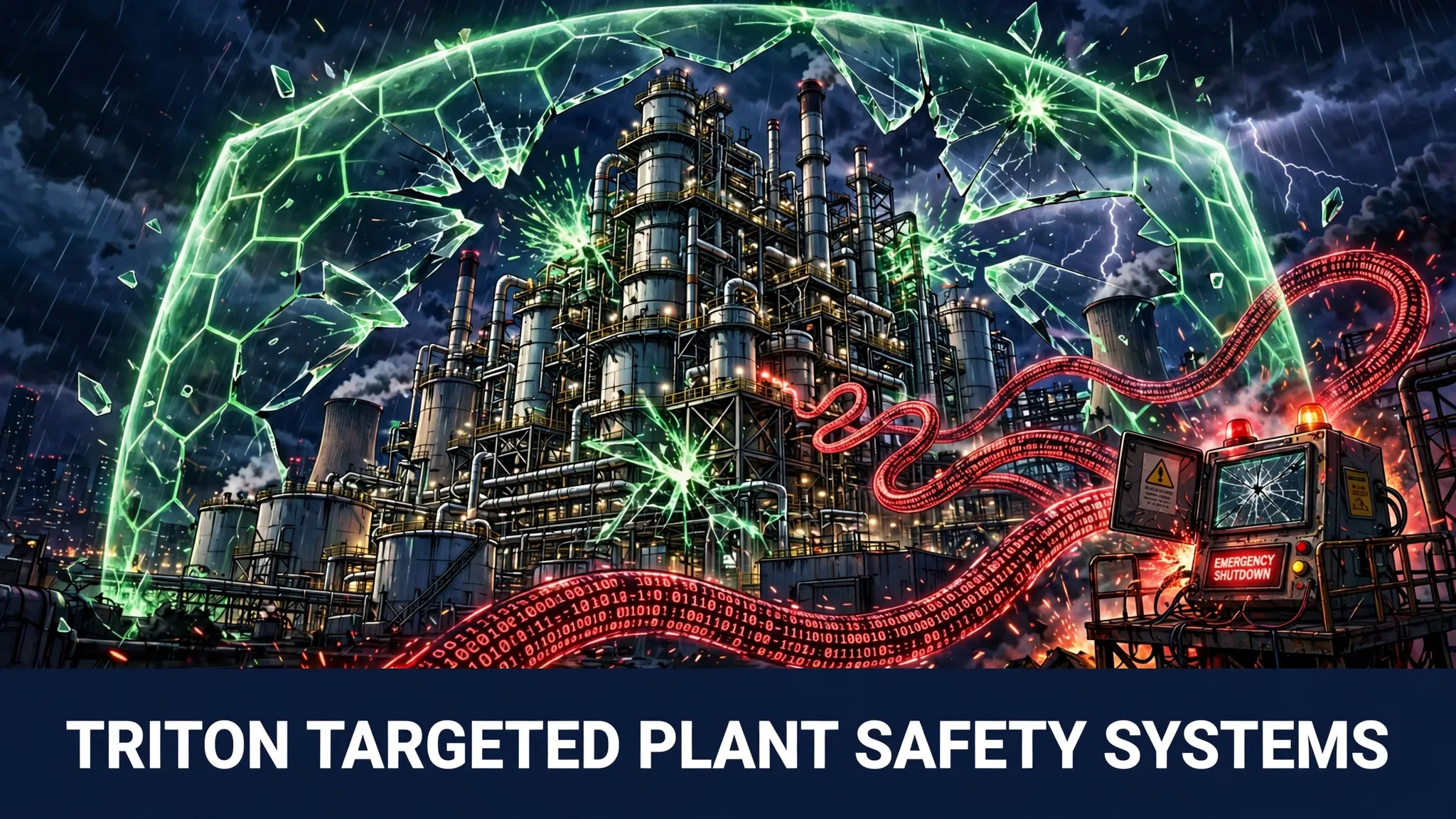
Think of it this way. A big factory has two kinds of brains. The first brain runs the place — it opens valves, heats chemicals, moves liquids around. The second brain does nothing but watch the first one. It checks the temperature a thousand times a second. If the pressure climbs too high or a pipe starts to fail, this second brain takes over and shuts everything down safely, even if the first brain is screaming to carry on. That second brain is called a safety instrumented system, and it exists for one reason: to be the last line of defence between a small problem and a disaster.
Triton’s target was exactly that second brain — a set of safety controllers called Triconex, made by the company Schneider Electric. The controllers were installed at a petrochemical plant, reported to be in Saudi Arabia. A petrochemical plant handles oil and gas chemicals, the kind of place where a serious accident could mean a huge fire or explosion. Triton was written to reach inside those safety controllers and change how they worked. If the guardian could be reprogrammed, then one day, when a real problem appeared, the guardian might simply sit there and let it happen.
How Triton malware got inside a protected plant
A plant like this is not connected to the open internet for anyone to wander into. So how did the attackers get in? Investigators found that they did not attack the factory floor first. They started where almost every attack starts: in the offices.
First, the attackers broke into the plant’s ordinary office network — the IT network used for email, documents and everyday work. From there, slowly and patiently, they worked their way across toward the second, more sensitive network: the operational network, where the machines and the safety controllers actually live. The whole point of keeping these two networks separate is that a problem in the office should never be able to reach the factory floor. In this case, the attackers found a path across.
Then came the small detail that made everything possible. The safety controllers at the plant had a physical key switch on them. Turn the key one way, and the controller can only run — nobody can change its settings from a computer. Turn it the other way, to a position called “program,” and its settings can be rewritten remotely. Investigators reported that the key had been left in the “program” position. One small switch, left in the wrong place, opened the door. The attackers used that opening to load their own code into some of the safety controllers and change how they behaved.
For an ordinary person, the lesson hides inside that little key. Attackers rarely smash through the strongest wall. They walk around, they check every door, and they wait for the one small thing somebody forgot — a switch left on, a password never changed, a door between two networks left open.
The day the plant shut itself down
Here is the strange, lucky turn in this story. In June 2017, the plant suddenly shut itself down. Then, in August 2017, it happened again. Nothing had exploded. No one had pressed an emergency button. The safety system had simply decided something was wrong and closed the plant safely, exactly as it was designed to do.
Those two shutdowns are what gave the attackers away. When experts dug into why the safety controllers were misbehaving, they found the reason: the attackers’ own code contained a mistake. While trying to reprogram the controllers, the Triton malware had tripped over itself, and the safety system — still working, still watching — responded by shutting the plant down. The guardian had caught the intruder by accident, and in doing so, it saved the day and exposed the whole attack.
Let us be very clear about the ending, because it matters: nobody was hurt. There was no fire, no explosion, no injury. The plant was shut down safely, twice, and that is what led investigators to discover Triton in the first place.
So why do experts still find this case so frightening? Because of what the attack was aiming at. FireEye, the security firm that investigated the incident (its team is now part of Mandiant), assessed that Triton was built to disable or sabotage the safety systems. In FireEye’s assessment, the fear was this: if the guardian had been silently switched off, and then something physical went wrong at the plant — a pressure surge, a broken pipe, a failed valve — nothing would have stepped in to stop it. A manageable problem could have grown into an explosion nobody could control. FireEye also publicly assessed that Triton’s development was linked to a Russian state-owned research institute in Moscow, the Central Scientific Research Institute of Chemistry and Mechanics. As reported at the time, the United States sanctioned that institute in 2020 over the Triton attack.
Personally, the detail I cannot stop thinking about is that little key switch — a whole attack, built by experts over a long time, came down to one small switch left in the wrong position by an ordinary human being.
How Triton malware teaches you to protect yourself
You do not run a petrochemical plant, so why should this story matter to you? Because the defence that saved that plant is the same defence that protects your phone, your email and your family photos. It is called layers.
The plant survived because it had more than one line of protection. The attackers got through the office network, and they got through to the controllers — but the safety system itself was still standing behind everything else, and it caught them. One wall failed. The next wall held.
At home, your layers look like this:
- A strong, different password for every account. If one password leaks, the attacker gets one account, not your whole life. A stolen key should never open every door in the house.
- Two-factor sign-in turned on. This is the second lock. Even if someone steals your password, they still cannot get in without the code from your phone. Notice how this is exactly the idea behind that physical key switch: changing important settings should need something physical, in your hand, not just something typed from far away.
- Backups of your important files kept somewhere separate, like an external drive or a second account. If a virus ever locks or destroys what is on your computer, a backup means the story ends with an annoying afternoon, not a disaster.
- Keeping work and personal things apart where you can. Just as the plant tried to keep its office network away from its factory network, you can keep your main email — the one tied to your bank and password resets — separate from the address you hand out to every website and shop.
No single one of these steps makes you untouchable. Together, they mean an attacker has to beat every layer, one after another, and most attackers simply move on to an easier target.
Common questions
What exactly did Triton attack? Triton attacked the safety instrumented system of a petrochemical plant — specifically Triconex safety controllers made by Schneider Electric. These controllers are the plant’s last line of defence, designed to shut everything down safely if dangerous conditions appear. Triton tried to reprogram them so that this protection could be disabled or sabotaged.
Was anyone hurt in the Triton attack? No. Nobody was hurt, and there was no explosion or fire. In June and August 2017 the plant shut itself down safely, twice, because an error in the attackers’ own code tripped the safety system — and those shutdowns led investigators to discover the malware.
How did Triton get into such a protected facility? Investigators found that the attackers first broke into the plant’s office IT network and then worked their way toward the operational network where the safety controllers lived. The attack was made possible because the controllers’ physical key switch had been left in the “program” position, which allowed their settings to be changed remotely.
Who was behind Triton? FireEye publicly assessed that Triton’s development was linked to a Russian state-owned research institute in Moscow, the Central Scientific Research Institute of Chemistry and Mechanics. The United States sanctioned that institute in 2020 over the attack, as reported at the time.
Can Triton attack my home computer? Triton was built for one very specific target: Schneider Electric’s Triconex industrial safety controllers. It is not a virus that spreads to home computers or phones. Its value to you is the lesson it teaches — protection works in layers, and small forgotten details, like a switch left in the wrong position or two-factor sign-in left off, are what attackers count on.
Sources
- Wikipedia — Triton (malware): https://en.wikipedia.org/wiki/Triton_(malware)