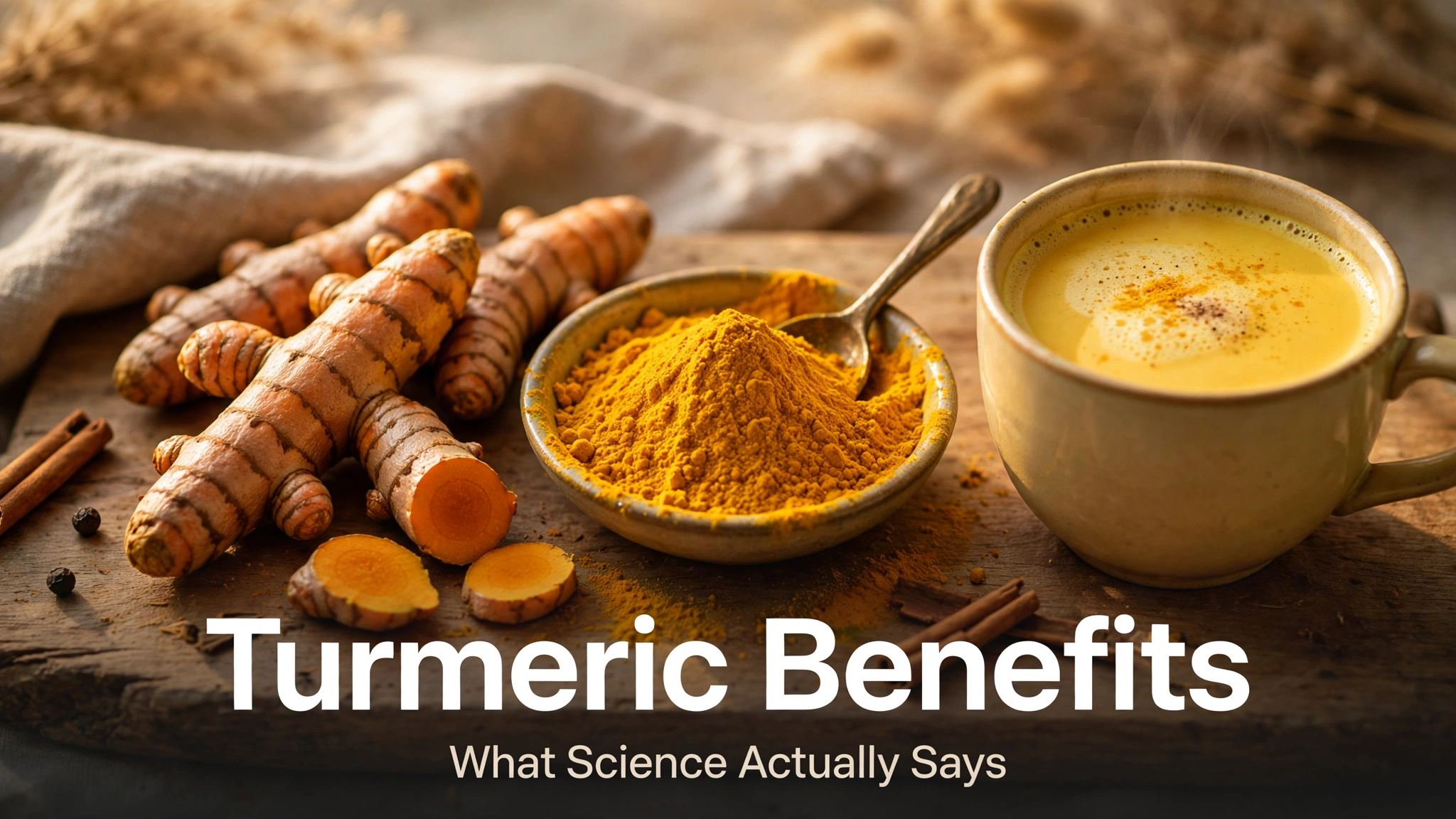
Turmeric Benefits Explained: What Science Actually Says
In this post
- What Turmeric Is and What Curcumin Does
- The Absorption Problem: Why Most Curcumin Is Wasted
- Turmeric and Inflammation: The Best Evidence
- Brain Health, Mood and the Claims That Go Too Far
- How to Use Turmeric in Cooking
- Supplements: When They Might Help and When They Do Not
- Turmeric, Exercise Recovery and Everyday Aches
- My Take:
Turmeric is one of the oldest spices in the world, and also one of the most talked about. It has been used in Indian cooking and in Ayurvedic medicine for thousands of years, it gives curry its golden colour, and in recent years it has become a global health trend, sold as capsules, lattes, shots and supplements. The claims made for it are enormous: that it reduces inflammation, relieves arthritis, protects the brain, prevents cancer and boosts immunity. Some of those claims have evidence behind them, and some of them do not, and telling the difference is the purpose of this article.
The active compound in turmeric is called curcumin, and it is the reason for most of the research. Curcumin has anti-inflammatory and antioxidant effects in laboratory studies, and it has been tested in hundreds of human trials. But there is a problem that the marketing rarely mentions: curcumin is poorly absorbed by the body, and most of what you eat passes through without being used. That single fact explains why the results in the laboratory are often better than the results in people, and why the form in which you take turmeric matters as much as the dose.
This article explains what turmeric and curcumin are, what the research actually shows for inflammation, arthritis, brain health and other conditions, why absorption is the key problem, how to use turmeric in cooking, when supplements might help, and what the risks are. It is general information, not medical advice, and it is written to separate what science actually says from what the advertisements claim.
This article is general information only. It is not individual medical advice. Talk to your doctor before starting a supplement, especially if you are pregnant, take medicine, or have a digestive or immune condition.
What Turmeric Is and What Curcumin Does
Turmeric is a spice made from the root of the Curcuma longa plant, a member of the ginger family, and it has been used in South Asian cooking for thousands of years. The root is bright orange-yellow, and it gives curry powder its colour and its earthy, slightly bitter flavour. In traditional medicine, turmeric has been used for digestive problems, wounds, skin conditions and joint pain, and it has a long history as both a food and a remedy. That history is part of its appeal, but it is not proof that it works for every condition it is claimed to treat.
Curcumin is the main active compound in turmeric, and it makes up about three to five percent of the spice by weight. It is a polyphenol, a type of plant compound with antioxidant properties, and it has been shown in laboratory studies to reduce inflammation by blocking certain molecules involved in the inflammatory response. It also has antioxidant effects, meaning it can neutralise free radicals, the unstable molecules that damage cells. These effects are real in a test tube, but the question is whether they translate into benefits in the human body, where curcumin is poorly absorbed and quickly broken down.
The distinction between turmeric and curcumin matters, because the spice and the supplement are not the same thing. A teaspoon of turmeric powder contains only a small amount of curcumin, around 100 to 200 milligrams, and most of it is not absorbed. A curcumin supplement can contain 500 milligrams or more of curcumin, often combined with other ingredients to improve absorption. The research on turmeric as a food and the research on curcumin as a supplement are different, and they should not be confused. Eating curry is not the same as taking a high-dose curcumin capsule.
The Absorption Problem: Why Most Curcumin Is Wasted
The biggest problem with curcumin is bioavailability, which is a technical word for how much of a substance actually gets into the bloodstream and reaches the tissues where it can work. Curcumin has very low bioavailability: it is poorly absorbed from the gut, it is rapidly broken down by the liver, and it is quickly removed from the body. Studies have found that even large doses of curcumin result in very low levels in the blood, and that most of the dose is excreted without being used. This is the reason why laboratory results, where curcumin is applied directly to cells, are often much better than human results.
There are ways to improve absorption, and they are worth knowing. Piperine, a compound in black pepper, can increase curcumin absorption significantly, by blocking the enzymes that break it down in the liver. This is why many curcumin supplements contain black pepper extract, and why traditional Indian cooking often combines turmeric with black pepper. The combination is not a coincidence. It is a practical solution that traditional cooks discovered long before scientists understood why it worked.
Fat also helps, because curcumin is fat-soluble, which means it dissolves in fat rather than in water. Taking curcumin with a meal that contains fat, or with oil, can improve absorption. Some supplement companies use special formulations, such as liposomal curcumin or curcumin bound to phospholipids, which are designed to be absorbed better. These formulations do increase blood levels, but they are more expensive, and it is not yet clear whether higher blood levels lead to better health outcomes. The absorption problem is real, but the solution is not as simple as taking a bigger dose.
Turmeric and Inflammation: The Best Evidence
Inflammation is the area where the evidence for curcumin is strongest, and it is also the area where the claims are most exaggerated. Chronic inflammation is involved in many diseases, from arthritis to heart disease, and a substance that reduces inflammation would be valuable. Laboratory studies show that curcumin can reduce inflammatory markers, and some human studies have found that it can lower levels of C-reactive protein, a marker of inflammation in the blood. But the effects are modest, and they depend on the dose, the form and the condition being treated.
The best human evidence is for arthritis, particularly osteoarthritis and rheumatoid arthritis. Several studies have found that curcumin supplements can reduce joint pain and stiffness, and that the effect is comparable to some anti-inflammatory medicines, with fewer side effects. The studies are generally small and short, and the quality varies, but the results are consistent enough that curcumin is now recommended by some guidelines as a complementary treatment for arthritis. It is not a replacement for medicine, but it may help as an addition, and it is worth discussing with a doctor.
For other inflammatory conditions, the evidence is weaker. There is some research on curcumin for inflammatory bowel disease, for metabolic syndrome and for muscle soreness after exercise, but the studies are small and the results are mixed. The honest summary is that curcumin has anti-inflammatory effects, that those effects are most clearly shown in arthritis, and that the claims for other conditions are not yet proven. It is a promising substance, not a proven cure, and the difference matters.
Brain Health, Mood and the Claims That Go Too Far
Curcumin is often claimed to protect the brain, improve memory and prevent dementia, and these claims are based on a mix of laboratory research and population studies. In the laboratory, curcumin has been shown to reduce the buildup of amyloid plaques, the protein deposits associated with Alzheimer’s disease, and to protect brain cells from damage. In populations that eat a lot of turmeric, such as in India, rates of Alzheimer’s disease appear to be lower than in Western countries, though this kind of observation cannot prove cause and effect, because many other factors differ as well.
The human studies on curcumin and brain health are small and preliminary. A few trials have found that curcumin can improve memory and attention in older adults, and that it may reduce symptoms of depression and anxiety. But the studies are short, the numbers are small, and the results have not been confirmed in large, well-designed trials. It would be wrong to say that turmeric prevents dementia or treats depression, and anyone with a mental health condition should seek professional help rather than relying on a supplement.
The cancer claims are even more exaggerated. Curcumin has been shown in laboratory studies to affect cancer cells, and it has been tested in early human trials, but there is no evidence that it prevents or treats cancer in people. The idea that a spice can cure cancer is appealing, but it is not supported by the research, and it can be dangerous if it leads people to delay or avoid proven treatment. Turmeric is a food, not a cancer drug, and it should never be presented as one. The research is interesting, but it is at a very early stage.
How to Use Turmeric in Cooking
The simplest and safest way to use turmeric is as a food, in cooking, where it has been used for thousands of years. A teaspoon of turmeric powder in a curry, a soup or a rice dish adds colour and flavour, and it provides a small amount of curcumin along with other beneficial compounds in the spice. Cooking turmeric with black pepper and with fat, such as oil or coconut milk, improves absorption, and this is how it is traditionally used in Indian cooking. The combination of turmeric, pepper and fat is not just a recipe. It is a practical way to get more from the spice.
Golden milk, a drink made with milk, turmeric, black pepper and sometimes ginger and honey, has become popular as a health drink, and it is a pleasant way to consume turmeric. The evidence that it provides a health benefit beyond the pleasure of drinking it is limited, but it is a harmless and enjoyable way to include turmeric in the diet. Turmeric tea, turmeric lattes and turmeric shots are similar: they are foods and drinks, not medicines, and they should be enjoyed as such. The benefit, if any, is small, but the risk is also small, and the enjoyment is real.
The practical advice is to use turmeric regularly in cooking, to combine it with black pepper and fat, and to enjoy it as part of a varied diet. A person who eats turmeric in curries several times a week is getting a steady, low dose of curcumin, along with the other spices and foods in the meal, and that is a sensible, traditional way to use it. A person who takes a high-dose supplement is doing something different, and they should understand that the evidence, the risks and the costs are also different.
Supplements: When They Might Help and When They Do Not
Curcumin supplements are widely available, and they vary enormously in dose, form and price. Most contain 500 to 1000 milligrams of curcumin per day, often with black pepper extract to improve absorption. The evidence for supplements is strongest for arthritis, where several studies have found a modest benefit for pain and stiffness. For other conditions, the evidence is weaker, and the decision to take a supplement should be based on a specific reason, not on a general hope that it will improve health.
The risks of curcumin supplements are generally low, but they are not zero. High doses can cause stomach upset, nausea and diarrhoea, and curcumin can interact with blood-thinning medicines, increasing the risk of bleeding. It can also affect blood sugar and blood pressure, and it should be used with caution by people who take medicine for these conditions. People with gallbladder problems should also be careful, because curcumin can stimulate the gallbladder. Pregnant women should talk to a doctor before taking high-dose supplements, because the safety in pregnancy is not well established.
The cost is also worth considering. A month’s supply of a good quality curcumin supplement can be expensive, and the benefit, if any, is modest. For a person with arthritis who has discussed it with their doctor, the cost may be justified. For a healthy person who wants a general health boost, the money is probably better spent on food, exercise or other proven habits. The supplement is not a substitute for a healthy diet, and it should not be treated as one.
Turmeric, Exercise Recovery and Everyday Aches
Another area where curcumin has been studied is exercise recovery, and the results are interesting for athletes and for people who exercise regularly. Intense exercise causes muscle damage and inflammation, which leads to soreness, and some studies have found that curcumin supplements can reduce muscle soreness and speed up recovery after hard training. The effects are modest, and the studies are small, but they are consistent enough to be worth noting. For an athlete who trains hard, a small reduction in soreness could be useful, though it is not a substitute for rest, sleep and proper nutrition.
The mechanism is the same as for arthritis: curcumin’s anti-inflammatory effects may reduce the inflammation that follows muscle damage, and its antioxidant effects may reduce the oxidative stress that comes with intense exercise. But the evidence is not strong enough to recommend curcumin as a routine recovery aid, and the practical factors matter more. Getting enough sleep, eating enough protein, staying hydrated and allowing time for recovery are all more important than any supplement, and they are the foundation that no capsule can replace.
For everyday aches and pains, the same logic applies. A person who has sore muscles after gardening or after a long walk may find that curcumin helps a little, but they are more likely to benefit from rest, gentle movement and, if needed, a standard pain reliever. Turmeric is not a painkiller, and it should not be treated as one. It is a spice with modest anti-inflammatory effects, and its place is in the kitchen and, for specific conditions such as arthritis, as a complementary supplement discussed with a doctor.
My Take:
I think turmeric is a perfect example of how a real food with a real history gets turned into a health fad, and how the fad then obscures the food. The real story is that turmeric is a wonderful spice, that it has been used in cooking for thousands of years, and that its active compound, curcumin, has genuine anti-inflammatory effects in the laboratory. The fad story is that turmeric cures arthritis, prevents cancer, protects the brain and boosts immunity, all from a single capsule. The first story is true and interesting. The second story is mostly marketing, and I think it does a disservice to a spice that deserves to be appreciated for what it actually is.
What I find most important is the absorption problem, because it is the fact that changes everything. If curcumin is poorly absorbed, then most of what you eat is wasted, and the laboratory results do not apply to real life in the way the marketing suggests. I think the companies that sell curcumin know this, which is why they add black pepper and use special formulations, but they rarely explain it clearly to the consumer. I would rather people understood that a teaspoon of turmeric in a curry provides only a small amount of curcumin, and that a supplement provides more, but that more does not automatically mean better. That honesty is more useful than a promise.
I am also frustrated by the cancer claims, because they are the most dangerous kind of health misinformation. When a person with cancer is told that turmeric can help, they may delay or avoid treatment that could save their life, and that is a serious harm. I do not think the people who make these claims are always acting in bad faith, but I do think they are acting irresponsibly. Curcumin research in cancer is at a very early stage, it is mostly in test tubes and animals, and it is not a treatment. Saying so plainly is not being negative. It is being honest, and honesty matters most when the stakes are highest.
The arthritis evidence is the part I find most encouraging, because it is specific, it is practical, and it is based on a clear need. People with arthritis are in pain, they want relief, and a supplement that can reduce pain with fewer side effects than some medicines is genuinely useful. I think curcumin deserves a place in the conversation about arthritis, as a complementary treatment, not as a replacement for medicine. That is a modest claim, but it is an honest one, and modest, honest claims are the ones that help people most.
My honest opinion is that the best way to use turmeric is in cooking, where it belongs. A curry with turmeric, black pepper and oil is a delicious meal, it provides a small amount of curcumin in a form the body can use, and it is part of a diet that is rich in vegetables, legumes and spices. That is a sensible, enjoyable way to include turmeric in your life, and it does not require a supplement or a health claim. The supplement has a place, mainly for arthritis, and mainly after a conversation with a doctor, but it is not the main way to benefit from turmeric. The food is.
I also think the traditional use of turmeric deserves respect, because it shows that the combination of turmeric, pepper and fat was not discovered by a supplement company. It was discovered by cooks, over thousands of years, who learned that the combination tasted good and worked well together. That is a reminder that traditional food knowledge is often wise, and that science sometimes catches up to what cooks already knew. I think we should listen to both: to the tradition that tells us how to cook, and to the science that tells us what the food can and cannot do.
Use turmeric as a spice, often, in cooking, and be sceptical of any product that promises to cure a serious disease with a single ingredient. Health is built on patterns, not on pills, and turmeric is one small part of a pattern that includes a varied diet, regular exercise, good sleep, and medical care when it is needed. That is not a dramatic message, and it will not make a good advertisement, but it is the truth, and the truth is more useful than a miracle, because a miracle asks you to believe and a pattern asks you to cook. The curry on your table, made with turmeric and pepper and oil, is doing more for you than the capsule in the cupboard, and it tastes better too.
I also think the exercise recovery research is a good example of how curcumin is best understood: as a modest helper, not as a solution. An athlete who takes curcumin and expects to recover twice as fast will be disappointed, but an athlete who takes it as part of a good recovery routine, with sleep, protein and rest, may notice a small benefit. That is the honest position, and it is the position I wish more supplement marketing took. Small benefits are still benefits, but they should be described as small, so that people can make an informed choice.
Curcumin supplements are expensive, and the price deserves a hard look before the purchase. A high-quality product with good absorption can cost a lot, and the benefit, if any, is modest, which changes the maths depending on who you are. For a person with arthritis, that cost may be worth it, especially if it reduces the need for other medicines. For a healthy person, the money is probably better spent on food, and a weekly curry with turmeric, pepper, and oil will provide enjoyment as well as a small amount of curcumin, at a fraction of the price. The supplement is not a scam, it is a trade, and the trade is only good if the benefit is worth the price, which, for most healthy people, it is not.
Enjoy turmeric in your cooking, respect its history, and treat supplements as a specific tool for a specific problem, not as a miracle in a bottle. The spice belongs in the pan, and the pan belongs on the table, shared.
A good curry, shared with people you love, is worth more than any supplement, and it is the way turmeric was always meant to be enjoyed.
I will keep using turmeric in my cooking, because it is a spice I enjoy, and I will keep recommending it as a food rather than as a medicine. That is the honest place for it, and it is a good place to be.
Frequently Asked Questions
What is the difference between turmeric and curcumin?
Turmeric is the spice made from the root of the Curcuma longa plant. Curcumin is the main active compound in turmeric, making up about 3 to 5 percent of the spice by weight.
Does turmeric help with arthritis?
Some studies show that curcumin supplements can reduce joint pain and stiffness in osteoarthritis and rheumatoid arthritis, with an effect comparable to some anti-inflammatory medicines. It is a complementary treatment, not a replacement for medicine.
Why is black pepper added to turmeric supplements?
Black pepper contains piperine, which can significantly increase curcumin absorption by blocking the enzymes that break it down in the liver.
Can turmeric prevent cancer?
No. There is no evidence that turmeric prevents or treats cancer in people. Laboratory studies are at a very early stage, and turmeric should never replace proven cancer treatment.
Is turmeric safe to take every day?
Turmeric as a food is safe for most people. High-dose curcumin supplements can cause stomach upset and can interact with blood-thinning medicines. Talk to a doctor before taking high doses.
How should I use turmeric in cooking?
Use it in curries, soups and rice dishes, combined with black pepper and fat such as oil or coconut milk, which improves absorption and is how it is traditionally used.
Sources
- https://www.nccih.nih.gov/health/turmeric
- https://www.nhs.uk/live-well/eat-well/food-types/
- https://www.mayoclinic.org/drugs-supplements-turmeric/art-20365834
- https://www.healthline.com/nutrition/top-10-evidence-based-health-benefits-of-turmeric
- https://www.webmd.com/vitamins/ai/ingredientmono-662/turmeric