Vangelis: The Life Story Behind Greece's Soundtrack Genius
In this post
- A Boy in Greece Who Taught Himself Music
- Aphrodite’s Child and the Move to Paris
- Chariots of Fire and an Oscar
- Blade Runner and Music for the Future
- A Private Man, a Long Career, and a Quiet Goodbye
- Music for Space, the Sea, and the Human Spirit
- A Composer Who Rarely Performed Live
- The Oscar, the Honours, and a Quiet Pride
- My Take:
Vangelis was a Greek composer who made music that sounded like the future, and his work is still heard in films, in advertisements, and in the memories of millions of people around the world. When people hear the slow and powerful theme from Chariots of Fire, they think of running, of hope, and of a dream that is worth chasing. When they hear the dark and beautiful music from Blade Runner, they think of a city in the rain, of robots who dream of being human, and of a future that is both wonderful and sad. Both of those pieces were written by Vangelis, a quiet and private man from Greece who preferred to work alone in his studio rather than to stand on a stage.
He was born in Greece in 1943, and he grew up in a country that was going through war and hard times. As a child, he taught himself to play the piano, and he began to compose music without ever learning to read it in the normal way. He was a self-taught musician, a man who learned by listening, by playing, and by feeling, and that gave his music a freedom that other composers did not have. He did not follow the rules of classical music. He made his own rules, and he used electronic instruments to create sounds that no one had heard before.
What makes his story worth telling is the way he changed film music and electronic music without ever trying to be famous. He did not give many interviews, he did not like to perform live, and he did not chase awards, yet he won an Oscar, he wrote music for some of the most famous films ever made, and he became one of the most loved composers in the world. He was a shy and private man who made music that spoke to millions, and that is a rare and beautiful thing. This is the story of how a boy from Greece became the soundtrack genius of the modern world.
A Boy in Greece Who Taught Himself Music
Vangelis was born Evangelos Odysseas Papathanassiou on 29 March 1943 in Agria, a small town near Volos in Greece, and he grew up in a family that loved music. His father was a property developer, and his mother was a singer, so music was part of his home life from an early age. As a child, he was given piano lessons, but he did not like the formal way of learning, and he preferred to play by ear, to listen to a sound and then to find it on the piano himself. He was a curious and independent child, and he learned music in his own way.
He began to compose when he was still very young, and he wrote his first pieces as a child, without knowing how to write them down in the normal way. He played the piano, he listened to the radio, and he imagined new sounds in his head. He was not interested in becoming a classical pianist. He was interested in making new music, in finding sounds that no one had heard before, and in using music to tell stories and to create moods. That curiosity stayed with him for his whole life, and it is what made his music so special.
Greece in the 1940s and 1950s was a difficult place, with war, civil war, and poverty, but young Vangelis found comfort in music. He listened to Greek folk songs, to church music, and to the popular music of the time, and he also listened to jazz and to classical music from other countries. He was learning from many different kinds of music, and he was building a sound in his head that was both Greek and universal. He did not know then that he would become famous, but he knew that music was what he wanted to do with his life.
When he was a teenager, he began to play in bands, and he started to think about music as a career. He moved to Athens, where the music business was, and he began to work with other musicians. He was still a young man, and he was still learning, but he already had a clear idea of what he wanted. He wanted to make music that was new, that was emotional, and that used electronic sounds in a way that no one had done before. The boy from Agria was ready to become a musician, and his journey was about to begin.
Aphrodite’s Child and the Move to Paris
In the 1960s, Vangelis formed a band called Aphrodite’s Child with Demis Roussos and Lucas Sideras, two other Greek musicians, and they became one of the most successful Greek bands of the time. They made music that mixed rock, pop, and Greek sounds, and they had hits in Greece and in other European countries. Their most famous album, 666, which was released in 1972, was a long and ambitious work based on the Book of Revelation, and it showed that Vangelis was not afraid to try big and difficult ideas.
The band moved to Paris, where the music business was bigger, and they recorded their albums there. Paris in the late 1960s was a lively place for music, and Vangelis learned a great deal from working in a new city with new musicians. He was still young, but he was already a serious composer, and he was learning how to work in a studio, how to use new instruments, and how to make a record that would be heard all over Europe. Aphrodite’s Child gave him his first taste of international fame, and it taught him how to be a professional musician.
After a few years, the band broke up, and Vangelis decided to work on his own. It was a brave decision, because he was leaving a successful band to try something new, but he knew that he wanted to make music in his own way, without having to agree with other people. He moved to London, and then to Paris, and he began to work as a solo composer, making albums of electronic music that were very different from anything else at the time. He was free to experiment, and he used that freedom to create a new sound.
His early solo albums, including Heaven and Hell and Albedo 0.39, showed what he could do. They were long pieces of electronic music, full of synthesizers, choirs, and strange and beautiful sounds. They were not pop songs. They were works of art, and they were loved by people who liked music that was different and ambitious. Vangelis was building a reputation as a composer who could make electronic music that was emotional, not cold, and that was a rare thing at the time.
Chariots of Fire and an Oscar
In 1981, Vangelis wrote the music for the film Chariots of Fire, a British film about two runners at the 1924 Olympic Games, and that music changed his life. The main theme is slow, powerful, and full of hope, and it became one of the most famous pieces of film music ever written. It was played at the Olympic Games, in advertisements, and in many other places, and people who had never heard of Vangelis knew his music. It won him the Academy Award for Best Original Score in 1982, and it made him famous all over the world.
The music for Chariots of Fire was special because it was electronic, but it did not sound cold or mechanical. It sounded warm, human, and full of feeling, and it captured the spirit of the film, the story of two men who ran for different reasons but who both believed in something bigger than themselves. Vangelis used synthesizers to create a sound that felt both modern and timeless, and he showed that electronic music could be as emotional as any orchestra. It was a breakthrough, and it changed the way film music was made.
After Chariots of Fire, he was asked to write music for many other films, and he became one of the most sought-after film composers in the world. He wrote music for Missing, for Antarctica, for 1492: Conquest of Paradise, and for many other films, and each time he brought his own sound to the film. He did not copy other composers. He made music that was his own, and directors loved him for it, because his music made their films more powerful and more memorable.
He also continued to make solo albums, and he worked on projects about space, about the sea, and about history. He was interested in science, in the stars, and in the future, and his music often sounded like it came from another world. He was a composer who looked to the future, and his music helped people to imagine what the future might be like. Chariots of Fire was the beginning of his fame, but it was not the end of his work.
Blade Runner and Music for the Future
In 1982, Vangelis wrote the music for Blade Runner, a science fiction film directed by Ridley Scott and starring Harrison Ford, and that music became one of the most loved film scores of all time. Blade Runner is set in a dark and rainy future city, where robots called replicants try to live as humans, and Vangelis’s music captures that world perfectly. It is sad, beautiful, and mysterious, with synthesizers, saxophone, and voices that sound like they come from far away. It is music that makes you feel the rain, the neon lights, and the loneliness of the future.
The Blade Runner score was not released as a full album for many years, but people who saw the film remembered the music, and they talked about it for decades. It became a cult classic, and it influenced many other composers who wanted to write music for science fiction films. Vangelis had created a sound for the future, a sound that was both electronic and human, and it showed that he was a composer who could imagine a world that did not yet exist.
He also wrote music for 1492: Conquest of Paradise in 1992, a film about Christopher Columbus, and that music also became very popular, especially in Europe. It was grand, emotional, and full of choirs and drums, and it captured the spirit of exploration and discovery. He wrote music for Antarctica in 1983, for the film about the frozen continent, and that music was cold, beautiful, and lonely, like the place itself. Each film gave him a new world to imagine, and he imagined it with music.
His work in film showed that he was not only a composer of electronic music. He was a storyteller, a man who could use music to tell a story, to create a mood, and to make an audience feel something. He did not need words. His music spoke for itself, and it spoke in a language that people all over the world could understand. That is why his film scores are still loved today, and why they are still played in concerts and on the radio.
A Private Man, a Long Career, and a Quiet Goodbye
Vangelis was a very private man, and he did not like to give interviews or to perform live. He preferred to work alone in his studio, surrounded by his synthesizers and keyboards, making music in his own time and in his own way. He gave very few concerts, and when he did, they were special events, not regular tours. He believed that music should speak for itself, and that a composer did not need to be famous to be important. That shyness made him mysterious, and it made people even more interested in his music.
He lived in Paris for many years, and later in London and in Athens, and he worked on many projects, including music for the Olympic Games, for space missions, and for documentaries about the natural world. He was interested in science, and he worked with NASA on music about space, because he believed that music and science were connected, and that both were about exploring the unknown. He was a composer who looked at the stars, and his music often sounded like it came from the stars.
In his later years, he continued to compose, and he released albums that showed he was still interested in new sounds and new ideas. He did not retire, and he did not stop working. He kept making music until the end of his life, because music was not a job for him. It was a way of life, a way of thinking, and a way of feeling. He was a man who lived for music, and who made music for the world.
Vangelis died on 17 May 2022 in Paris, at the age of seventy-nine, and his death was mourned all over the world. People spoke about him as one of the greatest film composers of all time, and as a pioneer of electronic music. His music was played on the radio, in concerts, and in tributes, and people remembered the films he had scored and the emotions his music had given them. He left behind a huge body of work, and that work will keep being heard for many years.
Music for Space, the Sea, and the Human Spirit
Vangelis was fascinated by space, by the sea, and by the natural world, and much of his music was inspired by those things. He wrote music about the stars, about the planets, and about the vastness of the universe, and his sound often feels as if it comes from far away, from a place beyond the Earth. He worked with NASA on projects about space, and he wrote music for documentaries about the cosmos, because he believed that music and science were both about exploring the unknown, and that both could help people to understand the world and their place in it.
His album Albedo 0.39, which was released in 1976, is a good example of that fascination. It is about the Earth as seen from space, about light, about the planet, and about the beauty of the world from far away. The music is slow, beautiful, and full of wonder, and it makes the listener feel small and yet connected to something very large. That is a powerful feeling, and it is a feeling that Vangelis created with synthesizers, with choirs, and with his own imagination. He was a composer who looked at the stars and tried to turn what he saw into sound.
He also wrote music about the sea, about Antarctica, and about the natural world, and each time he brought the same sense of wonder to his work. His music for the film Antarctica is cold, lonely, and beautiful, like the frozen continent itself, and it makes the audience feel the ice, the wind, and the silence of that place. He did not need words to describe Antarctica. His music described it, and it did so with a truth that words could not match. That is the power of his art.
That interest in space and nature shows that Vangelis was not only a film composer. He was a thinker, a person who wondered about the universe, about life, and about the future, and who used music to explore those questions. His music is a window to the stars, and it helps people to dream about what is out there, and about what it means to be human in a very large universe. That is a beautiful legacy, and it is one that will keep inspiring people for many years.
A Composer Who Rarely Performed Live
Vangelis gave very few live concerts in his long career, and that is one of the most unusual things about him. Most famous composers and musicians tour the world, play for large audiences, and enjoy the applause, but Vangelis preferred to stay in his studio, surrounded by his synthesizers, and to make music alone. He gave a few special concerts, including a concert in Athens in 2001 for the Mars mission, and a few others, but he did not tour, and he did not perform regularly. He believed that his music should speak for itself, and that he did not need to be on stage to be heard.
That choice made him mysterious, and it made people even more interested in his music. Fans wondered what he was like, what his studio looked like, and how he made his sounds, but he rarely told them. He gave very few interviews, and when he did, he talked about music, about space, and about the future, not about himself. He was a private man, and he protected his privacy with care, because he wanted to focus on his work, not on fame. That is a brave choice in a world that rewards publicity, and it shows that he cared about his art more than about being famous.
His few live performances were special events, and people who attended them remembered them for a long time. They were not like a normal concert. They were like a journey, with music, lights, and images of space, and they felt more like a ceremony than a show. He did not need to dance or to talk to the crowd. He let his music do the talking, and his music was enough. That is a powerful lesson for musicians: you do not need to be loud to be heard. You need to make good music, and people will listen.
The Oscar, the Honours, and a Quiet Pride
Vangelis won the Academy Award for Best Original Score in 1982 for Chariots of Fire, and it was the highest honour of his career, but he did not make a great show of it. He was a private man, and he accepted the award with quiet pride, not with loud celebration. He also received many other honours in his life, including awards in Greece and in other countries, and he was recognised as a pioneer of electronic music and as one of the greatest film composers of his time. Those honours mattered to him, but they were not the reason he made music. He made music because he loved it, because he wanted to explore new sounds, and because he wanted to share his imagination with the world.
His Oscar win also helped electronic music to be taken seriously, because it showed that a score made with synthesizers could be as emotional and as beautiful as a score made with a full orchestra. Before Vangelis, many people thought that electronic music was cold and mechanical, but Chariots of Fire proved them wrong. It was warm, human, and full of hope, and it won the highest prize in film music. That was a breakthrough, not only for Vangelis, but for all electronic musicians who came after him, and it is part of why his legacy is so important.
My Take:
When I think about Vangelis, I think about a man who made music that sounded like the future, and I think that is the most amazing thing about him. He used electronic instruments, synthesizers and keyboards, to create sounds that no one had heard before, and he made those sounds feel warm and human, not cold and mechanical. That is very hard to do, because electronic music can easily sound like a machine, but Vangelis made it sound like a heart. When I hear Chariots of Fire, I feel hope. When I hear Blade Runner, I feel sadness and wonder. That is a gift, and it is a gift that few composers have.
I also think about how he taught himself music, and I find that inspiring. He did not learn to read music in the normal way, and he did not follow the rules of classical training. He learned by listening, by playing, and by feeling, and he made his own rules. That takes courage, because the music world often tells young people that they must learn in one way, and Vangelis showed that there is another way. He showed that a person can learn by doing, by experimenting, and by trusting their own ears. I think that is a good lesson for anyone who wants to create something new.
What I like most about his story is his shyness and his privacy. He did not like to give interviews, he did not like to perform live, and he did not chase fame, yet he became one of the most famous composers in the world. That tells me that real talent does not need to shout. It can be quiet, and it can still be heard. He let his music speak for him, and his music spoke very loudly. I respect that, because in a world where many people try to be famous, he tried to be true to his music, and that is a braver choice.
I also think about Chariots of Fire, and about how that one piece of music became part of the world’s memory. It is played at the Olympic Games, in advertisements, and in many other places, and people who have never seen the film know the music. That is a wonderful thing for a composer to give. He wrote a piece of music that is now part of how the world thinks about running, about hope, and about dreams. That is a legacy that few composers achieve, and it is a legacy that he earned by writing with feeling.
There is a sad part in his story too, and it is the sadness in Blade Runner. That film is about robots who want to be human, about a future that is dark and lonely, and Vangelis’s music captures that sadness perfectly. It is beautiful, but it is also lonely, and it makes you think about what it means to be human. I think that is why people love that score so much, because it is not only music for a film. It is music about life, about loneliness, and about the desire to be alive. That is deep, and it is moving.
I also think about his work with NASA and with space, and I like that he was interested in the stars. He believed that music and science were connected, and that both were about exploring the unknown. That is a beautiful idea, and it shows that he was not only a musician. He was a thinker, a person who looked at the sky and wondered what was out there. His music often sounds like it comes from space, like it is floating among the stars, and that is why it feels so special.
When I think about Aphrodite’s Child, I think it is interesting that he started in a band, and then he left to work alone. That takes courage, because he was leaving a successful group to try something new, but he knew that he wanted to make music in his own way. He did it, and he became even more successful on his own. That shows me that sometimes you have to leave a good thing to find a better thing, and that you have to trust yourself even when it is scary.
I also think about his death in 2022, and I feel sad that he is gone, but I also feel happy that his music is still here. He died in Paris, a city he loved, and people all over the world mourned him. His music was played, his films were watched again, and people remembered what he had given them. That is a good way to be remembered, not for a single moment, but for a lifetime of music that will keep being heard.
If I have a criticism, it is not really a criticism of him. It is a sadness that the world is loud, and that quiet people like Vangelis are rare. He did not want to be famous, and he did not want to be in the spotlight, but the world needed his music, and it found him anyway. I wish there were more artists like him, people who work quietly and let their work speak, rather than people who shout about themselves. He showed that quiet work can be powerful, and that is a lesson the world needs.
Another thing I think about is how his music has been used in so many places, in films, in advertisements, in sports, and in everyday life. That shows that his music is not only for one kind of person. It is for everyone, for people who run, for people who dream, for people who watch films, and for people who look at the stars. That is a universal gift, and it is a gift that few composers can give.
When I compare him with other film composers, what stands out is his originality. He did not copy other people. He made his own sound, with synthesizers and with feeling, and he kept that sound for his whole career. He was not afraid to be different, and he was not afraid to try new things. That originality is rare, and it is one of the reasons his music is still loved today.
For a young reader, I think the lesson from Vangelis is simple. Learn in your own way, trust your ears, and do not be afraid to be different. He taught himself, he made his own sound, and he became one of the greatest composers in the world. He did not become famous by following the rules. He became famous by breaking them, gently and with feeling. That is the lesson I take from his story, and it is a lesson that applies not only to music but to any creative work.
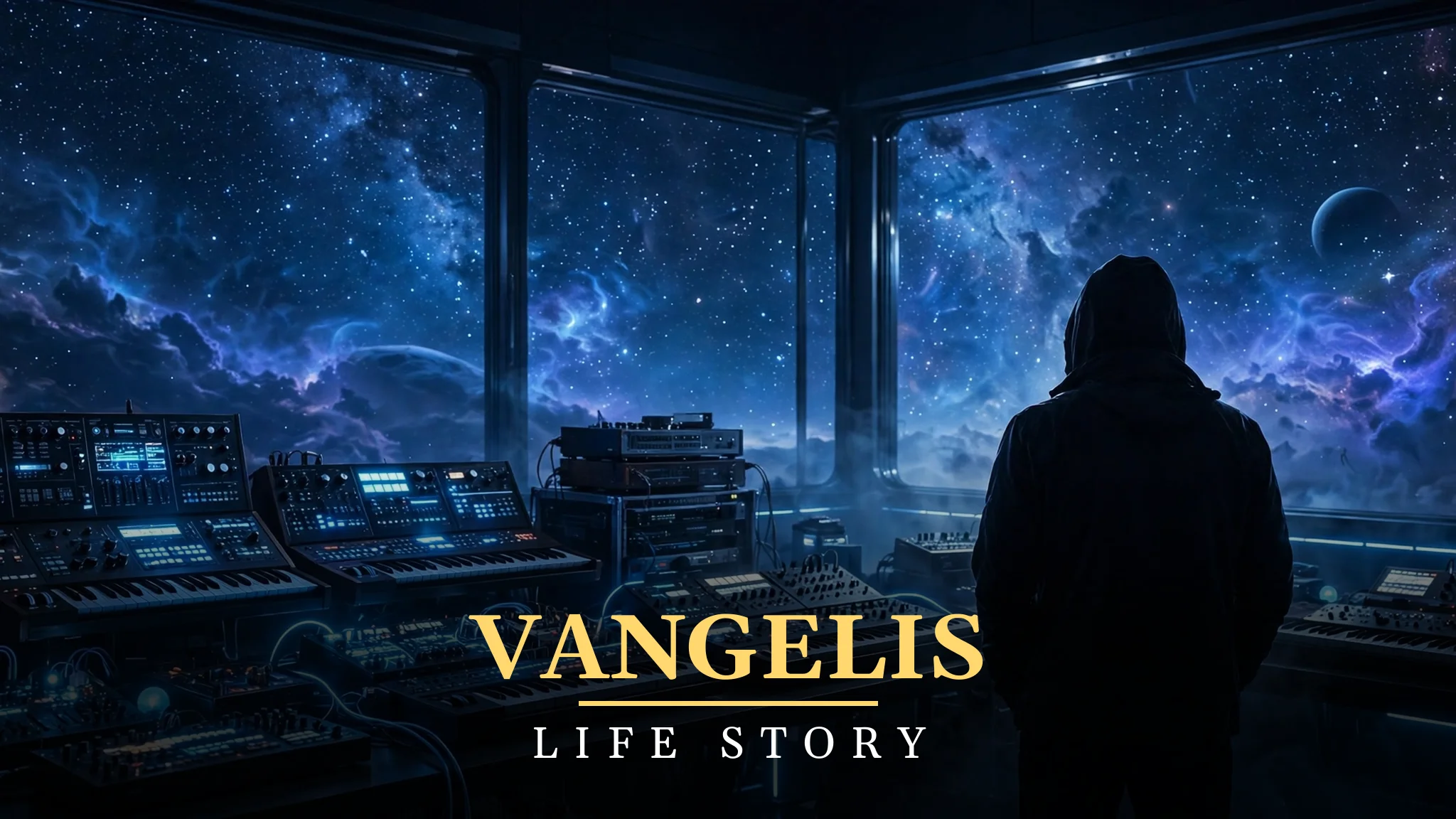
I keep thinking about his studio, full of keyboards and synthesizers, with a man working alone, making music that would be heard by millions. That is a beautiful image, a quiet man in a dark room, creating sounds that would travel all over the world. I hope young musicians learn from that image, and that they understand that you do not need a big stage to make great music. You need a good idea, a good ear, and the patience to work alone until the music is right.
In the end, I think Vangelis teaches us that music can be a window to the future. His music helped people to imagine what the future might be like, to feel hope, to feel sadness, and to feel wonder. He lived a quiet life, he worked alone, and he gave the world music that will last for a long time. I would rather be remembered like that, for the music I gave and the feelings I shared, than for a single famous moment, and I believe he would say the same.
I also think about his love of space, and about how his music sounds like it comes from the stars. He wrote music about the Earth from space, about Antarctica, and about the cosmos, and he did it with synthesizers and with feeling. That is a beautiful idea, that music can help us to imagine the universe, and to feel connected to something larger than ourselves. I think that is why his music feels so special, because it is not only about life on Earth. It is about the whole universe, and about our place in it.
I think about his work with NASA, and I like that a composer and scientists could work together, because they both wanted to explore the unknown. He believed that music and science were connected, and that both were about wonder, about curiosity, and about trying to understand the world. That is a generous and open way of thinking, and it shows that he was not only a musician. He was a thinker who looked at the sky and wondered what was out there. I admire that curiosity, and I hope young people keep it alive.
Another thing I notice is how his music has been used in so many different places, from the Olympic Games to space documentaries, from films to advertisements. That shows that his music is universal, that it can fit many different stories, and that it speaks to people in many different ways. A piece of music that can be used for running, for space, and for a film about the future is a piece of music that has a special power, and Vangelis had that power.
I also think about his shyness again, and about how he preferred to work alone in his studio rather than to be on stage. That is a brave choice in a world that rewards fame, and it shows that he cared about his music more than about being famous. He let his music travel the world, even while he stayed at home, and that is a kind of generosity. He gave his music to the world, and he did not ask for applause in return. That is a quiet and beautiful way to live, and it is one that I respect very much.
In the end, I keep coming back to the idea of a window to the future. His music helped people to imagine what the future might be like, to feel hope, to feel sadness, and to feel wonder. He lived a quiet life, he worked alone, and he gave the world music that will last for a long time. I hope young musicians learn from him, that they trust their ears, that they look at the stars, and that they make music that is their own. That is the best legacy a composer can leave, and it is the legacy that Vangelis left behind.
I also think about how rarely he performed live, and I find that fascinating. Most famous musicians tour the world, but Vangelis stayed in his studio and let his music travel without him. That is a brave choice, because it means giving up applause, fame, and money, in order to focus on the work itself. I respect that, because it shows that he cared about music more than about being famous. He did not need a stage to be great. He needed a studio, a keyboard, and an idea, and that was enough.
I think about his privacy, too, and I admire it. He gave very few interviews, he did not talk about himself, and he protected his private life. In a world where many artists share everything on social media, Vangelis shared only his music, and that is a powerful statement. It says that the work matters more than the person, and that a composer does not need to be a celebrity to be important. I think that is a lesson the world needs today, when fame is often valued more than talent.
Another thing I notice is how his few concerts were special events, not regular tours. People who attended them remembered them for a long time, because they were like journeys, with music, lights, and images of space. That shows that a rare performance can be more meaningful than a hundred ordinary ones. He did not perform often, but when he did, it mattered. That is a good lesson for any artist: quality matters more than quantity, and a single beautiful performance can be worth more than many forgettable ones.
I also think about the future, and about whether young composers will learn from his example. I hope they will, because he shows that you can be quiet, private, and focused, and still be one of the greatest composers in the world. You do not have to shout to be heard. You have to make good music, and people will find it. That is a hopeful message for shy and sensitive artists, and it is a message that Vangelis lived by for his whole life.
In the end, I keep coming back to the studio, to a quiet man alone with his keyboards, making music that would be heard by millions. That is a beautiful image, and it is an image that gives me hope. It shows that great art can be made quietly, without fame, without applause, and without a stage. I would rather be remembered like that, for the music I gave in silence, than for a single famous moment, and I believe he would say the same.
Frequently Asked Questions
Where was Vangelis born?
Vangelis, whose full name was Evangelos Odysseas Papathanassiou, was born on 29 March 1943 in Agria, near Volos in Greece.
What is Vangelis’s most famous music?
His most famous music is the theme from Chariots of Fire, which won him an Oscar in 1982, along with his score for Blade Runner, which is one of the most loved film scores of all time.
Did Vangelis win an Oscar?
Yes, he won the Academy Award for Best Original Score for Chariots of Fire in 1982, and his music for that film became famous all over the world.
Was Vangelis in a band?
Yes, in the 1960s he was in the band Aphrodite’s Child with Demis Roussos and Lucas Sideras, and they made the ambitious album 666 before he left to work as a solo composer.
Why did Vangelis not perform live very often?
He was a very private man who preferred to work alone in his studio, and he gave very few concerts, believing that his music should speak for itself rather than needing a live show.
When did Vangelis die?
He died on 17 May 2022 in Paris at the age of seventy-nine, and his death was mourned around the world as the loss of a pioneer of electronic and film music.


