Vasco Rossi: The Life Story Behind Italy's Rock Legend
In this post
- A Boy From Zocca and the Love of Music
- Punto Radio and the First Album
- Colpa d’Alfredo, Siamo Solo Noi, and the Breakthrough
- Vita Spericolata, Sanremo, and the Reckless Life
- Cosa Succede in Citta, C’e Chi Dice No, and the King of Italian Rock
- Modena Park and the Biggest Concert in Italian History
- Albachiara and the Songs Everyone Sings
- My Take:
Vasco Rossi is the biggest rock star Italy has ever had. He is not a polite pop singer. He is a wild, loud, and honest rocker who has been singing about freedom, about love, and about living dangerously for almost fifty years, and who still fills stadiums with tens of thousands of people who know every word of every song. He is called Il Blasco, and also the Komandante, the Commander, because his fans follow him like an army, and because his concerts are not just shows. They are gatherings, celebrations, and moments of freedom.
He was born in Zocca, a small town in the hills of Modena, the son of a truck driver, and he grew up in a modest home, in a place where life was simple and hard. He became a disc jockey, he founded one of Italy’s first free radio stations, and he made his first album with almost no money. Then he wrote songs that spoke to a whole generation of young Italians, songs about being alone, about being free, and about living a reckless life, and those songs became anthems.
Vasco has lived a life as wild as his songs. He has had problems with drugs, with his health, and with the law, and he has survived them all, and he has kept singing. He has played the biggest concert in Italian history, in Modena Park in 2017, in front of more than two hundred thousand people, and he is still going. This is the story of how a boy from a small town in the hills became the commander of Italian rock.
A Boy From Zocca and the Love of Music
Vasco Rossi was born on 7 February 1952 in Zocca, a small town in the hills of the province of Modena, in northern Italy. His father, Giovanni Carlo Rossi, was a truck driver, and his mother, Novella, was a housewife. The family was not rich, but they were close, and they lived a simple life in a town where everyone knew everyone else, and where the hills and the fields were a part of everyday life.
As a boy, Vasco loved music, and he listened to the records that came from America and from England, the rock and roll, the blues, and the songs of the great singers of the time. He also learned to play the guitar, and he began to write his own songs, songs about his life, about his town, and about the feelings of a young man who wanted more than the life he was born into. He was a restless boy, a boy who dreamed of a bigger world, and who found that world in music.
He went to school in Modena, and he studied accountancy, but his heart was not in numbers. It was in music, in radio, and in the world of rock. He became a disc jockey, playing records in clubs and on the radio, and he learned what people liked, what made them dance, and what made them feel alive. He was a natural performer, a man who loved to be on stage, and who loved to talk to an audience, even when the audience was only a few people in a small club.
Zocca stayed with him, even when he left it. He has returned to the town again and again, and he has sung about it, and about the hills, and about the simple life he left behind. He is a man who comes from a small place, and who carries that place with him, even when he is singing in a stadium in front of a hundred thousand people.
Punto Radio and the First Album
In 1975, Vasco founded Punto Radio, one of the first free radio stations in Italy. In those years, the radio in Italy was controlled by the state, and young people who wanted to hear rock music had to listen to foreign stations or to pirate radio. Vasco and his friends started their own station, in a small room, with a transmitter they had built themselves, and they played the music they loved, day and night. It was a brave and illegal thing to do, and it was the beginning of free radio in Italy.
Punto Radio taught Vasco a great deal. He learned to talk to an audience, to choose the music, and to be a voice that people trusted. He also learned that there was an audience in Italy for rock music, an audience of young people who wanted songs that spoke to their lives, not the polite pop songs that the state radio played. That audience would become his audience, and they would stay with him for the rest of his life.
In 1978, he made his first album, Ma cosa vuoi che sia una canzone, What Do You Want a Song to Be, a record that was made with almost no money, and that sold very little. It was a modest start, but it was a start, and it showed that Vasco had a voice and a style of his own, a rough and honest voice, and songs that were simple and direct. He followed it with Non siamo mica gli americani, We Are Not the Americans, in 1979, another album that found a small audience, and that showed he was growing as a songwriter.
He was still a young man, still learning, and still waiting for the song that would make him famous. He knew that he had something to say, and he knew that there were young people in Italy who wanted to hear it. He just had to find the right song, the right words, and the right moment. That moment was coming, and it would change his life.
Colpa d’Alfredo, Siamo Solo Noi, and the Breakthrough
The breakthrough came in 1980, with the album Colpa d’Alfredo, Alfredo’s Fault, a record that spoke to young Italians in a way no one had before. The songs were about life in the provinces, about boredom, about love, and about the feeling of being trapped in a small town. Young people heard themselves in those songs, and they began to follow Vasco, to buy his records, and to come to his concerts.
In 1981, he made Siamo solo noi, It’s Just Us, an album that became an anthem for a generation. The title song, Siamo solo noi, is a song about a group of friends, about being young, about being together, and about not needing anyone else. It is a song that Italian audiences still sing at his concerts, with their arms around each other, because it says something simple and true: we are just us, and that is enough.
In 1982, he made Vado al massimo, I’m Going to the Max, another success, and he became one of the most famous rock singers in Italy. His concerts were wild, his fans were loyal, and his songs were on the radio everywhere. He was no longer a disc jockey from Zocca. He was Vasco Rossi, the rock star, the voice of a generation, and the man who sang what young Italians felt but could not say.
His style was new in Italy. He sang in a rough voice, he used simple words, and he talked about sex, about drugs, about freedom, and about the anger of young people. Some people were shocked, and some radio stations refused to play his songs, but young people loved him, because he was honest, and because he did not pretend to be something he was not. He was one of them, and he sang for them.
Vita Spericolata, Sanremo, and the Reckless Life
In 1983, Vasco went to the Sanremo Music Festival, the most important music event in Italy, and he sang Vita spericolata, A Reckless Life, a song that became one of his most famous hits. The song is about living dangerously, about drinking, about loving, and about not caring what people think. He sang it with a wild energy, and he finished second to last in the competition, but the song became a sensation, and it is now regarded as one of the great Italian rock songs of all time.
Vita spericolata captured the spirit of Vasco’s life and of his audience. It was a song about freedom, about living without rules, and about the price of that freedom. Young Italians sang it at the top of their voices, because it said what they felt: that life should be lived fully, even if it is dangerous, even if it hurts, and even if it does not last. The song became an anthem, and it has stayed an anthem for more than forty years.
In the same year, he made the album Bollicine, Little Bubbles, another great success, with songs that mixed rock, pop, and the energy of his live concerts. He toured Italy, playing in theatres and in sports halls, and his concerts became famous for their wildness, for the singing of the audience, and for the feeling that something real was happening on stage.
But the reckless life had a price. Vasco struggled with drugs in the 1980s, and he was arrested and spent time in prison for drug possession. It was a dark time in his life, and it could have ended his career. He has spoken honestly about those years, about the mistakes he made, and about the help he received from his family and his friends. He survived, and he came back, and he kept singing, with a new understanding of what his life meant.
Cosa Succede in Citta, C’e Chi Dice No, and the King of Italian Rock
Through the 1980s, Vasco continued to make albums that spoke to his audience, including Cosa succede in città, What’s Happening in Town, in 1985, and C’è chi dice no, There Are Those Who Say No, in 1987, an album that became one of his biggest successes. The title song, C’è chi dice no, is a song about saying no, about refusing to follow the rules, and about standing up for yourself, and it became another anthem for his fans.
In 1989, he made Liberi liberi, Free Free, and in 1993, Gli spari sopra, The Shots Above, an album that included the song Gli spari sopra, a song about violence and about the world, and that showed Vasco was still growing as a songwriter, still thinking about the world around him, and still willing to say what he thought.
By the 1990s, Vasco was the biggest rock star in Italy, a man who could fill stadiums, who could sell millions of records, and who could make a whole country sing his songs. His concerts became legendary, with tens of thousands of people, with lights, with sound, and with an energy that no other Italian singer could match. He was called Il Blasco, a nickname that his fans gave him, and the Komandante, the Commander, because his fans followed him like an army, and because he led them with his music.
He also became a father, and his family became important to him. He has four children, and his son Lorenzo has worked with him on his music. He has kept his private life out of the public eye, but he has spoken about how becoming a father changed him, how it made him think about his life, and how it gave him a reason to stay alive and to keep singing.
Modena Park and the Biggest Concert in Italian History
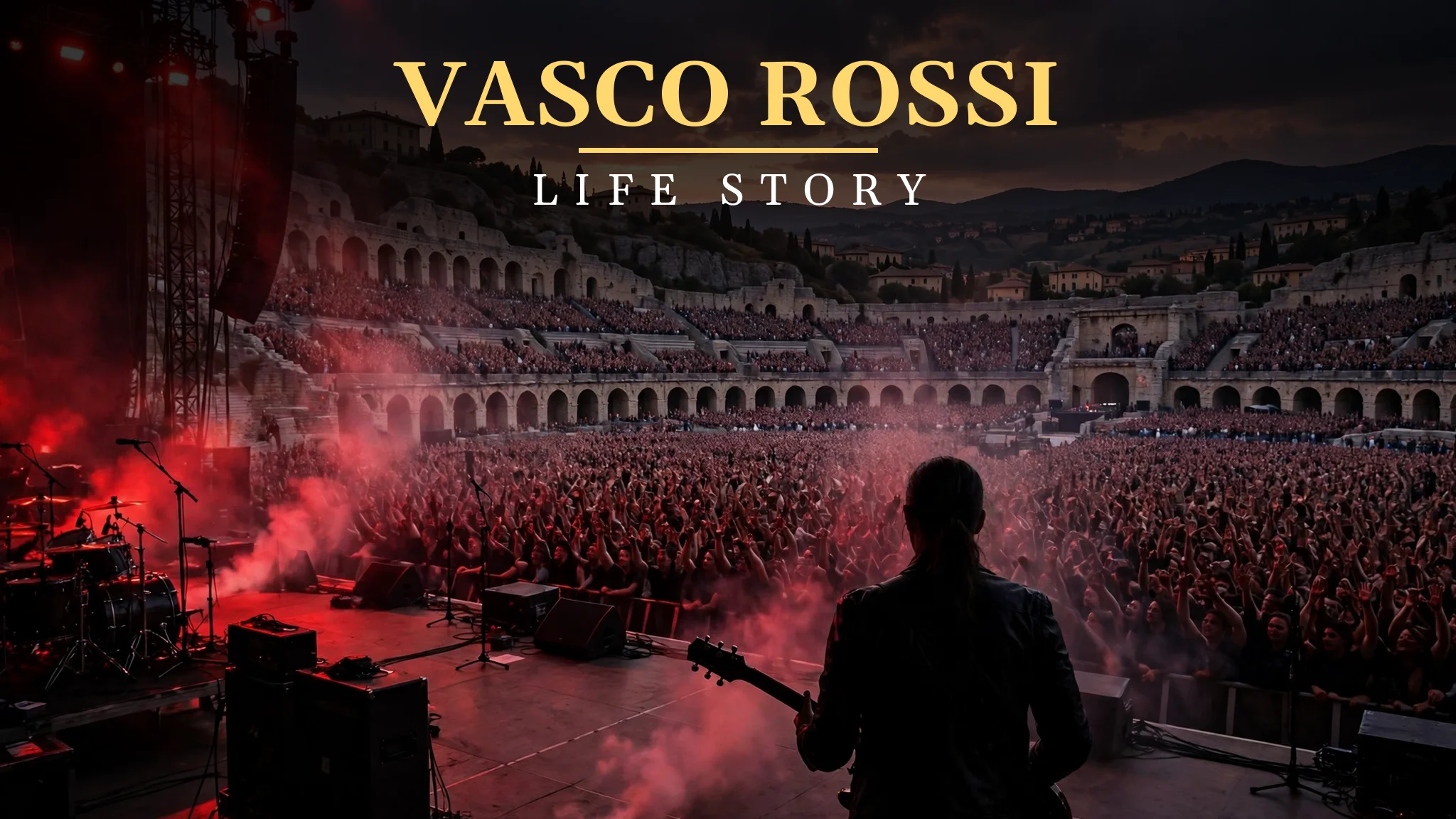
In 2017, Vasco did something that no Italian artist had ever done before. He played a concert in Modena Park, in Modena, in front of more than two hundred thousand people, the biggest ticketed concert in the history of Italy, and one of the biggest in the history of the world. The concert was called Modena Park 2017, and it was a celebration of forty years of his career, a night when his fans came from all over Italy to sing with him, to remember, and to celebrate.
The concert lasted for hours, and Vasco sang his greatest songs, from Vita spericolata to Siamo solo noi to Albachiara, his beautiful ballad about a girl in the morning light. The audience sang every word, and the night became a legend, a moment that people who were there will never forget. It was the peak of his career, and it proved that after forty years, Vasco was still the king of Italian rock, still loved, still powerful, and still able to bring a whole country together.
In 2011, Vasco had been seriously ill, and he had spent time in hospital, and many people worried that he would not sing again. He recovered, and he came back, and he kept touring, kept recording, and kept playing to huge audiences. He has said that music saved his life, and that his fans saved his life, because they gave him a reason to keep going, even when his body was tired and his health was failing.
In recent years, he has continued to make albums, including Sono innocente in 2014 and Siamo qui in 2021, and he has continued to tour, playing in stadiums all over Italy. He is now in his seventies, and he is still singing, still rocking, and still commanding his army of fans, who come to his concerts with their children and their grandchildren, because his songs belong to more than one generation.
Albachiara and the Songs Everyone Sings
Vasco Rossi is known for his loud rock songs, for Vita spericolata and for Siamo solo noi, but some of his most loved songs are quiet ones, and the most famous of them is Albachiara, Clear Dawn, a song from 1979 about a girl in the morning light, about youth, about innocence, and about the beauty of a new day. Albachiara is a gentle song, a song that is sung softly, and it is one of the songs that Italian audiences love most, because it shows a different side of Vasco, a tender side, a side that is not wild or reckless, but quiet and full of feeling.
The song is about a girl waking up in the morning, and about the light, and the air, and the feeling of being young, and it is a song that has become a part of Italian life, played at weddings, at school, and at moments when people want to remember what it feels like to be young. Vasco wrote it when he was still a young man, and he has sung it at almost every concert since then, and every time he sings it, the audience sings it with him, softly, like a prayer, like a memory.
His ballads are as important as his rock songs, because they show that he is not just a wild rocker. He is a songwriter who can write about love, about loss, and about the quiet moments of life, with the same honesty he brings to his loudest songs. Songs like Albachiara, like Sally, and like Un senso, A Meaning, are songs that people play when they are alone, when they are sad, and when they need to feel that someone understands them. That is a different kind of power, a quiet power, and Vasco has it, as well as the loud one.
His fans are also a part of his story. They call themselves his army, and they follow him from concert to concert, from city to city, singing his songs, wearing his colours, and living his music. They are not just fans. They are a community, a family, a generation of people who grew up with his songs, and who have passed them on to their children, and to their grandchildren. That is why his concerts are not just shows. They are gatherings, celebrations, and moments when a whole country comes together to sing.
Vasco’s songwriting is simple and direct. He uses simple words, short lines, and melodies that are easy to remember, and he writes about the things that matter to his audience: freedom, love, friendship, and the feeling of being alive. He does not use clever tricks, or big words, or complicated ideas. He writes what he feels, and he sings it as if he means it, and the audience believes him, because they feel the same things. That is the secret of his success, and it is a secret that cannot be copied, because it comes from honesty, and honesty cannot be faked.
He is now in his seventies, and he is still singing, still touring, and still writing songs, and his audience is still there, still singing, still following him. He has survived drugs, illness, and the passing of time, and he has done it by staying true to himself, by singing what he feels, and by never pretending to be someone else. That is a life worth celebrating, and a voice worth listening to, for as long as he sings.
In his early years, Vasco played with the Steve Rogers Band, a group of musicians from his region who became his first real band, and who helped him find the loud and direct sound that would define his music. Playing with a band taught him to listen, to share the stage, and to trust other musicians, and that trust has stayed with him through every band he has played with since. His live band is now a family, a group of players who have toured with him for years, and who know his songs as well as he does, and who give his concerts the power and the energy that his fans love.
He has also kept testing new songs on stage, playing them live before they are recorded, and listening to how the audience reacts, because he believes that a song is not finished until it has been sung in front of real people, in a real hall, on a real night. That is an old-fashioned way of working, and it is a brave one, because a new song can fail in front of thousands of people, and there is nowhere to hide. Vasco does it anyway, because he trusts his audience, and because he knows that a song that works live will work anywhere, and that is why his albums always feel like they were made for the stage, and for the people who sing along.
My Take:
When I think about Vasco Rossi, I think about a man who never learned to be polite, and who never wanted to. He is a rock star in the true sense: loud, honest, and unafraid to say what he thinks. He sang about drugs, about sex, about freedom, and about the anger of young people, when no one else in Italy dared to sing about those things. That takes courage, and I admire it, because it is easy to sing a pretty song that offends no one. It is hard to sing a song that tells the truth, and that makes people uncomfortable, and Vasco did that, again and again, for almost fifty years.
I think Vita spericolata is one of the greatest Italian rock songs ever written, because it says something that many people feel but few dare to say: that life should be lived fully, even if it is dangerous. The song is about a reckless life, about drinking, about loving, and about not caring what people think, and young Italians sang it because it was their life, or the life they wanted. I do not think the song is telling people to be reckless. I think it is telling them to be free, to live, and to not be afraid. That is a good message, even if the life it describes is a hard one.
What I love most about Vasco is his honesty. He has never pretended to be a saint. He has talked openly about his problems with drugs, about his time in prison, and about his health problems, and he has not made excuses. He has said: I made mistakes, I paid for them, and I am still here. That honesty is rare, and it is why his fans love him. They do not love him because he is perfect. They love him because he is real, because he has lived the life he sings about, and because he has survived it.
I also think about Siamo solo noi, and about how that song brings people together. It is a song about friends, about being young, about being together, and about not needing anyone else. When Vasco sings it at a concert, tens of thousands of people sing it with him, with their arms around each other, and for a moment, they are not alone. They are part of something bigger, a community, a family, a generation. That is the power of a great song, and Vasco has written many of them, songs that belong not just to him, but to everyone who sings them.
There is something I find moving about Modena Park in 2017, because it was the biggest concert in Italian history, and it was a celebration of forty years of music. More than two hundred thousand people came to Modena, to a park, to sing with a man who was sixty-five years old, and who had been singing for most of their lives. That is a remarkable thing. It means that his music has lived through generations, that parents brought their children, and that the songs still mean something, even after forty years. I wish I had been there, because it must have been an unforgettable night.
I also think about his health problems, and about how he kept going even when his body was failing. In 2011, he was seriously ill, and many people thought he would not sing again. He recovered, and he came back, and he kept touring, because music was his life, and because his fans needed him, and he needed them. That is a lesson in resilience, in not giving up, and in finding a reason to keep going when it would be easier to stop. I admire that, because it is easy to be strong when you are young and healthy. It is hard to be strong when you are old and ill, and Vasco was strong.
One thing I notice about Vasco is that he never left Italy. He could have gone to America, he could have tried to become an international star, but he stayed in Italy, singing in Italian, for Italian audiences, about Italian life. That is a brave choice, because it means that his fame is limited to one country, but it also means that his work is true, because he knows his audience, he knows their lives, and he sings about them. I respect that, because it shows that he cares more about being honest than about being famous all over the world.
If I have one criticism, it is only that his life has sometimes been too reckless, and that the songs about living dangerously may have encouraged some young people to live dangerously too. I do not blame Vasco for that, because a song is not a set of instructions, and every person must make their own choices. But I think it is worth saying that freedom has a price, and that Vasco paid that price, with his health, with his time in prison, and with the years he lost to drugs. He survived, and he learned, and he is still here, and that is the most important part of the story.
In the end, I think Vasco Rossi’s story teaches us to be free, to be honest, and to sing what we feel, even when it is not polite, even when it is not safe. He was a boy from Zocca, the son of a truck driver, who became the commander of Italian rock, who filled stadiums, who survived drugs and illness, and who is still singing in his seventies. That is a life worth celebrating, and a voice worth listening to. I will keep listening to his songs, because every time I hear them, I remember that music can be wild, can be free, and can bring people together, and that is a beautiful thing.
There is one more thing I want to say about Vasco, and it is about Albachiara, the quiet song that shows his tender side. People think of Vasco as a wild rocker, a man who sings about living dangerously, but Albachiara is a gentle song, about a girl in the morning light, about youth, and about the beauty of a new day. When he sings it, and the audience sings it with him, softly, like a prayer, it is one of the most moving moments in Italian music. It shows that Vasco is not just a rocker. He is a songwriter who can write about love, about innocence, and about the quiet moments of life, with the same honesty he brings to his loudest songs. I love that about him, because it shows that a person can be wild and tender at the same time, and that both sides are true.
I also think about his fans, and about how they call themselves his army, and how they follow him from concert to concert, singing his songs, and living his music. That is not just fandom. It is a community, a family, a generation of people who grew up with his songs, and who have passed them on to their children. I think about what it means to create a community like that, a place where people feel they belong, and where they can sing together, and be together, for one night. It is a wonderful thing, and it is one of the greatest achievements a singer can have, greater than any record sale, greater than any prize.
If I could ask him one question, I would ask him about Zocca, about the small town in the hills where he was born, and about whether he ever misses it, and whether he ever wants to go back and live there. I think he would say that he carries Zocca with him, wherever he goes, and that it lives in his songs, in his voice, and in his heart, and that going back would not change anything, because home is not a place. It is a feeling, and he feels it every time he sings, every time he looks at his audience, and every time he remembers where he came from. That is a wise answer, and I believe it.
I also think about his son Lorenzo, and about how Vasco has worked with him on his music, and about how a father and a son can share a love of music, and can work together, even when the father is a legend and the son is finding his own way. That is a beautiful thing, and it shows that Vasco is not just a rock star. He is a father, a man who wants to share what he knows with his children, and who wants them to find their own voice, just as he found his. I hope Lorenzo knows how lucky he is, and I hope Vasco knows how proud he should be.
Another thought that stays with me is about his health, and about how he kept going even when his body was failing. In 2011, he was seriously ill, and many people thought he would not sing again. He recovered, and he came back, and he kept touring, because music was his life, and because his fans needed him, and he needed them. That is a lesson in resilience, in not giving up, and in finding a reason to keep going when it would be easier to stop. I admire that, because it is easy to be strong when you are young and healthy. It is hard to be strong when you are old and ill, and Vasco was strong, and he is still strong, and that is an inspiration.
I also want to say something honest about the reckless life, because his songs celebrate it, and because some young people may have taken that celebration too literally. Freedom has a price, and Vasco paid that price, with his health, with his time in prison, and with the years he lost to drugs. He survived, and he learned, and he is still here, and that is the most important part of the story. A song is not a set of instructions. It is a feeling, and every person must make their own choices. Vasco made his choices, he paid for them, and he kept singing, and I respect him for that, because it takes courage to admit your mistakes, and to keep going anyway.
Finally, I want to say why I will keep listening to his songs. It is not because he is the biggest rock star in Italy, or because he filled a park with more than two hundred thousand people, or because his songs are anthems, although all of those things are true. It is because his songs remind me that music can be wild, can be free, and can bring people together, and that a boy from a small town in the hills can become the commander of a whole country, if he sings what he feels, and if he never stops. Vasco did that, and he is still doing it, in his seventies, on stage, in front of his army, singing his songs, and I will keep listening, because every time I hear them, I remember that freedom is real, that honesty is real, and that a song can change a life.
One more song stays with me about Vasco, and it is Sally, a song about a woman, about love, and about the pain of losing someone, a song that is quiet, sad, and beautiful, and that shows the tender side of a man known for his wild rock. When he sings Sally, and the audience sings it with him, softly, in the dark, it is one of the most moving moments in Italian music, because it shows that even the wildest rocker has a gentle heart, and that even the loudest voice can whisper. I love that about him, because it shows that a person can be many things at once, wild and tender, loud and quiet, reckless and loving, and that all of those things are true.
Frequently Asked Questions
When was Vasco Rossi born and where is he from?
Vasco Rossi was born on 7 February 1952 in Zocca, a small town in the hills of the province of Modena, Italy. His father was a truck driver, and his mother was a housewife.
What is Vita spericolata about?
Vita spericolata, A Reckless Life, is a song from 1983 about living dangerously and freely, without caring what people think. Vasco sang it at the Sanremo Music Festival, and it became one of his most famous hits.
What was Modena Park 2017?
Modena Park 2017 was a concert in Modena in front of more than two hundred thousand people, the biggest ticketed concert in Italian history, celebrating forty years of Vasco’s career.
Why is Vasco Rossi called Il Blasco and the Komandante?
Il Blasco is a nickname his fans gave him, and the Komandante, the Commander, comes from the way his fans follow him like an army and from the power of his stadium concerts.
What is Siamo solo noi about?
Siamo solo noi, It’s Just Us, from 1981, is a song about a group of friends, about being young and together, and about not needing anyone else. It is one of his most loved songs and an anthem for his fans.
Did Vasco Rossi have problems with drugs?
Yes, he struggled with drugs in the 1980s and was arrested and spent time in prison for drug possession. He has spoken honestly about those years and about how he survived them and came back to music.


