Wang Fei: The Life Story Behind China's Cool Voice
In this post
- A Childhood in Beijing, Far From Hong Kong
- Learning Cantonese and Finding Her Sound
- Red Bean, Legend, and the Songs Everyone Knows
- Chungking Express and a Film Star Who Barely Tries
- Stepping Back, Returning, and Staying Mysterious
- The Coolest Voice and What It Leaves Behind
- Why Distance Can Be a Kind of Honesty
- Fashion, Style, and the Image She Created
- My Take:
Wang Fei is the coolest singer in China, and she has been for more than thirty years. She does not try to be cool. She simply is, in the way she sings, in the way she dresses, and in the way she refuses to explain herself to anyone. She sings in a voice that is light, clear, and a little bit distant, as if she is singing from another world. Her songs are loved across China, in Hong Kong, in Taiwan, and in many other places. She is known as Faye Wong in English, and her Chinese name is Wang Fei. She has sold millions of records, she has acted in famous films, and she has done it all while giving very few interviews, appearing rarely in public, and keeping her private life to herself.
She was born in 1969 in Beijing, and she moved to Hong Kong as a young woman, where she became a star. She sang in Cantonese and in Mandarin, she worked with the best musicians, and she created a style that was entirely her own. She did not follow fashion. She made fashion follow her. Her songs, such as “Red Bean” and “Legend”, are known to almost everyone in the Chinese-speaking world. Her acting in Chungking Express is remembered as one of the great performances in Hong Kong cinema. And yet, for all her fame, she remains a mystery, a woman who lets her songs speak for her, and who says very little herself.
This is the story of a voice that is cool, clear, and unforgettable. It moves from a childhood in Beijing, through a move to Hong Kong, through the early years of learning to sing in a new language, to the great songs and films that made her a legend, and then to the quiet years, when she stepped back from the stage and lived her life away from the noise. It is a story about talent, about distance, and about what happens when a person refuses to play the game of fame in the usual way.
A Childhood in Beijing, Far From Hong Kong
Beijing in the 1970s was a very different place from the Beijing of today. It was a city of bicycles, of courtyards, and of a slower life. Wang Fei was born there on 8 August 1969. Her family was ordinary, and her childhood was the childhood of a girl in Beijing in those years: school, friends, and a growing love of music. She liked to sing, and she had a clear, sweet voice. She sang at school, she sang at home, and she dreamed, as many young girls do, of a life in music. She did not know then that her life would take her far from Beijing, to a city she had never seen, where she would have to learn a new language and a new way of life.
Her mother was a singer, and her father worked in a coal mine before moving into other work. Music was a part of her home, and she grew up hearing songs in Chinese, songs that her mother sang, and songs on the radio. She learned to sing by listening, by copying, and by feeling the music. She was a quiet girl, not loud or showy, and her singing was quiet too, at first. It was clear, it was gentle, and it had a quality that made people stop and listen. That quality would later become her trademark: a voice that does not shout, but that is heard clearly, even in a crowded room.
When she was a teenager, her family made a decision that changed her life. They moved to Hong Kong, a city that was then a British colony, a place of bright lights, of fast money, and of a music industry that was far bigger than anything in Beijing. Wang Fei was eighteen years old when she arrived in Hong Kong in 1987. She did not speak Cantonese, the language of Hong Kong, and she did not know anyone in the music world. She was a girl from Beijing, in a strange city, with a voice and a dream. She would have to learn a new language, a new culture, and a new way of singing, all at the same time. It was a brave step, and it was the start of everything that followed.
Hong Kong in the late 1980s was a place of opportunity, but it was also a place of pressure. Young singers were expected to be beautiful, to be fashionable, and to sing in Cantonese. Wang Fei was beautiful, but she was not fashionable in the usual way. She was quiet, she was different, and she did not try to fit in. She learned Cantonese, she studied singing, and she began to work her way up in the music industry. It was not easy, and it took time, but she had a voice that was unlike anyone else’s, and the people who heard it knew that she was special.
Learning Cantonese and Finding Her Sound
Learning to sing in Cantonese was a hard task for a girl from Beijing. Cantonese is a different language from Mandarin, with different sounds, different tones, and a different rhythm. A singer who does not speak Cantonese well will sound wrong, and audiences in Hong Kong will notice at once. Wang Fei worked hard to learn it. She listened, she practised, and she sang, again and again, until the language felt natural in her mouth. She also learned the style of Hong Kong pop music, known as Cantopop, which was the most popular music in the city at the time.
Her early albums in Hong Kong were in Cantonese, and they began to find an audience. She sang with a voice that was light and airy, very different from the powerful voices of many other singers. Her voice floated over the music, rather than pushing through it. It was a new sound, and young people in Hong Kong loved it. She became known as a singer who was modern, cool, and a little bit mysterious. She did not smile a lot in her photographs. She did not give many interviews. She let her music speak for her, and her music spoke clearly.
One of her early hits was “Easily Hurt Woman”, a song about love and pain that became famous across Hong Kong and in other Chinese-speaking places. The song showed what her voice could do: it could be sad without being heavy, it could be beautiful without being showy, and it could make a listener feel the pain of love in a way that felt personal. She sang it as if she were telling a secret, quietly, to one person, and that intimacy made the song powerful. It was the start of a style that would define her whole career: a cool, distant voice that somehow feels deeply personal.
As she became more famous, she began to sing in Mandarin as well, and her Mandarin songs reached audiences in mainland China, in Taiwan, and in many other places. She was no longer only a Hong Kong singer. She was a Chinese singer, known across the whole Chinese-speaking world. She had learned a new language, she had found a new sound, and she had become a star in a city that was not her home. That is a remarkable achievement, and it is one that few singers have managed.
Red Bean, Legend, and the Songs Everyone Knows
Wang Fei’s most famous songs are known to almost everyone in China. “Red Bean”, released in 1998, is a song about love and loss, about a small red bean that stands for longing. She sang it in Mandarin, with a voice that is gentle, sad, and beautiful. The song became one of the most loved Chinese pop songs of all time, and it is still sung in karaoke rooms today. People who hear it feel a pang of sadness, a memory of a love that has gone, and a beauty in that sadness that is hard to describe. That is the power of Wang Fei’s voice. It can make sadness feel beautiful.
Another famous song is “Legend”, which she sang at the Spring Festival Gala in 2010, the most watched television show in China. The song is about a love that is like a legend, a story that is told and retold, and that never quite ends. Her performance on the Gala was watched by hundreds of millions of people, and it reminded the whole country of who she was. She had been away from the stage for some time, and her return was a major event. She stood on the stage, she sang, and the audience listened in silence, because her voice demanded silence. It was a moment that people still talk about today.
She also sang “Eyes on Me”, the theme song for the video game Final Fantasy VIII, released in 1999. The song was in English, and it became famous around the world, not only in China. It was a gentle, romantic song, and Wang Fei sang it with the same cool clarity that marked all her work. It showed that her voice could cross languages, that it could sing in English as well as in Chinese, and that it could touch listeners in many countries. For a singer from Beijing, who had learned Cantonese in Hong Kong, to sing a hit song in English for a Japanese video game was an extraordinary journey, and it showed how far her voice could travel.
These songs, and many others, made Wang Fei one of the most successful singers in Chinese music history. She sold millions of records, she won awards, and she became a legend in her own lifetime. But she did it in her own way, without the noise and the show that usually come with such success. She sang, she left the stage, and she went home. That quietness is part of who she is, and it is part of why her songs feel so personal. They are not performances for a crowd. They are songs sung by one person, to one listener, in a quiet room.
Chungking Express and a Film Star Who Barely Tries
Wang Fei is not only a singer. She is also an actress, and her most famous film role is in Chungking Express, directed by Wong Kar-wai and released in 1994. The film is one of the most loved Hong Kong films of all time, a story about love, loneliness, and the city of Hong Kong itself. Wang Fei played Faye, a young woman who works in a fast-food shop, who dreams of California, and who falls in love with a policeman. She played the part with a naturalness that surprised everyone. She did not act like a trained actress. She acted like herself, quiet, dreamy, and a little bit strange, and the camera loved her for it.
Her performance in Chungking Express won her praise from critics around the world. The film was shown at festivals, and it became a classic of Hong Kong cinema. Wang Fei’s Faye is one of the most memorable characters in the film, a girl who dances alone in a shop, who listens to music on her headphones, and who dreams of a life far away. She played the part without trying too hard, and that effortlessness is what made it work. She was not acting. She was being, and the camera caught it.
She also appeared in 2046, another film by Wong Kar-wai, released in 2004, and in other films, but Chungking Express remains her most famous acting role. It showed that she could be a film star as well as a singer, and that her cool, distant style worked on screen as well as it worked in song. She did not pursue acting as a full-time career. She took roles when they interested her, and she left them when they did not. That selectivity is part of who she is. She does not do things because she is expected to. She does them because she wants to, and when she does not want to, she stops.
Her acting style, like her singing style, is cool and distant. She does not overact. She does not show big emotions. She lets the audience feel what her character feels, without telling them how to feel. That restraint is hard to do, and it is the reason her performance in Chungking Express is still praised today. She played a girl who is lonely, who is dreaming, and who is in love, and she played her with a quietness that made the audience lean in closer, to hear what she was thinking. That is the power of her coolness. It draws people in, rather than pushing them away.
Stepping Back, Returning, and Staying Mysterious
One of the most unusual things about Wang Fei is how often she has stepped back from fame. She has taken long breaks from singing, sometimes for years, to live her life, to raise her children, and to be away from the noise. She has two daughters: Dou Jingtong, known as Leah Dou, from her marriage to the musician Dou Wei, and Li Yan, from her marriage to the actor Li Yapeng. She has raised them largely out of the public eye, and she has protected their privacy with a fierceness that is rare among famous people.
She returned to the stage in 2010 and 2011 for a series of concerts, and again in 2016 for a single concert called “Faye’s Moments”, which was watched by millions online. Each return was a major event, because she had been away for so long, and because her fans had waited for her. She did not return with a big show, with dancing and with noise. She returned quietly, she sang her songs, and she left. That is her way. She does not need to prove herself with a spectacle. Her voice is the spectacle, and it is enough.
Her private life has been much discussed, as the private lives of famous singers often are. She has been married twice, and she has been in a long relationship with the actor Nicholas Tse, a relationship that has been on and off for many years. She does not talk about these things in public. She does not give interviews about her love life. She keeps her private life private, and she expects the public to respect that. Some people find that frustrating, because they want to know everything about a star. Wang Fei does not care. She believes that her songs are public, and her life is private, and she has held that line for more than thirty years.
That mystery is part of her appeal. In a world where famous people share everything, Wang Fei shares almost nothing, and that makes people more curious, not less. They listen to her songs more carefully, trying to hear the truth of her life in them. They watch her films, looking for clues. They wait for her next concert, hoping she will return. She has turned privacy into a kind of art, and it is an art that few other stars have mastered. She is famous, and she is unknown, at the same time, and that is a remarkable thing to achieve.
The Coolest Voice and What It Leaves Behind
Wang Fei’s legacy is already secure. She is one of the greatest singers in Chinese music history, a woman who changed the sound of Cantopop and Mandopop, who sang songs that millions of people love, and who acted in one of the greatest Hong Kong films ever made. She did all of that while giving very few interviews, while taking long breaks, and while keeping her life to herself. She proved that a singer does not need to be loud, or to be always in the news, to be great. A singer needs a voice, and songs, and the courage to be herself.
Her influence on other singers is large. Many young singers in China, in Hong Kong, and in Taiwan have said that Wang Fei is their model, the singer they most admire, and the one they most want to be like. They admire her voice, her style, and her independence. They want to sing like her, to dress like her, and to live like her, with the same cool distance from fame. That influence will last, because it is not based on a single hit song. It is based on a whole career, built on a clear and consistent vision of what a singer can be.
For audiences, she remains a familiar and beloved figure, even when she is not on stage. Her songs are played on the radio, in karaoke rooms, and in homes across China. People sing “Red Bean” when they are sad, they listen to “Legend” when they are dreaming, and they remember Chungking Express when they think of Hong Kong. Her work is part of the fabric of Chinese popular culture, and it will remain so for many years, whether she returns to the stage or not.
Her story is a reminder that fame does not have to be loud. It can be quiet, it can be distant, and it can be mysterious, and it can still be powerful. Wang Fei has shown that a person can be famous and private, can be loved and unknown, can be cool and warm, all at the same time. That is a rare achievement, and it is one that will be remembered long after the noise of other stars has faded. Her voice is cool, her songs are beautiful, and her mystery is complete. That is enough, and it has always been enough.
Why Distance Can Be a Kind of Honesty
It is worth thinking about why Wang Fei’s distance feels honest, rather than cold. Many famous people are distant because they are afraid, or because they are hiding something. Wang Fei’s distance feels different. It feels like a choice, a way of protecting something true. She does not share her life because she believes that her life belongs to her, and that her songs belong to the public. That is a clear line, and she has held it for decades. It is honest, because it does not pretend. She does not pretend to be open when she is not. She is simply herself, quiet, cool, and private, and she lets the audience decide what to make of that.
That honesty is the heart of her appeal. In a world where famous people often perform openness, sharing every detail of their lives for attention, Wang Fei’s refusal to perform is refreshing. She does not ask for sympathy. She does not ask for praise. She sings, and she leaves. The audience is left with the songs, and the songs are enough. That is a kind of honesty that is rare, and it is the reason her fans stay loyal, even when she is away for years. They know that when she returns, she will be the same Wang Fei, with the same cool voice, and the same clear songs. That consistency is a gift, in a world that changes too fast.
Fashion, Style, and the Image She Created
Wang Fei’s style is as famous as her voice. She is known for her cool, effortless fashion, for clothes that are simple, elegant, and a little bit strange. She wears what she likes, not what fashion tells her to wear, and that independence has made her a style icon in China and in Hong Kong. Young people copy her clothes, her hair, and her way of standing, because they want to be as cool as she is. But her coolness cannot be copied, because it does not come from clothes. It comes from who she is: a person who does not care what other people think, and who dresses for herself, not for the camera.
Her style has changed over the years, from the early days in Hong Kong, when she wore bright colours and bold outfits, to the later years, when she wore simple, dark clothes, with clean lines. Each change reflected a change in her life, and in her music. She did not follow fashion. She made fashion follow her, and designers in Hong Kong and in China watched what she wore, and tried to copy it. That influence is rare, and it is a sign of how important she is, not only as a singer, but as a cultural figure. She is not only a voice. She is an image, and that image has shaped the way a generation of young people in China think about style.
Her photographs are also famous, because they show the same cool distance as her music. She does not smile a lot in her photographs. She does not pose like a model showing off. She stands, quietly, looking at the camera, or looking away from it, as if she is thinking about something else. That distance makes people curious. They want to know what she is thinking, and they listen to her songs to find out. Her style, like her music, is a kind of mystery, and that mystery is part of her appeal. She does not give everything away. She keeps something back, and that something makes people want more.
But style, like beauty, can be a trap. People can talk about Wang Fei’s clothes more than they talk about her songs, and that would be a shame, because her songs are the most important thing about her. She has understood that, and she has kept her music at the centre of her life, even when fashion offered her more attention. She is a singer first, and a style icon second, and that order matters to her. Her clothes are only a part of who she is, not the whole of it. The whole of it is her voice, her songs, and her mystery, and those are the things that will last, long after the clothes have been forgotten.
My Take:
I think Wang Fei is the most mysterious singer in China, and I mean that as a compliment. She does not explain herself. She does not give interviews about her feelings. She does not share her life online. She sings, and she leaves, and the songs are left to speak for her. In a world where famous people are expected to share everything, that mystery is refreshing. It is also brave, because it goes against the idea that a star must be open to be loved. Wang Fei is not open, and she is loved anyway, because her songs are open, and her voice is honest, and that is enough. I think there is a lesson in that for all of us. We do not need to share everything to be loved. We need to do good work, and to let the work speak, and the right people will hear it.
What I admire most about her is her voice, and the way it sounds. It is light, clear, and a little bit distant, as if she is singing from another room, or from another world. When she sings “Red Bean”, I feel a sadness that is beautiful, not heavy. It is a sadness that makes me think of a love that has gone, and of the beauty in remembering it. That is a hard thing to do with a voice. Many singers can make you feel sad, but they make you feel heavy, and tired. Wang Fei makes you feel sad and light at the same time, as if the sadness is floating, like a red bean in water. I do not know how she does it. I only know that no other singer sounds like her, and that her voice is one of the most recognisable in Chinese music. That is a rare gift, and it is one she has used well.
I also think about her move from Beijing to Hong Kong, and what it must have taken. She was eighteen years old. She did not speak Cantonese. She did not know anyone in the music world. She arrived in a strange city, and she had to learn a new language, a new culture, and a new way of singing, all at the same time. I think about how brave that was. Many people would have stayed in Beijing, where they were comfortable, where they spoke the language, where they knew people. Wang Fei left, and she learned, and she became a star in a place that was not her home. That takes a kind of courage that is easy to praise and hard to practise. It is the courage to be a stranger, to be uncomfortable, and to keep going until the strange place becomes home. I admire that, because it shows that she was willing to be uncomfortable to grow. Many of us are not willing to be uncomfortable. We stay where we are safe, and we wonder why we do not grow. Wang Fei grew because she was willing to be uncomfortable, and that is a lesson I want to remember.
There is a sad part to her story, and I want to name it honestly. The sad part is the loneliness that seems to run through her songs and her films. In Chungking Express, she plays a girl who is lonely, who dreams of California, and who dances alone in a shop. In her songs, she sings about love that has gone, about longing, and about being far away. I think that loneliness is real, and I think it is part of who she is. She is a person who keeps her distance, who does not let many people close, and who lives much of her life alone, even when she is famous. That distance protects her, but it also isolates her. I worry about that, not only for her, but for all people who keep their distance. Distance can be a strength, but it can also be a prison. I hope Wang Fei has people close to her, people who know her truly, and who love her for who she is, not for her fame. I hope she is not as lonely as her songs sometimes sound.
I want to say something about her acting, because I think it is underrated. People talk about her as a singer, and they forget that she gave one of the great performances in Hong Kong cinema, in Chungking Express. She played Faye, a girl who works in a fast-food shop, who is dreamy, strange, and in love. She played her without trying, without overacting, and with a naturalness that made the character unforgettable. I think that performance deserves more respect than it sometimes gets, because it shows that Wang Fei is not only a singer. She is a performer in the fullest sense, a person who can act with her face, with her body, and with her silence, as well as with her voice. She did not pursue acting, and that is her choice, but the acting she did was remarkable, and it is part of her legacy.
The lesson I take from Wang Fei is about the power of being yourself, even when yourself is quiet, cool, and distant. We are often told that we must be loud, friendly, and open to succeed. Wang Fei shows that there is another way. You can be quiet. You can be cool. You can be distant. You can keep your life to yourself, and you can still be loved, if your work is honest and if your voice is true. I think that is a hopeful message for people who are not loud, who are not social, and who feel that the world wants them to be someone else. You do not need to be someone else. You need to be yourself, and to do your work well, and the right people will find you. Wang Fei found her audience by being herself, and her audience found her, even though she did not shout for their attention. That is a quiet kind of success, and it is a lasting one.
Finally, I want to say that her story makes me think about Hong Kong, and about Beijing, and about the two cities that shaped her. Beijing gave her a childhood, a family, and a first love of music. Hong Kong gave her a career, a new language, and a stage. She belongs to both cities, and to neither, fully. She is a girl from Beijing who became a star in Hong Kong, and a Hong Kong star who sings in Mandarin for audiences in Beijing. That in-between place is where her music lives, and it is a beautiful place to be. It is a place of two languages, two cultures, and two homes, and Wang Fei has made it her own. I hope that after reading her story, you will think about the places that shaped you, and about how they live inside you, in your voice, in your work, and in your heart. Wang Fei’s places live inside her songs, and her songs will live long after she has stopped singing.
I also think about the way Wang Fei’s silence works, because silence is such a large part of who she is. She does not give interviews. She does not explain her songs. She does not talk about her life. In a world where famous people are expected to talk all the time, her silence is striking. It is also powerful, because it makes people listen more carefully to what she does say, which is her music. When a person talks all the time, their words lose value. When a person rarely speaks, their words, and their songs, gain value. Wang Fei’s silence gives her music more weight, because the music is the only place where she speaks, and the audience knows it. I think that is a lesson for all of us. We do not need to talk all the time to be heard. Sometimes, silence is more powerful than speech, and a single song, sung well, can say more than a thousand interviews. Wang Fei understands that, and she has built her career on it.
I want to think, too, about what it means to be a mother in private, when you are famous in public. Wang Fei has two daughters, and she has raised them largely out of the public eye. She has protected their privacy with a fierceness that is rare among famous people. She does not show them off. She does not talk about them in interviews. She lets them live their own lives, away from the cameras. I think that is a brave and loving choice, because it is easy for a famous parent to use their children for attention, or to let the public into their children’s lives. Wang Fei has not done that. She has drawn a line around her family, and she has held it, for many years, without apology. I respect that line, and I think it is one of the most important things about her. A famous person who protects their children’s privacy is a person who understands what truly matters, and Wang Fei understands it. Her daughters are not part of her public image. They are part of her private life, and that life belongs to them, not to the public.
There is another part of her story that I find moving, and it is the way she has handled getting older in public. She is fifty-seven years old, and she is still beautiful, still cool, and still loved. She has not tried to look younger than she is. She has not had obvious work done to her face, or tried to pretend that time has not passed. She has aged in her own way, quietly, and with dignity. That is rare in the world of fame, where many stars fight age with everything they have, and end up looking like they are fighting a losing battle. Wang Fei does not fight age. She accepts it, and she lets it show, in her face, in her voice, and in her songs. I think that acceptance is beautiful, and it is a lesson for all of us. Age is not an enemy. It is a part of life, and a person who accepts it with grace is more beautiful than a person who fights it with fear. Wang Fei’s grace, as she grows older, is one of the reasons I admire her.
I want to be honest about something else as well. Wang Fei’s mystery can be frustrating. Fans want to know more about her. They want interviews, photographs, and news. She gives them very little, and that can feel like a rejection. I understand that frustration, because I feel it too, as a person who admires her work and wants to know the woman behind it. But I also understand her choice. She believes that her songs are public, and her life is private, and she has held that line for more than thirty years. That is her right, and it is a right we should respect, even when it frustrates us. A singer does not owe us their life. They owe us their songs, and Wang Fei has given us many great songs. That is enough, and it has always been enough, even if we wish for more.
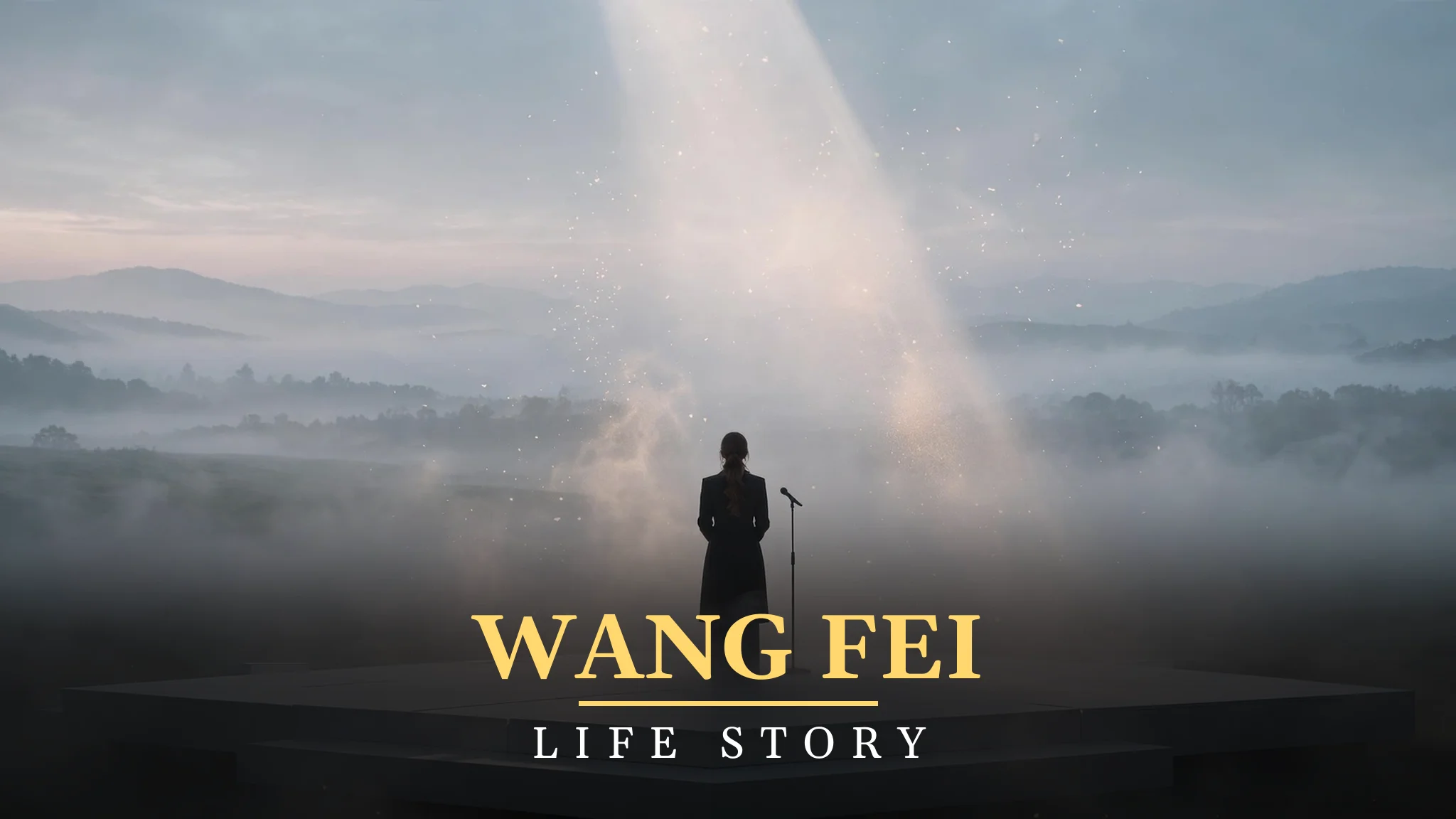
Finally, I want to return to the image of the woman standing alone on a white platform in a misty valley, beside a microphone, with a beam of light falling from the sky, which is the image on her cover. That image fits Wang Fei perfectly, because it shows a woman who is alone, in a vast and beautiful landscape, with only a microphone for company, and a light falling on her from above. She is not part of a crowd. She is not on a busy stage. She is alone, in the mist, singing to the mountains. That is Wang Fei, as I understand her. She is a voice in the mist, a light in the mountains, and a mystery that does not need to be solved. I think that is a beautiful image, and it is a hopeful one. It says that a person can be alone, and still be heard, and that a single voice, in a quiet place, can be more powerful than a thousand voices in a noisy room. Wang Fei has proved that, again and again, for more than thirty years, and I believe she will keep proving it, for many years to come.
I also want to say something about the way Wang Fei’s songs age, because good songs do not get old in the same way that fashionable songs do. A fashionable song sounds dated after a few years, because it belonged to a moment. A true song sounds fresh after twenty years, because it belongs to no moment, or to every moment. “Red Bean” still sounds fresh today, more than twenty-five years after it was released, because it is about a feeling that never gets old: longing for someone who has gone. Wang Fei’s best songs are like that. They do not chase fashion. They speak to feelings that last, and that is why they will still be sung in twenty years, when many other hits of today have been forgotten. That lasting quality is the true test of a song, and Wang Fei passes it, again and again.
Frequently Asked Questions
Who is Wang Fei and what is she best known for?
Wang Fei, also known as Faye Wong, is a Chinese singer born in 1969 in Beijing. She is best known for songs such as “Red Bean” and “Legend”, for “Eyes on Me” from Final Fantasy VIII, and for her acting in the film Chungking Express.
Where was Wang Fei born and where did she become famous?
She was born in Beijing and moved to Hong Kong in 1987 at eighteen years old. She learned Cantonese, became a star in Hong Kong’s Cantopop scene, and later sang in Mandarin for audiences across China and the Chinese-speaking world.
What is the song Red Bean about?
“Red Bean”, released in 1998, is a song about love and loss, in which a small red bean stands for longing for someone who has gone. It is one of the most loved Chinese pop songs of all time and is still sung in karaoke rooms today.
What film did Wang Fei act in?
Her most famous film role is Faye in Chungking Express, directed by Wong Kar-wai and released in 1994. She played a dreamy young woman working in a fast-food shop who falls in love with a policeman, in a performance praised around the world.
What is Eyes on Me?
“Eyes on Me” is the theme song Wang Fei sang in English for the video game Final Fantasy VIII in 1999. It became famous around the world and showed that her voice could cross languages and reach listeners in many countries.
How old is Wang Fei?
Wang Fei was born on 8 August 1969, so she was fifty-seven years old in 2026. She became famous in Hong Kong in the early 1990s and has been one of China’s most loved singers for more than thirty years.
Why is Wang Fei known as a mysterious star?
She is known as mysterious because she rarely gives interviews, shares very little about her private life, and takes long breaks from performing. She lets her songs speak for her, and each return to the stage becomes a major event for her fans.


