Wes Anderson: The Life Story Behind the Whimsical Director
In this post
- A Houston Schoolboy Whose Parents Split Apart
- Bottle Rocket and the Friendship That Built a Career
- The Royal Tenenbaums and a Family of Fallen Geniuses
- The Life Aquatic, Darjeeling, and the Years of Wandering
- Fantastic Mr. Fox, Moonrise Kingdom, and the Return to Childhood
- The Grand Budapest Hotel and the Biggest Success
- An Oscar, a Quiet Life, and the Style That Endures
- The French Dispatch, Asteroid City, and the Later Worlds
- My Take:
Wes Anderson makes films that look like no one else’s films. You can recognise one of his films from a single frame: the colours are soft and precise, the camera sits exactly in the middle, the characters stand in a straight line, and the whole picture feels like a doll’s house that someone has built with great care. It is a style that some people love and some people find too neat, but no one mistakes it for anyone else’s work. In a film industry where most directors try to look like everyone else, Wes Anderson has spent thirty years looking like himself.
He grew up in Houston, Texas, in a family that broke apart when he was eight years old, and he went to a boys’ school where he learned to be precise, polite, and observant. He met his best friend and writing partner, Owen Wilson, at university, and together they made a short film about two young men who plan a robbery and fail at it. That short film became their first feature, and it began a career that has taken Anderson from small comedies about lonely men to large, beautiful films about hotels, families, and the past.
What makes his story interesting is not just the style. It is the feeling underneath the style. His films look playful and bright, but they are often about sad things: parents who have died, families that have fallen apart, children who have to grow up too fast, and adults who cannot let go of the past. The neatness of his films is a way of holding sadness in place, of making it bearable by putting it in a beautiful box. This is the story of how a quiet boy from Houston became one of the most distinctive directors in the world.
A Houston Schoolboy Whose Parents Split Apart
Wesley Wales Anderson was born on 1 May 1969 in Houston, Texas, the middle of three sons born to Melver Anderson, who worked in advertising, and Texas Ann Anderson, who worked in real estate and later became an archaeologist. He grew up in a comfortable home, went to good schools, and was a bright and curious boy. He loved books, he loved films, and he loved to make things. He was not a loud child, and he was not a natural athlete. He was a watcher, a boy who noticed details that other people missed, and who liked to arrange things in a neat and orderly way.
When Wes was eight years old, his parents divorced. The divorce was a shock, and it changed the family. His mother moved out, his father stayed in the house, and the three boys had to learn to live in a family that was no longer whole. Wes later said that the divorce was the most important event of his childhood, and that it shaped the way he thought about families for the rest of his life. Many of his films are about families that have broken apart, about parents who are absent or difficult, and about children who try to hold things together. The Royal Tenenbaums, which is about a family of former child geniuses whose father returns after many years away, is the clearest example, but the theme runs through almost all of his work.
He went to St. John’s School in Houston, a private school for boys, where he was a good student and where he began to make short films with a borrowed camera. He also acted in school plays, and he discovered that he enjoyed being in charge of a production, telling people where to stand and how to say their lines. After school, he went to the University of Texas at Austin, where he studied philosophy. Philosophy taught him to think carefully and to ask questions, but it did not teach him how to make a film. What university gave him was more important: a roommate named Owen Wilson, a tall, funny, and laid-back young man from Dallas, who became his best friend and his writing partner.
At university, Wes and Owen began to write together. They wrote a short film called Bottle Rocket, about two young men, Dignan and Anthony, who plan a series of robberies and fail at almost all of them. The film was funny, sad, and strange, and it showed a world that was both ordinary and slightly off balance. Wes directed the short film, and it was shown at the Sundance Film Festival, where it caught the attention of producers who offered to turn it into a feature film. Wes and Owen were in their early twenties, and they had made a film that Hollywood wanted to see.
Bottle Rocket and the Friendship That Built a Career
Bottle Rocket was made into a feature film in 1996, with Owen Wilson and his brother Luke Wilson starring as the two young men, and with James Caan as a small-time criminal who mentors them. The film was released by a major studio, but it was not a commercial success. It earned little money, and it was soon forgotten by most audiences. But it was noticed by critics, who praised its originality, its humour, and its style. The film showed that Wes Anderson had a voice of his own, and that he was willing to make films about characters who were not heroes, who were not successful, and who were not even particularly competent. Dignan and Anthony were dreamers, and their dreams were bigger than their abilities, and that was what made them interesting.
The failure of Bottle Rocket at the box office did not stop Anderson. He had learned how to make a feature film, he had worked with actors, and he had found a style that felt like his own. He also had a partner in Owen Wilson, and the two of them continued to write together. Their next film, Rushmore, released in 1998, was a turning point. It was a comedy about a fifteen-year-old boy named Max Fischer, played by Jason Schwartzman, who attends a private school called Rushmore Academy, falls in love with a teacher, and competes with a rich industrialist, played by Bill Murray, for her affection. The film was funny, sad, and beautifully made, and it was a success. Bill Murray, who had been a comedy star for many years, gave one of his best performances in it, and he became a regular in Anderson’s films.
Rushmore also introduced the world to Anderson’s visual style in full. The film used symmetrical compositions, with characters placed in the centre of the frame, and it used colours that were soft and precise. It used music in a careful way, with songs that told the audience how to feel about a scene. And it used a narrator, of sorts, in the form of chapter titles and a structure that felt like a book. The film was not like other comedies of its time. It was slower, quieter, and more careful, and it trusted the audience to notice the details. Rushmore made Anderson a director to watch, and it gave him the freedom to make the film he had been waiting to make.
The Royal Tenenbaums and a Family of Fallen Geniuses
In 2001, Anderson made The Royal Tenenbaums, a film about a family of former child prodigies who have grown up to be unhappy adults, and whose father, Royal Tenenbaum, returns after many years away, pretending to be dying, in order to win back his family. The film starred Gene Hackman as Royal, Anjelica Huston as his wife Etheline, and a cast that included Ben Stiller, Gwyneth Paltrow, Luke Wilson, Owen Wilson, and Bill Murray. The film was funny, sad, and beautifully designed, with a house that felt like a museum, costumes that told the audience who each character was, and a narrator who spoke in a calm, literary voice.
The Royal Tenenbaums was a success, and it was nominated for an Academy Award for Best Original Screenplay. It is now regarded as one of Anderson’s best films, and it is the film that most clearly shows his interest in families that have broken apart. The Tenenbaums were once brilliant children, and they grew up to be adults who could not live up to their early promise. Their father was charming and selfish, their mother was patient and tired, and the children were all trying, in different ways, to be loved. The film does not offer easy answers. It shows a family that is damaged but still connected, and it ends with a sense of hope that is quiet and uncertain.
The film also showed Anderson’s gift for working with actors. Gene Hackman, who was known for playing tough and serious roles, gave a performance that was funny, sad, and deeply human. Anjelica Huston was calm and strong. Gwyneth Paltrow, as Margot, a playwright who hides her feelings behind sunglasses and a fur coat, gave a performance that was both mysterious and moving. Anderson had a talent for casting actors who were right for his world, and for giving them the space to be still, to be quiet, and to let the audience come to them. That patience is rare in comedy, and it is one of the reasons his films feel different.
The Life Aquatic, Darjeeling, and the Years of Wandering
After The Royal Tenenbaums, Anderson made The Life Aquatic with Steve Zissou in 2004, a film about an oceanographer, played by Bill Murray, who sets out to find the shark that ate his friend. The film was colourful, funny, and strange, with a ship that was cut open like a doll’s house so the audience could see all the rooms inside, and with a soundtrack of David Bowie songs sung in Portuguese by a Brazilian musician named Seu Jorge. The film was not a commercial success, and some critics found it too strange, but it has since become a cult favourite, and it shows Anderson at his most playful and imaginative.
In 2007, Anderson made The Darjeeling Limited, a film about three brothers, played by Owen Wilson, Adrien Brody, and Jason Schwartzman, who travel across India by train after the death of their father, trying to reconnect with each other. The film was shot in India, with bright colours, crowded trains, and a sense of adventure that was both funny and sad. The brothers argue, they fight, and they slowly learn to be kind to each other. The film was accompanied by a short film called Hotel Chevalier, about one of the brothers and a former lover, which was released online before the main film. The Darjeeling Limited was a smaller film than The Life Aquatic, and it was more personal, about grief, family, and the difficulty of growing up.
During these years, Anderson’s life changed as well. He moved to Paris, where he lived for many years, and he began to work with a wider group of actors and collaborators, including the French actor Mathieu Amalric and the British actor Tilda Swinton. He also began to work more closely with the cinematographer Robert Yeoman, who had shot his films since Bottle Rocket, and with the production designer Adam Stockhausen, who helped to build the worlds of his later films. Anderson was no longer a young director from Texas. He was a filmmaker with a reputation, a style, and a company of actors who returned to work with him again and again.
Fantastic Mr. Fox, Moonrise Kingdom, and the Return to Childhood
In 2009, Anderson made a film that surprised many people: Fantastic Mr. Fox, an animated film based on the children’s book by Roald Dahl, about a fox who steals chickens from three farmers and has to protect his family. The film was made with stop-motion animation, with puppets made of fur and felt, and it was shot in a way that made the puppets look handmade and imperfect. The film starred George Clooney as the voice of Mr. Fox, and Meryl Streep as his wife, and it was nominated for an Academy Award for Best Animated Feature. It was a film for children, but it was also a film for adults, about a father who cannot give up his wild nature, and about a family that has to learn to live with who he is.
In 2012, Anderson made Moonrise Kingdom, a film about two twelve-year-old children, Sam and Suzy, who run away together on a small island off the coast of New England in the summer of 1965. The film was a love story, a comedy, and a coming-of-age film, all at the same time, and it was shot with a warmth and a precision that made it feel like a memory. The film starred Bruce Willis, Edward Norton, Bill Murray, Frances McDormand, and Tilda Swinton, along with two young actors, Jared Gilman and Kara Hayward, who played the children. Moonrise Kingdom was a success, and it was nominated for an Academy Award for Best Original Screenplay. It is one of Anderson’s most loved films, because it captures the feeling of being young and in love for the first time, and the sadness of knowing that the world will not stay simple.
Moonrise Kingdom also showed Anderson’s gift for working with children. He did not treat the young actors as cute or as props. He treated them as serious actors, with real feelings, and he gave them dialogue that was funny, strange, and honest. Sam and Suzy are not like the children in most films. They are serious, they are stubborn, and they are willing to run away from the adults who do not understand them. Anderson understood that children have inner lives that are as rich and as complicated as adults, and he respected that. That respect is one of the reasons his films feel true, even when they look like fairy tales.
The Grand Budapest Hotel and the Biggest Success
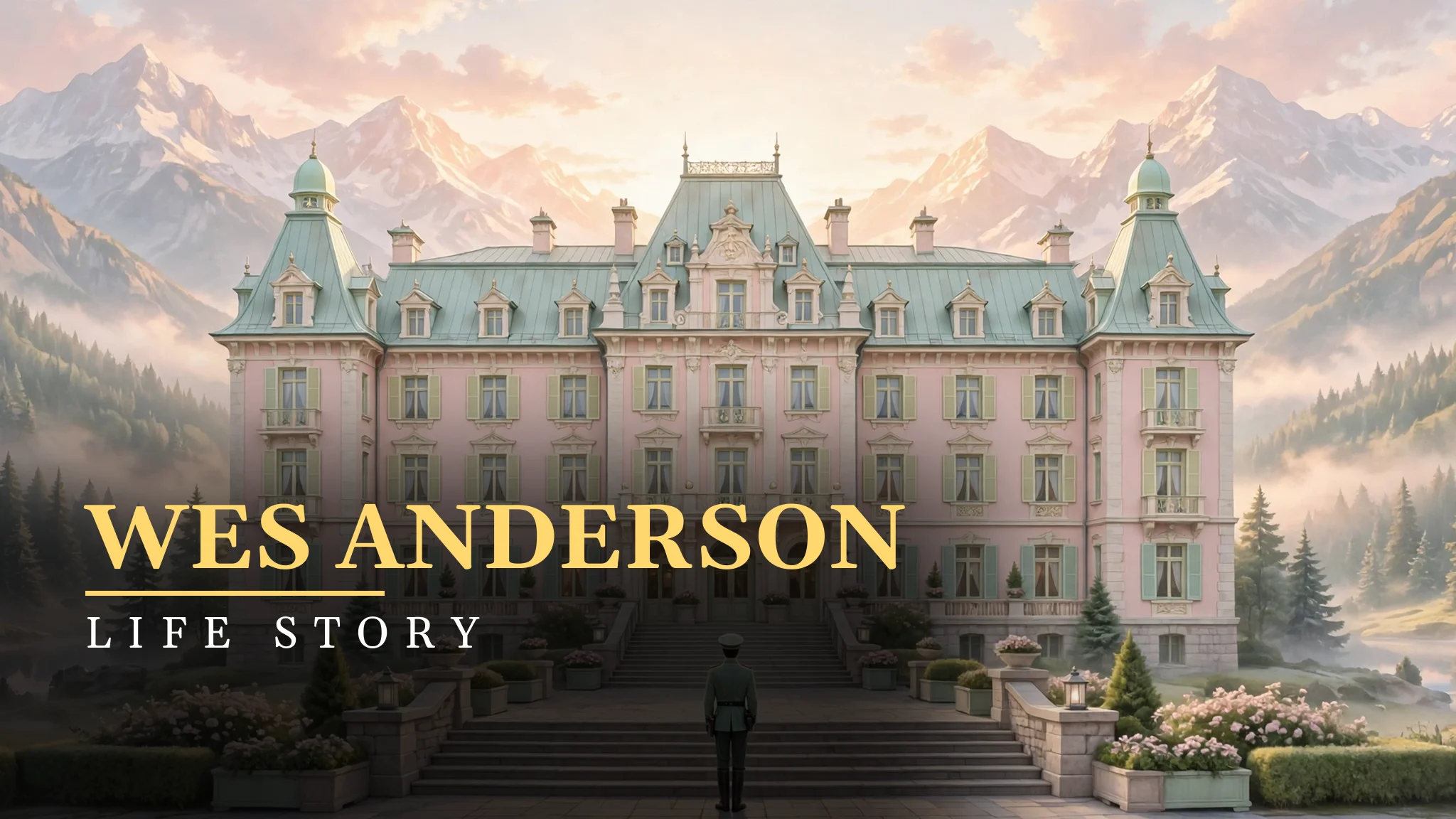
In 2014, Anderson made The Grand Budapest Hotel, a film set in a fictional European country in the 1930s, about a concierge named Gustave H., played by Ralph Fiennes, and his young protégé, Zero, played by Tony Revolori. The film is a comedy, a murder mystery, and a love story, all wrapped in a beautiful pink hotel in the mountains, with a story told in layers, like a book within a book. The film was Anderson’s biggest commercial success, earning far more than any of his earlier films, and it won four Academy Awards, including Best Production Design and Best Original Score. It was nominated for Best Picture and Best Director, and it made Anderson a major figure in world cinema.
The Grand Budapest Hotel is a film about a world that is disappearing. Gustave is a man from an older time, when hotels were grand, manners mattered, and a concierge could solve any problem. The world around him is changing, with war coming, with new money, and with a cruelty that Gustave does not understand. The film is funny, but it is also sad, because it is about the loss of a way of life. Anderson has said that the film was inspired by the work of the Austrian writer Stefan Zweig, who wrote about a Europe that was destroyed by war, and the film carries that sadness underneath its bright colours and its jokes.
After The Grand Budapest Hotel, Anderson made Isle of Dogs in 2018, a stop-motion animated film set in a future Japan, about a boy who travels to an island of discarded dogs to find his pet. The film was praised for its animation and its imagination, and it was nominated for an Academy Award for Best Animated Feature. He made The French Dispatch in 2021, a film about a fictional magazine in France, told as a series of stories, with a large cast and a structure that felt like a magazine come to life. He made Asteroid City in 2023, a film about a group of people who gather in a desert town in the 1950s to watch a meteor shower, and about a play that is being performed about them. Each film was different, but each one was unmistakably his, with the same care, the same colours, and the same sadness underneath the jokes.
An Oscar, a Quiet Life, and the Style That Endures
In 2024, Anderson won his first Academy Award, for Best Live Action Short Film, for The Wonderful Story of Henry Sugar, a short film based on a story by Roald Dahl, starring Benedict Cumberbatch. It was a small film, made with care and precision, and it was a fitting award for a director who had spent his career making films that were both beautiful and strange. Anderson did not attend the ceremony, and he accepted the award quietly, which was in keeping with his nature. He is not a man who seeks attention. He is a man who makes films, and who lets the films speak for themselves.
Anderson lives a quiet life. He has a partner, the writer and costume designer Juman Malouf, and they have a daughter. He lives in Paris and in London, and he works with the same group of actors and collaborators, many of whom have been with him since his first films. He is known for being polite, precise, and hardworking, and for treating his films like small, handmade objects. He storyboards every shot, he plans every colour, and he builds every set with care. That attention to detail is what makes his films look the way they do, and it is what makes them feel like they were made by a single person with a clear vision.
Today, Wes Anderson is regarded as one of the most distinctive directors in the world, and his style has been copied, parodied, and celebrated in ways that few directors experience. There are videos online that imitate his style, there are advertisements that borrow his colours, and there are young filmmakers who try to make films that look like his. He has said that he is flattered by the imitation, but that he is also a little embarrassed by it, because he never set out to create a style. He set out to tell stories, and the style grew out of the stories. That is the most honest thing a director can say, and it is the reason his films will last: they are not just a style. They are stories, told with care, by a man who learned to see the world clearly when he was eight years old and his family broke apart.
The French Dispatch, Asteroid City, and the Later Worlds
Wes Anderson’s later films kept building new worlds, each one more detailed than the last. The French Dispatch, released in 2021, was a film about a fictional American magazine based in a French town, told as a series of stories that felt like articles in a magazine: a story about an artist in prison, a story about a student protest, and a story about a kidnapped chef. The film had a large cast, including Bill Murray, Tilda Swinton, Frances McDormand, and Timothée Chalamet, and it was shot in black and white and in colour, with a structure that jumped between stories. Some critics loved its inventiveness, and others found it too clever for its own good, but no one denied that it was a film only Anderson could have made, with its love of print, of France, and of the written word.
Asteroid City, released in 2023, was a film about a group of people who gather in a desert town in the American Southwest in the 1950s to watch a meteor shower, and about a play that is being performed about them, with actors who step in and out of the story. The film starred Jason Schwartzman, Scarlett Johansson, and Tom Hanks, and it was about grief, about a father who cannot tell his children that their mother has died, and about the strange feeling of being in a place that is both real and imaginary. The film was quiet, sad, and beautiful, and it showed that Anderson, now in his fifties, was still interested in the same themes that had driven his work since Rushmore: families that are broken, children who are trying to understand the world, and adults who cannot say what they feel.
My Take:
I want to begin with a confession: the first time I saw a Wes Anderson film, I thought it was too neat. Everything was in the middle, everything matched, everything was pink or yellow or pale blue, and I wondered whether a real person could live in a world that tidy. Then I watched it again, and I noticed something I had missed the first time: the neatness was holding something sad in place. The characters were smiling, but they were lonely. The houses were beautiful, but the families inside them were broken. The colours were bright, but the stories were about loss. I realised that the neatness was not a decoration. It was a way of coping, a way of making sadness bearable by putting it in a beautiful frame. That changed the way I saw his films, and it changed the way I think about style in general.
What I admire most about Anderson is that he did not copy anyone. He could have made films that looked like other people’s films, and he would have had an easier career. Instead, he made films that looked like his own drawings, his own memories, and his own way of seeing the world. That takes courage, because the first time you show the world something new, the world does not always understand it. Bottle Rocket failed at the box office. The Life Aquatic divided critics. But Anderson kept making films his way, and over time the world learned to see what he was doing. That is a lesson I think about often: if you make something that is truly yours, it may take time for people to understand it, but when they do, they will remember it, because there is nothing else like it.
I also think about his parents’ divorce, and about the way it shaped his work, because I believe that is the key to his films. He was eight years old when his family broke apart, and he spent the rest of his life making films about families that break apart and try to come back together. The Royal Tenenbaums is the clearest example, but the theme is everywhere: in Rushmore, where a boy tries to win the love of a teacher because his own family is not enough; in The Darjeeling Limited, where three brothers travel across India because their father has died; in Moonrise Kingdom, where two children run away because the adults around them do not understand them. These are not just stories. They are a man working through the most painful experience of his childhood, again and again, in different forms. I find that deeply human, and I find it brave, because it would be easier to make films about something else, something safer. Anderson chose to keep returning to the wound, and to try to understand it from a new angle each time.
There is something else I want to say about his style, which is that it is often misunderstood. People talk about the symmetry, the colours, and the neatness as if they were the point of his films. I do not think they are the point. I think they are the surface, and the point is underneath. The point is the sadness, the loneliness, and the love that his characters feel but cannot always express. The neatness is a way of holding those feelings still, so that the audience can look at them without being overwhelmed. It is like a museum: the objects are arranged carefully, not because the museum is more important than the objects, but because the arrangement helps you to see them clearly. Anderson’s films are museums of feeling, and the style is the frame that lets you see the feeling.
I also admire the way he works with actors. He has a company of actors who return to his films again and again: Bill Murray, Owen Wilson, Jason Schwartzman, Tilda Swinton, and many others. That is not an accident. It is because he treats actors with respect, because he gives them the time to be still and quiet, and because he writes parts that are worth playing. Bill Murray’s performance in Rushmore is one of the best of his career, and it happened because Anderson gave him a character who was sad, funny, and human, and who did not have to be loud to be interesting. That is a gift that few directors have: the ability to see what an actor can do, and to give them the space to do it. I think that is why actors love working with him, and why they keep coming back.
But I also want to be honest about the limits of his work. His films are not for everyone, and they are not always successful. Some people find his style too mannered, too neat, or too detached from real life. I understand that criticism, and I think there are moments when it is fair. The Life Aquatic is a film that I admire more than I love, because it is so strange that I sometimes feel locked out of it. The French Dispatch is a film that I found beautiful but difficult to follow, because it is made of many small stories that do not add up to a single feeling. Anderson’s style can become a cage, and when it does, the films feel like exercises in neatness rather than stories about people. I do not think that is a reason to dismiss him. I think it is a reason to be honest about the fact that a strong style is both a gift and a risk, and that even a great director can be trapped by his own success.
I think about Moonrise Kingdom a lot, because it is the film of his that I love most, and it is the one that tells me the most about him. Sam and Suzy are twelve years old, and they run away together because the adults around them do not understand them. The film treats their love seriously, not as a joke or as a phase, but as a real and important feeling. That is a rare thing in cinema, where children are often treated as cute or as innocent, but not as serious people with inner lives. Anderson understood that children have feelings that are as deep as adults, and he made a film that honoured that. I think that understanding comes from his own childhood, from the experience of being a boy whose family broke apart and who had to learn to see the world clearly at a young age. He never forgot what it felt like to be young and to be taken seriously, and he gave that gift to Sam and Suzy.
The Grand Budapest Hotel is the film that made him famous to a wider audience, and I understand why. It is beautiful, funny, and sad, all at the same time, and it is about a world that is disappearing. Gustave H. is a man from an older time, when manners mattered and a hotel was a place of grace. The world around him is changing, with war and cruelty coming, and he does not know how to live in it. I think that film is about Anderson himself, in a way, because he is also a man from an older time, a man who values craft, care, and beauty in a world that often values speed and noise. He made a film about a man who is out of place, and he made it with love, because he understands what it feels like to be out of place.
I also think about his friendship with Owen Wilson, because it is one of the most important relationships in his career. They met at university, they wrote Bottle Rocket together, and they have worked together ever since. That kind of friendship is rare in Hollywood, where people move on and forget each other. Anderson and Wilson did not move on. They stayed friends, they stayed collaborators, and they built a career together. I find that moving, because it tells me that Anderson values loyalty, and that he understands that a career is not just about films. It is about the people you make them with, and the friendships that last longer than any single film.
If I had to choose one lesson from his life, it would be this: make the thing that is yours, even if the world does not understand it at first. Anderson made films that looked like no one else’s, and he waited for the world to catch up. That takes patience, and it takes a belief in your own vision that is stronger than the desire to be popular. I think that is a lesson for anyone who makes things, whether it is a film, a book, a painting, or a business. The world will always tell you to be more like everyone else, because that is safer. Anderson did not listen, and his films are better for it. They are not perfect, and they are not for everyone, but they are his, and that is enough.
Finally, I want to say that I am grateful for Wes Anderson’s films, because they remind me that sadness can be beautiful, and that a broken family can still be a family, and that a careful, neat, handmade world can hold feelings that are too big to say out loud. He is a director who sees the world clearly, and who has the patience to build it, one frame at a time, until it looks like the world he carries inside him. That is a rare gift, and it is one that I hope he keeps sharing for many years to come.
I also think about his collaborators, because Anderson does not work alone, and his films are the work of a team that has stayed together for decades. Robert Yeoman has shot his films since Bottle Rocket, and his camera work, with its symmetry and its stillness, is as much a part of the Anderson style as the writing. Adam Stockhausen has designed the sets, building hotels, trains, and desert towns that feel like real places and like models at the same time. Alexandre Desplat has written the music, giving the films a lightness and a sadness that the images alone cannot give. These are not just hired hands. They are partners, and Anderson trusts them, and they trust him, and the films are better for it. That is a lesson for anyone who makes things: find the people who understand your work, keep them close, and let them do what they do best.
There is also something I want to say about the criticism that his films are all surface, all style and no feeling, because I think that criticism misses the point. A film that is all surface would not make me sad, and Anderson’s films make me sad. When I watch The Royal Tenenbaums, I feel the sadness of a family that cannot love each other properly. When I watch Moonrise Kingdom, I feel the sadness of two children who have to run away to be together. When I watch The Grand Budapest Hotel, I feel the sadness of a world that is disappearing. Those feelings are not surface. They are deep, and they are real, and the style is the way Anderson lets us feel them without being overwhelmed. A beautiful frame does not hide a feeling. It holds it, and it lets us look at it clearly. That is what his style does, and I think it is a kind thing to do for an audience.
I also think about the way his films treat children, because that is a thread that runs through his work, and it is one that I find moving. In Rushmore, Max Fischer is a fifteen-year-old who is trying to be an adult, and who fails, and who learns. In Moonrise Kingdom, Sam and Suzy are twelve, and they run away because the adults do not understand them. In The Royal Tenenbaums, the children were geniuses, and they grew up to be unhappy adults because no one let them be children. Anderson understands that childhood is not a simple time, and that children have inner lives that are as complicated as adults. He films them with respect, with care, and with a camera that does not look down on them. That respect is rare in cinema, where children are often treated as cute or as innocent, but not as serious people. Anderson treats them seriously, and his films are better for it.
Frequently Asked Questions
How did Wes Anderson meet Owen Wilson?
Wes Anderson met Owen Wilson at the University of Texas at Austin, where they were both students, and they became best friends and writing partners. Together they wrote a short film called Bottle Rocket, about two young men who plan robberies and fail at them, which was shown at the Sundance Film Festival and later made into a feature film in 1996.
Why are Wes Anderson films so symmetrical and colourful?
Wes Anderson uses symmetrical compositions, with characters placed in the centre of the frame, and soft, precise colours, as part of a visual style that makes his films look like a doll’s house or a handmade model. The style is not just decoration: the neatness helps to hold the sadness of his stories in place, so the audience can look at difficult feelings without being overwhelmed.
What is The Royal Tenenbaums about?
The Royal Tenenbaums, released in 2001, is about a family of former child prodigies who have grown up to be unhappy adults, and whose father, Royal, returns after many years away, pretending to be dying, to win back his family. The film stars Gene Hackman, Anjelica Huston, Ben Stiller, Gwyneth Paltrow, and Luke Wilson, and it was nominated for an Academy Award for Best Original Screenplay.
Did The Grand Budapest Hotel win any Academy Awards?
Yes, The Grand Budapest Hotel, released in 2014, won four Academy Awards, including Best Production Design and Best Original Score, and it was nominated for Best Picture and Best Director. It was Wes Anderson’s biggest commercial success, and it is set in a fictional European country in the 1930s, in a pink hotel in the mountains.
What is Moonrise Kingdom about?
Moonrise Kingdom, released in 2012, is about two twelve-year-old children, Sam and Suzy, who run away together on a small island off the coast of New England in the summer of 1965. The film is a love story, a comedy, and a coming-of-age film, and it treats the children’s feelings seriously. It was nominated for an Academy Award for Best Original Screenplay.
Has Wes Anderson won an Academy Award?
Wes Anderson won his first Academy Award in 2024, for Best Live Action Short Film, for The Wonderful Story of Henry Sugar, a short film based on a story by Roald Dahl and starring Benedict Cumberbatch. He had been nominated before for films like The Royal Tenenbaums, Moonrise Kingdom, and The Grand Budapest Hotel, but he had not won until then.


