What Is a Balanced Meal in Simple Words
In this post
- What “Balanced” Really Means
- The Four Parts of a Balanced Plate
- Energy Foods: The Part That Fills You Up
- Protein Foods: The Part That Builds and Repairs
- Vegetables and Fruit: The Part That Protects
- Water, Oil and the Small Things People Forget
- What a Balanced Meal Is Not
- Building a Balanced Plate on a Small Budget
- Balanced Meals in a Real Day
- My Take:
The words “balanced meal” sound complicated, like something that needs a chart, a scale and a nutrition degree. In truth, the idea is very simple, and most people already understand it without realising it. A balanced meal is a meal that gives your body different kinds of food in one sitting, so that no single need is left out. It has something for energy, something that helps your body grow and repair itself, something from plants for fibre and vitamins, and water to drink. That is the whole idea. You do not need to weigh your food or count anything. You only need to look at your plate and ask one question: is there more than one kind of food here, or is it all the same thing? If your plate has rice, lentils and vegetables, it is balanced. If it has only a pile of white rice, it is not, even though you feel full. This article explains each part in plain words, with examples from everyday food, so you can build a balanced plate without any special knowledge or special shopping.
What “Balanced” Really Means
The word balanced is doing a lot of work in this phrase, so it is worth understanding properly. Balanced does not mean perfect, and it does not mean that every meal must have exactly the right amount of everything. Nobody eats perfectly at every meal, and nobody needs to. Balanced means that over the course of a day, your body gets a mix of the different things it needs, and that each meal carries its fair share of that mix. Think of it like a team. A cricket team cannot win with eleven batsmen and no bowlers. It needs different players doing different jobs. Your body is the same. It needs energy food to keep you moving, protein food to build and repair, plant food for fibre and vitamins, and water to carry everything around. A meal that has only one of these is like a team with only one kind of player. It might work for a little while, but it cannot do the whole job.
It also helps to know that balance works over a day, not only over a single plate. If your breakfast was mostly bread and tea, that is fine, as long as your lunch and dinner bring in the lentils, vegetables and fruit that breakfast missed. You do not need to fix everything at every meal. What you need is a day that, taken together, covers the different kinds of food. This takes the pressure off. Many people give up on eating well because they think one imperfect meal has ruined the day. It has not. The day is long, and the next meal is a fresh chance. A balanced diet is a pattern across a week, not a test you pass or fail at lunchtime.
There is one more thing the word balanced does not mean: it does not mean expensive. A balanced meal is not a plate of imported food or a special diet product. Some of the most balanced meals in the world are also the cheapest: rice and lentils with vegetables, bread and beans with salad, potatoes and eggs with greens. These meals have fed families for generations, and they are balanced because they mix different kinds of food, not because they cost a lot. When anyone tells you that healthy eating needs expensive ingredients, they are usually selling something. The honest truth is that balance is about variety, not price.
The Four Parts of a Balanced Plate
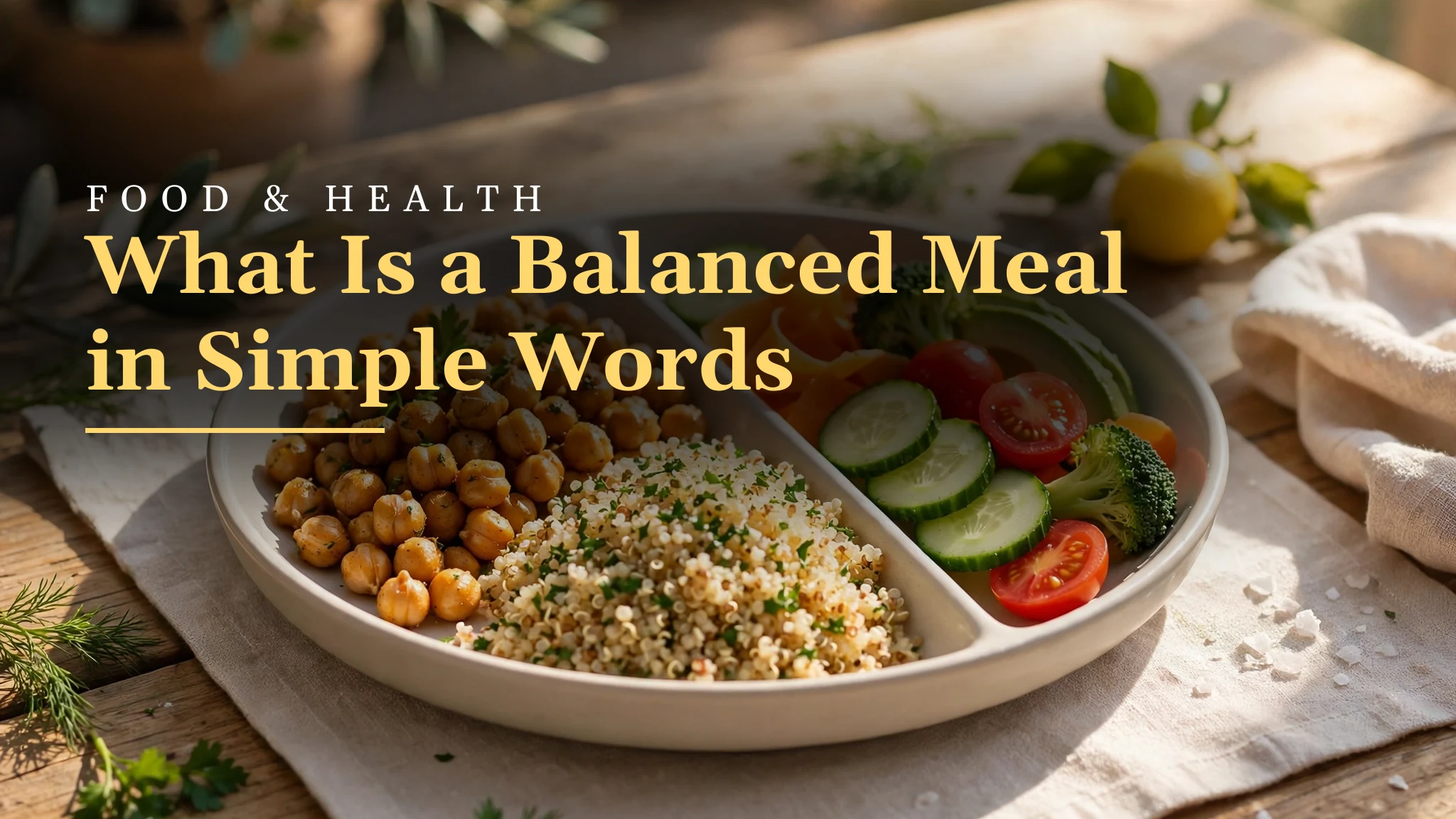
The easiest way to understand a balanced meal is to picture a plate divided into parts. About half of the plate should be vegetables and fruit, or at least a good share of vegetables with a little fruit on the side. About a quarter of the plate should be energy food, the starchy foods like rice, bread, chapatti, potatoes or pasta. And about a quarter should be protein food, such as lentils, beans, eggs, meat, fish or yoghurt. Beside the plate, a glass of water. That picture is the whole lesson, and it is used by health organisations all over the world because it works without numbers, without weighing and without any special knowledge. You just look at the plate.
The half of the plate that is vegetables matters most, because it is the part people skip most often. Vegetables give you fibre, which keeps your digestion moving and helps you feel full, and they give you vitamins and minerals that your body uses for everything from healthy skin to a steady immune system. They also add bulk to a meal without adding many calories, which means you can eat a satisfying amount of food without overeating. A plate that is mostly rice with a spoonful of vegetables on the side is not balanced, even if the vegetables are there. The vegetables need a real share of the plate, not a decoration. Salad counts too. A bowl of chopped onion, tomato, cucumber and lemon beside your main dish is a genuine part of the meal, not an extra.
The quarter that is energy food is the part that keeps you going. Rice, bread, chapatti, potatoes, pasta and oats all belong here. They give your body its main fuel, and without them you feel tired and hungry quickly. The mistake people make is letting this part take over the whole plate. A plate piled high with rice and only a little lentil curry is mostly fuel and very little else. You will feel full, but you will be hungry again soon, and you will have missed the protein and vegetables your body also needed. The quarter that is protein food is the part that builds and repairs. Lentils, beans, chickpeas, eggs, meat, fish, milk and yoghurt all belong here. Protein helps your muscles, your skin and your blood, and it is the part of the meal that keeps you feeling full the longest. A meal without any protein food is a meal that fades fast.
Water is the fourth part, and it sits beside the plate rather than on it, which is probably why people forget it. Your body needs water to digest food, to carry nutrients around, and to keep your energy steady. A meal eaten with almost no water is harder for your body to process, and many people mistake thirst for hunger, eating more when a glass of water would have settled them. You do not need a special drink with your meal. Plain water is enough, and it is the best choice. Sweet drinks, by contrast, add sugar without adding anything your body needs, and they do not belong in the balanced picture at all.
Energy Foods: The Part That Fills You Up
Energy foods are the foods that give your body fuel, and they are the foods most people eat most of. Rice, wheat, bread, chapatti, potatoes, pasta, oats and corn all belong in this group. Your body breaks them down into a form of sugar called glucose, which your muscles and your brain use to work. Without energy food, you feel tired, weak and unable to concentrate, because the fuel tank is empty. This is why a day without rice or bread feels so hard, and why people doing physical work need a generous share of these foods. A labourer who skips his bread at lunch will feel it in his arms and legs by the afternoon, not just in his stomach.
Not all energy foods behave the same way, and the difference is worth knowing. Whole grains, like whole wheat bread, brown rice and oats, still have their fibre, so they digest slowly and keep you full for hours. White rice and white bread have had most of their fibre removed, so they digest quickly, give you a fast burst of energy, and leave you hungry again sooner. Neither one is bad, and both have their place. White rice with lentils and vegetables is a perfectly good meal. But if you find yourself hungry an hour after eating, the reason may be that your energy food was too refined and too quick. Mixing in some whole grains, or eating your rice with lentils and vegetables, slows the whole meal down and keeps you satisfied for much longer. That is the practical value of fibre: it stretches a meal out over hours instead of minutes.
Portion is where energy food usually goes wrong, and it goes wrong in a quiet way. Nobody notices they are eating too much rice, because rice is soft, mild and easy to keep eating. A plate that starts as a quarter rice can easily become a plate that is three quarters rice, simply because the rice pot is in the middle of the table and the vegetables ran out. The fix is not to eat less rice with a sense of punishment. The fix is to serve yourself the vegetables and the protein first, and then add the rice to fill the remaining space. When the plate is already half full of vegetables and lentils, there is only a quarter of space left for rice, and the balance happens by itself. This small change in the order of serving is one of the most useful habits in healthy eating, because it works without willpower and without measuring.
Protein Foods: The Part That Builds and Repairs
Protein is the part of food that your body uses to build and repair itself. Your muscles, your skin, your hair, your blood and your immune system are all made with protein, and your body is constantly repairing them. Every day, small amounts of muscle and skin are broken down and rebuilt, and that rebuilding needs protein from your food. Without enough protein, you feel weak, you recover slowly from hard work or illness, and you feel hungry again soon after eating, because protein is the nutrient that keeps you full the longest. This is why a meal with lentils or eggs satisfies you far more than a meal of plain rice, even if both meals have the same amount of food on the plate.
The good news is that protein food is not only meat. Lentils, chickpeas, beans, peas and soy are rich in protein, and they are also cheap, filling and easy to store. Eggs are one of the best protein foods there are, and they are affordable in most places. Milk, yoghurt and cheese give protein too, and a small pot of yoghurt with a meal adds a real share of it. Meat and fish are also good sources, but they are not the only ones, and a person who eats no meat can still get enough protein from lentils, beans, eggs and dairy. This matters, because many people believe that a meal without meat is a meal without protein, and that belief is simply wrong. A plate of rice, lentil curry and vegetables is a complete, protein-rich meal, and it has fed whole populations for centuries.
How much protein you need depends on your age, your size and how active you are, but for most adults, a palm-sized share of protein food at each main meal is a sensible guide. That means a bowl of lentils, two eggs, a piece of fish or a cup of yoghurt, roughly the size of your own palm. Children need protein for growth, and older people need it to keep their muscles strong, so it is worth making sure protein appears at every meal, not just at dinner. A breakfast of tea and biscuits has almost no protein, which is one reason it leaves you hungry by mid-morning. A breakfast of eggs, or bread with yoghurt, carries you much further. The simplest test is to look at your plate and ask: is there a protein food here? If the answer is no, add one, even a small one. A spoonful of lentils or a boiled egg changes the whole meal.
Vegetables and Fruit: The Part That Protects
Vegetables and fruit are the part of a balanced meal that people understand least and skip most, and that is a shame, because they do more quiet work than any other part of the plate. Vegetables give you fibre, which keeps your digestion steady and helps you feel full. They give you vitamins, such as vitamin A for your eyes and skin, vitamin C for your immune system, and folate, which your body needs to make healthy blood. They give you minerals like potassium and magnesium. And they give you all of this with very few calories, which means you can eat a lot of them without eating too much energy. A big plate of vegetables is a generous meal, not a punishment, and it is one of the reasons balanced meals are so satisfying.
The trick with vegetables is variety, because different colours give you different things. Dark green leaves like spinach give you iron and folate. Orange vegetables like carrots and pumpkin give you vitamin A. Red vegetables like tomatoes give you other useful compounds. There is no single vegetable that does everything, which is why eating the same one vegetable every day is not enough. You do not need to eat ten kinds at once. You need to change them across the week: spinach one day, carrots the next, cabbage the next, and so on. The same goes for fruit. An apple, a banana, an orange and a handful of grapes are not the same food, even though they are all fruit. Each one brings something slightly different, and eating a few different fruits across the week covers far more than eating the same one every day.
Many people say they do not eat vegetables because they are expensive or hard to cook, but most of the time the vegetables are already in the kitchen, just not on the plate in a big enough share. Onions, tomatoes, potatoes and green chillies are vegetables, and a curry made with them already has vegetables in it. The problem is usually the amount, not the absence. A curry with two tomatoes for a whole family is not a vegetable-rich meal. A curry with tomatoes, onions, spinach and peas is. Salad is the easiest way to add vegetables without cooking anything at all. A chopped salad of onion, tomato and cucumber with lemon takes five minutes, costs very little, and turns an ordinary plate of rice and lentils into a genuinely balanced meal. Fruit can be dessert. A banana or an orange after lunch is a far better finish than a sweet, and it counts towards the balance of the day.
Water, Oil and the Small Things People Forget
Water is part of a balanced meal, even though it is not food. Your body is mostly water, and every job it does, from digesting food to carrying nutrients to keeping your temperature steady, needs water. When you do not drink enough, you feel tired, you get headaches, and your digestion slows down. Many people also mistake thirst for hunger, and eat when a glass of water would have been enough. The simple habit is to drink a glass of water with each meal, and to keep drinking through the day. Tea counts towards your fluid, but sweet drinks do not help in the same way, because they add sugar your body does not need. Plain water is the best, cheapest and simplest choice, and it deserves a place in the picture of a balanced meal.
Oil and fat are the small part that people get confused about, because fat is often talked about as if it were always bad. In truth, your body needs some fat. Fat helps you absorb certain vitamins, it keeps your skin healthy, and it makes food taste good and feel satisfying. The question is not whether to eat fat, but how much and what kind. A small amount of oil for cooking, a handful of nuts, or a little yoghurt is a normal and useful part of a meal. A meal swimming in oil, or a diet full of fried snacks, is a different matter. The fat in fried food is often used again and again, heated to high temperatures, and eaten in large amounts, and that is where the problems begin. The rule is simple: a little fat, used in cooking or eaten as part of whole foods like nuts and seeds, is part of balance. A lot of fat, especially from fried food, tips the plate the wrong way.
Salt is another small thing that matters more than people think. Your body needs a little salt, but most people eat far more than they need, and most of it comes not from the salt they add at the table, but from processed food, salty snacks and sauces. Too much salt over time is linked to higher blood pressure, and it makes you thirsty in a way that plain water does not fix quickly. The habit that helps most is to taste your food before adding salt, and to use herbs, lemon, green chillies and spices for flavour instead. Spices are not a problem. Chilli, turmeric, cumin, coriander and ginger add flavour without adding salt or sugar, and they are one of the best tools for making a balanced meal taste good. A meal that tastes good is a meal you will eat again, and that is the real test of any healthy habit.
What a Balanced Meal Is Not
It helps to say clearly what a balanced meal is not, because several misunderstandings are very common. A balanced meal is not a diet meal. It is not small, and it is not bland. A balanced plate can be generous, filling and full of flavour. People who think balanced means tiny portions give up quickly, because they are hungry all the time, and hunger is not a plan. A balanced meal should leave you satisfied. If you finish your plate and you are still hungry, the answer is usually more vegetables and more protein, not less food altogether.
A balanced meal is also not a meal made of special products. You do not need a protein powder, a diet bar, a vitamin drink or a packet labelled healthy. Those products are expensive, and most of them are less useful than ordinary food. A boiled egg is better than a protein bar. A bowl of lentils is better than a meal replacement shake. An orange is better than a vitamin drink. The food industry makes a lot of money by making ordinary eating sound complicated and by selling the solution, but the solution is already in your kitchen. Rice, lentils, vegetables, eggs, yoghurt and fruit are the solution, and they have always been.
A balanced meal is not the same thing every day, either. Some people hear the word balanced and imagine one fixed plate they must eat at every meal, and that quickly becomes boring. Balance is not one plate repeated forever. It is a mix that changes across the day and across the week: rice and lentils today, bread and eggs tomorrow, potatoes and beans the day after. The plate changes, but the pattern stays the same, and that is what makes it possible to keep for years instead of weeks. Finally, a balanced meal is not a cure for anything. It will not fix an illness on its own, and it is not a medicine. It is simply the way of eating that gives your body the best chance to stay steady and strong, day after day, and that is enough.
Building a Balanced Plate on a Small Budget
One of the most common reasons people give for not eating a balanced meal is money, and it is worth answering this honestly. It is true that some healthy foods are expensive. Imported fruit, packaged nuts and special grains can cost a lot. But a balanced meal does not need any of those. The cheapest foods in most markets are also the most useful for balance. Lentils, chickpeas and beans are among the cheapest protein foods in the world. Rice and wheat are cheap energy foods. Onions, tomatoes, cabbage, carrots and seasonal vegetables are usually the cheapest vegetables, because they grow locally and in season. Eggs are cheap protein. A banana is cheap fruit. A plate built from these foods costs very little, and it is genuinely balanced.
Seasonal food is the key to eating well on a small budget. Vegetables and fruit that are in season are cheaper, fresher and tastier than those that are not. In winter, root vegetables and leafy greens are cheap. In summer, gourds, tomatoes and mangoes are cheap. Buying what is in season, rather than what you saw in a picture or an advertisement, is one of the oldest and smartest habits in food. It also means your plate changes through the year, which is good for variety. A family that buys seasonal vegetables is already eating a more varied diet than a family that buys the same expensive imported fruit all year.
Planning helps too, and it does not need to be complicated. Cooking lentils or beans in a big pot and eating them over two days saves time and money. Buying a sack of rice or flour lasts longer and costs less per meal than buying small packets. Keeping a few eggs, some yoghurt and a bag of onions in the house means a balanced meal is always possible, even on a day when there was no time to shop. And cooking at home is almost always cheaper than buying ready food, because ready food adds the cost of someone else’s time, packaging and profit, and it often adds extra salt, sugar and oil as well. A home-cooked plate of rice, lentils and vegetables is not only cheaper than a takeaway. It is also more balanced, because you can see what went into it.
Balanced Meals in a Real Day
The easiest way to see balance is to walk through a real day. Breakfast could be bread with an egg, a banana and a cup of tea, with a glass of water. That plate has energy food in the bread, protein in the egg, fruit in the banana, and water beside it. It is a balanced breakfast, and it takes ten minutes. Lunch could be rice, lentil curry, a vegetable dish and a chopped salad. That plate has energy in the rice, protein in the lentils, vegetables in two forms, and water. Dinner could be chapatti, chickpeas, spinach and yoghurt. Again the same pattern: energy, protein, vegetables and water, in different foods from lunch. None of these meals is special. None of them needs a recipe book. They are ordinary meals, arranged so that each one carries its share of the different kinds of food.
Notice that the pattern is the same at every meal, but the foods are different. That is the whole skill, and once you see it, you cannot unsee it. You start to notice it everywhere: a plate with only rice and nothing else looks empty in a new way. A meal of only fried snacks looks thin. A plate with rice, lentils and salad looks complete. You do not need to measure anything. You look at the plate, and you can see whether the different kinds of food are there. If one kind is missing, you add it. If the rice has taken over the plate, you serve more vegetables next time. That is all there is to it, and it is a skill you can use for the rest of your life, in any kitchen, in any country, with whatever food is available.
Children learn this faster than adults, because they learn by watching. A child who grows up seeing a plate with rice, lentils and vegetables will think that is what a meal looks like, and they will carry that picture with them when they grow up. A child who grows up seeing only fried snacks and sweet drinks will think that is normal, and they will have to unlearn it later. This is one reason the balanced plate matters beyond your own health. It is also a lesson you are teaching, quietly, three times a day, without saying a word. The plate you serve is the lesson, and it is worth making it a good one.
My Take:
If you ask me what a balanced meal is, I will not give you a chart or a list of numbers. I will give you a picture, and the picture is a plate with different kinds of food on it. Half vegetables, a quarter rice or bread, a quarter lentils or eggs, and a glass of water beside it. That is the whole lesson, and I think it is one of the most useful lessons in health, because it is the only one that works without money, without special knowledge and without any equipment. You do not need to weigh anything. You do not need to count anything. You look at your plate, and you can see whether it is balanced or not. I like advice that a person can use in their own kitchen on the same day they hear it, and this is that kind of advice.
I think the reason the balanced plate matters so much is that most unhealthy eating is not caused by bad food. It is caused by missing food. The person who eats only rice is not eating poison. They are eating one good food and missing three others. The person who eats only fried snacks is not a bad person with no self-control. They are a person whose plate has no vegetables, no protein and no water on it. Once you see eating this way, the fix becomes much kinder and much easier. You do not need to give up the food you love. You need to add the foods you are missing. Add lentils to the rice. Add salad to the plate. Add a glass of water to the meal. The meal becomes balanced not by taking things away, but by adding things in, and that is a far easier change to keep than any diet that starts with a list of forbidden foods.
I also think we should be honest about why so many people eat unbalanced meals, because it is rarely laziness. It is usually time, money or habit. A person who works ten hours and comes home tired does not have the energy to cook three different dishes, so they eat whatever is quickest, and the quickest thing is usually one food, not four. A person with very little money buys the cheapest food that fills the stomach, and that is usually rice or bread, not vegetables and eggs. A person who grew up eating one kind of meal keeps eating it, because it is what they know. I understand all of these reasons, and I do not blame anyone for them. But I also think the fix is smaller than people imagine. A chopped salad takes five minutes. A pot of lentils can be cooked in bulk and eaten for two days. An egg takes three minutes to boil. Balance does not need an hour in the kitchen. It needs five extra minutes and a small change in what you put on the plate.
There is a point about money that I want to make plainly, because it is the point that stops most people before they start. Healthy eating has a reputation for being expensive, and that reputation is largely created by advertising. The foods you see in advertisements for healthy eating, the imported berries, the packaged nuts, the special grains, are expensive. But they are not the foods that make a meal balanced. The foods that make a meal balanced are lentils, beans, eggs, rice, wheat, onions, tomatoes, cabbage, carrots, spinach and bananas, and those are among the cheapest foods in any market. A plate of rice, lentils and vegetables costs less than a packet of biscuits in many places, and it feeds you for hours instead of minutes. I think it is important to say this, because a person who believes healthy eating is only for rich people will never try it, and that belief is wrong. Balance is cheap. It is the fancy version of healthy eating that is expensive, and you do not need the fancy version.
I want to say something about children, because I believe the balanced plate is one of the best things a parent can teach, and it is taught without a single lecture. Children watch what is on the table. If they see a plate with rice, lentils and vegetables every day, they will grow up thinking that is what a meal is. They will not need to learn it later, because they will have lived it. If they see a plate of only fried food and sweet drinks, they will think that is normal, and they will carry that idea into their adult life. I think this is the real reason to care about balance, beyond your own health. Every meal you serve is a lesson, and the lesson is silent. You do not need to explain vitamins to a child. You need to put vegetables on their plate, and let them see you eating vegetables on yours. That is the whole lesson, and it lasts longer than any advice you could give them in words.
I am also wary of the way balance gets turned into a product. You will see protein powders, diet bars, vitamin drinks and packets labelled healthy, and they all promise to do what a balanced meal does. In my view, almost none of them does it better than ordinary food, and most of them do it worse, at ten times the price. A boiled egg is better than a protein bar, because it is real food with nothing added and nothing hidden. A bowl of lentils is better than a meal replacement shake, because it has fibre, it fills you, and it costs almost nothing. An orange is better than a vitamin drink, because it gives you fibre and water with the vitamin. I am not against every product, but I think a person should ask a simple question before buying one: could I get the same thing from ordinary food? Most of the time, the answer is yes, and the ordinary food is cheaper, tastier and more filling. The food industry makes money by making eating sound complicated. It is not complicated. It is a plate with different kinds of food on it.
My own view of breakfast is worth saying, because breakfast is the meal where balance is lost most often. Many people eat tea and biscuits, or bread and jam, and call it breakfast. That meal is almost all sugar and starch, with no protein and no fruit or vegetables, and it is no surprise that it leaves you hungry by mid-morning. An egg, a banana, or a small pot of yoghurt changes the whole morning, and it takes only a few minutes. I am not saying you must eat a big breakfast. I am saying that whatever breakfast you eat, it should have more than one kind of food in it. That is the test, and it is the same test at lunch and dinner. If your breakfast has only one kind of food, add a second one. That is the whole rule, and it is enough.
I think the hardest part of eating a balanced meal is not knowing what to do. It is doing it on a busy day, when you are tired and the easy food is right there. So I want to be practical about this. The trick that works best, in my view, is to make balance the default, not a decision you have to make three times a day. Keep lentils or beans cooked in the fridge. Keep eggs in the house. Keep onions, tomatoes and lemons on the table. When those things are already there, a balanced meal is the easy option, not the hard one. When they are not there, the easy option is a packet of biscuits, and willpower alone will not beat that, because willpower is weakest when you are tired and hungry. I have learned that the people who eat well are not the people with the strongest willpower. They are the people whose kitchens make the good choice the easy choice. Set up your kitchen that way, and the balanced plate follows on its own.
There is also a point about taste that I think matters more than most health advice admits. A balanced meal must taste good, or nobody will eat it twice. Vegetables that are boiled until they are grey and tasteless will not win anyone over. But vegetables cooked with onion, tomato, garlic, cumin, chilli and lemon taste like real food, because they are real food. Lentils with spices are delicious. Salad with lemon and salt is fresh and bright. A balanced meal is not a punishment, and it should never be served as one. If your vegetables taste bad, the problem is the cooking, not the vegetables. Learn one or two ways to cook them well, and the whole idea of balance becomes enjoyable instead of dutiful. I would rather a person eat a delicious plate of rice, lentils and vegetables than a miserable plate of plain boiled food they will abandon in a week. The delicious plate is the one they will still be eating in a year, and a year is what matters.
I want to end with the simplest version of this idea, because I think simplicity is the point. A balanced meal is a plate with different kinds of food. Energy food, protein food, vegetables and water. That is it. You do not need a chart, a scale, an app or a special product. You need to look at your plate and ask whether more than one kind of food is there. If the answer is yes, you are doing well. If the answer is no, add one more kind. That is the whole skill, and it is a skill you can use for the rest of your life, in any kitchen, with whatever food you have. I think that is a beautiful thing about this idea. It does not belong to rich people or to experts. It belongs to anyone with a plate and a little attention, and that includes you.
So here is my final view, in plain words. Do not make eating complicated. Do not buy special products. Do not count and weigh and worry. Put different kinds of food on your plate, drink water with your meal, and change the foods across the week so your body gets a mix. Eat your rice, but eat your lentils and your vegetables with it. Eat your bread, but eat your egg and your fruit with it. Teach your children by showing them, not by lecturing them. And if one meal is not balanced, do not worry about it, because the next meal is a fresh chance. Balance is not a test you pass or fail. It is a pattern you build, one plate at a time, and every plate is a chance to get it right. That is what a balanced meal is, in the simplest words I know.
I also want to say something about eating outside the home, because that is where most balanced plates fall apart. At a wedding, at a guest’s house, or at a roadside stall, you do not control the menu, and the food is often rich, fried and served in large amounts. I do not think the answer is to refuse food or to sit apart worrying. The answer is to use the same simple picture in a smaller way. Take a little of everything instead of a lot of one thing. Fill half your plate with salad or vegetables if they are there. Eat slowly, drink water, and stop when you are comfortably full. Nobody expects a wedding meal to be a perfect balanced plate, and one rich meal does not undo a week of ordinary eating. What matters is what you eat most days at home, not what you eat once at a celebration. I think people give up on balance because they believe one imperfect meal has ruined it, and that belief is the real enemy. It has not ruined anything. The next meal at home is a fresh start.
If a friend asked me where to begin, I would not hand them a chart. I would ask them to look at the plate they ate at lunch today and tell me what was on it. If it was only rice, I would say add lentils tomorrow. If it was rice and lentils, I would say add a salad. If it was all three, I would say you are already doing it, and keep going. That is how simple this is, and that is why I trust it. Small additions, repeated every day, change a diet far more than a dramatic new plan that lasts a week. I would also tell that friend not to compare their plate with anyone else’s. Your plate does not need to look like a picture in a magazine. It needs to have different kinds of food on it, it needs to taste good, and it needs to fit your money and your day. If it does those three things, it is a balanced meal, and you do not need anyone’s approval to call it one.
Frequently Asked Questions
Is what is a balanced meal in simple words something I should think about every day?
Yes, in a simple form. A balanced meal just means your plate has different kinds of food: something for energy like rice or bread, something with protein like lentils or eggs, vegetables or fruit, and water to drink. You do not need to think about it all day. Just glance at your plate at each meal and check whether more than one kind of food is there.
How long does it take to notice anything from what is a balanced meal in simple words?
Most people notice small changes gradually over one to three weeks of ordinary eating, not after a single day. The first thing people usually notice is feeling full for longer after a meal, because protein and fibre slow digestion down. Bigger changes, like steadier energy through the afternoon, build up over weeks of eating this way most days.
Can what is a balanced meal in simple words fit into a busy workday?
Yes. A balanced meal does not need extra time or special cooking. A plate of rice, lentils and a chopped salad of onion, tomato and cucumber takes no longer than a plate of plain rice, and a boiled egg with bread and a banana is a balanced breakfast in ten minutes. Keeping lentils cooked, eggs in the house and salad vegetables on the table makes it the easy option even on busy days.
What is the simplest way to start with what is a balanced meal in simple words?
Start with one small step: add one missing kind of food to the meal you already eat. If your plate is only rice, add lentils and a little salad. If your breakfast is only tea and biscuits, add an egg or a banana. One small addition at a time is easier to keep than changing everything at once, and it lets you see what difference it makes.
Does what is a balanced meal in simple words work the same way for everyone?
No, it does not look the same for everyone, because people differ in age, size, work and appetite. A labourer needs more energy food than someone sitting at a desk, a child needs smaller portions more often, and an older person may need softer foods. But the pattern is the same for everyone: a mix of energy food, protein food, vegetables or fruit, and water. The amounts change, the pattern does not.
What should I do if what is a balanced meal in simple words does not suit me?
If a food in the balanced picture does not suit you, do not force it. Swap it for another food in the same group: if lentils upset your stomach, try eggs or yoghurt for protein; if one vegetable does not suit you, try another. If you have a health condition, or you feel unwell after changing how you eat, stop forcing the change and speak to a qualified health professional, because general information can never replace advice about one person’s situation.
Sources
- NHS — Eat Well
- World Health Organization — Nutrition
- Centers for Disease Control and Prevention — Nutrition
- Healthline — Nutrition
- Mayo Clinic — Nutrition and Healthy Eating
This article is general information only. It is not medical advice and it does not diagnose, treat, or cure anything. For personal concerns, speak to a qualified health professional.


