Why Do Countries Drive Left or Right?
In this post
A World Split by a Simple Choice
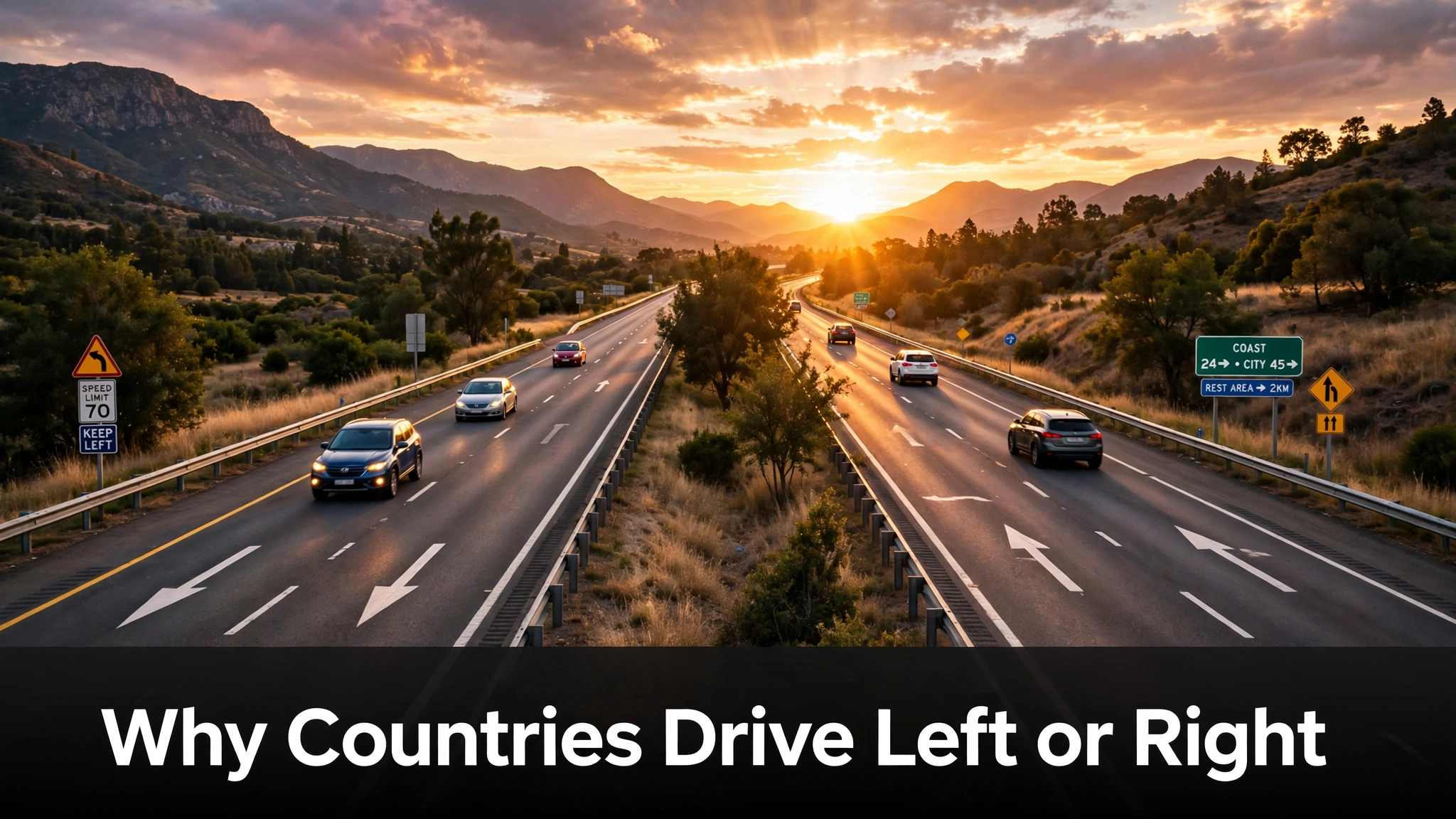
About two-thirds of the world’s countries drive on the right, and about one-third drive on the left. That split looks arbitrary, but it is the result of history, empire, geography, and inertia. Once a country chooses a side, changing it is expensive and disruptive, because it requires changing road signs, markings, intersections, vehicle fleets, and driver habits. Countries therefore tend to keep the side they inherited, even when their neighbours drive on the other side. The result is a world map where traffic side tells a story about colonisation, trade, and political influence.
The left-driving world is dominated by the former British Empire: the United Kingdom, Ireland, India, Pakistan, Australia, New Zealand, South Africa, and many Caribbean, African, and Pacific nations. Japan, Thailand, and Indonesia also drive on the left, for different historical reasons. The right-driving world includes most of Europe, the Americas, China, and the Middle East. Border crossings between left and right countries, such as between Thailand and its neighbours, or between Hong Kong and mainland China, require special arrangements, such as bridges, interchanges, or vehicle adaptations, because the change of side cannot happen in the middle of a road.
For travellers, the side matters most as a pedestrian and as a driver. A visitor from a right-driving country, crossing a street in London or Sydney, must remember to look right first, not left, because traffic approaches from the opposite direction. A driver renting a car in a country with the opposite side must adjust to a different seating position, mirror layout, and roundabout direction. These adjustments are learnable, but they demand attention in the first days, when mistakes are most likely. Understanding why the split exists does not remove the danger, but it helps a traveller respect it.
Why People Originally Kept Left
The oldest explanation for left-hand traffic comes from a time before cars, when people travelled on horseback or on foot. Most people are right-handed, and a rider passing on the left side of the road would have their right hand, holding a sword or weapon, facing an oncoming rider. Keeping left therefore allowed a rider to defend themselves if the stranger proved hostile, and to mount a horse from the left side, away from traffic, because horses were traditionally mounted from the left. Whether every ancient road followed this rule is debated, but the logic explains why left-keeping was common in Britain and in other societies where horse travel and armed encounters were part of daily life.
Roman roads are sometimes cited in this story, with claims that Romans kept left, based on ruts and archaeological evidence at quarries and gates. The evidence is suggestive but not conclusive for the whole empire, and Roman practice alone does not explain the modern map. What matters more is that Britain formalised left-keeping early, through custom and then law. A London bridge rule in the eighteenth century, and later national legislation, made left-hand traffic the legal standard in Britain. Once Britain built an empire, it exported that standard to its colonies, along with its language, legal system, and railway gauges.
Left-keeping also made sense for horse-drawn wagons, where the driver sat on the left rear horse or on the left side of the wagon, so that their right hand could hold the whip and reach oncoming traffic. That arrangement, like the sword explanation, favoured keeping left, because the driver needed a clear view of the road edge and of passing vehicles. These pre-car habits created a strong tradition, which cars inherited. When motor vehicles arrived, they did not create a new side; they adopted the side already established by horses, carts, and pedestrians.
Napoleon, France, and the Spread of Right-Hand Traffic
The spread of right-hand traffic in continental Europe is often linked to France and to Napoleon, though the story is more complex than a single decree. In France, before the Revolution, aristocrats kept left, while peasants kept right, to avoid collisions with carriages. The Revolution, which rejected aristocratic privilege, promoted keeping right as an egalitarian rule. Napoleon then spread French practices, including right-hand traffic, through his conquests in Europe. Countries under French influence, or seeking to align with France, adopted the right side, and that alignment persisted after Napoleon’s fall.
The United States also adopted right-hand traffic, for practical rather than revolutionary reasons. Early American wagons, especially the large Conestoga wagons used for freight, were driven from the left rear horse or from a seat that gave the driver a better view of oncoming traffic when keeping right. Teamsters, who drove teams of horses, sat on the left, so keeping right allowed them to see the road edge and to pass other wagons safely. As the United States expanded westward, right-keeping became the standard, and it was later formalised state by state. Canada, though part of the British Empire, eventually switched to the right to align with its much larger neighbour, showing that trade and geography can outweigh imperial tradition.
Other right-driving countries followed similar logic: alignment with a dominant neighbour, a desire to standardise with trading partners, or a political break with a former colonial power. Sweden’s famous switch in 1967, known as Dagen H, is the clearest example of a deliberate change. Sweden drove on the left, but all its neighbours drove on the right, and its cars were mostly left-hand drive, built for right-hand traffic. After years of debate, Sweden switched overnight, with massive preparation, new signs, and a temporary speed limit. The switch succeeded because it was planned, communicated, and enforced, but it also showed why most countries do not switch: the cost and disruption are enormous.
Why Britain and Its Former Colonies Kept Left
Britain kept left because it had formalised the rule before cars, and because it had no land border with a right-driving neighbour that forced a change. As an island, Britain could maintain its own standard without daily friction at a border. When Britain colonised India, Australia, Africa, and the Caribbean, it built roads, railways, and traffic laws on the left, and those systems persisted after independence. Changing to the right would have required replacing vehicle fleets, rebuilding intersections, and retraining millions of drivers, for a benefit that was unclear when the country’s main trading partners were also left-driving or reached by sea.
India is the largest left-driving country by population, and its left-hand traffic is a direct legacy of British rule, reinforced by the fact that its neighbours, Pakistan, Bangladesh, Sri Lanka, and Nepal, also drive on the left, except for Myanmar, which switched to the right. Australia and New Zealand, as islands with no land borders, had little pressure to change, and their vehicle markets developed around right-hand-drive cars. South Africa, similarly, kept left after British influence, and its neighbours, such as Namibia, Botswana, and Zimbabwe, also drive on the left, creating a regional left-driving bloc in southern Africa.
Japan’s left-hand traffic has a different origin. Japan was never colonised by Britain, but it adopted British railway practices in the nineteenth century, when it modernised rapidly and hired British engineers. Railways in Japan ran on the left, and road traffic followed the railway convention. Thailand, also never colonised, kept left partly because of British influence on its transport and trade, and partly because its neighbours in the region, including Malaysia and Singapore, drove on the left. Indonesia, a former Dutch colony, drives on the left, which is an exception to the Dutch right-hand rule, and is often explained by the influence of British rule during a brief period and by later alignment with regional neighbours.
Why Countries Rarely Switch Sides Now
Switching traffic side is one of the most disruptive changes a country can make. It requires new road signs, new road markings, redesigned intersections and roundabouts, new bus stops and pedestrian crossings, and changes to vehicle imports, because the driver’s seat position is optimised for the traffic side. Drivers must relearn habits that are automatic, such as which mirror to check, how to enter a roundabout, and which side to look when crossing. Pedestrians must relearn where to look. The risk of accidents rises sharply in the first weeks, even with preparation, as Sweden’s switch showed, despite its careful planning and low traffic at the time.
Cost is the second barrier. A national switch costs billions in today’s money, for signs, infrastructure, public education, and vehicle adaptation, while the benefits are mainly long-term and diffuse, such as easier cross-border travel and cheaper vehicle imports from right-driving markets. For a country whose neighbours also drive on the same side, or which is an island, the benefit is small. For a country with a large existing fleet of vehicles built for its current side, the cost is especially high, because vehicles cannot be converted cheaply. That is why most switches in history happened when vehicle numbers were low, or when political change made a break with the past desirable, as in some post-colonial switches.
Modern exceptions prove the rule. Myanmar switched from left to right in 1970, under military rule, for political reasons, and the switch created lasting problems, because many vehicles remained right-hand drive, built for left-hand traffic, creating visibility problems for drivers. Samoa switched from right to left in 2009, to align with Australia and New Zealand, its main sources of vehicles and migrants, and to allow cheaper vehicle imports. That switch succeeded because Samoa is small, its vehicle fleet was limited, and the change was planned with public holidays and education. Large countries have not followed, because the scale makes a switch impractical.
Left, Right, and Vehicle Design
Traffic side determines where the driver sits. In right-hand traffic countries, cars are usually left-hand drive, with the driver on the left, so that the driver can see oncoming traffic when overtaking and can judge the centre of the road. In left-hand traffic countries, cars are usually right-hand drive, with the driver on the right, for the same reason. The driver’s position is therefore a mirror image, and so are many road features: roundabouts circulate clockwise in right-hand traffic and anticlockwise in left-hand traffic, motorway exits are on the right in right-hand countries and on the left in left-hand countries, and overtaking is done on the left in right-hand countries and on the right in left-hand countries.
This design has practical consequences for travellers. A driver from a right-hand country, renting a car in a left-hand country, must adjust to sitting on the right, using the left hand for gears in a manual car, and entering roundabouts in the opposite direction. An automatic car removes the gear problem, but not the spatial one. Pedestrians face a simpler but more dangerous adjustment: looking the wrong way when crossing. Many left-driving cities now paint look-right or look-left warnings on crossings in tourist areas, precisely because visitors’ habits are strong and automatic. Paying attention to those warnings, rather than relying on habit, is essential.
Vehicle imports also reflect traffic side. Left-driving countries import mainly right-hand-drive vehicles, often from Japan, the United Kingdom, and Australia, while right-driving countries import left-hand-drive vehicles from a wider market. That market split affects price and availability: a left-driving country that switches to the right would suddenly find its existing fleet mismatched to its roads, and its import market changed. Traffic side is therefore not only a road rule; it is an economic system, linking roads, vehicles, manufacturing, and trade. That system reinforces itself, which is why the map changes so slowly.
Border Crossings Between Left and Right
Borders between left and right countries are engineering challenges. The simplest solution is a bridge or interchange that gradually moves traffic from one side to the other, without a head-on meeting. The Hong Kong-Zhuhai-Macau Bridge, for example, includes a special interchange where traffic switches sides, because Hong Kong and Macau drive on the left while mainland China drives on the right. Similarly, the border between Thailand, which drives on the left, and Laos, Cambodia, and Myanmar, which drive on the right, involves bridges and crossings designed to manage the change safely.
Other borders handle the change differently. At some crossings, traffic simply changes side at the border post, with signs, barriers, and a controlled area to guide drivers. At others, vehicles from one side are not allowed to drive far into the other country, or drivers must adapt to local rules immediately. For travellers, the key is to follow signs, slow down, and not assume the road ahead follows the same side as the road behind. Border areas often have extra signage, road markings, and sometimes police guidance, because authorities know the change is confusing.
These crossings also show that traffic side is a political choice, not a natural law. Two countries can meet, agree a safe way to switch, and live with the difference, rather than forcing one to change. That coexistence is the modern norm: the world does not need a single side, as long as each border is managed safely. The persistence of both sides is therefore not a failure of standardisation, but a sign that standardisation has costs, and that diversity, managed carefully, is acceptable.
My Take:
My first view is that traffic side is a perfect example of how history lives in everyday life. When you cross a street in London, you are following a rule shaped by horse riders, swords, and empire, not by a modern safety study. When you drive in Paris, you are following a rule shaped by revolution and by Napoleon. Those histories are invisible until you travel, and then they become suddenly visible, in the direction you look, the seat you sit in, and the roundabout you enter. I find that fascinating, because it shows that even the most mundane rules carry a past.
My second view is that inertia is not always a bad thing. People often assume that standardising everything would be better, and that the world should pick one side and stick to it. But the cost of switching, in money, in accidents, and in disruption, is real, and the benefit for many countries is small. A country that drives on the left, with neighbours who also drive on the left, gains little by switching to match a distant majority. Inertia, in this case, is not laziness; it is a rational response to cost and risk. Standardisation is valuable, but it is not free, and it is not always worth the price.
My third view concerns travellers, who are the people most affected by the split. A traveller does not need to know the history of Napoleon to cross a street safely, but they do need to know to look the other way. I think travel advice should focus on that practical habit, not on historical trivia. Look right in left-driving countries, look left in right-driving countries, and do it consciously for the first few days, until the new habit forms. That single habit prevents more accidents than any knowledge of empire or revolution. History explains the rule; habit protects the traveller.
My fourth view is about Sweden’s switch, which I regard as a lesson in how change should be done, when it is done at all. Sweden prepared for years, changed signs overnight, lowered speed limits, and communicated relentlessly. It succeeded, but it also showed that success requires enormous effort and a small, well-organised country. Large countries, with millions of vehicles and vast road networks, cannot copy that overnight model easily. The lesson is not that switching is impossible, but that it is a national project, not a simple decree. Any politician who proposes a switch without that level of planning should not be believed.
My fifth view is that vehicle design reveals how deeply traffic side shapes daily life. The driver’s seat, the mirrors, the roundabout, the motorway exit, and the import market all follow from one choice. That interconnectedness explains why the choice persists: changing the road rule means changing the vehicle fleet, the infrastructure, and the trade patterns. It is a system, not a single sign. Understanding that system helps explain why seemingly simple reforms are hard, in traffic and in other areas of life. A rule that touches many parts of a system cannot be changed by changing one part alone.
My sixth view is optimistic about coexistence. The world does not need to drive on the same side to travel safely, as long as borders are designed well and travellers are alert. Bridges that switch sides, signs that warn pedestrians, and cars that adapt to local rules all show that diversity can be managed. That is a useful lesson beyond traffic: difference does not always need to be eliminated; it can be bridged, signposted, and respected. The left-right split, which looks like a problem, is actually a working example of how different systems can meet safely.
My final view is simple and practical. Wherever you travel, learn the side before you arrive, practise looking the correct way, and if you drive, choose an automatic car and a quiet first route. Give yourself time to adjust, and do not drive tired or after a long flight in an unfamiliar system. Those small precautions matter more than any theory about why the side exists. History explains the map, but attention explains survival. Look the right way, drive slowly at first, and the split becomes an interesting quirk rather than a danger.
My seventh view is about learning from Sweden and Samoa together. Sweden shows that a large, well-organised country can switch with years of preparation, while Samoa shows that a small country can switch to align with its closest partners. Both switches succeeded because they were planned, communicated, and timed to minimise disruption. Both also show that a switch is a choice about future alignment, not about correcting a past mistake. Neither side is wrong; each country chose the side that fit its history, neighbours, and vehicle market at the time.
My eighth view concerns autonomous vehicles and future roads. Self-driving cars will need to handle both left and right systems, border changes, and roundabouts in both directions, which means traffic side will remain a design problem for engineers, even if human drivers become rarer. Standardisation may become easier with software, because a car can be reprogrammed to drive on either side, while a human driver cannot be reprogrammed overnight. That technological shift could, in the long term, reduce the cost of diversity, though it will not erase the infrastructure differences in signs, exits, and intersections.
Finally, I think the left-right split is a useful reminder that not every difference needs solving. The world contains many systems that differ by history and geography, from plug sockets to paper sizes, and we manage them with adapters, signs, and awareness, rather than by forcing uniformity. Traffic side is one of the most visible of those differences, and we manage it every day, at borders, in rental cars, and on crossings. That management, imperfect as it is, works. It works because people pay attention, follow signs, and respect a rule that is not their own. That respect is a small, daily act of international cooperation.
One final practical note for drivers: if you hire a car abroad, spend the first ten minutes in a quiet car park or side street, practising turns, roundabouts, and mirror checks on the unfamiliar side, before joining busy traffic. That short practice, boring as it seems, builds muscle memory for the new layout and reduces the chance of turning into the wrong lane at the first junction, which is where many visitor accidents happen. A calm first ten minutes can protect the whole holiday.
Frequently Asked Questions
Why do some countries drive on the left and others on the right?
Traffic side reflects history, especially British colonial influence for left-driving countries and French, American, and continental European influence for right-driving countries. Once established, the side persists because switching is costly and disruptive.
Which countries drive on the left?
Left-driving countries include the United Kingdom, Ireland, India, Pakistan, Australia, New Zealand, Japan, Thailand, South Africa, and many former British territories. About one-third of countries drive on the left.
Why does Britain drive on the left?
Britain formalised left-keeping early, linked to horse travel, where most riders kept left so their right hand faced oncoming riders, and later made it law. As an island, Britain faced little pressure to change, and it exported the rule through its empire.
Why did Sweden switch from left to right?
Sweden switched in 1967 because all its neighbours drove on the right and most Swedish cars were left-hand drive, built for right-hand traffic. The switch was planned for years and carried out overnight, with new signs and temporary speed limits.
Is it dangerous to drive in a country with the opposite side?
It can be risky in the first days, because habits such as mirror checks, roundabout entry, and looking when crossing are automatic. Choosing an automatic car, starting on quiet roads, and consciously practising the new side reduces risk.
How do borders between left and right countries work?
Borders use special bridges, interchanges, or controlled crossing areas that guide traffic from one side to the other safely. Drivers should follow signs, slow down, and expect the side to change at or near the border post.