Why Do Whales Sing? The Science Explained
In this post
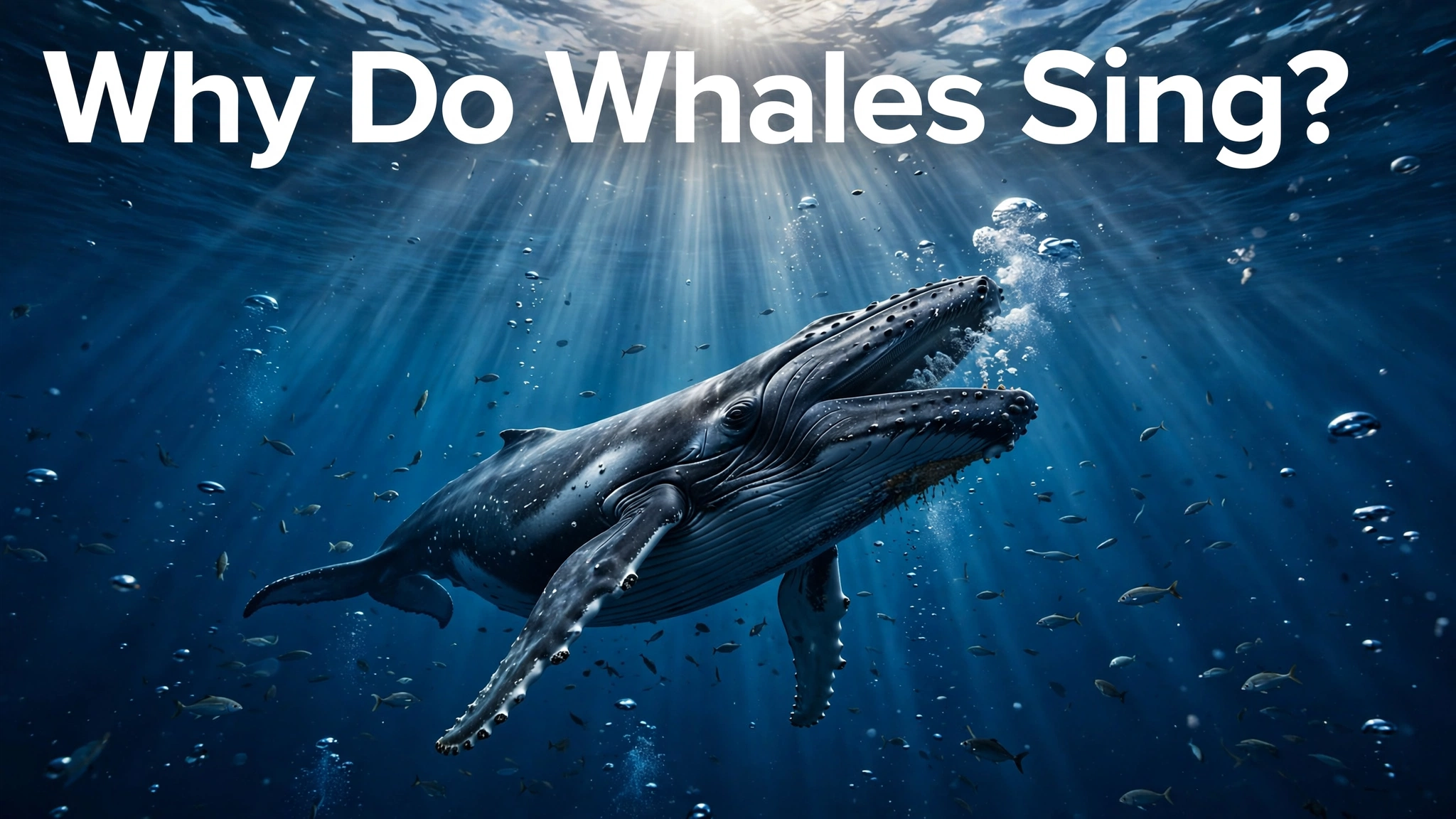
Whale songs are among the most beautiful and mysterious sounds in nature: long, complex melodies that can last for hours and travel for miles underwater. Humpback whales are the most famous singers, but other whales, including blue whales and belugas, also produce sounds. Scientists have studied whale songs for decades, and they have learned a great deal, but many questions remain. Why do whales sing? What do their songs mean? And how do they learn them? This article explains the science in simple terms, and it looks at what whale songs tell us about communication, culture, and the ocean.
Whale songs are not random noise. They have structure, with themes, phrases, and units that repeat and change over time, much like human music. Male humpbacks sing during the breeding season, and their songs change from year to year, with new songs spreading through a population like a fashion trend. That cultural transmission, where whales learn songs from each other, is one of the most fascinating aspects of whale behaviour, and it suggests that whales have a form of culture. This guide covers how whales sing, why they sing, and what their songs mean.
How Whales Make Sound Underwater
Whales make sound in a very different way from humans, because they do not have vocal cords in the same way. Humpback whales produce sound by pushing air through structures in their respiratory system, creating vibrations that travel through water far more efficiently than through air. Sound travels about four times faster in water than in air, and low-frequency sounds can travel for hundreds of kilometres. Whales can also hear very well, with sensitive hearing that allows them to detect sounds from far away. The combination of powerful sound production and sensitive hearing makes the ocean a rich acoustic environment, where sound is the primary way to communicate over long distances.
The more we understand, the better we can protect the places and species we love. Climate change is not an abstract future problem; it is already changing where species live, when they breed, and how often extreme events happen. A bird that arrives too early for the insects it feeds on, a flower that blooms before its pollinator appears, a coral reef that bleaches in warm water: all of these are signs of a system out of sync. Understanding those changes requires long records, careful observation, and honest reporting, since a single warm year proves little, but a trend over decades proves a great deal.
Children who grow up with nature, who play outside, who watch birds, and who get muddy, are more likely to care about it as adults. That connection is not automatic; it needs to be nurtured, by parents, by teachers, and by communities that make space for nature in everyday life. A garden, a park, a school trip to a river: all of these are modest steps, but they matter, because they create memories and habits that last. If we want the next generation to protect nature, we need to give them a chance to love it first, and love begins with experience, not with a textbook.
Humpback Songs: Structure and Complexity
Humpback whale songs are among the most complex sounds in the animal kingdom. A song can last for twenty minutes or more, and it is made up of units, phrases, and themes that repeat in a structured pattern. All the males in a population sing the same song at any given time, but the song changes gradually over a season, and new songs can replace old ones. The songs are learned, not innate: young whales learn from older males, and songs spread from one population to another. That learning and change is why scientists compare whale songs to human music and language, because they show creativity, memory, and cultural transmission.
That speed is the problem: nature can adapt, but it needs time, and we are not giving it enough. Slowing down, protecting what remains, and restoring what has been damaged are all ways to give nature the time it needs. It is not about returning to the past; it is about giving the future a chance. Another angle is how human activity has changed nature in a extremely short time. In a few generations, we have changed the climate, cleared forests, and altered rivers, in ways that took nature millions of years to build.
Each species, no matter how small or how ordinary, has a role in its ecosystem, and removing one can have effects that ripple far beyond what anyone expected. A bee that pollinates a flower, a wolf that controls deer, a tree that shelters birds: each one is part of a web, and the web is stronger when it is diverse. That is why protecting biodiversity matters, not only for the species themselves, but for the services they provide, such as pollination, clean water, and healthy soil. Losing a species is not just losing a name on a list; it is losing a piece of a system that supports us all.
Why Do Male Humpbacks Sing?
The most widely accepted explanation is that male humpbacks sing to attract mates and to compete with other males. Singing during the breeding season, when females are present, suggests a role in courtship, similar to birdsong. The complexity of the song may signal the singer’s fitness, health, and experience, helping females choose a mate. Singing may also serve to space males apart, reducing conflict, or to coordinate behaviour in a group. The exact function is still debated, and it is likely that songs serve more than one purpose, including social bonding and communication over long distances. What is clear is that singing is a central part of humpback life during the breeding season.
It is a system we belong to, and our health depends on it. Clean air, clean water, fertile soil, and a stable climate are all provided by nature, and they are not free in the sense that they can be used without limit. When we damage nature, we damage ourselves, although the damage may not be visible immediately. Recognising that connection, and acting on it, is the most important lesson nature can teach us, and it is a lesson we are still learning. There is a temptation to treat nature as a resource to be used, or as a backdrop for photographs, but it is more than that.
That invisibility makes them easy to ignore, but it does not make them unimportant. In fact, the smallest organisms frequently have the largest effect, because they are the foundation on which larger life depends. Paying attention to the invisible, through science and through curiosity, is a reminder that the world is far more complex than it looks. One more thing worth noting is how much of nature is invisible to the naked eye. Microbes in the soil, plankton in the ocean, and fungi underground all do work that is essential to life, yet we rarely see them.
How Songs Spread Like Culture
One of the most remarkable discoveries about whale songs is that they spread like cultural trends. A new song can appear in one population and, over a few years, spread to neighbouring populations, replacing the old song. That spread happens because whales listen to each other and learn new songs, much as humans learn new music. Songs also change over time, with new themes added and old ones dropped, in a process that resembles musical evolution. This cultural transmission is rare in animals, and it suggests that whales have a form of culture, where knowledge is passed from one individual to another, not only through genes but through learning.
Science is often presented as a collection of facts, but in reality it is a process of asking questions, testing ideas, and changing your mind when the evidence changes. That process is slow, and it is sometimes frustrating, because a question that seemed settled can reopen when fresh evidence arrives. That is not a weakness of science; it is its strength. A guide that admits uncertainty, that says what is known and what is still unknown, is more trustworthy than one that pretends to have all the answers. Readers should be wary of any account that sounds too certain about a complex natural system, because nature is rarely simple.
Satellite tracking shows where animals migrate, underwater microphones record whale songs, and cameras in nests show behaviour that humans rarely see. That technology is exciting, but it does not replace the need to go outside, to look, and to listen. A satellite can tell you where a bird is, but it cannot tell you what it feels like to hear it sing at dawn. Both kinds of knowledge matter, and the best naturalists combine them: they use technology to learn, and they use their senses to understand. Technology has changed how we study nature, and it has opened windows that were previously closed.
Other Whales That Sing and Call
Humpbacks are the most famous singers, but other whales also communicate with sound. Blue whales, the largest animals on Earth, produce very low-frequency calls that can travel for hundreds of kilometres, and they are thought to be used for long-distance communication. Beluga whales, known as the canaries of the sea, produce a wide variety of clicks, whistles, and calls, and they are highly social. Sperm whales use clicks for echolocation, to find prey in the deep ocean, and they also have codas, patterns of clicks that may identify individuals and groups. Each species has its own acoustic world, adapted to its environment and its social life.
A tree grows slowly, a river carves a valley over millions of years, and a species evolves over even longer timescales. That patience is a contrast to our fast, impatient culture, and it is a useful corrective. Not everything needs to happen quickly, and some of the most important things happen gradually. Learning to wait, to watch, and to let nature take its course is a skill, and it is one that makes us better observers, better stewards, and better people. Patience is not passivity; it is attention over time, and it is the heart of natural history. Finally, the natural world teaches patience.
The most interesting thing about the natural world is how much of it happens without us noticing, and how much we miss when we rush past it. A bee visiting a flower, a bird singing before dawn, a tree sharing nutrients underground: all of these are happening every day, in ordinary places, and they are easy to overlook. Slowing down, paying attention, and learning to notice modest details is the starting point for understanding nature, and it costs nothing. A walk with attention is more educational than a long journey without it, since attention turns a familiar place into a fresh one. That habit of noticing is the foundation of all natural history.
Threats to Whale Songs: Ocean Noise
Whale songs are threatened by ocean noise from ships, sonar, and industrial activity, which can mask whale calls and make communication harder. When the ocean is noisy, whales may have to sing louder, change their pitch, or stop singing, which can affect breeding and social behaviour. Noise pollution is a growing problem, especially in busy shipping lanes, and it is one of the reasons whale populations are under stress. Reducing ship speed, creating quiet zones, and developing quieter technology can help. Protecting the acoustic environment is as important as protecting the physical habitat, because for whales, sound is the main way to communicate, navigate, and find food.
That work is slow and often unglamorous, but it is the work that matters most. A single beautiful park is not enough if the land around it is destroyed, because nature does not respect boundaries drawn on a map. Protected areas, such as national parks and nature reserves, are essential, but they are not enough on their own. Animals move, rivers flow, and birds migrate, so a park that protects one place may not protect the whole journey. Connecting protected areas with corridors, protecting habitats outside parks, and reducing pollution and habitat loss everywhere are all part of conservation.
A wild place is a privilege to visit, not a right to consume, and treating it as a privilege keeps it wild. When we visit wild places, we leave a mark, whether we intend to or not. Footprints, litter, noise, and disturbance all affect wildlife and habitats, and the effect grows as more people visit. Responsible visiting means staying on paths, keeping a distance from animals, leaving no trace, and supporting local people who protect the place. It is not about spoiling the fun; it is about making sure the fun is available for the next visitor, and for the wildlife that lives there.
What Whale Songs Teach Us About Communication
Whale songs teach us that communication is not only about words, and that culture is not only human. The fact that whales learn songs, change them, and pass them on suggests a level of social complexity that we are only beginning to understand. Studying whale songs also reminds us how much we still do not know about the ocean, and how much we have to lose if we damage it. The songs are beautiful, but they are also a warning: the ocean is a noisy, changing place, and the whales that depend on sound are vulnerable. Listening to them, and protecting their right to be heard, is a responsibility that comes with our ability to hear them.
Nature is everywhere, if you look for it, and looking for it is the first step to caring for it. Finally, it is worth saying that nature is not only out there, in parks and wilderness; it is also here, in cities, in gardens, and in the sky above a street. A pigeon on a roof, a tree on a pavement, a weed in a crack: all of these are nature, adapting to human life. Noticing that urban nature, and valuing it, is a way to stay connected to the natural world even when you cannot travel to a famous place.
Community science, where ordinary people record what they see, is also valuable, because it creates data over a large area and a long time that no single researcher could collect. Nature belongs to everyone, and everyone can contribute to understanding it. Local knowledge is often undervalued in science, but it is essential. A fisherman who knows where a species feeds, a farmer who knows when a bird arrives, a guide who knows which valley holds fog: all of these individuals know things that no textbook contains. Listening to that knowledge, and combining it with scientific research, gives a fuller picture than either one alone.
My Take:
Whale songs are a reminder that the ocean is not silent, and I think that is a powerful idea. We think of the sea as a quiet, empty place, but for whales it is full of sound, of songs that travel for miles and change like music. That acoustic world is as rich as any forest or city, and it is largely invisible to us, because we do not live in it. I find that humbling, because it suggests that there are whole worlds of communication around us that we barely notice, and that we should listen more carefully before we fill them with noise. Another opinion I hold is that science writing should be honest about uncertainty. When researchers disagree, or when evidence is thin, saying so is respect for the reader, not weakness. Too much popular writing presents a single neat explanation as if the case were closed, and readers feel betrayed when the story changes. I would rather read an account that says what is known, what is guessed, and what is still unknown, because that account can be trusted when new evidence arrives. Nature is complicated, and a guide that admits that is more useful than one that pretends otherwise.
I also believe whale songs matter because they show that culture is not only human. Whales learn songs, pass them on, and change them, and that is a form of culture that deserves respect. If we damage the ocean with noise and pollution, we are not just harming animals; we are silencing a culture. That is a loss that cannot be measured in numbers, and it is why protecting the acoustic environment matters as much as protecting the physical one. The songs are beautiful, but they are also a responsibility. I also want to say something about responsibility. Visiting wild places and sharing photographs all have an effect, and the effect grows as more people do it. Keeping a distance, staying on paths, and leaving no trace are not rules for other people; they are the price of being allowed to visit at all. The best travellers are the quiet ones, who leave a place as they found it and who support the local people who protect it. Enjoyment and care are not opposites; care is what makes enjoyment possible for the next person.
Whale songs are a reminder that the ocean is not silent, and I think that is a powerful idea. We think of the sea as a quiet, empty place, but for whales it is full of sound, of songs that travel for miles and change like music. That acoustic world is as rich as any forest or city, and it is largely invisible to us, because we do not live in it. I find that humbling, because it suggests that there are whole worlds of communication around us that we barely notice, and that we should listen more carefully before we fill them with noise. Finally, my take is that the real gift of learning about nature is a changed way of looking. Once you know why a whale sings, how a bee dances, or how trees share resources, you cannot unsee it. The world becomes more alive, more connected, and more worth protecting. That change in seeing lasts longer than any single trip, and I hope readers carry it with them on their next walk, their next night under the sky, and their next conversation about a place they love. That is where knowledge turns into care.
I also believe whale songs matter because they show that culture is not only human. Whales learn songs, pass them on, and change them, and that is a form of culture that deserves respect. If we damage the ocean with noise and pollution, we are not just harming animals; we are silencing a culture. That is a loss that cannot be measured in numbers, and it is why protecting the acoustic environment matters as much as protecting the physical one. The songs are beautiful, but they are also a responsibility. I also believe that protecting nature is not only about saving rare species; it is about saving the ordinary places where we live. A local park, a river, a hedgerow: all of these matter, and they are often the places most at risk, because they are not famous enough to be protected. Caring for the ordinary is as important as caring for the spectacular, because the ordinary is where most life happens, and where most people meet nature. Start where you are, protect what is near, and the rest will follow.
Whale songs are a reminder that the ocean is not silent, and I think that is a powerful idea. We think of the sea as a quiet, empty place, but for whales it is full of sound, of songs that travel for miles and change like music. That acoustic world is as rich as any forest or city, and it is largely invisible to us, because we do not live in it. I find that humbling, because it suggests that there are whole worlds of communication around us that we barely notice, and that we should listen more carefully before we fill them with noise. My view is that nature is most interesting when we stop treating it as a backdrop and start treating it as a system we belong to. A river, a cave, or a light in the sky is not just a beautiful sight; it is evidence of forces that have worked for far longer than we have been watching. That perspective is humbling, because it reminds me how small a human life is, and hopeful, because it shows how much there is still to learn. Admiration without care is not enough; the places we love need protection, not just attention.
I also believe whale songs matter because they show that culture is not only human. Whales learn songs, pass them on, and change them, and that is a form of culture that deserves respect. If we damage the ocean with noise and pollution, we are not just harming animals; we are silencing a culture. That is a loss that cannot be measured in numbers, and it is why protecting the acoustic environment matters as much as protecting the physical one. The songs are beautiful, but they are also a responsibility. I also believe curiosity is a skill that can be practised anywhere. You do not need an expensive trip to notice something worth understanding. A bird singing before dawn, a bee moving between flowers, a tree whose roots connect to its neighbours: all of these are within reach of an ordinary walk, if you slow down. We lose a great deal by rushing past the ordinary in search of the spectacular, because the ordinary is where understanding begins. The spectacular makes a good photograph, but the ordinary, understood properly, changes how you see everything.
Frequently Asked Questions
Why do whales sing?
Male humpbacks mainly sing to attract mates and compete with other males, although songs may also help with social bonding and long-distance communication.
How do whales make sound?
Whales produce sound by pushing air through structures in their respiratory system, creating vibrations that travel efficiently through water.
Do all whales sing?
Humpbacks are the most famous singers, but blue whales, belugas, and sperm whales also produce calls, clicks, and songs for communication and echolocation.
How long is a humpback whale song?
A humpback song can last twenty minutes or more, with repeated themes and phrases, and it changes gradually over a season.
Do whales learn their songs?
Yes, whale songs are learned from other whales, and new songs can spread through a population like a cultural trend.
Does ocean noise affect whale songs?
Yes, noise from ships and sonar can mask whale calls, forcing whales to sing louder, change pitch, or stop singing, which affects breeding and communication.