Why Is Space Black? Explained Simply
In this post
- Why Earth’s Sky Is Blue but Space Is Black
- The Torch Test: Light Needs Something to Bounce Off
- Olbers Paradox and Why Stars Do Not Fill the Sky
- What Expansion Does to Distant Starlight
- What Astronauts Actually See in Space
- Is Space Completely Empty and Completely Black
- Simple Answers to Common Confusions
- My Take:
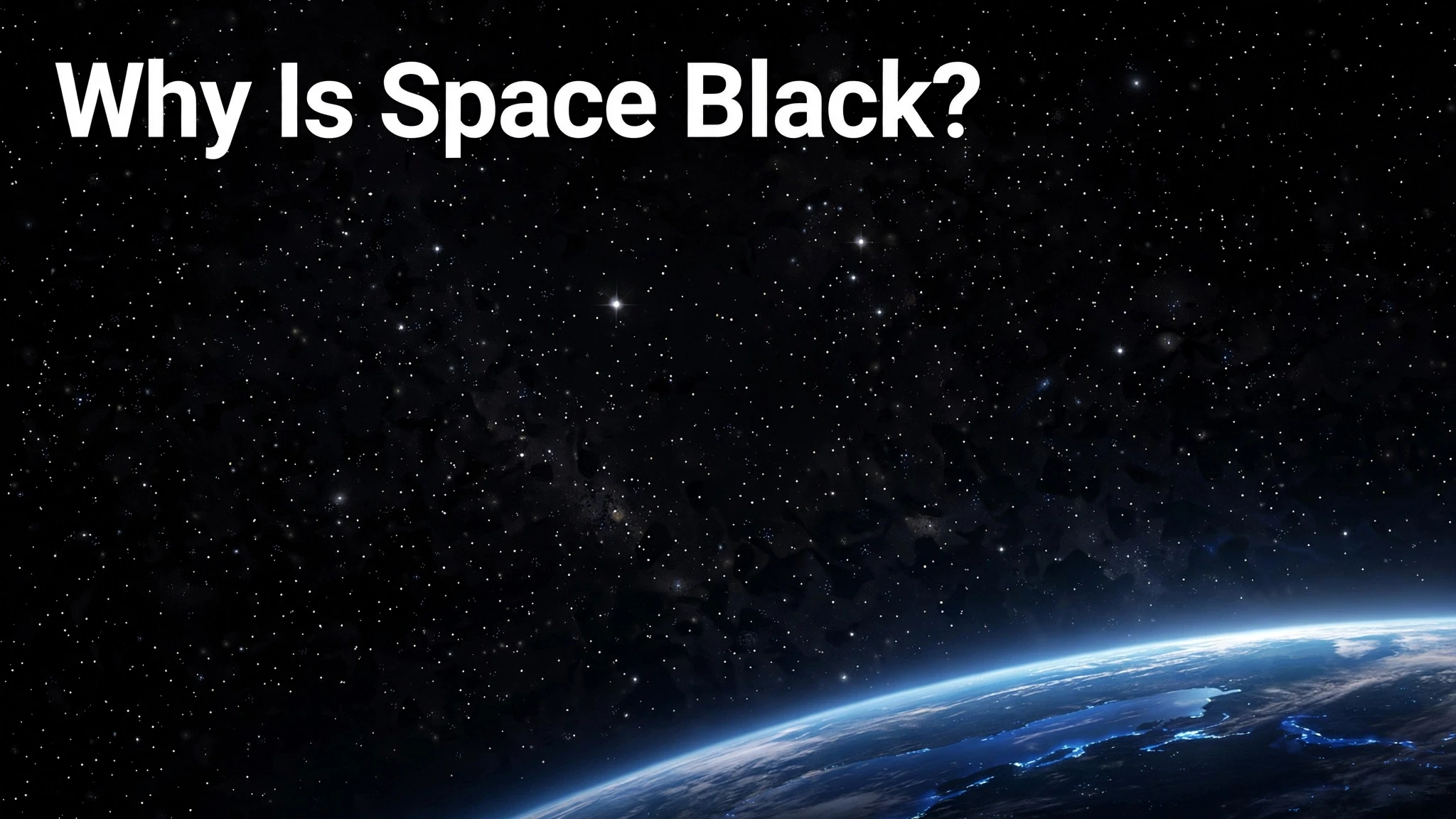
Look up on a clear night and the sky is dark, even though the universe is full of stars. Step outside in daylight and the sky is blue, because sunlight is scattered by air. Go higher, above the atmosphere, and the same Sun shines against a black sky. This contrast confuses many people, because it feels as if light itself should make space bright. It does not, and the reason is surprisingly simple: space looks black mainly because there is almost nothing in it to scatter light toward your eyes, and because most of the universe is too far, too dim, or too shifted in colour for us to see.
A useful comparison is a torch in a dark room. If the room is full of dust or smoke, the beam becomes visible because tiny particles bounce light sideways into your eyes. If the air is perfectly clean and empty, the beam is almost invisible from the side, even though it is bright where it lands. Space is far emptier than any clean room on Earth. Between stars there are only a few atoms per cubic metre in many regions, so sunlight can travel for enormous distances without hitting anything and being scattered back to an observer. An astronaut sees the Sun as a brilliant disc, sees planets and spacecraft lit by it, and still sees blackness everywhere else, because no scattered glow fills the gaps.
There is also a famous puzzle behind this question, often called Olbers paradox. If the universe were infinite, unchanging, and filled with stars in every direction, then every line of sight should eventually end on a star, and the whole night sky should blaze like the surface of the Sun. It does not. The puzzle is resolved by several facts working together: the universe has a finite age, so light from the most distant stars has not had time to reach us; the universe is expanding, which stretches distant light toward red and then beyond visible light; and stars are not packed tightly enough, with vast dark gaps between them. Together, these facts leave most of the sky dark.
This guide explains the science in plain language, without pretending that one answer covers everything. It covers why Earth’s sky is blue, why space is different, what expansion does to starlight, why stars do not fill the sky, and what astronauts really see. It also clears up common myths, such as the idea that space is black because there is no Sun there, or that black means empty in every sense. Space is not a perfect void, and darkness is not the same as nothingness.
Why Earth’s Sky Is Blue but Space Is Black
Earth’s daytime sky is blue because of scattering. Sunlight enters the atmosphere and collides with nitrogen and oxygen molecules. Short blue wavelengths scatter much more strongly than longer red wavelengths, in a process called Rayleigh scattering, so blue light is thrown in all directions and reaches your eyes from every part of the sky. That is why the sky looks like a glowing blue dome rather than a black background with a bright Sun. At sunrise and sunset the light travels through more air, blue light is scattered away, and the remaining reds and oranges dominate, which is why those skies look warm and golden.
Above the atmosphere, that scattering layer is gone. An astronaut on the Moon, which has almost no atmosphere, sees a black sky even in full daylight, with the Sun shining brilliantly. The same applies in low Earth orbit: the sky does not turn blue, because there are too few particles to scatter sunlight into a background glow. This is the single most important difference between looking up from Earth and looking out from space. Colour in the sky is not a property of sunlight alone; it depends on what sunlight hits on its way to your eyes.
Clouds, dust, and pollution add extra scattering on Earth, which is why a hazy day can look white or grey rather than deep blue. On a very clear high mountain, the sky looks darker blue, because there is less air above you and less scattering. This trend continues as you climb: less air means a darker sky. Space is the extreme end of that trend, where the air is effectively absent and the background returns to black. The lesson is that blackness in space is not mysterious darkness swallowing light; it is the normal appearance of a place with almost nothing to bounce light around.
The Torch Test: Light Needs Something to Bounce Off
Imagine standing in a large dark hall with a powerful torch. Point it at a white wall and the wall lights up. Point it into open air with no wall, dust, or fog, and you see the torch itself and perhaps a faint beam near the lens, but not a glowing room. Light travels in straight lines until it hits something. Your eyes only register light that enters them, either directly from a source or after being reflected or scattered by an object. In space, most light simply passes by without ever entering a camera or an eye, so the regions it passes through look black.
This explains why photographs from space often look so stark. A planet, a moon, or a spacecraft is bright because sunlight reflects off its surface toward the camera. The background remains black because no dust cloud or atmosphere is there to reflect light in between. Even the Milky Way, our own galaxy, appears in long-exposure photographs as a band of stars and faint clouds, not as a glowing sky, because the light from its stars is concentrated in points rather than spread evenly. Short phone-style exposures would show even less, which is why astronaut snapshots can look emptier than professional astronomy images.
A related point is that darkness does not mean the absence of energy. Space is filled with radiation we cannot see, including infrared, radio waves, and the faint cosmic microwave background left over from the early universe. Our eyes are sensitive only to a narrow band of visible light, so we miss most of what is passing through space. Instruments can detect that invisible glow, and when astronomers translate it into visible colours, space suddenly looks rich and textured. The black sky is therefore partly a limit of human vision, not a complete description of the universe.
Olbers Paradox and Why Stars Do Not Fill the Sky
Heinrich Olbers, a German astronomer, helped popularise a puzzle that had troubled thinkers for centuries: in an infinite universe full of stars, why is the night dark? The logic is strong. Imagine standing in a forest: if the forest goes on forever in every direction, every direction you look should eventually hit a tree trunk, so you would see trees everywhere and no gaps. Replace trees with stars and the same reasoning suggests a sky covered with starlight, as bright as a star’s surface. The fact that the night is dark therefore tells us that at least one assumption in the puzzle must be wrong.
The first correction is age. The observable universe is about 13.8 billion years old, according to the standard cosmological model, so light has only had a finite time to travel. Stars beyond a certain distance have not had enough time for their light to reach us yet, and the most distant light we can see comes from the early universe, not from an endless supply of stars. The second correction is expansion. Space itself is expanding, which stretches the light from distant galaxies toward longer wavelengths. Visible light can be shifted into infrared, where our eyes cannot see it, so distant galaxies fade from view even though they still exist.
The third correction is that stars are not spread evenly like paint. They cluster into galaxies, and galaxies cluster into groups, leaving enormous voids between them. Even within our galaxy, stars are separated by distances that dwarf their sizes. The Sun, for example, is about 1.4 million kilometres across, while the nearest star is more than four light-years away, a gap so large that starlight covers only a tiny fraction of the sky. Put together, finite age, expansion, and clumpy distribution explain why the sky is mostly dark, with stars as isolated points rather than a continuous blaze.
What Expansion Does to Distant Starlight
Expansion is often misunderstood as galaxies flying apart through space like fragments of an explosion. A better picture is that space itself is stretching, carrying galaxies with it, much as dots on an inflating balloon move apart without moving across the balloon’s surface. As light travels through expanding space, its wavelength stretches, an effect called cosmological redshift. Blue and green light from a distant galaxy can arrive as red or infrared light, and the most distant galaxies can be shifted entirely out of the visible range.
This has a direct effect on darkness. Even if the universe contained stars in every direction, their light would not all arrive as visible light. Much of it would arrive as infrared or radio waves, invisible to the naked eye. Telescopes such as the James Webb Space Telescope are designed to detect infrared light precisely for this reason, and they reveal galaxies that are invisible in ordinary photographs. When astronomers colour those infrared images for display, the sky fills with galaxies that our eyes alone would miss, which confirms that darkness is partly a matter of wavelength, not absence.
Expansion also dims distant objects in another way: as space stretches, the energy of each photon falls and photons arrive less frequently, so distant galaxies look fainter than they would in a static universe. This dimming grows stronger with distance, so the farthest galaxies contribute almost nothing to visible brightness. The night sky is therefore dark not because the universe is empty, but because the universe’s history and expansion hide most of its light from human eyes.
What Astronauts Actually See in Space
Astronaut accounts consistently describe space as black, but with important details. The Sun is dazzling and white, stars are sharp points without twinkling, because there is no turbulent air to blur them, and Earth is brilliantly blue and white. The blackness is often described as deeper and more absolute than any night on Earth, because there is no airglow, no scattered city light, and no faint blue haze. At the same time, astronauts can see the Milky Way as a dense band of stars, and they can see faint clouds of gas and dust when they look carefully, especially away from bright sunlight.
Inside a spacecraft, the view changes with the eyes’ adaptation. If an astronaut has been looking at a brightly lit cabin or at sunlit Earth, faint stars may be hard to see until their eyes adjust to darkness. This is similar to stepping from a bright room into a dark garden: at first you see little, then stars emerge as your pupils widen and your retina adapts. Photographs add another layer, because cameras expose for bright subjects such as a spacecraft or Earth, and faint stars may be underexposed and disappear from the image. A missing star in a photograph is therefore not evidence that space is empty in that direction.
Astronauts also see phenomena that do not exist in Earth skies in the same way, such as the thin glowing line of Earth’s atmosphere at the planet’s edge, called airglow, and sudden flashes that can be caused by cosmic rays hitting the retina. These details remind us that space is an active environment, full of particles and radiation, even where it looks black. Blackness is the background against which bright objects stand out, not a sign that nothing is happening.
Is Space Completely Empty and Completely Black
Space is not completely empty. Even the emptiest regions between galaxies contain a few hydrogen atoms per cubic metre, plus dark matter whose presence is inferred from gravity, plus the cosmic microwave background, a faint glow left over from when the universe first became transparent. That background is almost uniform and extremely cold, about 2.7 kelvin, and it shines mainly in microwaves, so it is invisible to the eye but detectable with instruments. If human eyes could see microwaves, the whole sky would glow faintly in every direction, day and night.
Closer to home, interplanetary space contains dust left over from comets and asteroids, which scatters sunlight into a faint glow called zodiacal light. This is sometimes visible from dark places on Earth as a soft cone of light after sunset or before sunrise, and spacecraft can detect it more clearly. Interstellar space contains larger clouds of gas and dust, some of which glow when lit by nearby stars and some of which block starlight and appear as dark patches. The famous dark nebulae are examples: they look black because they hide the stars behind them, not because they are holes in the universe.
So the honest answer is that space is black to human eyes in most directions, but not black to all instruments and not empty in any absolute sense. The darkness we see is a combination of very low density, finite cosmic age, expansion shifting light out of view, and the narrow range of wavelengths our eyes detect. Change any one of those factors, and the sky would look different, which is exactly what happens when astronomers observe in infrared, radio, or X-ray light.
Simple Answers to Common Confusions
One common confusion is the idea that space is black because the Sun is far away or because there is no light in space. The Sun’s light fills the solar system; it reaches Pluto and beyond, and it lights planets, moons, and asteroids. Darkness in space is not a lack of light travelling through it, but a lack of material to scatter that light toward an observer. A room can be full of torch beams and still look dark from the side if nothing reflects them to you.
Another confusion is about the Moon’s daytime sky. Photographs from the Apollo missions show a black sky above sunlit lunar ground, and some people have treated this as suspicious. In fact it is exactly what physics predicts for a world with almost no atmosphere. The lunar surface is bright because sunlight reflects off rock and dust, while the sky above remains black because there is no air to scatter sunlight. The same effect would occur on any airless world, and it is one of the clearest demonstrations that sky colour comes from atmosphere, not from sunlight alone.
A third confusion concerns blue sky and space photographs taken from Earth. Telescopes on Earth look through the atmosphere, so their images must correct for scattering and turbulence. Space telescopes avoid that problem, which is why their images are sharper and their backgrounds are darker. When you see a deep space image with a black background and colourful galaxies, remember that the colours are often chosen to represent different wavelengths or to enhance faint details. The black background is real in the sense that visible light there is extremely faint, but the colours of the objects are a translation, not a direct snapshot of what an eye would see.
My Take:
My honest view is that this question is wonderful because it exposes how much of what we see depends on our surroundings, not just on the thing we are looking at. Most people assume the sky has a colour of its own, as if blue were painted onto the heavens. Learning that blue is an effect of air, and that black is what remains when air is removed, changes how you think about seeing itself. I find that shift more valuable than any single fact about stars, because it teaches you to ask what is between you and the object, not only what the object is.
I also think the Olbers paradox deserves more attention than it usually gets, because it shows that a simple observation, a dark night sky, can overturn a whole picture of the universe. For centuries, people could have assumed an infinite, eternal, static universe, and the darkness of night was quietly contradicting that assumption all along. It took the ideas of a finite age and an expanding universe to resolve the puzzle, and that is a good reminder that the most ordinary experiences can carry deep evidence. A child asking why the night is dark is asking a question that once puzzled professional astronomers, and that should be celebrated rather than brushed aside.
On the science itself, my opinion is that the torch analogy is the best teaching tool, because it is testable in everyday life. You can shine a torch across a clean room and across a dusty room and see the difference immediately. That hands-on check makes the abstract idea of scattering concrete, and it prevents the common mistake of thinking that light automatically fills a space with brightness. I would encourage teachers and parents to start there, before introducing expansion or redshift, because once scattering is understood, the rest of the explanation feels like adding layers rather than replacing a mystery with jargon.
I am, however, cautious about oversimplifying expansion. Many popular explanations say distant light is redshifted and leave it there, as if that alone explains everything. In reality, finite age, clumping, and dimming all matter, and redshift alone would not darken the sky if the universe were infinite and eternal. I think a good explanation should name all the contributors and be honest about which ones are most important. That honesty does not make the story less beautiful; it makes it more trustworthy, because the reader can see that scientists did not settle for the first neat answer.
I also have a view on how space images are presented. Professional astronomy images are beautiful, but their colours are often enhanced or translated from invisible wavelengths, and this can mislead people into expecting space to look colourful to the naked eye. I think image captions should say plainly when colours are representative, because otherwise people feel cheated when they learn that a nebula would look faint and grey through a telescope eyepiece. Beauty does not need deception. A faint grey wisp that is actually a stellar nursery is astonishing enough without pretending it glows pink to the eye.
Finally, I believe this topic is a good antidote to the idea that science removes wonder. Knowing why space is black does not make a starry night less moving; it makes it more so, because you now know that each point of light has crossed an enormous, nearly empty, expanding universe to reach you, and that the darkness between those points is itself evidence about the universe’s age and fate. The black sky is not a blank. It is a record. When you look up and see darkness, you are seeing, in a very real sense, the youth and the expansion of everything that exists, and that is a far grander thought than a sky that is merely painted blue.
I also think this topic helps explain why astronomy images need honest captions, and why public understanding of science depends on those captions. When a telescope image is coloured to show infrared data, it is not lying, but it is translating, and a reader who does not know that translation is happening may build a false picture of what space looks like to the eye. I would like every popular astronomy image to carry a short note: this is what the instrument detected, this is how colour was assigned, and this is roughly what an eye would see. That transparency would not reduce wonder; it would increase trust, because people would know they are being shown evidence, not decoration.
Another angle worth considering is how darkness shapes the search for life and for new worlds. Because space is mostly dark to our eyes, astronomers must look for tiny dips in starlight when a planet passes in front of its star, or for faint reflected light from a distant world, or for radio signals that carry no visible light at all. The darkness is therefore not an obstacle to be lamented, but a background that makes faint signals detectable, much as a dark room makes a candle visible. If the sky were bright, exoplanet transits would be harder to spot, and the faint glow of distant galaxies would be drowned out. Darkness, in this sense, is a tool, not just an absence.
I also want to note the role of light pollution on Earth, which is a human-made version of a bright sky. In cities, scattered artificial light washes out stars, so many people have never seen a truly dark night sky, and they may find the idea of a black space sky less surprising than a rural observer would. Reducing light pollution, by shielding lights, using warmer colours, and turning off unnecessary lighting, restores a view that is both beautiful and scientifically valuable for amateur astronomers. It also reminds us that darkness is a natural resource, not merely the absence of light, and that protecting it has cultural as well as scientific value.
On a personal level, I find the finite age of the universe the most humbling part of this story. The night sky is dark partly because the universe is young, in cosmic terms, and light from the farthest regions has not yet arrived. That means the sky we see is not the whole universe, but only the part whose light has had time to reach us, a sphere centred on Earth with a horizon beyond which we cannot yet see. Future observers, billions of years from now, will see a different sky, with more light arrived and more galaxies shifted out of view, and that changing view is a reminder that astronomy is a historical science, studying a universe that is still unfolding.
Finally, I think the question why is space black should be kept alive in classrooms, not answered once and forgotten. Each new generation of telescopes, from infrared observatories to radio arrays, reveals a sky that is less black in its own wavelength, and each revelation refines our understanding of darkness. The black sky of the naked eye is therefore a starting point for inquiry, not an endpoint, and the best response to a child who asks why it is black is not a single sentence, but an invitation to explore scattering, expansion, and the limits of vision together. That invitation, more than any single fact, is what science education should offer.
Frequently Asked Questions
Why does space look black even though the Sun is shining there?
Because there is almost no air or dust in space to scatter sunlight toward your eyes. Sunlight travels in straight lines until it hits an object, so you see bright objects such as the Sun, planets, and spacecraft against a black background, with no glowing sky in between.
Would the sky be blue on the Moon during the day?
No. The Moon has almost no atmosphere, so there is almost no scattering to create a blue sky. Apollo photographs show a black sky above sunlit ground, which is exactly what physics predicts for an airless world.
If the universe has countless stars, why is the night sky not bright?
Because the universe has a finite age, space is expanding and shifting distant light out of visible wavelengths, and stars are clustered with huge gaps between them. Most lines of sight do not end on a star, and much distant light arrives as invisible infrared or radio waves.
Can instruments see light in space that our eyes cannot?
Yes. Telescopes detect infrared, radio, X-ray, and microwave light, including the cosmic microwave background. When those invisible signals are translated into visible colours, space looks filled with galaxies, gas clouds, and faint glows that the naked eye misses.
Does black space mean space is completely empty?
No. Even very empty regions contain a few atoms per cubic metre, dust, radiation, and the cosmic microwave background. Space is extremely low in density compared with Earth, but it is not an absolute void.
Why do stars not twinkle in space?
Stars twinkle on Earth because their light passes through turbulent air that bends it slightly in changing directions. In space there is no air to cause that effect, so stars appear as steady, sharp points of light.