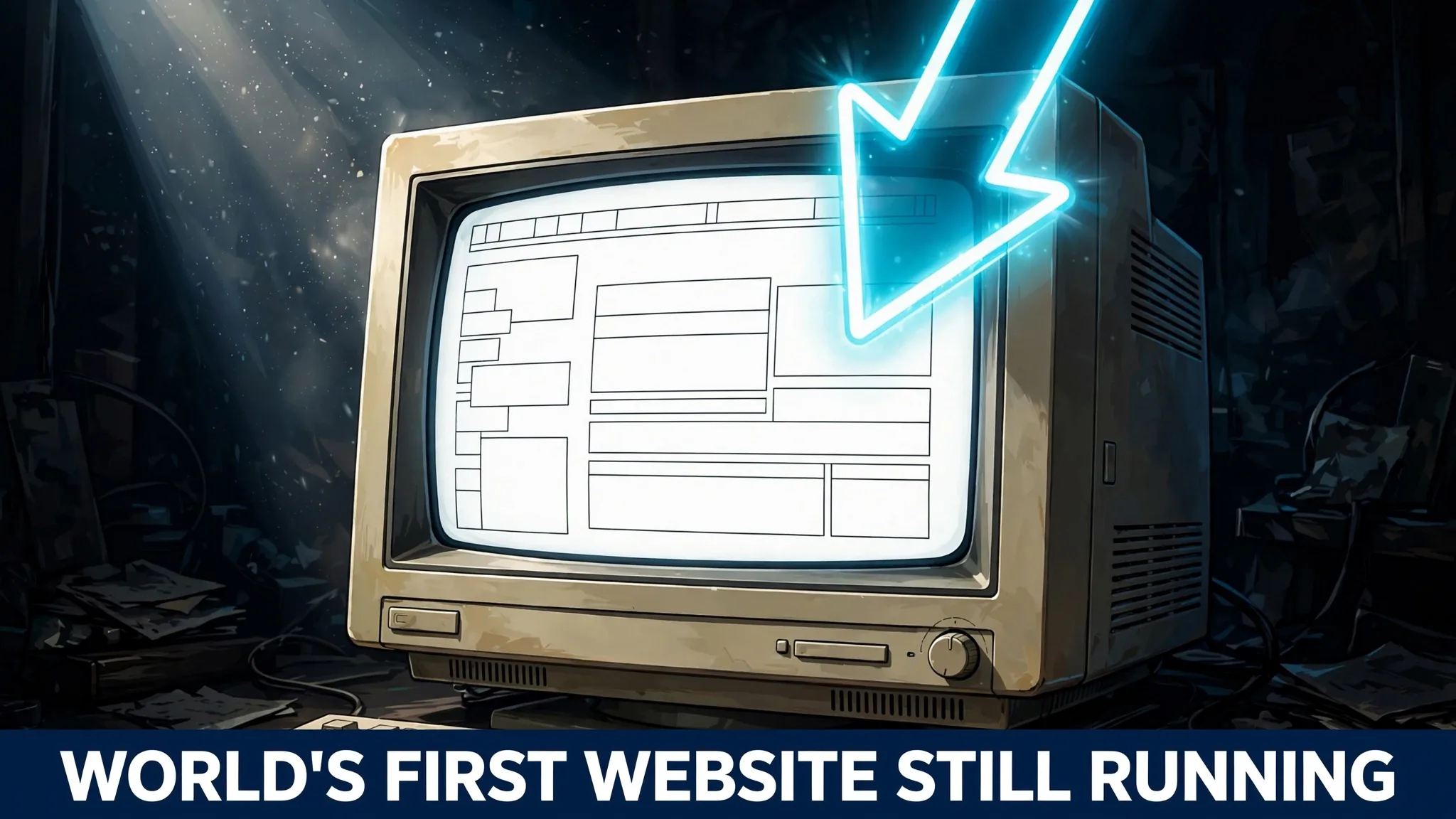
World's First Website Still Running
In this post
The first website in the world had no photographs. No colours, no videos, no buttons, no advertisements — just plain black text on a screen, with a few words you could click. It was smaller than the label on a jam jar. And here is the wonderful part: more than thirty years later, you can still open it, at the very same address where it began.
This is the story of info.cern.ch — the little page that quietly started the world we now live in.
A Scientist With A Problem
The story begins at CERN, the great European physics laboratory near Geneva, in Switzerland. Thousands of scientists from universities and institutes all over the world worked with CERN, and they all had the same everyday headache: information was scattered everywhere. Documents lived on different computers, in different systems, and finding who knew what — or where a file was hiding — wasted endless time.
A British scientist at CERN named Tim Berners-Lee believed there had to be a better way. In 1989 he proposed a radical idea: a “web” of documents, joined together by links, so that anyone could jump from one piece of information to another with a simple click, no matter which computer it lived on. His bosses let him build it. By the end of 1990, working with colleagues including the Belgian engineer Robert Cailliau, he had created the first web server, the first web browser, and the tools that made the whole thing run.
All he needed now was a first page.
The First Website Was About The Web Itself
In 1991, the world’s first website went live for people beyond CERN, at the address info.cern.ch. And what did this history-making page talk about? Itself.
The first website was dedicated to the World Wide Web project. It explained what the web was and how it worked. It described the basic features of the new system, told visitors how to reach other people’s documents, and — most generous of all — explained how anyone could set up a web server of their own. The very first page of the web was, in effect, an instruction book: the web teaching the world how to join the web.
It was a tiny thing. The opening page held fewer than a thousand characters of text and about twenty-five links. No pictures at all. But every idea that matters was already there: pages, addresses, links, and the freedom for readers to wander from one document to the next. Everything since — the shops, the videos, the schools, the social feeds, the page you are reading right now — grew out of that plain little sheet of text.
The Computer With The Handwritten Warning
The first website did not live in a giant data centre. It lived on Berners-Lee’s own desk, on his NeXT computer — one single machine that was the world’s first web server.
Because everything depended on that one computer, somebody stuck a label on it, written in red ink, that has since become famous. It read: “This machine is a server. DO NOT POWER IT DOWN!” The warning was deadly serious. If anyone had switched that computer off — to save electricity, or to plug in a kettle — the entire World Wide Web would have gone dark, because the entire World Wide Web was that machine.
The partly peeled label can still be seen today. The NeXT computer is preserved at CERN, where it sits as a permanent exhibit in the Microcosm exhibition — a humble black box that once carried the whole web on its shoulders.
The Gift: CERN Gave The Web To Everyone
For its first couple of years, the web belonged mostly to scientists and computer experts. Other information systems of the time were built around control and charging: if you wanted to publish or read, somebody expected to be paid. The web could easily have gone the same way — owned, licensed, and locked.
Then, on 30 April 1993, CERN did something extraordinary. It put the World Wide Web software into the public domain, and later released it again under an open licence to make the decision doubly sure. The software needed to run a web server was made freely available to anyone, together with a basic browser and a library of code to build on. No fees. No permission slips. No owner.
It may be the most valuable gift ever given away. Because the web was free, anyone could open a server, anyone could publish a page, and anyone could improve the tools. Students did it. Businesses did it. Children did it. The web did not just grow — it exploded, and it has never stopped. Every website that has ever existed since traces its permission to exist back to that one decision in 1993.
The Page That Vanished — And Came Back
Here is the strange twist. As the web grew into billions of pages, the very first page was left behind. The files at info.cern.ch were changed and updated over the years, and the original first website, exactly as it had been, was no longer there at its own address. The birthplace of the web had quietly disappeared from the web.
CERN decided that this piece of history was too important to lose. In 2013, the laboratory launched a project to restore the first website. The team hunted through old files and equipment to find the earliest surviving versions of the original pages, and put them back where they belonged: at the original address, info.cern.ch.
So today, anyone in the world can do something slightly magical. You can type in the very first web address ever used, and the very first website will answer — the same plain text, the same links, explaining the same brand-new idea, exactly as the earliest visitors saw it. It may be the only museum in the world that you visit simply by typing its name.
From One Page To The World We Live In
Stand back and look at the whole arc of the story. In 1989, the web was one man’s proposal. In 1991, it was a single page of plain text on one desk computer in Geneva, with a handwritten note begging people not to switch it off.
Today, the web is where much of humanity learns, works, shops, plays, argues, falls in love and says goodnight. There are more pages than anyone could ever count, and new ones arrive every second. Every single one of them is a descendant of that first modest page — a page that was never sold, never locked away, and never really about making money at all. It was a scientist sharing his tool with the world, and the world, given the chance, built everything else.
And the best part? The beginning is still there. The first website is still running. Go and say hello to it.
Frequently Asked Questions
What was the address of the first website? info.cern.ch. Its famous first page explained the World Wide Web project. The site was built by Tim Berners-Lee at CERN and opened to the wider world in 1991.
What did the first website actually contain? Plain text and links — fewer than a thousand characters on the opening page, with about twenty-five links. It explained what the web was, how to read other people’s documents, and how to set up a web server of your own. There were no images at all.
Who was Tim Berners-Lee? A British scientist working at CERN, the European physics laboratory in Switzerland. He invented the World Wide Web in 1989 and built the first browser, the first server and the first website.
Why did the web spread so fast? Because it was free. On 30 April 1993, CERN put the web’s software into the public domain, so anyone could run a server, publish pages and build tools without paying fees or asking permission.
Is the page at info.cern.ch today exactly the original? It is a restoration. The original page had been changed over the years and was no longer at its address, so in 2013 CERN brought the earliest surviving version of the first website back to its original address, where it remains today.
Can I still see the first web server? Yes. Berners-Lee’s NeXT computer — still wearing its handwritten red label warning people not to power it down — is preserved at CERN as a permanent exhibit in the Microcosm exhibition.
Sources
- CERN, “The birth of the Web”: https://home.cern/science/computing/the-birth-of-the-web/
- BetaNews, “The way we were – CERN recreates the first website”: https://betanews.com/article/the-way-we-were-cern-recreates-the-first-website/
- History of Informatics Exhibition, “WWW has been around for twenty years”: https://ajovomultja.hu/node/529?language=en
- The picture on this page is an original illustration made for Talha M Blog.