Zeus Trojan That Robbed Banks
In this post
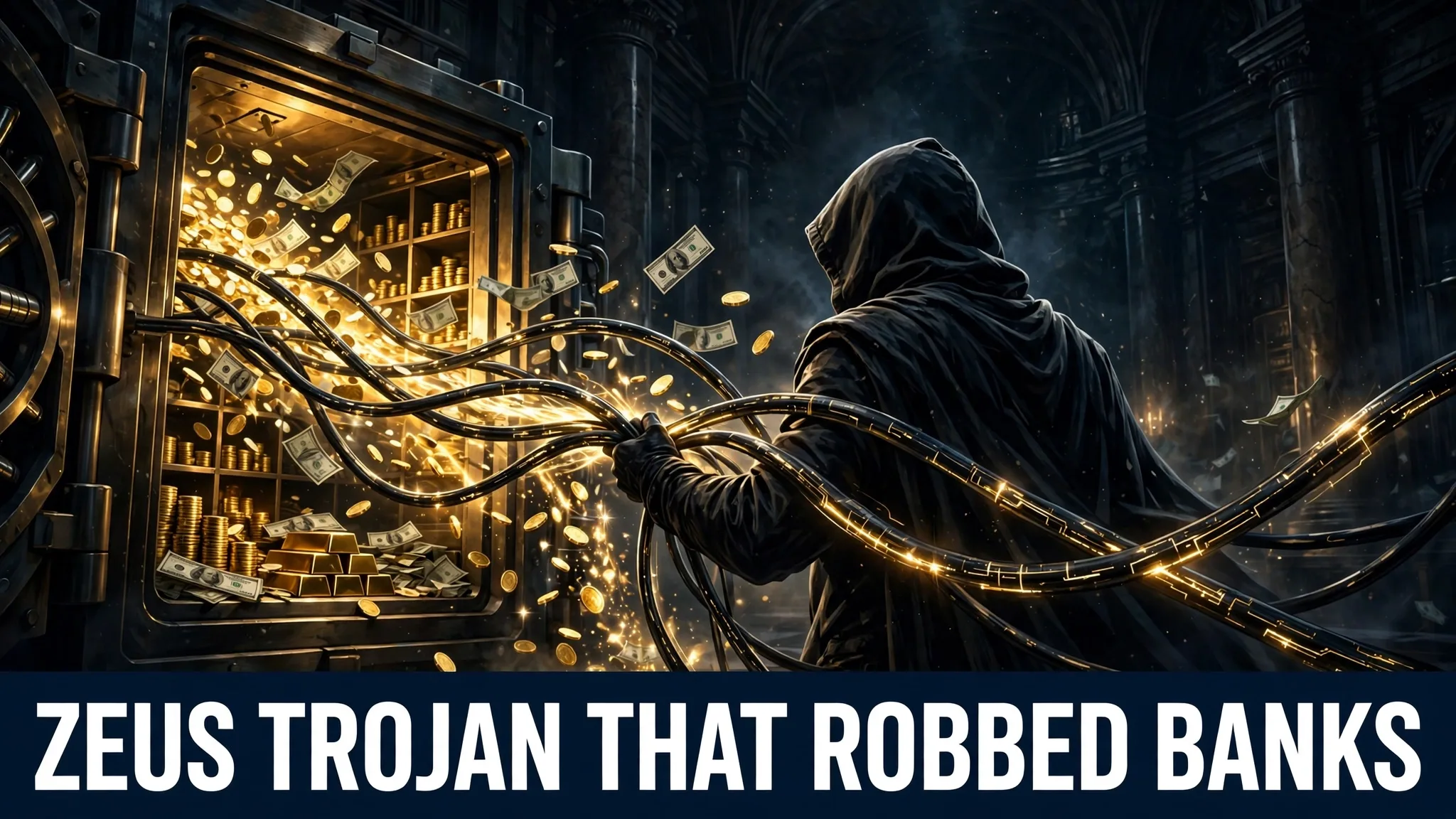
Imagine sitting down at your kitchen table with a cup of tea and your bank statement spread out in front of you. Everything looks normal at first. Then you look closer. There is a small payment you do not remember making. Another one, further up the page. And another. None of them are huge amounts. Nothing screams for attention. The money simply left, quietly, one small step at a time — and nobody knocked on any door, broke any lock, or set off any alarm to take it.
That is exactly how thousands of ordinary people first met the Zeus trojan. Not with a crash, not with a scary warning on the screen, but with numbers on a statement that did not add up. By the time most victims noticed anything was wrong, the thief had been living inside their computer for weeks or even months, watching every visit to the bank and writing down every secret they typed.
What the Zeus trojan is and what it does
Zeus, sometimes written as ZeuS, is a banking trojan — a hidden program built for one main job: stealing the usernames and passwords people use for online banking. It was first identified in 2007, and it infects computers running Windows.
A trojan is different from a burglar in one important way. It does not smash its way in. It arrives dressed as something harmless — a file, an update, a download you thought you wanted — and once you let it in, it settles down silently and starts work. You can use your computer all day and never see it. There is no strange face on the screen. There is no noise. Zeus was designed to be invisible, because an invisible thief can keep stealing for far longer than a loud one.
It watches every key you press
The first of Zeus’s two big tricks is called keylogging. That simply means it records every key you press on your keyboard and keeps the list. Think about what that means in real life. When you open your bank’s website and carefully type your username and password, you believe those words travel straight from your fingers to your bank. With Zeus on the machine, a copy of every letter went to the criminals first.
Passwords, card numbers, answers to secret questions — Zeus gathered them all, the way a hidden notebook under your keyboard would gather everything you ever wrote.
It lies to you on the real bank page
The second trick is even more clever, and it is the one that made Zeus famous. Zeus could secretly change what your browser showed you while you were on your bank’s genuine website. You typed the real address. You saw the real page. But Zeus quietly added extra boxes to it — boxes asking for details your bank would never ask for, like your full card number, your PIN, or your date of birth.
Because the page looked completely real, most people filled in the boxes without a second thought. Why would they not? They were on the bank’s own website, after all. They had no way to know that a hidden program was editing the page inside their own browser, right in front of their eyes. I find this trick scarier than the keylogging, honestly, because it defeats the one piece of advice everyone gives — “check you are on the real website.” With Zeus, you were.
Once it had your details, Zeus sent them away to servers controlled by criminals. The stealing of the password was only the first half of the crime. The second half was moving the money, and for that the gangs used people called money mules — ordinary-looking men and women who were paid to receive stolen money into their own accounts and pass it along, so the trail became hard to follow.
How Zeus spreads and how it can reach you
Zeus did not wander the world on its own. It travelled the same roads that most malware still travels today, and that is why its story still matters to anyone who uses a computer.
Phishing emails
The most common road was the phishing email — a message pretending to be from a bank, a delivery company, a tax office, or some other organisation you might trust. The email would push you to open an attachment or click a link, often with a little pressure: an unpaid bill, a blocked account, a problem that needed fixing right now. One careless click could be enough to let the trojan in.
Poisoned downloads and malicious adverts
Zeus also spread through downloads that had been secretly poisoned — free programs, games, and files from untrustworthy corners of the internet that carried the trojan hidden inside them. And it spread through malicious adverts: infected ads placed on normal websites, waiting for a visitor whose computer was not fully updated. A person could visit a perfectly respectable page, click nothing at all, and still walk away infected.
This is the part worth sitting with for a moment. The victims of Zeus were not careless people using strange websites. Many were careful people who simply opened the wrong email on the wrong day, or trusted a download that looked fine. The lesson for ordinary readers is plain: the thief does not break down the bank’s strong door. It sits inside your browser and waits for you to open the door yourself, with your own hands, using your own password.
The damage story: from one hidden program to a worldwide crime business
In 2010, the FBI broke up one large Zeus crime ring in an operation called Operation Trident Breach. More than 100 people were arrested, and the FBI said that this single ring had stolen about $70 million. One ring. One version of the program. Stopping it should have been the end of the story — but Zeus had a second life in it.
In 2011, the Zeus source code leaked. The source code is like the master recipe of a program, and once it escaped, countless other criminals could cook up their own versions for free. Zeus building kits — ready-made toolboxes for creating fresh copies of the trojan — were even sold online like ordinary products, so a criminal did not need to be a genius programmer. They only needed to buy the kit.
Gameover ZeuS: the version with no head to cut off
The strongest later version was called Gameover ZeuS, and it fixed the one weakness that had made earlier versions vulnerable. Older malware usually took orders from a single central server, so police could sometimes shut a whole crime network down by seizing that one machine. Gameover ZeuS linked infected computers directly to each other instead — computer to computer, in a web with no single centre. There was no single server to grab, no one throat to cut.
It took an international police operation in 2014 to disrupt it. The United States charged a Russian man, Evgeniy Bogachev, as its alleged leader, and offered a $3 million reward for information leading to his arrest. That one detail tells you the scale of what Zeus had become: it started as a hidden program on home computers and grew into a worldwide business of theft, with a price on its alleged boss’s head like an old wanted poster.
How to protect yourself from banking trojans
No single habit makes you untouchable, but a handful of simple habits close nearly every door that Zeus and its descendants use.
- Turn on two-factor authentication for your bank. This is the extra step where your bank asks for a code sent to your phone, on top of your password. It matters because it makes a stolen password almost useless on its own — the thief has your key but not your phone. Turn it on even if it feels like a small bother.
- Never reach your bank through a link in an email or message. If an email says your account has a problem, ignore the link completely. Close the email, open your browser yourself, and type your bank’s address with your own hands, or use the bank’s official app. A link in a message can lead to a fake page, and it can also carry the download that installs the trojan.
- Treat unexpected attachments as guilty until proven innocent. Banks and delivery companies do not send surprise files that you must open urgently. If an attachment arrives with pressure — pay now, confirm now, your account will close — that pressure itself is the warning sign. Real organisations can wait five minutes while you check. Criminals cannot, because checking is what stops them.
- Check your bank statements regularly, not rarely. Zeus won by being quiet and small. Money that leaves in small amounts only gets caught by people who actually look. A weekly glance at your statement turns a disaster you discover after six months into a small problem you catch in seven days. If you see even one payment you do not recognise, call your bank the same day.
- Keep your computer and browser updated. Many infections slip in through old holes that the makers have already patched. An update you keep postponing is an open window you keep forgetting to close. Turn on automatic updates and let them do their boring, lifesaving work.
- Be suspicious of new boxes on familiar pages. This is the Zeus trick itself. If your bank’s page suddenly asks for things it never asked for before — your full card number, your PIN, codes it normally never requests — stop. Close the page. Call the bank on the number printed on your card and ask. A thirty-second phone call is cheaper than an emptied account.
Common questions
What is the Zeus trojan in simple words?
Zeus is a hidden program that infects Windows computers and steals online banking passwords. It watches what you type and can even add fake boxes to real bank pages to trick you into giving away extra details. Criminals then use those stolen details to move money out of your account.
How would I know if a banking trojan is on my computer?
Usually, you would not — these programs are built to stay invisible, so the absence of warnings proves nothing. The clearest signs appear at the bank’s end: payments you do not recognise, or your bank page asking for unusual details it never asked for before. Keeping your antivirus updated and your statements checked is how most people catch it.
Why did Zeus keep coming back after arrests?
Because the gangs were only one part of the problem. When the Zeus source code leaked in 2011, anyone could build their own version, and kits for making it were sold online. Arresting one ring was like cutting one branch off a tree that had already scattered its seeds everywhere.
Can a banking trojan infect my phone too?
Zeus itself targeted Windows computers, but banking trojans as a family exist for phones as well, usually hiding inside fake apps or poisoned downloads. The same habits protect you on both: install apps only from official stores, never through links in messages, and keep two-factor authentication switched on.
What should I do if I see a payment I do not recognise?
Call your bank immediately using the number on your card or the bank’s official app — not a number from any suspicious email. Tell them the payment is not yours, ask them to protect the account, and change your banking password from a different, clean device. Speed matters, because stolen money gets harder to recover with every hour that passes.
Sources
- Wikipedia — Zeus (malware): https://en.wikipedia.org/wiki/Zeus_(malware)
- Wikipedia — Gameover ZeuS: https://en.wikipedia.org/wiki/Gameover_Zeus