Aaron Kwok: The Life Story Behind Hong Kong's Dancing King
In this post
- A Gold Shop Boy Who Learned to Dance
- A Motorcycle Advert and Sudden Fame in Taiwan
- The Dancing King and the Four Heavenly Kings
- The Storm Riders and the Move Into Serious Film
- Cold War, Later Films, and a Star Who Keeps Growing
- The Discipline of a Dancer Who Never Stops
- Why Hong Kong Still Calls Him the Dancing King
- My Take:
Aaron Kwok is a star who moves. When he steps onto a stage, the whole room moves with him, because he is not only a singer, he is a dancer, and his dancing changed Hong Kong pop music forever. Before Aaron, a male singer in Hong Kong could stand still and sing a ballad, and that was enough. After Aaron, a male singer had to dance, had to move, and had to give the audience a show with his whole body. He is known as the Dancing King, and he is one of the Four Heavenly Kings, and he is also an actor who has won the highest acting prizes in Asia. He has done all of this through hard work, through discipline, and through a love of movement that has never left him.
He was born Kwok Fu-shing in Hong Kong on 26 October 1965, into an ordinary family that ran a small gold shop. He was not born into fame, and he did not have a shortcut into the entertainment world. He joined the dance training programme at TVB, the great television station of Hong Kong, and he learned to dance the hard way, through long hours of practice, through sore muscles, and through the discipline of a dancer’s life. He worked as a backup dancer, standing behind other stars, and he learned what it was like to be on a stage without being the centre of attention. That experience taught him patience, and it taught him that a star is made not in a single moment, but through years of work that no one sees.
His story is a story of a dancer who became a king. A motorcycle advertisement in Taiwan in 1990 made him famous almost overnight, and his first album in Mandarin became a huge hit. He returned to Hong Kong as a star, he became one of the Heavenly Kings, and he filled arenas with concerts that were famous for their dancing and their energy. He also became a serious actor, winning the Golden Horse Award for Best Actor twice, and starring in films like The Storm Riders and Cold War. He married, he became a father, and he kept dancing through all the changes of his life. This is the story of how a backup dancer became the Dancing King of Hong Kong, and why his energy still inspires people today.
A Gold Shop Boy Who Learned to Dance
Aaron Kwok was born in Hong Kong in 1965, and he grew up in a family that ran a small shop selling gold jewellery. It was an ordinary, hard-working family, and Aaron learned early that life was about work, about serving customers, and about taking pride in what you do. He was not a child who dreamed only of fame. He was a boy who liked to move, who liked music, and who had a natural sense of rhythm that his family and his friends noticed. He was also a boy who was willing to work hard, and that willingness would become the foundation of his whole career.
When he finished school, Aaron did not go to university. He joined the dance training class at TVB, the television station that made most of the popular programmes in Hong Kong. The training was hard, and it was not glamorous. Dancers had to practise for hours every day, they had to learn many styles, from modern dance to traditional dance, and they had to be ready to perform at any time. Aaron took to the training with energy and with discipline, and he soon became one of the best dancers in his class. He learned how to move his body with grace and with power, and he learned how to perform in front of a camera, which is a different skill from performing in front of a live audience.
After his training, Aaron worked as a backup dancer on television shows, dancing behind the stars who were already famous. It was not a job that brought fame, and it was not a job that brought much money, but it was a job that taught him a great deal. He learned how a television show is made, he learned how a star behaves on stage, and he learned how to keep going when the work is hard and the reward is small. He watched the stars from behind, and he dreamed of the day when he would be the one in front, with the lights on him and the audience cheering his name. That day would come, but not in the way he expected, and not in Hong Kong first, but in Taiwan.
The years as a backup dancer were important, because they gave Aaron a skill that few other singers had: the ability to dance at a professional level. When he later became a singer, he did not have to learn to dance. He already knew how, and he could dance better than almost any other pop star in Asia. That skill would set him apart, and it would make him the Dancing King. But first, he needed a chance, and that chance would come from a television advertisement for a motorcycle, a chance that would change his life in a single moment.
A Motorcycle Advert and Sudden Fame in Taiwan
In 1990, Aaron Kwok appeared in a television advertisement for a motorcycle in Taiwan, and the advert made him famous almost overnight. He rode the motorcycle with style, he looked handsome and confident, and the audience in Taiwan fell in love with him. The advert was shown again and again, and people began to ask who the young man on the motorcycle was. It was a strange way to become famous, through an advert rather than through a song or a film, but it was the break that Aaron had been waiting for, and he took it with both hands.
The fame from the advert led to a recording contract in Taiwan, and Aaron released his first Mandarin album, Loving You Endlessly, in 1990. The album was a huge success, and its title song became a hit across Taiwan and in other parts of Asia. Aaron’s voice was clear and strong, and his dancing in his performances made him stand out from every other singer. He was not only singing. He was dancing, he was moving, and he was giving the audience a show that they had never seen before from a male singer in Chinese pop music. Young fans in Taiwan loved him, and his fame grew quickly.
The success in Taiwan changed Aaron’s life completely. He was no longer a backup dancer. He was a star, with fans, with records, and with a future in music. He returned to Hong Kong as a star, and the Hong Kong music world welcomed him back with open arms. He began to release Cantonese albums as well as Mandarin albums, and he became known in both languages, which meant that his fame reached across the whole Chinese-speaking world. He was a singer who could sing in Cantonese for Hong Kong and in Mandarin for Taiwan and mainland China, and that breadth made him one of the biggest stars in Asia.
By the early 1990s, Aaron was one of the most famous young men in Hong Kong. He had gone from dancing behind other stars to standing in front of his own audience, and he had done it in a very short time. The sudden fame could have made him arrogant, but Aaron stayed focused on his work. He knew that fame that comes quickly can go quickly, and he worked hard to keep it. He practised his dancing, he worked on his singing, and he took care with each album, because he wanted his fame to last, and he was willing to work for it.
The Dancing King and the Four Heavenly Kings
In the early 1990s, Aaron Kwok became one of the Four Heavenly Kings of Hong Kong, alongside Jacky Cheung, Andy Lau, and Leon Lai. The four kings were the biggest male stars in Cantopop, and together they defined an era. Each of them was different. Jacky was known as the God of Songs, Andy was known for his hard work, Leon was known for his elegance, and Aaron was known for his dancing. His dancing was not a small part of his act. It was the centre of it, and it changed what a Hong Kong pop concert could be. Before Aaron, a concert was mainly about singing. After Aaron, a concert was about singing and dancing together, with energy, with movement, and with a show that filled the whole stage.
Aaron’s concerts became famous for their energy and for their spectacle. He danced with a large group of dancers, he wore bold and colourful costumes, and he moved across the stage with a power and a grace that left the audience breathless. His fans loved the energy, and they loved the fact that he gave everything he had in every show. He did not hold back. He danced as if each concert were his last, and the audience felt that energy and answered it with cheers. His concerts at the Hong Kong Coliseum became legendary, and they set a new standard for what a pop concert in Hong Kong could be.
His music in this period was also successful. He released album after album, in Cantonese and in Mandarin, and his songs became hits across Asia. He sang dance songs that filled the dance floors, and he sang ballads that showed his softer side. His voice was strong and clear, and it carried the energy of his dancing. He was not only a dancer who sang. He was a singer who danced, and the two skills together made him a complete performer, one of the most exciting stars in Hong Kong music.
By the middle of the 1990s, Aaron was one of the biggest stars in Asia. He had money, he had fame, and he had the love of millions of fans, but he kept the discipline of a dancer. He practised every day, he looked after his body, and he took his work seriously. That discipline is rare in a star, and it is one of the reasons his career has lasted for so long. He became a king, and he wore the crown with energy, as if the crown were a reason to dance even harder.
The Storm Riders and the Move Into Serious Film
While his music career was at its height, Aaron Kwok also became a film actor, and his film work gave him a second life as a star. He had appeared in films from the early 1990s, but his great film breakthrough came in 1998 with The Storm Riders, a fantasy action film based on a popular comic book. In the film, he played Cloud, a young warrior with a tragic past, and his performance was praised for its energy and its emotion. The film was a huge success, and it showed that Aaron could carry a major film as well as a major concert. He was not only a pop star trying his hand at acting. He was an actor who could hold the screen.
In the years that followed, Aaron took on more and more serious film roles, and he worked hard to be taken seriously as an actor. He starred in films of many different kinds, from action to romance to drama, and he brought the same discipline to acting that he brought to dancing. He learned how to listen to another actor, how to be still in front of a camera, and how to let a character grow slowly over the course of a film. That learning took time, and it took patience, but Aaron was willing to put in the time, because he wanted to be more than a singer who acted on the side. He wanted to be a real actor.
His hard work as an actor was rewarded in the middle of the 2000s, when he won the Golden Horse Award for Best Actor, one of the highest honours in Chinese-language film. He won it for Divergence in 2005, playing a policeman in a dark and complex crime story, and he won it again for After This Our Exile in 2006, playing a father who struggles with gambling and with his family. Winning the award twice in a row was a remarkable achievement, and it proved that Aaron was not only a dancing star. He was one of the finest actors of his generation, and his performances were recognised by the most respected judges in Asian cinema.
By the late 2000s, Aaron was a true double star: a singer who filled arenas and an actor who won the top prizes. Few performers in Hong Kong could do both at such a high level, and even fewer could do both with such energy. He moved between the recording studio, the concert stage, and the film set with ease, and he brought the discipline of one world into the other. His film work gave his songs more depth, and his music gave his film roles a sense of rhythm and feeling. He was at the top of his career, and he was doing it in two worlds at once.
Cold War, Later Films, and a Star Who Keeps Growing
In 2012, Aaron Kwok starred in Cold War, a crime thriller about the Hong Kong police force, and the film became one of the most successful Hong Kong films of its time. He played a senior police officer caught in a struggle for power, and his performance was praised for its seriousness and its control. The film led to a sequel, and it showed that Aaron could carry a modern, complex thriller as well as a fantasy action film or a drama. He was no longer a young dancer. He was a mature actor, and his performances had a depth that came from years of experience.
He continued to act in major films in the 2010s, including The Monkey King in 2014, in which he played the Bull Demon King, and Project Gutenberg in 2018, a crime film about counterfeit money that became a huge hit. In each film, he brought a different energy, a different character, and a different challenge, and he never seemed to repeat himself. He chose roles that asked him to grow, and he worked with directors who trusted him. He was a star who had become a serious actor, and that is a rare achievement in Hong Kong entertainment, where many singers act but few are taken seriously as actors. Aaron was taken seriously, and he earned that respect through hard work and through the quality of his performances.
His music career also continued in the 2010s, with new albums, new concerts, and new songs that showed his voice was still strong. His concerts became even more spectacular, with new stage designs, new dances, and new ways of using the arena. He was known for a concert stage that could turn and move, giving the audience a new view from every seat, and for shows that were planned with great care. He was not a singer who rested on his old hits. He kept working, he kept dancing, and he kept finding new ways to give his fans a great evening.
In his personal life, Aaron married Moka Fang in 2017, and they have two daughters. Fatherhood changed him, as it changes many people, and it gave him a new sense of what matters in life. He has spoken about his daughters with love, and he has tried to balance the demands of a busy career with the needs of his home. That balance is not easy for a star who travels constantly, but Aaron has worked at it, and his family remains a central part of his life, even when the stage calls him away. He is a Dancing King who has become a father, and he dances now not only for his fans, but for his family too.
The Discipline of a Dancer Who Never Stops
Aaron Kwok has always been known for his discipline, and that discipline is the secret behind his long career. A dancer’s body must be looked after every day, with practice, with exercise, and with rest, and Aaron has done that for more than thirty years. He practises his dancing, he works on his fitness, and he takes care with his diet and his health, because he knows that a dancer who stops practising will lose his skill quickly. That care is not easy, and it is not glamorous, but it is the reason he can still dance with energy in his fifties, when many other singers have slowed down. He is a star who has earned his energy through daily work, not through luck.
That discipline also shows in his singing and in his acting. He does not arrive at a recording studio or a film set unprepared. He practises, he learns his lines, he studies his character, and he arrives ready to work. The people who work with him say that he is one of the most professional stars in Hong Kong, because he respects the time of others and he gives his best in every take. That professionalism is rare, and it is one of the reasons directors and producers want to work with him again and again. He is a star who can be trusted, and trust is the hardest thing for a star to earn.
His discipline has also helped him through the hard times in his career. There have been years when his music did not sell as well, years when his films did not do as well as hoped, and years when new singers arrived and the press said that his time had passed. Aaron did not panic, and he did not give up. He kept working, he kept practising, and he kept finding new roles and new songs. He understood that a career is not a straight line, but a long road with ups and downs, and that the only way through the downs is to keep walking. That steady attitude has carried him through more than thirty years, and it is still carrying him today.
Why Hong Kong Still Calls Him the Dancing King
Aaron Kwok is still called the Dancing King of Hong Kong, and he has earned that title through more than thirty years of energy, discipline, and hard work. He changed Hong Kong pop music by showing that a male singer could dance, and he changed Hong Kong film by showing that a dancing star could also be a serious actor. His songs, from Loving You Endlessly to his later hits, are part of the shared memory of Hong Kong, and his films, from The Storm Riders to Cold War, are part of the shared memory of Hong Kong cinema.
For a new fan, the best place to start is with his music, especially his dance songs, and then with his films, especially Divergence and Cold War, which show his acting at its best. Then watch a recording of one of his concerts, and see how he moves across a stage with a power that few singers can match. Together, these pieces show a complete performer: a dancer, a singer, an actor, and a father. He is the Dancing King, and he earned that crown one step at a time, starting as a backup dancer behind other stars and ending as a star in his own right.
Aaron Kwok’s story is not a story of sudden fame. It is a story of a boy from a gold shop who learned to dance, who waited for his chance, and who then spent more than three decades earning the love of his city. He is a reminder that discipline, energy, and hard work can turn a backup dancer into a king, and that a king who keeps dancing will never grow old in the hearts of his fans.
My Take:
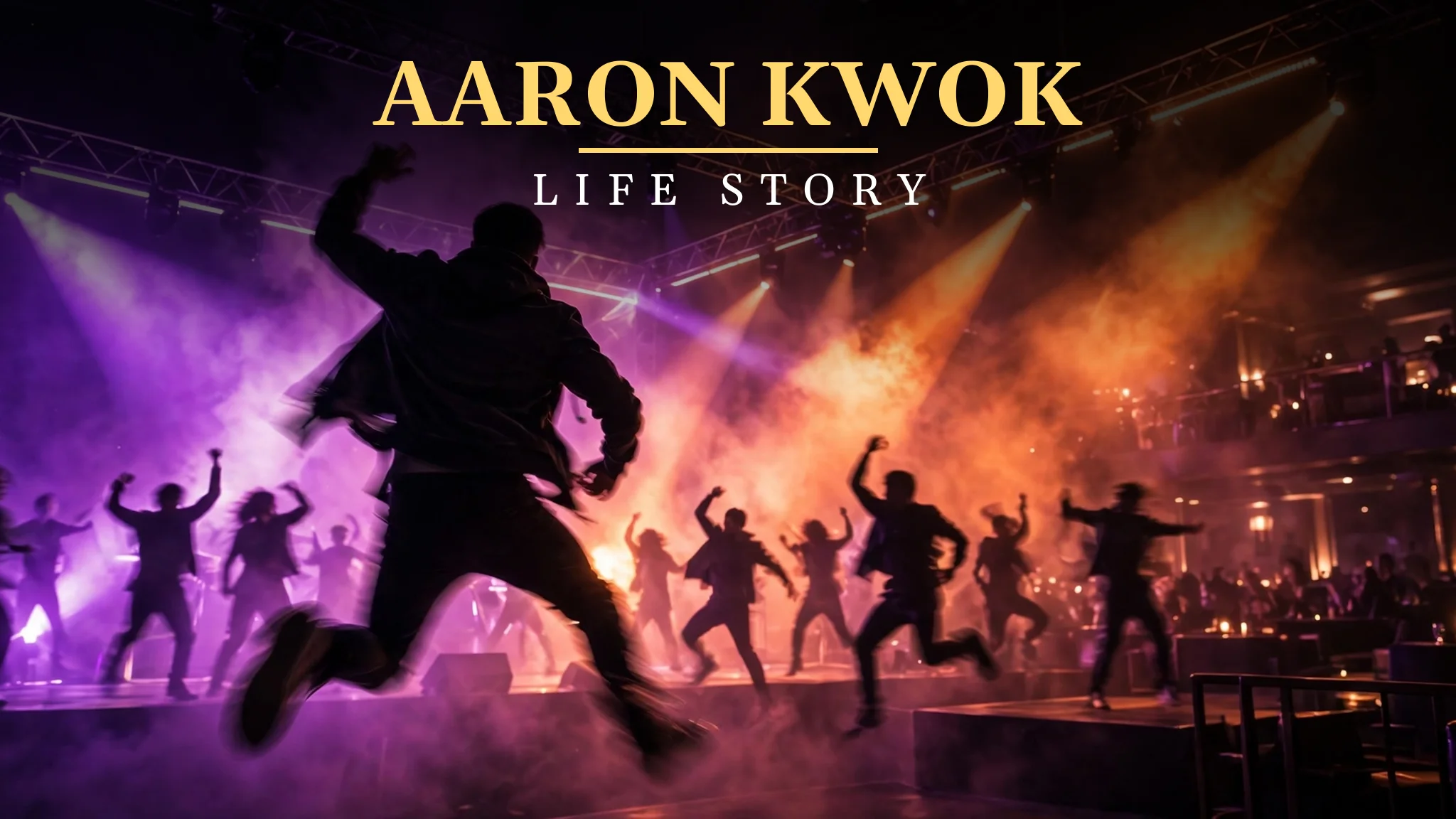
When I think about Aaron Kwok, the first thing I think about is movement. I picture him on a stage, dancing with a group of dancers behind him, moving with a power that makes the whole room feel alive. That image stays with me, because it tells me who he is in a way that no photograph of him standing still can. He is a man who expresses himself through his body, through dance, and through energy, and that energy has been the centre of his career for more than thirty years. I admire him for that energy, and I admire him even more for the discipline behind it, because energy without discipline fades quickly, and Aaron’s energy has not faded at all.
I think about his beginning, and I find it one of the most honest beginnings in Hong Kong pop music. He was not discovered as a singer. He was a backup dancer, standing behind other stars, dancing in the background while the lights were on someone else. That is a humble place to start, and it is a place that teaches a person a great deal. He learned what a stage feels like from behind, he learned how a show is made, and he learned how to work hard without being thanked. I think about how many young people would have given up in that place, feeling that they would never be the star, and I admire Aaron for not giving up. He kept dancing, he kept practising, and he waited for his chance. When the chance came, in the form of a motorcycle advert in Taiwan, he was ready, because he had spent years getting ready. That is a lesson I carry with me: the years when no one is watching are the years that make you ready for the moment when everyone is watching.
The motorcycle advert is a strange and wonderful part of his story, because it shows that a break can come from anywhere. He did not become famous through a song, or through a film, or through a contest. He became famous through an advert, through riding a motorcycle with style and confidence. I love that, because it tells me that life does not follow a straight plan, and that a person should be ready for any door that opens, even a door that looks strange. Aaron walked through that door, and he made the most of it. He released his first album, he sang Loving You Endlessly, and he became a star in Taiwan almost overnight. He did not waste the chance. He used it, and he built on it, and that is why the advert was not only a lucky moment, but the beginning of a great career.
His place among the Four Heavenly Kings is another part of his story that I think about often. He was the dancer among the kings, and his dancing changed what a Hong Kong pop concert could be. Before Aaron, a male singer could stand still and sing, and that was enough. After Aaron, a male singer had to move, had to dance, and had to give the audience a show with his whole body. I think about the young singers who watched Aaron and who learned to dance because of him, and I realise that his influence goes far beyond his own songs. He changed the whole style of Hong Kong pop, and he did it not by talking about change, but by dancing it. That is a powerful kind of influence, because it is influence through action, not through words. He showed, he did not tell, and the whole music world followed him.
I also admire his acting, and I admire it because he worked so hard to earn it. Many singers act, but few are taken seriously as actors, and Aaron was taken seriously because he put in the work. He learned how to be still in front of a camera, how to listen to another actor, and how to let a character grow slowly. He won the Golden Horse Award for Best Actor twice, for Divergence and for After This Our Exile, and those wins were not given to him because he was famous. They were given to him because his performances were great. I think about the policeman in Divergence, a man in a dark and complex world, and the father in After This Our Exile, a man who struggles with his family and with himself, and I see that Aaron can play characters who are far from the Dancing King. He can play men who are tired, who are sad, and who are trying to do the right thing. That range is rare, and it is the result of years of learning and of humility. He was willing to be a beginner again in acting, even though he was already a king in music, and that willingness is one of the most admirable things about him.
Cold War is the film I return to most often when I think about his later acting, because it shows a mature Aaron, a man who can carry a complex thriller with control and with seriousness. He plays a senior police officer, a man who must make hard decisions, and he plays him without shouting or overacting. He lets the tension sit in his face, in his voice, and in the way he moves. That is the acting of a man who has learned that less can be more, and that a quiet moment can be stronger than a loud one. I think that lesson came from his years as a dancer, because a dancer learns that a small movement can be more powerful than a big one, if it is done with care. Aaron brought that dancer’s care into his acting, and his acting is better for it.
His discipline is the part of his story that I respect most, because it is the part that is hardest to see and easiest to forget. A dancer must practise every day, must look after his body, and must rest when he needs to rest. Aaron has done that for more than thirty years, and he can still dance with energy in his fifties because he has never stopped working. I think about how easy it would be for a star of his fame to stop practising, to rely on his old hits, and to let his body slow down. Aaron did not do that. He kept practising, he kept working on his fitness, and he kept giving his fans a great show. That discipline is not glamorous, and it is not something that makes headlines, but it is the reason his career has lasted. I think that is a lesson for anyone who wants to last in any field: talent will get you started, but discipline will keep you going, and Aaron has proved that, year after year.
I also think about his life as a father, because it shows a different side of the Dancing King. He married Moka Fang, he became a father to two daughters, and he has spoken about his family with love. That is a reminder that even the most energetic star has a quiet life at home, and that the stage is not the whole of a person’s life. He dances for his fans, but he also lives for his family, and that balance matters. I think about the man who dances with such power on stage, and who then goes home to be a father, and I see a complete person, not only a performer. That completeness is what makes his story feel real, and it is what makes his fans love him not only as a star, but as a person.
What I learn from Aaron Kwok, in the end, is that hard work and discipline can turn a backup dancer into a king, and that a king who keeps working will never lose his crown. He did not become famous by luck alone. He became famous by practising, by waiting, by taking his chance when it came, and by working hard every day after that. He teaches me that I should not be afraid to start at the back, that I should be ready for any door that opens, and that I should keep practising even when I am already good. He also teaches me that a person can be many things at once: a dancer, a singer, an actor, and a father, and that each of those things can make the others stronger.
If I could speak to a young person who is just finding Aaron Kwok now, I would say this. Watch him dance, and see the energy in his movement. Listen to his songs, and hear the strength in his voice. Watch Divergence and Cold War, and see the depth in his acting. Then think about your own life, and about the work you are doing when no one is watching. Do not despise the humble beginning, because Aaron started as a backup dancer, and he became a king. Practise every day, be ready for your chance, and when it comes, take it with both hands and work hard to keep it. That is, I think, the best way to honour a star who has given so much to his city.
I will remember Aaron Kwok as the Dancing King of Hong Kong, as a backup dancer who became a star, as an actor who won the highest prizes, and as a man whose discipline and energy have never faded. His dancing will keep inspiring young performers for many years to come, and his story will keep telling us that hard work, practised every day, is the truest path to a lasting crown. I also think about his concerts, and about the stages he has built, because Aaron is known for concert stages that move, turn, and change, giving the audience a new view from every seat. He did not accept a flat stage with a singer standing still. He wanted a stage that was alive, that could rise, that could spin, and that could carry him and his dancers across the arena. I think about the planning behind such a show, the engineers, the dancers, the rehearsals, and the risk, because a moving stage can fail, and a singer who dances on it must be brave. Aaron was brave, and his concerts became famous for their spectacle, not only for their music. He gave his fans an experience they could not get from a record, and that is why they return again and again. He treats a concert as a gift, and he wraps that gift with care.
His love of racing cars is another part of his story that I find interesting, because it shows a man who loves speed, who loves machines, and who loves the thrill of a race. He has spoken about his cars, and about the joy of driving, and that passion is different from singing and acting, but it is part of who he is. I think about a star who is known for dancing, and who also loves the speed of a car, and I see a person who is full of energy, who needs to move, and who finds joy in motion. That energy is the same energy he brings to the stage, and it is the reason his concerts feel so alive. He is a man who was born to move, whether he is dancing, driving, or acting, and that movement is the centre of his life.
His two Golden Horse wins deserve more attention, because winning the Best Actor prize once is hard, and winning it twice in a row is remarkable. He won for Divergence in 2005 and for After This Our Exile in 2006, two very different films, and both wins proved that he was not only a dancing star. He was one of the finest actors in Asia, and his performances were recognised by the most respected judges in Chinese cinema. I think about the policeman in Divergence, a man in a dark world, and the father in After This Our Exile, a man who struggles with his family, and I see that Aaron can play characters who are far from the Dancing King. He can play men who are tired, who are sad, and who are trying to do the right thing. That range is rare, and it is the result of years of learning and of humility. He was willing to be a beginner again in acting, even though he was already a king in music, and that willingness is one of the most admirable things about him.
I also think about his daughters, and about what fatherhood has given him. He married Moka Fang in 2017, and they have two daughters, and he has spoken about them with love. I think about a man who dances with such power on stage, and who then goes home to be a father, to play with his daughters, and to live a quiet family life, and I see a complete person, not only a performer. Fatherhood has given him a new sense of what matters, and it has made his work feel even more meaningful, because he is now working not only for his fans, but for his family. He dances for his daughters too, and that is a beautiful thing. He is a Dancing King who has become a father, and he carries both roles with the same energy and the same care.
Finally, I think about his dance training at TVB, and about how that training still shapes him today. He learned to dance through long hours of practice, through sore muscles, and through the discipline of a dancer’s life, and that discipline has never left him. He still practises, he still looks after his body, and he still takes his work seriously, even after more than thirty years. I think about the young dancers who watch him and who want to be like him, and I want to point to his training and say: he did not become the Dancing King overnight. He became the Dancing King through years of practice, through years of working as a backup dancer, and through years of showing up every day. That is a lesson for anyone who wants to be great at something: practise, be patient, and keep showing up, even when no one is watching. Aaron showed up, and Hong Kong noticed, and Hong Kong still calls him the Dancing King.
Frequently Asked Questions
How did Aaron Kwok first become famous?
Aaron Kwok first became famous in 1990 through a television advertisement for a motorcycle in Taiwan, which led to a recording contract and his hit Mandarin album Loving You Endlessly.
Why is Aaron Kwok called the Dancing King?
Aaron Kwok is called the Dancing King because he trained as a professional dancer at TVB and brought high-energy dancing to Hong Kong pop concerts, changing what a male singer’s stage show could be.
Was Aaron Kwok one of the Four Heavenly Kings?
Yes, Aaron Kwok was one of the Four Heavenly Kings of Hong Kong in the 1990s, alongside Jacky Cheung, Andy Lau and Leon Lai, and he was known among them as the dancer and the most energetic performer.
Which films won Aaron Kwok his Best Actor awards?
Aaron Kwok won the Golden Horse Award for Best Actor for Divergence in 2005 and again for After This Our Exile in 2006, two dark and complex dramas that proved his serious talent as a film actor.
What is Aaron Kwok’s most famous film role?
Aaron Kwok’s most famous film roles include Cloud in The Storm Riders from 1998 and the senior police officer in Cold War from 2012, a crime thriller that became one of Hong Kong’s most successful films.
Is Aaron Kwok married and does he have children?
Aaron Kwok married Moka Fang in 2017 and they have two daughters, and he has spoken about balancing his busy singing and acting career with his life as a father.


