Jacky Cheung: The Life Story Behind Hong Kong's God of Songs
In this post
Jacky Cheung is the singer that other singers call the God of Songs. It is a big title, and it is not given lightly in Hong Kong, where there are many great singers and where the public is hard to please. Yet Jacky has carried that title for more than thirty years, and no one has taken it from him, because his voice is one of the finest in the history of Chinese pop music. He can sing a quiet ballad that makes a whole arena fall silent, and he can sing a powerful song that fills a stadium with sound, and he does both with a control and a feeling that few singers can match. He is also an actor, a husband, and a father, and he has lived his life with a humility that makes his greatness even more remarkable.
He was born Cheung Hok-yau in Hong Kong on 10 July 1961, into an ordinary family, and he grew up in a city that was full of music and full of change. He was not born into fame, and he did not have a shortcut into the entertainment world. Before he ever sang on a professional stage, he worked in an office for an airline, booking seats and answering telephones, living the life of an ordinary young man in Hong Kong. He sang in his spare time, in amateur contests, and in small gatherings, and he dreamed of a life in music, but he did not expect it to happen. That ordinary beginning is part of what makes his story so powerful, because it shows that a great singer can come from anywhere, even from behind a desk.
His story is a story of a voice that was too good to stay hidden. He won an amateur singing contest in 1984, he released his first album Smile in 1985, and he sang Goodbye Kiss in 1993, a song that became one of the best-selling Chinese albums of all time. He became one of the Four Heavenly Kings, he starred in films like As Tears Go By, and he filled stadiums across Asia with concerts that are still talked about today. He married, he became a father, and he kept singing through all the changes of his life. This is the story of how an airline office worker became the God of Songs, and why his voice still moves millions of people today.
An Office Worker in Hong Kong With a Hidden Voice
Jacky Cheung was born in Hong Kong in 1961, and he grew up in an ordinary family in a city that was changing fast. Hong Kong in the 1960s and 1970s was a place of crowded streets, busy markets, and a growing sense of energy, and Jacky was a normal boy in that city. He went to school, he played with his friends, and he listened to the songs that played on the radio. He liked to sing, and he sang whenever he could, but singing was a hobby, not a plan. His family expected him to study, to find a good job, and to build a stable life, and Jacky did what his family expected. He finished school, and he found work in an office.
He worked as a reservation officer for Cathay Pacific, the great airline of Hong Kong, booking seats for passengers and answering their questions on the telephone. It was a steady job, with a regular salary and a clear future, and many young men in Hong Kong would have been happy with it. Jacky was good at the job, and he was polite and careful with the passengers, but his heart was not in the office. His heart was in music, and he sang in his spare time, in amateur contests and in small gatherings with friends. His voice was strong and clear, and the people who heard him sing knew that he had a gift, even if Jacky himself did not yet believe it.
Singing in an amateur contest was a brave step for a young office worker, because it meant standing up in front of strangers and asking them to judge his voice. Jacky did it, and he did it with the same care and discipline that he brought to his office job. He practised, he chose his songs carefully, and he sang with feeling, not with show. He did not try to be flashy. He tried to be honest, and the audience heard that honesty in his voice. He was building a skill, and he was building it in the quiet hours after work, when most people were resting. That quiet building would soon lead to a chance that would change his life completely.
By the early 1980s, Jacky was a young man with a good job, a good voice, and a dream that he had not yet dared to follow fully. He was not a teenager with nothing to lose. He was an adult with a salary and a future, and leaving that future for music was a risk. But his voice was too good to stay hidden behind a desk, and the people around him kept telling him to try. In 1984, he entered an amateur singing contest in Hong Kong, and that single decision would take him from the airline office to the biggest stages in Asia, in a way that no one, least of all Jacky himself, had expected.
Winning the 1984 Contest and the Smile Album
In 1984, Jacky Cheung entered the Hong Kong 18 Districts Amateur Singing Contest, and he won. He was twenty-three years old, and he had come to the contest as an office worker with a good voice, not as a professional singer. The judges heard something special in him: a voice that was strong, warm, and full of feeling, and a way of singing that was honest and natural. He won the contest, and the win gave him a recording contract with PolyGram, one of the biggest record companies in Hong Kong. For a young man who had been booking airline seats, it was a sudden and surprising turn, and it meant that he had to learn a whole new profession very quickly.
His first album, called Smile, came in 1985, and it introduced his voice to the Hong Kong public. The album was a success, and it showed that Jacky could carry a full record of songs with grace and with feeling. The songs were modern Cantopop, with catchy melodies and clear, honest words, and Jacky sang them with a natural style that stood out from the more polished and distant style of some other singers. He did not sound like a star who was trying to impress the audience. He sounded like a young man singing about his own life, and the audience liked that. His early songs began to play on the radio, and people began to remember his name, even though he was still very new to the business.
The late 1980s were years of learning for Jacky. He released album after album, and he worked with the best songwriters and producers in Hong Kong, learning how a great song is made. He learned that a song is not only a melody, but also a set of words that must feel true, and that a singer must understand those words before he can sing them well. He also learned how to perform live, how to talk to an audience, and how to keep his voice strong through long days of recording and performing. He was building a career the slow way, by doing the work and by getting better with each album, and he was building it with the same discipline he had learned in his office job.
By the end of the 1980s, Jacky was becoming known as one of the most promising young singers in Hong Kong. He had a growing fan base, he had a reputation for singing well, and he had the respect of the people who worked with him. He was also beginning to act, and his film work would soon give him a second career. He was a singer who took his craft seriously, and that seriousness would soon be rewarded with a song that would make him famous across the whole of Asia and that would earn him the title of God of Songs.
Goodbye Kiss and the Song That Crossed Asia
In 1993, Jacky Cheung released the album Goodbye Kiss, known in Cantonese as 吻別, and it became the defining work of his career. The title song is a ballad about saying goodbye to a love, about the pain of parting, and about the memory of a kiss that will not fade. When Jacky sang it, his voice carried both the sadness and the beauty of the song, and listeners across Asia recognised themselves in it. The album sold in huge numbers, not only in Hong Kong, but also in Taiwan, in mainland China, and in other parts of Asia, and it became one of the best-selling Chinese-language albums of all time. It is still one of the most famous albums in the history of Chinese pop music.
Goodbye Kiss gave Jacky a new place in Asian music. He was no longer only a promising singer in Hong Kong. He was a singer whose voice was known across the whole Chinese-speaking world, and whose songs were sung in karaoke bars from Hong Kong to Beijing to Taipei. The song became a standard, a song that every singer tried to copy and that every listener knew by heart. It was a song about goodbye, but for Jacky it was a hello: a hello to a new level of fame, to a new audience, and to a new title. People began to call him the God of Songs, and the name stuck, because his voice had earned it.
The success of Goodbye Kiss also showed Jacky’s gift for choosing songs that are true to life. He did not choose songs only because they were catchy. He chose songs because they said something honest about love, about loss, and about the pain of saying goodbye. That choice, made again and again over many albums, is one of the reasons his music has lasted. A song that is true will still be true in twenty years, while a song that is only fashionable will fade in a year. Jacky built his career on true songs, and Goodbye Kiss is the best example of that.
After Goodbye Kiss, Jacky’s fame grew even larger. He became one of the Four Heavenly Kings, alongside Andy Lau, Leon Lai, and Aaron Kwok, and he held that place for years. He released album after album, and he kept finding new songs that spoke to his listeners. He sang in Cantonese and in Mandarin, and his voice travelled across Asia with ease. He was not a singer who rested on one hit. He kept working, he kept singing, and he kept growing, and Goodbye Kiss was the song that proved he could carry the hopes and the sorrows of a whole continent in his voice.
As Tears Go By and a New Life in Film
While his music career was at its height, Jacky Cheung also became a film actor, and his film work gave him a second life as a star. In 1988, he starred in As Tears Go By, directed by Wong Kar-wai, playing Fly, a young gangster who is loyal to his friend and who lives a dangerous life in Hong Kong. His performance was praised for its energy and its emotion, and he won the Hong Kong Film Award for Best Supporting Actor for the part. It was a remarkable achievement for a singer who was still new to acting, and it showed that Jacky had a gift for film as well as for music.
He went on to make many more films, in many different styles, from action to comedy to drama, and he brought the same care to each one. He starred in Bullet in the Head in 1990, a powerful film about friendship and war, and he appeared in Ashes of Time and in many other films that are still watched today. He worked with the biggest directors and the biggest stars in Hong Kong, and he was never overshadowed. His film career ran beside his music career, and the two fed each other. The stage taught him how to hold a crowd, and the film set taught him how to be still and let the camera find him. Together, they made him one of the most complete performers of his generation.
Jacky’s acting was different from his singing, and that difference is part of what makes him interesting. As a singer, he is the God of Songs, a voice that fills a stadium. As an actor, he is often a supporting player, a man who gives his best to a role without needing to be the centre of attention. That humility is rare, and it is one of the reasons directors loved working with him. He did not demand the biggest part. He took the part that suited the film, and he played it with full commitment. That attitude, of serving the story rather than serving himself, is the mark of a true professional, and it is one of the reasons his film work is still respected today.
By the 1990s, Jacky was a true double star: a singer who filled arenas and an actor who won the top prizes. Few performers in Hong Kong could do both at such a high level, and even fewer could do both with such humility. He moved between the recording studio, the concert stage, and the film set with ease, and he brought the discipline of one world into the other. His film work gave his songs more depth, and his music gave his film roles a sense of rhythm and feeling. He was at the top of his career, and he was doing it in two worlds at once, without ever losing his gentle and modest manner.
Concerts, Family, and a Voice That Never Fades
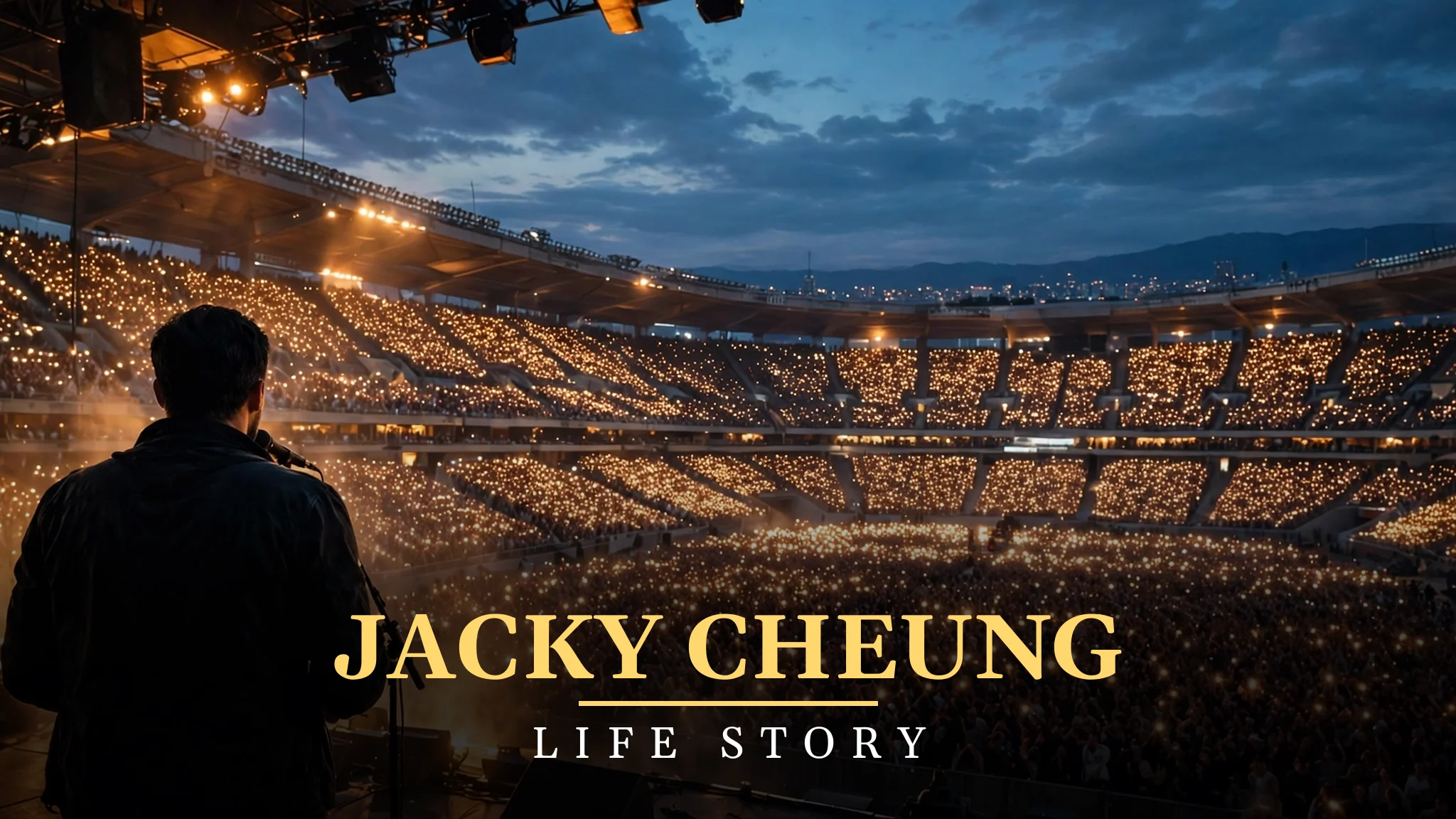
Jacky Cheung’s concerts are famous across Asia, not because they are the flashiest, but because they are the most musical. He stands on a large stage, in front of tens of thousands of people, and he sings with a control and a feeling that makes the whole stadium feel like a small room. His concert tours, including his long-running series of shows that have filled stadiums in Hong Kong, Taiwan, mainland China, and beyond, have drawn huge crowds, and his fans return again and again to hear his voice live. A Jacky Cheung concert is not only a show. It is a lesson in singing, and the audience leaves feeling that they have heard one of the finest voices in the world.
In 1996, Jacky married May Lo, an actress, and they have two daughters. Marriage and fatherhood changed his life, as they change the lives of many people, and they gave him a new sense of what matters. He has spoken about his family with love, and he has tried to balance the demands of a busy career with the needs of his home. That balance is not easy for a singer who travels constantly, but Jacky has worked at it, and his family remains a central part of his life, even when the stage calls him away. He is known in Hong Kong for being a devoted husband and father, and that reputation is as important to him as his fame as a singer.
In the years since, Jacky has continued to release music and to perform, even as the music world has changed around him. Streaming, social media, and new styles of pop have changed how people listen to music, but Jacky has adapted without losing himself. He has released new albums, he has performed in concerts that have broken records for their length and their scale, and he has appeared on television, sharing his experience with younger singers. He is no longer only a star. He is a senior figure in Hong Kong music, and younger singers look to him for guidance, just as he once looked to older singers for guidance when he was starting out.
Through it all, his voice has remained his greatest gift. It is a voice that is strong and warm at the same time, and it has not lost its power with the years. He has looked after it, he has trained it, and he has used it with care. That is why, after more than thirty-five years, people still want to hear him sing. They trust his voice, and they trust the person behind it, an office worker who became a god of songs without ever forgetting how to be humble.
The Humility of a God of Songs
Jacky Cheung is known in Hong Kong not only for his voice, but for his humility, and that humility is one of the most remarkable parts of his story. He is called the God of Songs, yet he behaves like an ordinary man. He is polite, he is modest, and he is quick to praise other singers and slow to praise himself. He has said in interviews that he does not think of himself as a god, and that he is only a singer who works hard and who loves music. That attitude is rare in a star of his fame, and it is one of the reasons his fans love him so deeply. They do not only love his voice. They love the person behind the voice, a person who has stayed humble even at the top.
That humility also shows in his work. He does not demand the biggest part in a film, he does not demand the loudest billing on a concert poster, and he does not try to outshine other singers. He takes the work that suits him, he does it with care, and he lets the work speak for itself. He has helped younger singers, he has shared the stage with them, and he has given them advice that comes from real life, not from pride. He tells them to practise, to look after their voices, and to be true to themselves, because those are the lessons that carried him from the airline office to the biggest stages in Asia.
His humility is also visible in his family life. He is a husband and a father, and he has kept his family out of the spotlight, protecting their privacy and giving them a normal life as far as possible. He does not use his family to gain attention, and he does not share their private moments with the public. That respect for privacy is part of his character, and it is one of the reasons his fans respect him. He is a star who knows where the stage ends and where life begins, and he guards that line with care, just as he guards his voice with care.
Why Jacky Cheung Still Matters
Jacky Cheung still matters today, not only because of his songs and his films, but because of the example he sets for younger stars. He shows that a singer can come from an ordinary job, can work hard, can stay humble, and can become one of the greatest voices in the history of Chinese music. He shows that a career can last for decades if it is built on quality, on care, and on respect for the audience. He shows that a star can be a god of songs and still be a kind and modest man, and that those two things are not in conflict, but are part of the same person.
For a new listener, the best place to start is Goodbye Kiss, because it shows his voice at its strongest and his message at its clearest. Then listen to his other ballads, and hear how he can make a quiet song feel like a conversation with a friend. Then watch As Tears Go By, and see how he can act with energy and with emotion. Together, these pieces show a complete artist: a singer, an actor, a husband, and a father. He is the God of Songs, and he earned that title one song at a time, starting from behind a desk in an airline office and ending on the biggest stages in Asia.
Jacky Cheung’s story is not a story of sudden fame. It is a story of an office worker who loved to sing, who worked hard, who waited for his chance, and who then spent more than thirty-five years earning the trust of his continent. He is a reminder that a great voice can come from anywhere, that humility is a strength, and that a song sung with honesty can last for a lifetime.
My Take:
When I think about Jacky Cheung, the first thing I think about is not his title, and not his fame, but the desk. I keep picturing him as a young man in Hong Kong, sitting in an office for an airline, booking seats on the telephone, and singing in his head while he worked. That image stays with me, because it tells me who he is in a way that no photograph of a stadium concert can. He is a person who had an ordinary job, who lived an ordinary life, and who carried an extraordinary voice inside him, waiting for its chance. I think about the many people in the world who sit at desks, who work in offices, who serve customers, and who carry a dream inside them that no one can see. Jacky is proof that the dream can come true, even from behind a desk, and that is a message I find deeply hopeful.
I think about the contest in 1984, and I find it encouraging in a way that many star stories are not. He was twenty-three years old, he was not a teenager, and he was not a person with nothing to lose. He had a job, he had a salary, and he had a future, and he risked that future to sing in a contest. That takes a special kind of courage, because it is easy to dream when you are young and have nothing, and it is much harder to dream when you are an adult with responsibilities. Jacky dreamed anyway, and he sang anyway, and he won. I think about the young man who walked onto that contest stage, not knowing if his voice was good enough, and I admire him for walking on at all. Many of us never walk on. We stay behind our desks, we tell ourselves that it is too late, and we let the dream fade. Jacky did not let it fade. He gave it a chance, and the chance changed his life. That is a lesson I carry with me: it is never too late to try, and a dream does not have an expiry date.
Goodbye Kiss is the song I return to most often when I think about him, because it is a song about saying goodbye, and saying goodbye is one of the hardest things in life. We say goodbye to people we love, to places we love, and to times in our lives that will never come back. Jacky sings about that goodbye with a voice that is both sad and beautiful, and he makes the listener feel that the goodbye is not only an ending, but also a memory that will stay. I think about the people who have played Goodbye Kiss when they were leaving Hong Kong, when they were leaving a love, or when they were saying goodbye to a parent, and I realise that a song can be a friend in the hardest moments of life. Jacky gave Asia a song for those moments, and that is a gift that goes far beyond entertainment. It is a gift of comfort, and comfort is one of the most precious things a singer can offer.
I also admire his voice itself, and I want to be clear about what I mean by that. I do not only mean that he can sing high notes or hold a long note, although he can do those things. I mean that his voice sounds true. When he sings a ballad, I believe him. When he sings about love, about loss, and about longing, I believe that he has felt those things, and that he is singing from his own heart, not from a script. That honesty is rare, and it is the reason his fans have stayed with him for more than thirty-five years. People can tell when a singer is only performing, and they can tell when a singer is truly feeling the song. Jacky makes people feel that he is truly feeling it, and that feeling is what turns a listener into a fan for life. It is also what earned him the title of God of Songs, because a god of songs is not only a person with a good voice. It is a person whose voice can touch the heart, and Jacky’s voice does that, again and again.
His acting in As Tears Go By is another part of his work that I find moving, because it shows a different side of him. He plays Fly, a young gangster who is loyal to his friend and who lives a dangerous life, and he plays him with energy and with emotion. He won the Best Supporting Actor award for that role, and the award meant a great deal, because it proved that he was not only a singer. He was an artist in the full sense of the word, and his art could live on a screen as well as on a stage. I think about the humility in that performance, because he did not demand the biggest part. He took a supporting part, and he made it unforgettable. That is a lesson for all of us: we do not need to be the centre of attention to make a difference. We can play our part well, even if it is a small part, and our work will be remembered. Jacky played a supporting part, and he won an award for it, because he played it with his whole heart.
I also think about his humility, because it is easy to overlook humility when we talk about great stars. Jacky is called the God of Songs, yet he behaves like an ordinary man. He is polite, he is modest, and he is quick to praise other singers. He has said that he does not think of himself as a god, and that he is only a singer who works hard. I think that attitude is one of the reasons his career has lasted so long. A star who believes his own praise will stop growing, because he will think he has nothing left to learn. A star who stays humble will keep learning, will keep practising, and will keep getting better. Jacky has kept learning for more than thirty-five years, and his voice is still strong because he has never stopped working on it. That is a lesson for anyone who wants to last: stay humble, keep practising, and never believe that you have nothing left to learn.
His concerts are the part of his story that I find most impressive in a practical sense, because they show what a great voice can do in a large space. He stands on a stadium stage, in front of tens of thousands of people, and he sings with a control that makes the whole stadium feel like a small room. That is not easy. A large space can swallow a voice, and a large crowd can make a singer shout. Jacky does not shout. He sings with control, with feeling, and with a clear sound that fills the space without forcing it. I think about the young singers who watch his concerts and who try to learn from him, and I realise that he is not only a performer, but also a teacher. He teaches by example, by showing what a voice can do when it is trained, cared for, and used with honesty. That teaching will outlast his own concerts, because it lives in the singers who have learned from him.
What I learn from Jacky Cheung, in the end, is that a great voice can come from anywhere, that humility is a strength, and that a long career is built on steady work and on honesty. He did not become the God of Songs by being the loudest, or the most fashionable, or the most shocking. He became the God of Songs by singing the truth, by choosing songs that mattered, by working hard, and by treating his audience with respect. He also teaches me that it is never too late to follow a dream, that an office worker can become a star, and that a star can stay humble and still be great. Those are lessons that go far beyond music, and they are lessons I will keep.
If I could speak to a young person who is just finding Jacky Cheung now, I would say this. Listen to Goodbye Kiss, and hear the sadness and the beauty in it. Listen to his other ballads, and hear how he sings about love and loss with honesty. Watch As Tears Go By, and see how he can act with energy and with feeling. Then think about your own life, and about the dream you carry, even if you are sitting at a desk right now. Do not think that your dream has an expiry date, and do not think that an ordinary job means an ordinary life. Jacky was an office worker, and he became the God of Songs, because he believed in his voice and he gave it a chance. Give your dream a chance, practise every day, stay humble, and sing your own song with honesty. That is, I think, the best way to honour a singer who has given so much to his listeners.
I will remember Jacky Cheung as the God of Songs who earned his title by telling the truth, one song at a time. He is a singer, an actor, a husband, and a father, and a voice that Asia trusts. His songs will keep playing in karaoke bars, in cars, and in quiet rooms for many years to come, and each time they play, they will remind us that a song can be a friend, and that a voice that is honest can help us feel a little less alone in saying goodbye. I also think about his long concert tours, and about what it takes to sing for hours, night after night, in stadiums across Asia. He has performed in Hong Kong, in Taiwan, in mainland China, and in many other places, and his concerts are known for their length, their scale, and their musical quality. He does not rush from one hit to the next. He takes his time, he lets a song breathe, and he gives the audience a full evening of music. I think about the stamina that takes, not only in the voice, but in the body and in the mind, and I realise that Jacky has treated his voice like an athlete treats his body: with training, with rest, and with care. He warms up, he practises, and he does not push his voice when it is tired. That care is why his voice is still strong after more than thirty-five years, and why audiences still come to hear him live. He is a singer who respects his gift, and that respect is the reason the gift has lasted.
His role in Bullet in the Head is another part of his film work that I think about often, because it is a powerful film about friendship and war, and Jacky plays a man caught in a terrible situation. He brings a raw emotion to the role, a sense of loyalty and of pain, that makes the audience feel the weight of the story. I think about the difference between his singing and his acting, and I see that as a singer he is the God of Songs, a voice that fills a stadium, and as an actor he is often a man who gives his best to a role without needing to be the centre of attention. That humility in acting is rare, and it is one of the reasons directors loved working with him. He did not demand the biggest part. He took the part that suited the film, and he played it with full commitment. That attitude, of serving the story rather than serving himself, is the mark of a true professional.
I also think about his daughters, and about the quiet family life he has built. He married May Lo in 1996, and they have two daughters, and he has kept his family out of the spotlight, protecting their privacy and giving them a normal life as far as possible. I think about a man who is famous across Asia, and who comes home to be a father, to help with homework, and to live a normal family life, and I see a complete person, not only a star. He does not use his family to gain attention, and he does not share their private moments with the public. That respect for privacy is part of his character, and it is one of the reasons his fans respect him. He knows where the stage ends and where life begins, and he guards that line with care, just as he guards his voice with care.
His voice training is another part of his story that deserves attention, because a voice like his does not stay strong by accident. He has practised for decades, he has learned how to breathe, how to hold a note, and how to sing with feeling without damaging his voice. I think about the young singers who try to sing loudly all the time, and who hurt their voices, and I want to point to Jacky and say: listen to how he sings, with control, with feeling, and with care, and learn from him. He sings with power when a song asks for power, and he sings quietly when a song asks for quiet, and he knows the difference. That knowledge comes from years of practice, and from a deep respect for the craft of singing. He is a teacher by example, and his example will outlast his own concerts, because it lives in the singers who have learned from him.
Finally, I think about his place among the Four Heavenly Kings, and about how he earned the title of God of Songs among them. Jacky was not the most fashionable king, and he was not the most dramatic. He was the singer with the best voice, and that voice set him apart. I think about the four kings sharing the stage, each with his own strength, and I see that Jacky’s strength was the simplest and the most lasting: he could sing better than anyone else, and he could make a song feel true. That is a lesson for anyone who feels compared to others: you do not need to be the loudest, or the most fashionable, or the most dramatic. You need to be the best at what you do, and to do it with honesty, and the world will recognise you. Jacky did that, and the world called him the God of Songs, and the name has stayed with him for more than thirty years.
Frequently Asked Questions
What did Jacky Cheung do before he became a singer?
Jacky Cheung worked as a reservation officer for Cathay Pacific in Hong Kong, booking airline seats and answering telephones, before he won an amateur singing contest in 1984 and began his professional music career.
What is Jacky Cheung’s most famous song?
Jacky Cheung’s most famous song is Goodbye Kiss, released in 1993, a ballad about saying goodbye to a love that became one of the best-selling Chinese-language albums of all time and earned him the title God of Songs.
Why is Jacky Cheung called the God of Songs?
Jacky Cheung is called the God of Songs because his strong, warm and controlled voice is widely seen as one of the finest in Chinese pop music, and his songs, especially his ballads, have moved listeners across Asia for more than thirty-five years.
Which film won Jacky Cheung an acting award?
Jacky Cheung won the Hong Kong Film Award for Best Supporting Actor for As Tears Go By in 1988, a Wong Kar-wai film in which he played Fly, a loyal young gangster living a dangerous life in Hong Kong.
Was Jacky Cheung one of the Four Heavenly Kings?
Yes, Jacky Cheung was one of the Four Heavenly Kings of Hong Kong in the 1990s, alongside Andy Lau, Leon Lai and Aaron Kwok, and he was known among them as the God of Songs for his exceptional voice.
Is Jacky Cheung married and does he have children?
Jacky Cheung married the actress May Lo in 1996 and they have two daughters, and he is known in Hong Kong for being a devoted husband and father who protects his family’s privacy.


