Actor Who Refused His Oscar
In this post
Los Angeles, the evening of 27 March 1973. Inside the Dorothy Chandler Pavilion, the 45th Academy Awards are glowing along — gowns, smiles, golden statues, polite applause. Millions of people are watching on television, around 85 million by the count given in later reports.
The biggest acting prize of the night is coming, and everybody knows the favourite: Marlon Brando, for The Godfather.
There is only one problem. Brando is not in the building.
Slow this night down, minute by minute, and watch what happened instead.
Minutes Before: A Woman Arrives in a Buckskin Dress
Sacheen Littlefeather reached her seat only minutes before the Best Actor award was announced. The 26-year-old actress and activist had come with Brando’s secretary, Alice Marchak. She wore a fringed and beaded buckskin dress and moccasins, her long dark hair tied with beadwork.
In her hands was the reason for everything that followed: a long typed speech, written by Brando himself. It ran to 739 words — far more than any winner is ever allowed to say.
The show’s producer, Howard W. Koch, saw those pages and told her plainly: “You can’t read all that.” Sixty seconds was all she would get.
Littlefeather later told the story with a sharper edge. In her telling, Koch warned her that she had 60 seconds, or she would be removed from the stage and arrested. Koch remembered it differently — he said he allowed her to stay and speak after she promised not to make a scene. Two people, two memories of the same tense minutes. That difference matters, and this night is full of them.
She also carried a promise. Brando had told her not to touch the trophy.
The Envelope Opens
The Best Actor award was presented by two stars: the Norwegian actress Liv Ullmann and the British actor Roger Moore, the new James Bond. They read the five nominees. Then Ullmann opened the envelope and called the name everyone expected:
Marlon Brando, for The Godfather.
The cameras turned to find the winner — and found, instead, a young woman in Apache dress walking down the aisle toward the stage. The announcer explained to the puzzled audience: “Accepting the award for Marlon Brando and The Godfather, Miss Sacheen Littlefeather.”
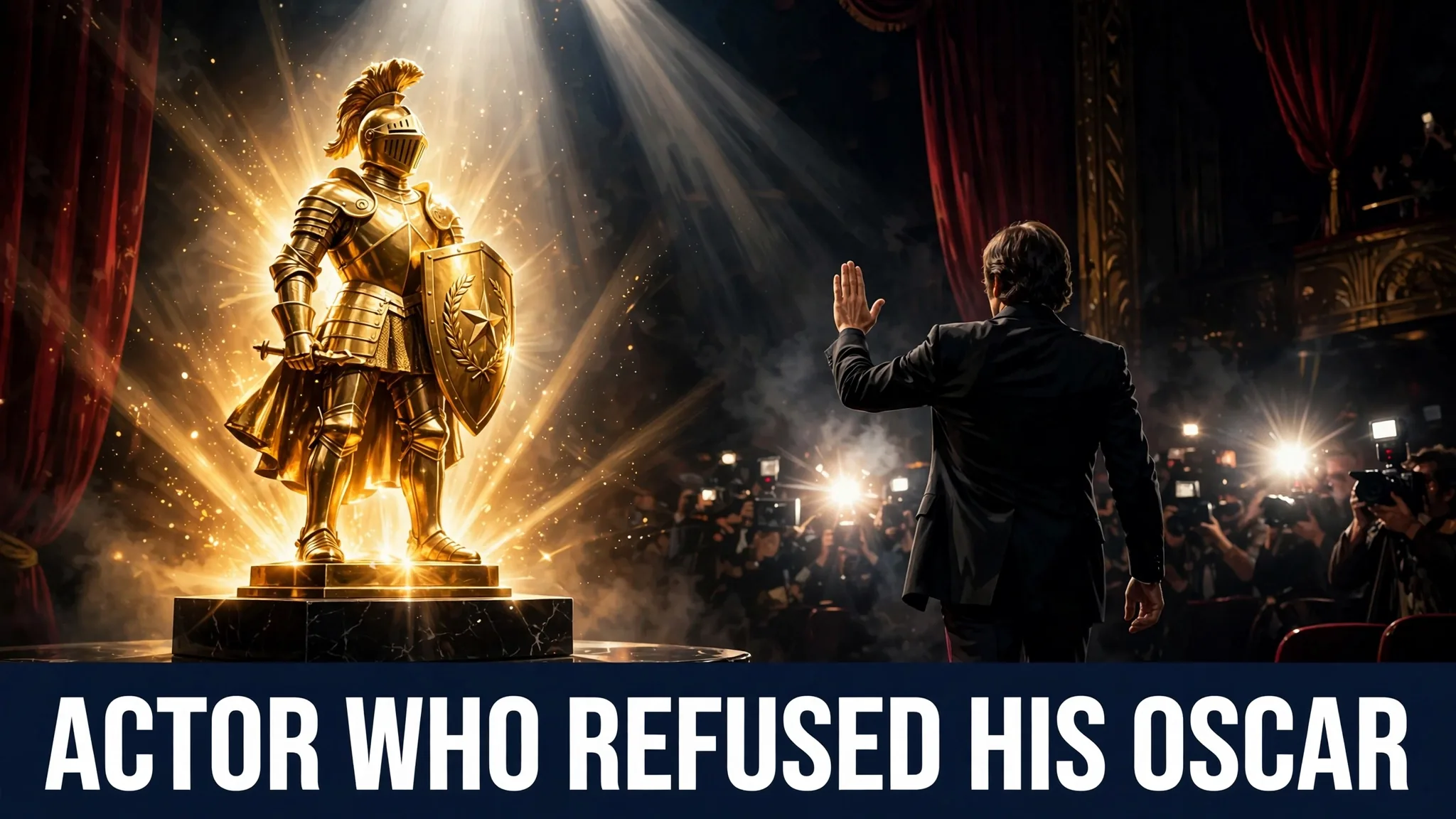
She climbed the steps. Moore held out the golden Oscar statue toward her.
She raised her hand and waved it away.
Sixty Seconds at the Microphone
The long speech could not be read, so Littlefeather spoke off the cuff, calmly, choosing her own words in the moment. She introduced herself, said she was representing Marlon Brando, and explained that he had asked her to tell the audience, in a very long speech she could not share because of time, that he “very regretfully cannot accept this very generous award.”
Then came the reason: “the treatment of American Indians today by the film industry… and on television in movie reruns, and also with recent happenings at Wounded Knee.”
At that line, sound rolled through the hall — booing and applause mixed together. She paused, said “excuse me,” and finished gently, saying she begged that she had not intruded on the evening, and hoping that “our hearts and our understandings will meet with love and generosity.”
Sixty seconds. That is all it took to split the room in two.
Moore escorted her off the stage toward the waiting press. As she passed the seats, she later recalled, some people mockingly made the “tomahawk chop” gesture at her.
Why Did Marlon Brando Refuse His Oscar?
Brando had planned the boycott before the ceremony, and it had two targets.
The first was Hollywood itself. For decades, American films had shown Native Americans as villains, savages or background extras, while the leading Native roles were usually given to white actors. Littlefeather had worked as a spokesperson against exactly that stereotype, and had known Brando for about a year — though accounts of how they first met still differ.
The second was happening far from Los Angeles, in South Dakota. At Wounded Knee, around 200 members of the American Indian Movement had occupied the small town and were facing off against thousands of United States marshals and other federal agents. The standoff had begun the previous month and was still going on as the Oscars were handed out. Brando wanted the country’s eyes on it.
So the most powerful actor in the world used the biggest stage in entertainment to say: keep your statue.
My own feeling, watching this story from fifty years away, is that the bravest person in that hall was not the famous star who stayed home. It was the 26-year-old who walked up those steps in his place, knowing the room might turn on her — and kept her voice steady anyway.
The Jokes, the Boos and the Backstage Legend
The rest of the night showed how raw the moment had left people. Later in the same ceremony, before announcing the Best Actress winner, Raquel Welch said, “I hope the winner doesn’t have a cause.” Clint Eastwood, presenting Best Picture, joked that he did not know if he should present the award “on behalf of all the cowboys shot in all the John Ford Westerns over the years.” Co-host Michael Caine criticised Brando for letting “some poor little Indian girl take the boos” instead of standing up and doing it himself.
Then there is the night’s most repeated backstage story. Littlefeather said for years — repeating it to the Los Angeles Times in 2016 — that John Wayne was waiting in the wings, furious and ready to drag her off the stage, held back only by six security guards. The show’s producer and its director both recalled the same scene.
Now the honest part: film historians Farran Nehme and Scott Eyman have since called that story a “persistent urban legend” that never happened, saying it was created by Pasetta a year after the ceremony and grew more exciting each time it was told. Wayne was reportedly angry, as many were. Whether six men truly held him back, the record cannot prove.
The Speech the World Read Afterwards
The 739 words Brando could not fit into the ceremony reached the public anyway. At a press conference afterwards, Littlefeather read the full text to journalists, and The New York Times published it in full.
Three months later, on The Dick Cavett Show, Brando said he was embarrassed for Sacheen and distressed that people had booed and whistled at her. “They should have at least had the courtesy to listen to her,” he said.
And the golden statue itself? Roger Moore was left holding it. Sacheen Littlefeather never touched it — she had promised. Brando never came to collect it. The most talked-about Oscar of the year simply stayed unclaimed, and the Academy later changed its ways: from then on, winners could no longer send someone else to accept — or refuse — an award for them.
The Price She Paid
Brando went back to being Brando. Littlefeather paid the bill.
She later said she was blacklisted by Hollywood — “redlisted,” as she put it — shut out of talk shows and casting offices, with threats made against her. She appeared in only a handful of small films, among them The Trial of Billy Jack and Winterhawk, before acting slipped away from her.
Her life after the spotlight was quieter and, in its own way, just as determined. She earned a degree in holistic health, taught in a traditional Indian medicine programme in Tucson, Arizona, worked with AIDS patients in San Francisco — including at a hospice founded by Mother Teresa — and helped found the American Indian AIDS Institute. She kept speaking for Native inclusion in Hollywood for decades, and in 2019 she received the Brando Award from the Red Nation International Film Festival.
An Apology, Almost Fifty Years Later
In June 2022, a letter arrived from the Academy’s president, David Rubin, calling her 1973 statement “a powerful statement that continues to remind us of the necessity of respect and the importance of human dignity.” Then it said the words she had waited half her life to hear: “The abuse you endured because of this statement was unwarranted and unjustified… For this we offer both our deepest apologies and our sincere admiration.”
On 17 September 2022, at an event called An Evening with Sacheen Littlefeather at the Academy Museum in Los Angeles, the apology was read aloud in full. She called it a dream come true — and answered with humour, the way she said her people survive: “We Indians are very patient people — it’s only been 50 years!”
She died just two weeks later, on 2 October 2022, at her home in Novato, California, aged 75, having lived with stage 4 breast cancer since 2018.
One Honest Footnote
An honest telling of this story cannot end without one more fact, because it is now part of the record. In her lifetime, Littlefeather said her father was of White Mountain Apache and Yaqui descent. Weeks after her death, her two younger sisters told journalist Jacqueline Keeler, writing in the San Francisco Chronicle, that their family has no Native American ancestry — that their father was born in Oxnard, California, of Spanish-Mexican descent, with no tribal ties. Keeler searched family records going back to 1850 and reported finding no evidence of Native ancestry. The Pascua Yaqui Tribe, for its part, noted that neither Littlefeather nor her parents were enrolled tribal members, while adding that this alone could not prove she had no Yaqui ancestry at all.
Readers will judge that dispute for themselves. What no one disputes is what happened on that stage in 1973, the abuse the Academy itself has apologised for, and the conversation that one quiet minute started — a conversation Hollywood is still having today.
Frequently Asked Questions
Who was Sacheen Littlefeather?
Sacheen Littlefeather (born Maria Louise Cruz, 14 November 1946) was an American actress and activist. She became famous worldwide on 27 March 1973, when she appeared at the 45th Academy Awards on behalf of Marlon Brando and declined his Best Actor Oscar for The Godfather.
Why did Marlon Brando refuse the Oscar for The Godfather?
Brando boycotted the 1973 ceremony to protest Hollywood’s treatment and portrayal of Native Americans in films and television, and to draw attention to the American Indian Movement’s ongoing standoff with federal agents at Wounded Knee, South Dakota.
What did Sacheen Littlefeather actually say on stage?
Given only about 60 seconds, she could not read Brando’s 739-word speech, so she summarised it off the cuff: Brando “very regretfully cannot accept this very generous award,” because of the film industry’s treatment of American Indians and the events at Wounded Knee. She later read the full speech to reporters, and The New York Times published it in full.
Did John Wayne really try to rush the stage?
That is what Littlefeather said, and the show’s producer and director recalled six security guards restraining Wayne. However, film historians Farran Nehme and Scott Eyman have called the story a “persistent urban legend” that never happened, so the truth of that famous backstage tale remains disputed.
Why did the Academy apologise to Littlefeather in 2022?
The Academy apologised for the abuse, mockery and career damage she suffered because of her 60-second speech. Its president, David Rubin, wrote that the abuse was “unwarranted and unjustified” and that her courage had gone unacknowledged for too long. The apology was read in full at a special evening in her honour on 17 September 2022, two weeks before she died.
Sources
- NPR / WHRO — “The Academy apologizes to Sacheen Littlefeather for her treatment at the 1973 Oscars”: https://www.whro.org/national-news/2022-08-15/the-academy-apologizes-to-sacheen-littlefeather-for-her-treatment-at-the-1973-oscars
- The Hollywood Reporter obituary — “Sacheen Littlefeather, Who Delivered Marlon Brando’s Oscar Rejection Speech, Dies at 75” (republished by Portside): https://portside.org/node/29643/printable/print
- h2g2 — “Sacheen Littlefeather and Marlon Brando’s Oscar Refusal”: https://h2g2.com/entry/A88029976
- Wikipedia — “Sacheen Littlefeather”: https://en.wikipedia.org/wiki/Sacheen_Littlefeather