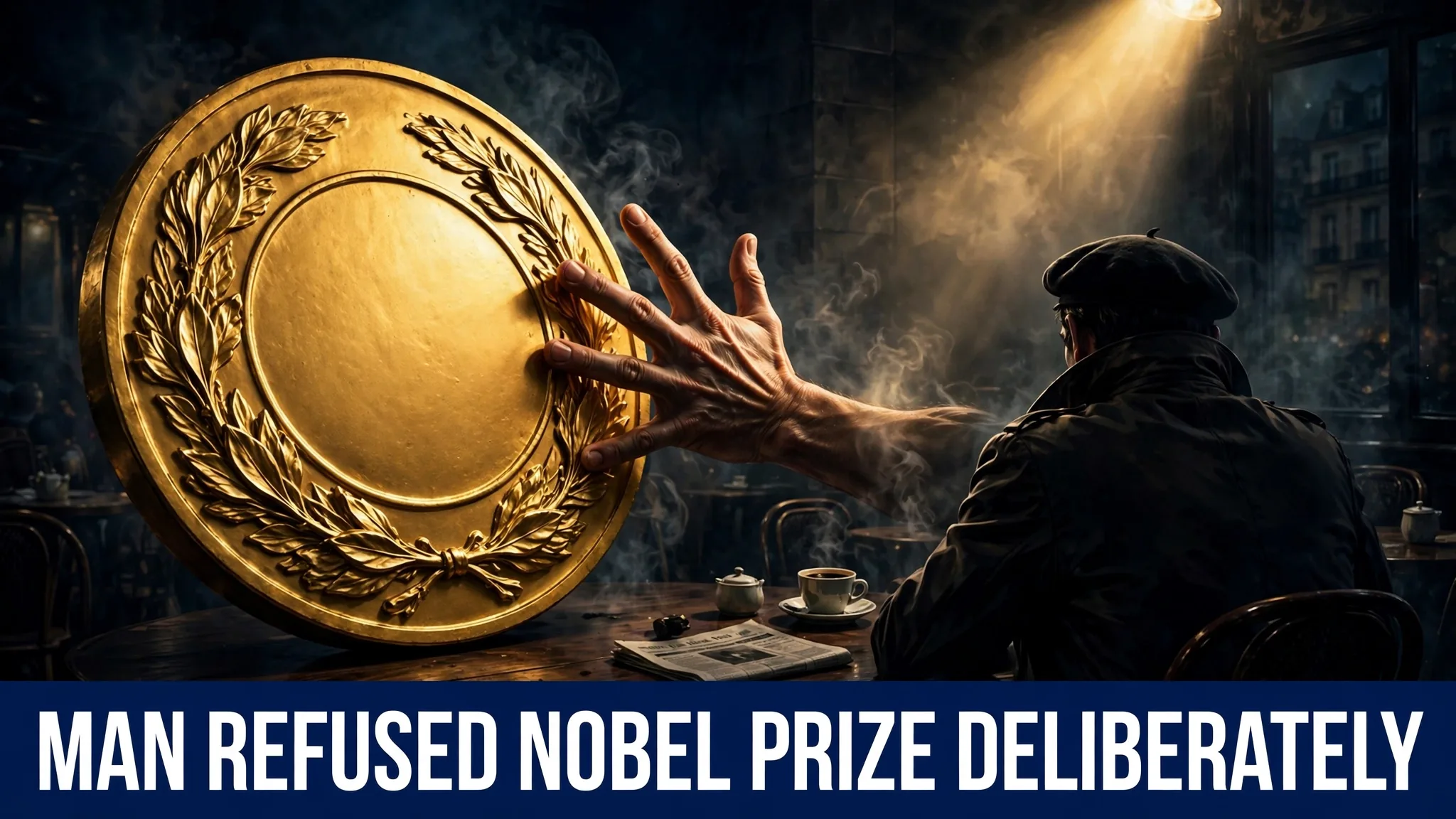
Man Refused Nobel Prize Deliberately
In this post
Paris, 14 October 1964.
A fifty-nine-year-old writer sat down with a pen and did something almost no human being has ever done. He wrote to Stockholm — politely, clearly — and asked to be taken off the list. The Nobel Prize in Literature was rumoured to be heading his way. Rumours were not enough for him. He wanted it in writing, his writing: if the Swedish Academy gave him the prize, he would not take it.
His name was Jean-Paul Sartre.
The strangest part? Nobody read the letter.
The Letter Sat There, Unopened
Eight days later, on 22 October 1964, the Swedish Academy stood before the world and announced its choice. The Nobel Prize in Literature went to Jean-Paul Sartre. The citation praised writing rich in ideas, burning with a spirit of freedom and a hunt for truth, work that had shaped an entire era.
His letter had simply arrived too late — or sat unread while the machinery moved on. Academy decisions, once locked in, cannot be unlocked. Sartre later admitted he had not understood that. He thought a man could still step aside. He could not.
So the crown came down on the head of the one man in Paris who had begged not to wear it.
The Very Next Morning, One Word: No
Sartre did not hesitate. He did not smile for the cameras and think it over. On 23 October, the French newspaper Le Figaro carried his public answer, and the answer was no.
He was gentle about it. He said sorry for the scandal. He sent warm words to the Swedish public. This was not an attack on the Academy, he insisted — and then he laid out his reasons, two sets of them, personal and objective, like a philosopher arranging knives on a table.
None Of This Was New For Him
Anyone surprised by the refusal had simply not been watching Sartre’s life.
He declined honours the way other men collect them. In 1945, France offered him the Legion of Honour, among the highest decorations his country gives. He turned it down. The respected Collège de France came calling. He would not enter. He even announced ahead of time that if the Soviet Union ever offered him its Lenin Prize, the answer would be no as well.
It was a rule, held for a lifetime. Every honour refused. No exceptions.
And this from a man the century could not stop reading. Born in Paris on 21 June 1905, Sartre wrote Nausea in 1938 and watched it travel the world. His play No Exit opened in 1944 and never really closed. In 1964 he published The Words, a memoir of his own childhood, and readers loved it. Beside him through all of it stood Simone de Beauvoir, his lifelong partner, and together they sat at the loud beating heart of existentialism, the philosophy that reached students and writers on every continent.
Stockholm had every reason to choose him. He had every reason, by his lights, to refuse.
A Writer Is Not A Building
The personal reason sat at the centre of his statement, and it came down to one image. A writer, he argued, must not let himself be turned into an institution.
Think about what that means. A medal is never just a medal. It ties the man to the machine that gave it. His private commitments would become the Academy’s commitments, tangled together. His next book would no longer arrive as one man’s words — it would arrive stamped, approved, official. Sartre wanted his pages to stand or fall on their own strength, in his own voice, with nothing gold standing between him and the reader.
Then came the objective reason, and it pointed at the map. This was 1964, deep in the Cold War, with the West and the communist East glaring across a divided world. Real exchange, Sartre said, should flow between people and between cultures — not through institutions parked in the middle. He also felt the prize’s history had not treated writers of every country and every belief evenly. Take the medal now, and the world would read it as choosing a side. He refused to be read that way.
Honestly, most of us would frame the letter from Stockholm and hang it over the desk. That is exactly why his no still stings a little. It quietly asks what each of us would protect, and what each of us would quietly sell.
Stockholm Answered: The Prize Stands Anyway
Now the story bends into something almost comic.
The Swedish Academy replied that a refusal changes nothing at all. The fact that he had declined the distinction did not, in the least, modify the validity of the award. The prize was his. Wanted or not. Only the presentation ceremony could not take place.
Read that slowly. Jean-Paul Sartre never travelled to Stockholm. He never held the gold medal. He never touched a single coin of the money. And yet his name sits on the official roll of Nobel laureates for 1964 to this day, with a small note beside it recording that he declined.
He dodged the reporters. He could not dodge the record book. The man became a Nobel winner by refusing to become one.
Two Refusals — Only One Of Them Was Free
Six years earlier, the same prize had produced a very different no.
In 1958, the Russian writer Boris Pasternak won the literature prize and at first accepted it. Then his own government turned on him. The Soviet authorities squeezed, threatened, and shamed him until his hand moved the way they wanted — and he declined. That refusal was not a choice. It was an extraction.
NobelPrize.org places the two men side by side, and the contrast could not be plainer. Pasternak was made to decline. Sartre declined because he had consistently refused all official honours. Others in history had been blocked from accepting. Sartre stood there with completely free hands — and used them to push the prize away.
Eleven Years Later, A Quiet Knock
One more twist survives, and it needs a warning label: this part is reported, not proven.
Lars Gyllensten, a member of the Swedish Academy, told the story in his memoir Minnen, bara minnen — “Memories, Only Memories” — published in 2000. According to him, in 1975 someone got in touch with the Academy. It was Sartre himself, the account says, or someone close to him, asking whether the prize money could still be handed over, eleven years after the refusal. The answer, according to the memoir, was no.
What really happened in that exchange? Who placed the call, and why? Nobody outside it can say for certain. What stands on solid ground is simpler: the money was never paid.
Fifty Thousand Mourners, And Not One Medal
Jean-Paul Sartre died in Paris on 15 April 1980. Some 50,000 people poured into the streets for his funeral.
Look at that crowd one more time. Not officials. Not an institution. Readers — tens of thousands of them, honouring a writer and nothing else. He had asked, all his life, to be judged by his books alone. Walking behind his coffin, Paris gave him exactly that.
So here is the question his refusal leaves sitting on the table. If the greatest honour of your life knocked tomorrow — the medal, the money, the world’s applause — and accepting it meant owing a small piece of yourself forever, would you open the door? Or would you pick up a pen, write a polite letter to Stockholm, and push it shut?
Frequently Asked Questions
What made Sartre turn the prize down? A rule he kept for his whole life: he declined every official honour, the Legion of Honour in 1945 included. He believed taking the Nobel would bind him to an institution, and he said a writer should not allow himself to be turned into one. He also refused to let his acceptance be read as picking a side in the Cold War.
Did he ever receive the medal or the money? No. The presentation ceremony never happened, and he never held the medal or touched the prize money.
Does his name still appear on the winners’ list? Yes. The Academy declared that his refusal did not touch the validity of the award, so official records still list Jean-Paul Sartre as the 1964 laureate in Literature, noted as having declined.
Had anybody refused a Nobel Prize before him? Boris Pasternak declined the 1958 literature prize, but only after the Soviet authorities forced his hand. Sartre’s refusal was the first one made freely, entirely by the winner’s own choice.
Did Sartre try to stop the prize before the announcement? He did. His letter of 14 October 1964 asked to be removed from consideration and warned that he would not accept. The letter went unread, and the Academy announced him on 22 October.
What about the claim that he asked for the money in 1975? Treat it as reported, not proven. Academy member Lars Gyllensten wrote in his 2000 memoir that Sartre, or someone close to him, asked in 1975 whether the money could still be paid, and was refused. The money was never handed over.
Sources
- NobelPrize.org, “Jean-Paul Sartre – Facts”: https://www.nobelprize.org/prizes/literature/1964/sartre/facts/
- NobelPrize.org, “The Nobel Prize in Literature 1964 – Press release”: https://www.nobelprize.org/prizes/literature/1964/press-release/
- NobelPrize.org, “Facts on the Nobel Prize in Literature”: https://www.nobelprize.org/prizes/facts/facts-on-the-nobel-prize-in-literature/
- Wikipedia, “Jean-Paul Sartre”: https://en.wikipedia.org/wiki/Jean-Paul_Sartre
- The picture on this page is an original illustration made for Talha M Blog.