AI Art and Copyright Explained: Who Owns AI Pictures
In this post
- Copyright in One Page: What the Law Actually Protects
- What Courts and Copyright Offices Have Said So Far
- The Training Question: Whose Work Taught the Machine?
- Can You Sell AI Art? The Practical Rules
- Artists, Style and Fairness: The Human Side
- Protecting Yourself: Practical Steps for Users and Creators
- What Is Likely to Change Next
- My Take:
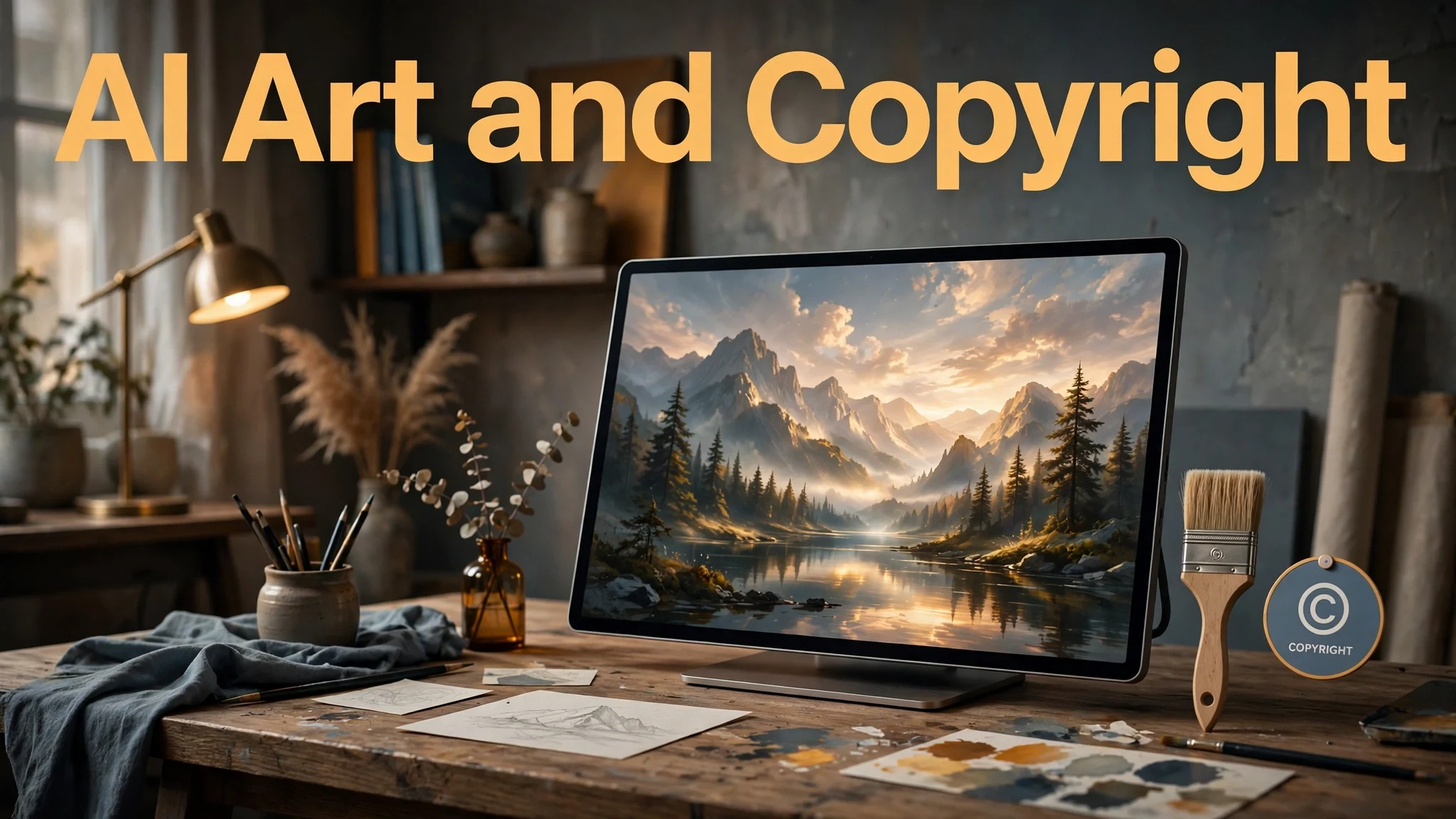
If you type a few words into an image generator and it produces a beautiful picture in seconds, a simple question follows: whose picture is it? Is it yours, because you wrote the prompt? Is it the company’s, because it built the model? Is it nobody’s, because a machine made it? Or does it belong in some way to the artists whose work the model was trained on? In 2027 this is not a philosophical puzzle. It is a practical question that decides whether you can sell the image, use it in an advert, claim it as your own, or be sued for using it.
The law is struggling to catch up, and it is doing so differently in different countries. Courts have begun to give answers, but those answers are narrow, they depend on the facts of each case, and they are already being appealed and argued over. Meanwhile millions of people are generating images every day, businesses are using them in marketing, and artists are discovering pictures that look strikingly like their own work. The gap between what the technology allows and what the law clearly permits is where most of the risk sits.
This article explains the question in plain language. It covers what copyright actually protects, what courts and copyright offices have said so far, how the training of AI models raises separate legal questions, what the rules are for selling and using AI images, and what both creators and users can do to protect themselves. It is not legal advice — for a specific dispute you need a lawyer — but it will help you understand the landscape before you make decisions that could cost you money or your reputation.
Copyright in One Page: What the Law Actually Protects
Copyright protects original creative work made by a human author: a painting, a photograph, a novel, a song. It gives the author the exclusive right to copy, sell, display and adapt that work, usually for their lifetime plus many decades. The key word is human. In most legal systems, including the United States, copyright has always assumed a human creator, because it was designed to reward human creativity and to give creators a way to earn a living from what they make.
Copyright does not protect ideas, styles or general techniques. You cannot copyright the idea of painting a sunset, or a style such as impressionism, or a method of shading. It protects the specific expression: this painting, with these colours in this arrangement. That distinction matters enormously for AI art, because many of the complaints about it are about style — a model that can produce an image “in the style of” a living artist — and style on its own has traditionally been outside copyright’s protection.
Copyright also does not protect facts, or work with no creativity at all. A purely mechanical copy, or a list of facts arranged in an obvious way, generally gets no protection. When courts look at AI images, they ask where the human creativity is: in the prompt, in the selection and editing, or nowhere at all. The answer to that question, case by case, is what will decide who, if anyone, owns the picture.
What Courts and Copyright Offices Have Said So Far
The clearest official position so far has come from the United States Copyright Office, which has said that a purely AI-generated image, produced from a short text prompt with no meaningful human creative input, is not eligible for copyright protection, because there is no human author. A person who types “a cat in a hat” and receives a picture cannot claim copyright in that picture in the US under this guidance. The reasoning is that the machine, not the person, decided the details of the image.
But the same guidance leaves an important door open: when a human makes creative choices that shape the final work — by writing a detailed prompt, by generating many versions and selecting and arranging them, by editing the image substantially in other software, or by combining AI output with original human work — the human contribution may be protectable. The protection would cover the human-authored parts, not the purely machine-generated parts. How much human input is enough is still being argued, and different cases may come out differently.
Courts in other countries have reached different conclusions, and some have not ruled at all. In the UK, the law contains a provision for computer-generated works, but how it applies to modern AI is disputed and untested at the highest level. In the EU, the emphasis has been on transparency and on the rights of the people whose work was used for training. The practical result is that the same image may be treated differently in different countries, and anyone using AI art internationally needs to be aware that there is no single global rule.
The Training Question: Whose Work Taught the Machine?
Separate from who owns the output is the question of how the model was trained. Image generators learn from enormous datasets of pictures, many of which were taken from the internet without the permission of the people who made them. Artists argue that this is a form of mass copying: their work was used to build a commercial product that can now imitate them, without payment or consent. The companies argue that training is a fair use, comparable to a human artist studying thousands of paintings to learn how to paint.
This dispute is now being fought in courts, with lawsuits brought by artists, photographers and stock image companies against AI firms. The outcomes are not yet settled, and they will matter enormously. If training is found to be infringement, the whole business model of some AI companies changes, and there may be licensing schemes where artists are paid when their work is used for training. If it is found to be fair use, the current model largely continues, though pressure for voluntary payment and opt-outs may still grow.
Even before the courts decide, the market is moving. Some companies now offer models trained only on licensed images, or on public domain work, and some offer to pay creators whose work is included. Others allow artists to opt out of future training datasets. These are partial answers, not a settlement, but they show that the industry knows the question will not simply go away. For users, the practical point is that the legal status of the model you use can affect the risk of the images you make with it.
Can You Sell AI Art? The Practical Rules
Whether you can sell an AI image depends on where you are, what you made, and what the tool’s terms say. If the image has no copyright protection, then in principle anyone can copy it, which makes it a weak product to sell: a buyer who pays for exclusive rights may discover they have no legal way to stop others using the same image. Some sellers deal with this by selling the file, the service, or a licence to use it, rather than claiming copyright they may not have. That distinction matters, and it should be explained honestly to buyers.
The tool’s terms of service matter as much as the law. Most major image generators give paying users broad rights to use what they generate, including commercially, but the terms vary, and free tiers are often more restricted. Some tools keep a licence to use your outputs themselves. Before you build a business on AI images, read the terms of the tool you use, and check whether they change — they do, and what was allowed last year may not be allowed this year.
There is also the question of what is in the image. An AI picture that closely resembles a copyrighted character, a famous photograph, a trademarked logo or a real person’s face can create legal trouble even if the image itself is AI-generated. The generator does not know or care about trademarks; it produces what the prompt asks for. The responsibility for what you publish or sell rests with you, not with the tool. A prompt that asks for a well-known character is a risk you are choosing to take.
Artists, Style and Fairness: The Human Side
For working artists, the issue is not only legal but personal and economic. An illustrator who spent a decade developing a distinctive style can now see a model produce work in that style in seconds, and can lose commissions to it. The fact that style itself is not protected by copyright does not make that feel fair, and it does not make it harmless. The law may not have an answer, but the market and the public conversation are still open, and many artists are arguing for new rules, or for licensing, rather than relying on old ones.
Some artists have responded by adapting: using AI as a tool for sketches and ideas while keeping the finished work human, or by building a reputation and a relationship with clients that a machine cannot copy. Others have organised, joined lawsuits, or used tools that attempt to protect their work from being used in training. There is no single right response, and the pressure is real. What is clear is that the value of human art is increasingly in the things a model cannot do: a personal vision, a relationship with an audience, and the judgement to know when a picture is right.
For users of AI art, the fairness question is worth taking seriously even where the law is silent. If you admire an artist, commission them. If you use a tool that can imitate a living artist, consider whether that is the right thing to do, not only whether it is legal. The tools will keep improving, but the norms around them are still being written, and the choices ordinary users make now will help decide what those norms become.
Protecting Yourself: Practical Steps for Users and Creators
If you use AI images, there are practical steps that reduce risk. Keep records of your prompts, your editing, and the versions you made, because that evidence shows your human contribution if ownership is ever questioned. Read the terms of the tool you use and keep a copy. Avoid prompts that name living artists, famous characters, trademarks or real people. If you use an image commercially, consider whether you need a licence, insurance, or a human artist to create a clean version instead.
If you are a creator worried about your work being used for training, there are steps too, though none is a complete solution. You can use opt-out mechanisms where they exist, add notices to your site, use tools designed to make images harder for models to learn from, and keep records of your original work with dates. Joining a collective or a lawsuit is a bigger step, but it is how many of the current cases are being fought. The most reliable protection remains the one that has always existed for artists: a distinctive voice and a direct relationship with the people who value it.
For businesses, the safest approach is to have a written policy: which tools are approved, what may and may not be put in a prompt, who checks outputs before publication, and what happens if a complaint arrives. That sounds bureaucratic, but it is far cheaper than a legal dispute, and it protects the company’s reputation as well as its legal position. In a fast-moving area, a clear policy that is actually followed is worth more than a clever argument after the fact.
What Is Likely to Change Next
The law will keep moving. More court decisions are expected, and legislatures in several countries are considering new rules on AI training, transparency and labelling. One likely change is a requirement that AI-generated images be labelled as such, so that audiences know what they are looking at. Another is a licensing system for training data, similar to how music is licensed, where creators are paid when their work is used. Neither is certain, and both will be argued over for years.
Technology is moving too. Models trained only on licensed or public domain images are becoming more common, and tools that record the provenance of an image — where it came from, what was used to make it — are being developed. These may make it easier to prove ownership and to pay creators fairly. They will not settle the philosophical question of whether a machine can be creative, but they may make the practical questions easier to answer.
The most useful attitude for now is to treat AI art as a powerful tool with unsettled rules. Use it, enjoy it, and be honest about what it is. Do not claim rights you may not have, do not use it to imitate a living artist’s livelihood, and do not assume that because something is easy to generate, it is safe to sell. The rules will become clearer, but the choices you make while they are unclear will still matter.
My Take:
My view on AI art and copyright is that everyone in this argument has a point, and that is exactly why it is so difficult. The artists who say their work was taken without permission are right to feel that way, because in any ordinary sense, it was: pictures they made were copied into a dataset and used to build a product that can now do something like what they do. The companies who say they were learning patterns, not copying pictures, also have a point, because a model does not store and reproduce your painting; it stores statistical patterns across millions of images. Both things can be true at once, and the law has to find a way to live with that, not to pretend one side is simply wrong.
What bothers me most is the gap between what is legal and what is fair. Style is not protected by copyright, and there are good reasons for that — if style were protected, art would freeze, because every artist learns from those before them. But there is a real difference between a young painter studying a master and a company building a machine that can produce a thousand pictures in a living artist’s style on demand. The scale and the speed change the moral question, even if they do not change the legal one. I think the law will eventually catch up, probably with licensing rather than with a ban, but the years in between are hard on the people whose work is being used.
I am also sceptical of the claim that a short prompt makes someone the author of a picture. Typing a sentence is a creative act, in the sense that choosing words is creative, but the person typing does not decide the composition, the colours, the lighting or the details — the model does. That is why the Copyright Office’s position feels broadly right to me: a simple prompt is not enough, but real human shaping — detailed direction, selection, editing, combination — can be enough. The line is fuzzy, and it will be argued case by case, but the principle that authorship follows actual creative control seems like the right one to me.
For ordinary users, my practical advice is to be more careful than the tools encourage you to be. The tools are designed to make generation feel effortless, and effortlessness encourages carelessness: a prompt naming a famous artist, a character from a film, a real person’s face. The fact that the tool allows it does not mean it is safe, and the fact that millions of people do it does not mean it is legal. If you want to sell AI images, the honest approach is to make images that do not depend on anyone else’s work, keep records of how you made them, and tell your buyers plainly what they are buying. That honesty will cost you some sales. It will also keep you out of trouble.
I think the most interesting question is not who owns a single AI picture but what happens to the value of human creativity. If pictures become nearly free, the value shifts from the picture itself to the things around it: the idea, the taste, the relationship, the story, the judgement. An artist who can do those things will still be valuable, perhaps more valuable than before. An artist whose work was mainly producing competent pictures to a brief will have a harder time. That is a painful transition, and I do not want to minimise it, but it is also the same transition that photography forced on painters and that digital tools forced on many other crafts. The work changes. The human part of it does not disappear; it moves.
On the training question, I lean towards licensing. The music industry found a workable, if imperfect, system where songs are licensed and creators are paid when their work is used, and something similar could work for images. It would not be simple — how do you divide payment across millions of images? — but difficulty is not a reason to do nothing. A system where creators can opt in, be paid, and be credited would be fairer than the present one, and it would also give AI companies a cleaner legal position. I would rather see that negotiated than imposed by a court after years of lawsuits, but either way, some form of payment seems inevitable to me.
I also worry about the effect on trust. When any image can be generated, audiences begin to doubt every image, and that doubt damages photography, journalism and evidence itself. Labelling AI images honestly is a small step, but it matters: a picture that says it is AI-made is honest in a way that a picture passed off as a photograph is not. I would like to see labelling become normal, not because it solves the copyright question, but because it protects the shared understanding that a picture can be evidence of something real. That understanding is worth more than any single image.
For creators reading this, my advice is practical rather than comforting. Keep records of your work with dates. Learn the opt-out tools, even if they are imperfect. Build a direct relationship with your audience, because a platform or a model cannot take that from you. And consider using the tools yourself, not because you should have to, but because understanding them makes you harder to replace and better able to explain what you do that a machine cannot. None of that is fair — you did not ask for this change — but it is the set of moves that gives you the most control in a situation you did not choose.
For businesses, I would say the risk is not only legal but reputational. A company caught using AI images that imitate a living artist, or that reproduce a copyrighted character, will face a story that is worse than a lawsuit: a story about a company that took a shortcut. The cost of commissioning a human artist, or of using a licensed model, is small compared with that. A written policy, a check before publication, and a willingness to pay for what you use are not luxuries. They are the basic hygiene of a business operating in a new medium.
In the end, I think the question of who owns AI pictures will be answered not by one court case but by a slow accumulation of decisions, licences, norms and habits. The picture you generate today exists in a grey area, and you should act as if that grey area matters: be honest about what you made, be careful about whose work you lean on, and be ready for the rules to change. The technology is remarkable, and it will keep getting better. The question is whether we build rules around it that reward the people whose work made it possible, or whether we let the ease of generation erase the value of creation. That choice is still open, and it belongs to all of us, not only to lawyers.
Frequently Asked Questions
Who owns an AI-generated image?
In the United States, a purely AI-generated image from a short prompt generally has no copyright owner, because copyright requires a human author. If a human makes substantial creative choices — detailed direction, selection, editing or combination with original work — the human contribution may be protectable. Rules differ by country, so check local law.
Can I sell AI-generated art?
Often yes, but with limits. Most major tools give paying users broad rights to use outputs commercially, but if the image has no copyright protection, you may not be able to stop others copying it. Read the tool’s terms, avoid images that resemble copyrighted characters or trademarks, and be honest with buyers about what they are buying.
Is it legal for AI models to train on artists’ work?
This is still being decided in courts. Artists argue it is infringement; AI companies argue it is fair use, like a human studying many paintings. Several lawsuits are ongoing, and the outcome will shape the industry. Some companies already offer models trained only on licensed images.
Can AI copy an artist’s style legally?
Style on its own is generally not protected by copyright, so a model producing work in a general style is in a grey area. However, copying a specific work, using an artist’s name in a prompt to imitate them commercially, or reproducing recognisable elements can create legal and reputational risk.
Do I need to label AI-generated images?
Requirements vary by country and platform, and labelling rules are still developing. Some jurisdictions and platforms already require or encourage disclosure. Labelling honestly is good practice even where it is not legally required, because it builds trust with your audience.
What should I do if my art was used to train an AI model?
Check whether the provider offers an opt-out for future training, keep dated records of your original work, and consider joining a collective or seeking legal advice about your options. Tools also exist that aim to make images harder for models to learn from, though none is a complete solution.