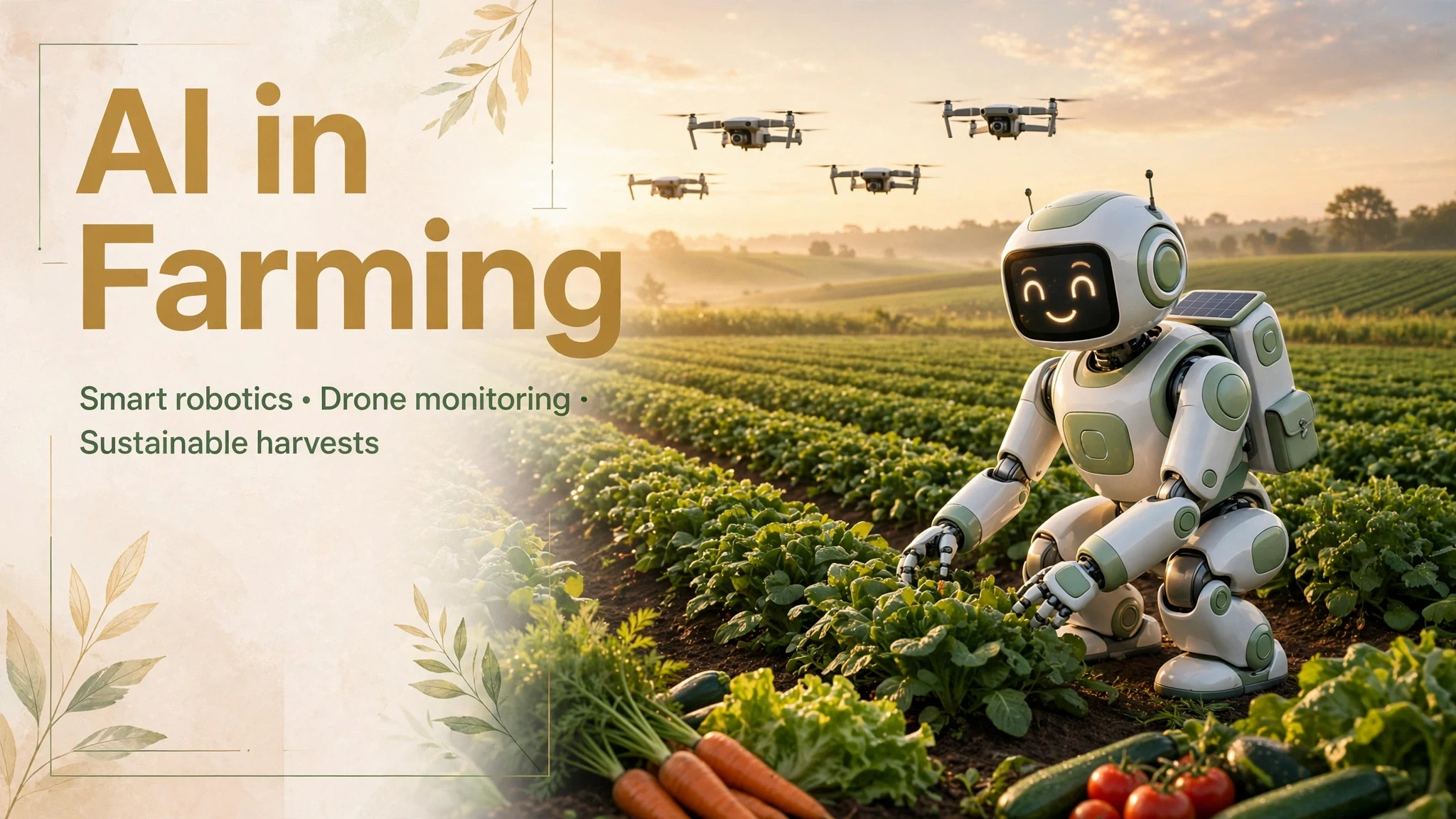
AI in Farming Explained: How Robots Grow Our Food
In this post
Most of the food on your plate in 2027 was probably touched by a machine that can see, decide and learn. A tractor that steers itself down a field, a drone that spots a sick plant before a human eye can, and a small robot that pulls weeds one by one are no longer science fiction. They are working on real farms right now, from huge wheat fields in the United States to small vegetable plots in the Netherlands. Artificial intelligence in farming is not one single invention. It is a whole set of tools that collect information about soil, weather, plants and animals, and then turn that information into decisions that used to depend entirely on a farmer’s experience.
The reason this matters is simple: the world needs more food, and farming is getting harder. Weather is less predictable, water is scarcer in many regions, labour is expensive and hard to find, and the cost of fertiliser and fuel keeps rising. At the same time, buyers and governments want food grown with fewer chemicals and less waste. AI promises to help farmers grow more from the same land while using less of everything else. A sprayer that only treats the weeds it can see, instead of spraying a whole field, can cut chemical use dramatically. A sensor that tells a farmer exactly when a field is thirsty can save thousands of litres of water over a season.
But AI in farming is not magic, and it is not replacing farmers. The best way to understand it is as a very fast assistant with excellent eyesight and a perfect memory, but no common sense of its own. It can count every plant in a field from the air, predict a disease outbreak from a change in leaf colour, or work out the best day to harvest. It cannot decide whether a family should take on debt to buy a new machine, comfort a farmer after a failed crop, or know the history of a particular piece of land the way the person who has worked it for thirty years does. This article explains how the technology actually works, where it helps most, what it costs, and what its limits are.
How AI Sees a Field: Cameras, Drones and Satellites
Everything starts with seeing. Modern farm AI relies on cameras that capture far more than a normal photograph. Multispectral cameras on drones record light in bands the human eye cannot see, including near-infrared, which reveals how healthy a plant is long before it looks sick to us. A healthy leaf reflects infrared light strongly; a stressed leaf reflects less. By flying over a field once a week, a drone can build a map showing exactly which patches are thriving, which are short of water, and which may be carrying the early signs of disease. Satellites do the same job on a bigger scale, covering thousands of hectares, though with less detail.
The images alone are useless without software that can read them. Machine learning models are trained on millions of labelled pictures of crops, weeds, pests and diseases, so they learn the difference between a young maize plant and a weed that looks almost identical. When a camera on a tractor or robot passes over the field, the model identifies each plant in real time, often in a fraction of a second. This is the same kind of image recognition that unlocks a phone with a face, but applied to leaves, stems and soil instead of people.
What makes this powerful is the scale and the speed. A person walking a field can inspect a few hundred plants in an hour and will get tired, miss things and disagree with a colleague about what they saw. A drone can survey a whole farm in a morning and produce the same map every time, with every plant counted and located. Farmers can then walk straight to the problem spots instead of searching blindly. The technology does not remove the farmer’s judgement; it points that judgement at the right place at the right time.
Robots That Weed, Plant and Pick
The most visible face of farm AI is the robot. Weeding robots are already working commercially: small machines that roll between crop rows, use cameras to tell crop from weed, and remove the weed with a tiny blade, a burst of hot air, or a precise zap of electricity. Because they only attack weeds, they can cut herbicide use by a large amount on the fields where they work. Some run on solar power and work slowly through the night, which sounds odd until you realise that a robot does not need sleep, holidays or overtime pay.
Planting and harvesting robots are harder, because every fruit and vegetable is a slightly different shape, colour and ripeness. Strawberry-picking robots use soft grippers and cameras to judge whether a berry is red enough to pick, then place it gently in a tray without bruising it. The work is slow compared with a skilled human picker, and the machines are expensive, so they are mainly used where labour is very scarce or very costly. Still, each year they get a little faster and a little cheaper, and growers who once dismissed them are now running trials.
The third group is the big machines: tractors and harvesters that drive themselves. Using GPS accurate to a few centimetres, these machines can plough, sow and spray in perfectly straight lines, day or night, without overlapping passes or missing strips. That precision saves fuel, seed and fertiliser. The farmer still supervises, plans the work and handles anything unusual, but the long, tiring hours of staring at a field edge while steering are gone. For many farmers, that alone is worth a great deal.
Smart Irrigation: Giving Each Plant Just Enough Water
Water is one of the biggest costs and risks in farming, and AI helps use it far more carefully. Soil sensors buried in a field measure moisture at different depths and send readings to a central system every few minutes. Combined with weather forecasts, the system works out whether a field needs watering, how much, and when. If rain is forecast for tomorrow evening, it may hold off watering today, saving water that would otherwise be wasted.
The difference from old-fashioned timers is that the decision is made field by field, and even zone by zone. A low corner of a field that stays damp needs less water than a sandy ridge that dries quickly. Instead of watering the whole field equally, a smart system can open different valves for different zones. Growers using this approach commonly report meaningful water savings, though exact figures vary widely by crop, climate and system, so any single percentage you see advertised should be treated as an example, not a promise.
Drip irrigation combined with AI takes this further. Water is delivered directly to the roots of each plant, drop by drop, at the moment the plant needs it. In dry regions this can be the difference between a viable crop and a failed one. The challenge is cost and maintenance: sensors break, pipes clog, and the systems need someone who can keep both the plumbing and the software working. For large farms the savings usually justify the investment; for small farms, simpler shared systems or cooperative ownership are often the realistic path.
Predicting Disease Before It Spreads
Plant diseases can destroy a crop in days, and the earlier they are caught, the cheaper they are to control. AI models trained on images of diseased leaves can flag an infection when only a few plants show symptoms, sometimes before a person walking the field would notice anything. The farmer gets an alert on a phone, with a map showing where the problem is, and can treat just that patch instead of spraying the whole field.
Prediction goes further than detection. By combining weather data, humidity readings, the history of disease on that farm, and the known behaviour of a fungus or pest, models can warn that conditions for an outbreak are building up over the next few days. This is similar to a weather forecast: not certain, but useful enough to change plans. A farmer might spray preventively on a small area, move a harvest forward, or change the irrigation schedule to keep leaves drier.
There are real limits here. A model trained on diseases in one region may perform poorly on a new variety of crop or in a different climate. A misidentification can lead to the wrong treatment, which costs money and can harm the crop. That is why agronomists stress that AI alerts are a starting point, not a diagnosis. The best farms use the alert to send a person to look, confirm, and then decide. Used that way, early warning is one of the clearest wins AI offers farming.
AI and Farm Animals: Healthier Herds
AI is not only for crops. On dairy farms, sensors on collars or ear tags track each cow’s movement, eating, rumination and temperature around the clock. A cow that stops chewing its cud, moves less, or spends more time lying down may be getting ill a day or two before any visible sign appears. The system flags the animal, the farmer checks it, and treatment starts early, when it is cheaper and more effective. The same data helps with breeding, by detecting the precise time a cow is in heat.
In poultry and pig farming, cameras and microphones monitor flocks and herds for changes in behaviour and sound. A change in the noise level of a chicken house can signal stress, heat or the start of a disease. Feed systems use AI to adjust rations for each group of animals based on age, weight and growth rate, so feed is not wasted and animals grow evenly. Feed is usually the largest cost in livestock farming, so even a small improvement matters.
There is a welfare argument too. Continuous monitoring means a sick or injured animal is found sooner, even at night or on a large farm where a person cannot watch every animal. Critics rightly point out that sensors are no substitute for good stockmanship, and that crowded, stressful conditions cannot be fixed by a clever collar. The fair view is that AI makes good animal care easier to deliver at scale, but it cannot make bad farming good.
What It Costs and Who Can Afford It
The biggest barrier to AI in farming is cost. A self-driving tractor can cost far more than a conventional one, a weeding robot can cost as much as a small car, and drone surveys, software subscriptions and sensors add up to a serious annual bill. Large farms can spread that cost over thousands of hectares and see a return quickly. A small family farm growing vegetables on a few hectares often cannot, which risks a future where big farms get more efficient and small farms fall further behind.
There are ways around this. Some farmers hire drone survey services by the flight instead of buying a drone. Machinery rings and cooperatives share expensive robots between several farms. Governments in some countries offer grants or low-interest loans for precision farming equipment, and start-ups are building cheaper, simpler tools aimed at smallholders, such as phone apps that diagnose a plant disease from a single photo. These apps are far from perfect, but for a farmer with no agronomist nearby, a rough answer in seconds can be genuinely useful.
The other hidden cost is data and skills. Farm AI needs connectivity, and many rural areas still have weak mobile signals. It needs someone who can interpret a map, update software and fix a sensor. Training matters as much as the hardware. The farms that get the most from AI are usually the ones that invest in learning how to use it, not just in buying it. Any sales pitch that promises returns without mentioning training or connectivity should be treated with caution.
The Limits, Risks and the Road Ahead
For all its promise, farm AI has real weaknesses. Models can be wrong, especially on crops, pests or conditions they were not trained on. A robot can mistake a young crop plant for a weed and destroy it. A system that depends on the internet stops working when the connection drops. And the data question is unresolved: the information a farm generates is valuable, and farmers reasonably ask who owns it, who can sell it, and whether it could be used against them, for example in pricing or insurance.
There are also environmental questions. Robots and sensors need manufacturing, batteries and eventually disposal. Data centres that train big AI models use energy. Against that, the savings in chemicals, water and fuel are real, and most researchers expect the balance to be positive when the tools are used well. The honest answer is that the net effect depends on how the technology is deployed, not on the technology itself.
Looking ahead, the direction is clear: machines will get cheaper, models will get better at handling new crops and regions, and more tools will be built for small farms. The farms of 2030 will probably still be run by people who know their land, but those people will have far better information than any previous generation of farmers. The goal is not a farm without farmers. It is a farm where a farmer’s experience is multiplied by machines that never tire and never forget.
My Take:
I keep coming back to one image when I think about AI in farming: a farmer standing at the edge of a field at dawn, phone in hand, looking at a map that shows exactly which corner of the field is thirsty and which patch has a disease starting. That farmer is not being replaced. That farmer is being given better eyes. And I think that is the right way to judge all of this technology, not by how clever it looks in a demonstration video, but by whether it makes the person who actually grows the food more capable, more confident and less exhausted at the end of the day.
What impresses me most is the quiet, boring part of it: counting, measuring and remembering. Farming has always depended on memory — which field flooded three years ago, which variety coped with a dry spring, where the weeds always appear first. Human memory is good but it fades, it leaves with the person, and it cannot hold a million data points. A system that remembers every plant, every reading and every season, and then puts that memory in the farmer’s pocket, is a genuinely new thing. It does not make the farmer less skilled. It makes the skill count for more, because it is aimed at the right place.
I am more sceptical about the grand promises. When a company says its robot will cut chemical use by some huge percentage or pay for itself in one season, I want to see the conditions: which crop, which country, which size of farm, over how many seasons. A result on a flat, rich farm in a mild climate tells me very little about a small, hilly farm with poor soil. The honest version of this story is that AI helps a lot in some situations, a little in others, and not at all in a few. Anyone selling a single number for all farms is selling, not explaining.
The cost question is the one I think about most, because it decides who benefits. If only the biggest farms can afford the best tools, then AI could widen the gap between large and small farms, and that would be a loss for rural communities and for food diversity. I would rather see the industry judged by how well it serves the smallholder with two hectares and a phone than by how impressive its biggest robot looks at a trade show. Shared machines, hire-by-the-flight drone services, cheap phone apps and government support are not side notes here. They are the difference between a technology that helps everyone and one that helps the already large.
On animals, I find the welfare case convincing but incomplete. Finding a sick cow a day earlier is a real good, and anyone who has kept animals knows that early treatment saves suffering as well as money. But a sensor cannot fix a system that keeps animals in conditions that make them sick in the first place. I worry a little that clever monitoring could become a way of managing bad conditions more efficiently instead of improving them. The test I would apply is simple: does this tool help the farmer spend more time actually caring for animals, or does it just let them care for more animals from a screen? The first is progress. The second is only scale.
I also think the data question deserves more attention than it gets. A farm generates valuable information about soil, yields and practices, and the companies that process that information gain a great deal from it. Farmers should know exactly what they are sharing, what it will be used for, and what they get in return. If I were advising a farmer, I would say: read the data terms the way you would read a contract for your land, because in a sense that is what it is. Your field’s history is an asset, and giving it away without understanding the deal is a mistake you may not notice until years later.
What gives me hope is the direction of travel on price and simplicity. The history of technology is that what starts expensive and complicated usually becomes cheaper and simpler, and farming is already seeing that with phone-based disease diagnosis and shared equipment. I expect the most important farm AI of the next ten years will not be a giant robot but a cheap, reliable tool that a small farmer can use without training and without a good internet connection. That is the version of this story that could actually change how the world eats.
If I had to sum up my view in one line, it would be this: AI in farming is at its best when it is humble, specific and farmer-led, and at its worst when it is grand, generic and sold as a replacement for human judgement. The farmers I would trust are the ones who test a tool on a small patch first, keep notes, and believe their own eyes over a dashboard. The companies I would trust are the ones who publish real results from real farms, including the failures. Everything else is marketing, and farming has never had room for that.
For a reader who is not a farmer, the practical takeaway is smaller than the headlines suggest, but it still matters. The food you buy will increasingly come from farms that use these tools, and that should mean less waste, fewer chemicals and more stable prices over time — if the tools are used well and if the benefits are shared. You can support that by caring about how food is grown, not just how cheap it is, and by being sceptical of both the hype that says robots will save farming and the fear that says they will destroy it. Neither is true. What is true is that a very old human job is getting very new tools, and the people doing the job deserve to be the ones who decide how those tools are used.
Finally, I would say this to anyone thinking of investing in farm AI, whether as a farmer or as a business: start small, measure honestly, and keep the farmer in charge. Try one tool on one field for one season. Write down what it cost, what it saved, and what went wrong. Talk to other farmers who have used it, not just to the salesperson. If the numbers work and the work feels easier, expand. If they do not, stop, and say so. That slow, stubborn, evidence-first approach is exactly how good farming has always worked, and it is the only way this new technology will earn its place in the field rather than just in the brochure.
Frequently Asked Questions
Is AI in farming already used on real farms, or is it still experimental?
It is already used on real farms, though unevenly. Self-driving tractors, drone surveys and soil sensors are commercial products in several countries, while picking robots and fully autonomous weeding are still mostly in trials or early commercial use. Large farms adopt first; small farms often use simpler tools such as phone apps.
Can AI farming robots really replace farm workers?
Not fully, and not soon. Robots handle specific repetitive jobs such as weeding or steering, but they are slower than skilled people at delicate work such as picking soft fruit, and they still need human supervision, maintenance and decision-making. The realistic picture is fewer hours of tiring routine work, not farms without people.
How much water can smart irrigation actually save?
Savings vary widely by crop, climate, soil and system, so there is no single reliable figure. Growers often report meaningful reductions compared with watering on a fixed schedule, because water goes only where sensors show it is needed. Treat any advertised percentage as an example from one situation, not a guarantee for your farm.
Does AI in farming help small farmers or only big ones?
Today it mostly helps big farms, because the equipment is expensive. Small farmers benefit more from shared machines, hire-by-the-flight drone services, cooperatives and cheap phone apps. Whether the gap closes depends on prices falling and on support designed for smallholders.
What happens to farm AI when the internet goes down?
It depends on the system. Some tools keep working offline and sync later, while others that rely on cloud processing stop or lose features. This is a real risk in rural areas with weak connectivity, and it is worth asking any supplier exactly what still works without a connection before buying.
Who owns the data collected from a farm by AI tools?
That depends on the contract with the supplier, and the terms vary. Some companies claim broad rights to use anonymised farm data, others give the farmer clear ownership. Farmers should read the data terms carefully before signing, and ask what is collected, who it is shared with and what they receive in return.