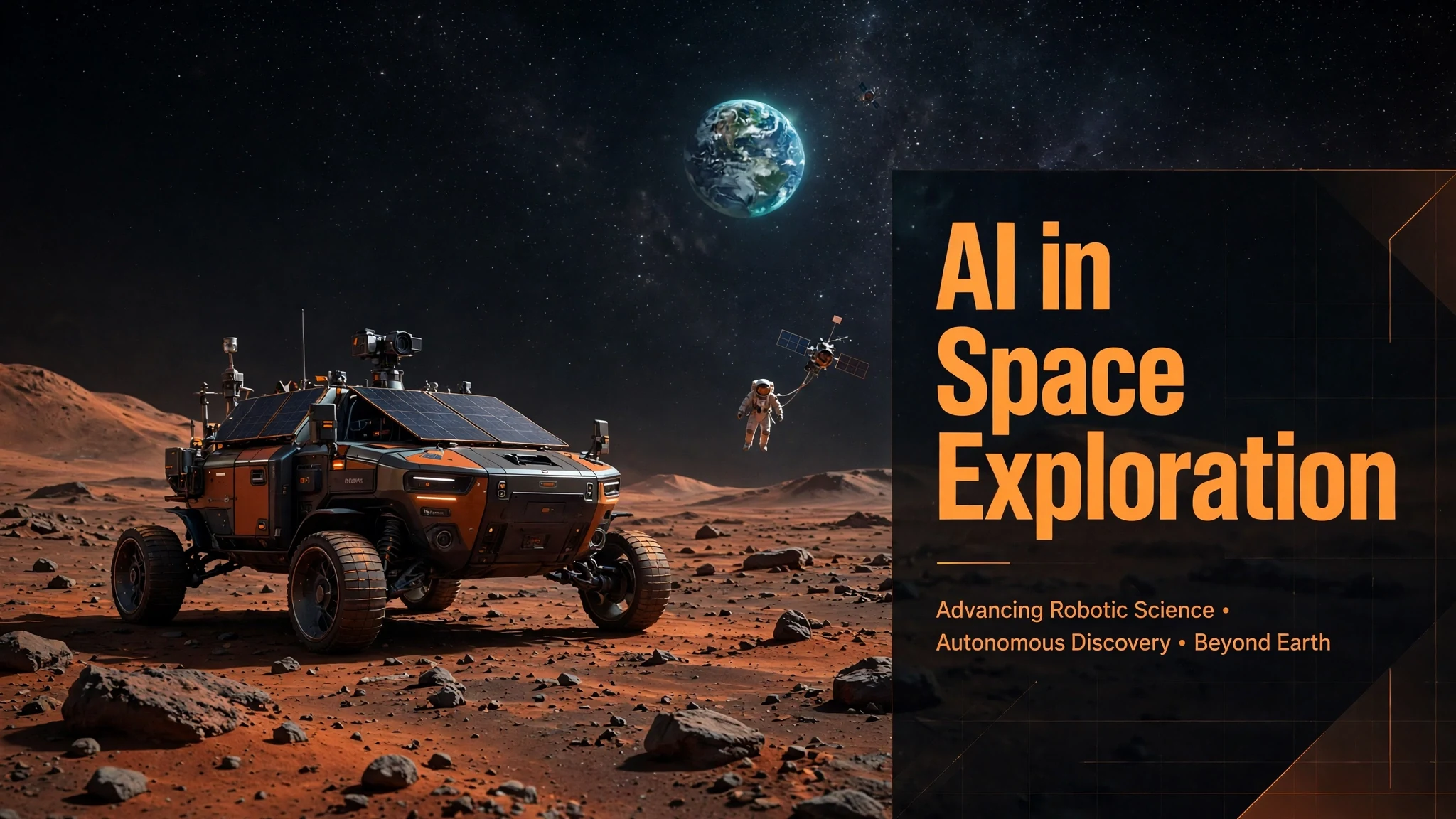
AI in Space Exploration: How Machines Explore the Stars
In this post
- Why Space Needs AI: Distance, Delay and Danger
- Rovers That Think: Driving on Mars Without a Driver
- Finding New Worlds: AI and the Hunt for Exoplanets
- Keeping Spacecraft Alive: AI as Engineer and Doctor
- Planning Missions and Landing in the Right Place
- The Risks: When a Machine Decides Far From Home
- What Comes Next: The Moon, Mars and Beyond
- My Take:
Space is the most hostile workplace humans have ever attempted, and it is also the place where artificial intelligence is most obviously necessary. A signal from Earth to Mars can take more than twenty minutes to arrive, which means a rover on Mars cannot wait for instructions when it meets a rock, a cliff or a dust storm. It has to decide for itself, in seconds, whether to stop, turn, or carry on. That decision, made by software millions of kilometres from any human, is the reason AI matters in space: distance makes remote control impossible, and danger makes human presence expensive and slow.
In 2027, AI is involved in almost every stage of a space mission. It helps design spacecraft, plan trajectories, and choose landing sites. It drives rovers across alien terrain, analyses the flood of data from telescopes, and watches over the health of satellites and space stations. On Earth, it sifts through images of the sky to find planets around distant stars, and it helps scientists make sense of data that would take a human lifetime to read. None of this replaces astronauts or scientists. It extends what they can do, and it goes where they cannot yet go.
This article explains how AI is actually used in space exploration, from the rovers crawling across Mars to the telescopes hunting for new worlds. It covers the navigation systems that keep spacecraft alive, the science that AI accelerates, the risks of trusting a machine so far from home, and what the next decade is likely to bring. The story is not one of robots replacing explorers. It is one of machines making exploration possible at a scale and in places that human hands and eyes alone never could.
Why Space Needs AI: Distance, Delay and Danger
The defining problem of space exploration is distance. Radio signals travel at the speed of light, which sounds fast until you measure it against the solar system: a message to the Moon takes about a second and a half, to Mars between three and twenty-two minutes depending on where the planets are, and to the outer planets, hours. A rover that had to ask Earth before every move would spend most of its life waiting. Instead, it carries its own intelligence, makes decisions locally, and reports back what it did. That autonomy is not a luxury; it is the only way the mission works at all.
Danger is the second reason. Space is cold, airless, irradiated and unforgiving, and a single mistake can end a mission worth billions. A spacecraft must monitor its own temperature, power, orientation and fuel, and respond to faults before they become disasters. AI systems watch thousands of sensor readings at once and notice patterns a human operator, watching a screen on Earth, would miss — a slow rise in temperature, a tiny change in vibration, a battery draining slightly faster than expected. Catching a fault early can be the difference between a saved mission and a lost one.
The third reason is volume. Modern telescopes and planetary missions produce more data than any team of scientists can read. A single sky survey can contain billions of objects; a single Mars rover sends back thousands of images. AI can sort, classify and flag the interesting fraction — the unusual rock, the flicker that might be a new planet, the signal that does not match anything known — so that human scientists spend their time on the discoveries, not on the sorting. Without that filtering, most of the data would simply never be looked at.
Rovers That Think: Driving on Mars Without a Driver
The Mars rovers are the most famous example of AI in space. A rover such as Perseverance carries cameras that build a three-dimensional map of the ground ahead, software that identifies rocks, slopes and sand traps, and a navigation system that plans a safe path and then drives it, stopping when something unexpected appears. The rover can travel hundreds of metres in a day on its own, where an earlier generation of rovers, driven step by step from Earth, covered far less ground in the same time.
The rover’s science is also partly autonomous. Its cameras and spectrometers can spot a rock that looks interesting — an unusual colour, a strange shape, a layered texture — and decide to take a closer look or to fire a laser at it to analyse its composition. This matters because the rover’s time is limited and its energy is precious; spending it on the most promising targets is what turns a good mission into a great one. Scientists on Earth still set the goals and review the results, but the rover chooses its own route to them.
The limits are real. A rover’s computer is far less powerful than a phone, because it must survive radiation, extreme cold and years of use without repair. Its AI is therefore careful and conservative, designed to avoid risk rather than to take chances. It can be fooled by unusual terrain, and it sometimes stops when a human driver would have carried on. That caution is deliberate: on Mars, there is no roadside assistance, and a stuck rover is a dead rover. The autonomy is impressive precisely because it is so careful.
Finding New Worlds: AI and the Hunt for Exoplanets
Beyond the solar system, AI has changed how astronomers find planets. A telescope watching a star measures its brightness over time; when a planet passes in front of the star, the brightness dips slightly, and that dip, repeated regularly, reveals a planet. The problem is that telescopes watch hundreds of thousands of stars, and the dips are tiny, buried in noise, and easily confused with other effects. Human astronomers could check a few thousand light curves in a career. AI models can check millions, and they have found planets that humans missed.
Machine learning is also used to sort the candidates. A model trained on confirmed planets and known false alarms learns the subtle differences between a real transit and a flicker caused by the star itself or by the instrument. It can rank thousands of candidates so that astronomers spend their limited telescope time on the most promising ones. Some of the most interesting recent finds — planets in unusual orbits, or around unusual stars — were first flagged by a model, then confirmed by people.
The same approach is spreading to other questions: finding galaxies, classifying supernovae, and searching for signals that might indicate life. In each case the pattern is the same: the data is too large for people alone, the AI does the sorting, and the people do the science. The discoveries still belong to the scientists, but the telescope that finds them is increasingly a partnership between human curiosity and machine patience.
Keeping Spacecraft Alive: AI as Engineer and Doctor
A spacecraft is a machine that must look after itself for years, in conditions no workshop can reproduce. AI systems monitor its health continuously: the temperature of its instruments, the charge in its batteries, the pressure in its tanks, the alignment of its antennas. They learn what normal looks like for that particular spacecraft, and they raise an alarm when something drifts from normal, even if no single reading is yet out of limits. That early warning gives controllers on Earth time to diagnose a problem and send a fix before it becomes a failure.
Some spacecraft can also fix themselves, at least in part. If a sensor fails, the system can switch to a backup. If a computer crashes, it can reboot and restore itself from a safe state. If a solar panel is not producing enough power, the system can shut down non-essential instruments and wait for better conditions. These are not dramatic acts of intelligence, but they are the difference between a mission that survives a bad day and one that ends on it. The engineers who design these systems often say their job is to make the spacecraft boring — to make nothing surprising happen — and AI helps them do that.
The International Space Station is a test bed for the same ideas closer to home. AI tools help schedule experiments, manage power and life support, and assist astronauts with routine tasks. An astronaut who can ask a system for the status of an experiment, or get help diagnosing a fault, saves time for the science that only a person can do. As missions go further from Earth, that kind of on-board help will become not a convenience but a necessity.
Planning Missions and Landing in the Right Place
Long before a spacecraft launches, AI helps plan where it should go and how it should get there. Landing on another world is one of the hardest problems in spaceflight: the spacecraft must pick a safe spot, avoid rocks and slopes, and land within a small target area, all while falling through an atmosphere at enormous speed. AI systems analyse images of the surface taken from orbit, map the hazards, and choose landing sites that balance safety with scientific interest. During the descent, the spacecraft compares what its cameras see with the map, and adjusts its course in real time.
Trajectory planning benefits too. The path a spacecraft takes between planets depends on gravity, fuel, timing and the positions of the planets, and there are many possible routes. Optimisation algorithms, a form of AI, can search through thousands of options to find one that uses less fuel or arrives sooner, or that visits two targets instead of one. These calculations are too complex to do by hand, and they are part of why modern missions can do more with less fuel than their predecessors.
On the ground, AI also helps design the spacecraft themselves. It can test thousands of design variations in simulation, finding shapes and structures that are lighter and stronger than a human designer would think of. Some of these designs look strange — organic, almost bone-like shapes — because they were optimised by a computer rather than drawn by a person. They work, and they save weight, which in spaceflight is the most expensive thing there is.
The Risks: When a Machine Decides Far From Home
Trusting a machine millions of kilometres away carries real risks. An AI can misread its surroundings: a shadow can look like a cliff, a patch of sand can look like solid ground, a sensor fault can look like a real problem. A wrong decision can damage a rover, waste a mission’s limited time, or in the worst case end the mission entirely. That is why space AI is designed to be cautious, to stop and wait when it is unsure, and to let humans override it when a signal can get through in time.
There is also the risk of the unknown: the model was trained on what engineers expected to find, but space has a habit of producing the unexpected. A rover that encounters terrain unlike anything in its training may behave unpredictably. Engineers try to guard against this with conservative rules and with extensive testing on Earth, but testing on Earth can never fully reproduce another world. The history of spaceflight is full of surprises, and AI does not remove them; it changes their shape.
The deepest risk is dependence. As missions become more autonomous, the skills and the judgement to intervene from Earth become harder to maintain, and a failure in the autonomous system can leave a mission with no fallback. The answer is not to avoid autonomy — it is essential — but to design it so that failures are graceful, so that a spacecraft in trouble can protect itself and wait for help, rather than making a bad situation worse. In space, the first rule of a good machine is the same as the first rule of a good explorer: do not make things worse.
What Comes Next: The Moon, Mars and Beyond
The next decade will see AI used more deeply and further from home. Missions to the Moon will use AI to map the surface, to find water ice in permanently shadowed craters, and to help build habitats. A crewed mission to Mars will need AI not only to drive rovers but to manage life support, to monitor the health of the crew, and to help astronauts make decisions when Earth is twenty minutes away by radio. A habitat that can look after itself, notice a problem before the crew does, and suggest a fix, is not a luxury on such a mission; it is part of keeping people alive.
Further out, AI will be essential for missions to the outer planets and beyond, where signals take hours and a spacecraft must operate alone for years. A probe visiting the moons of Jupiter or Saturn will need to choose its own targets, manage its own power, and decide what data is worth sending home, because it cannot send everything. The most distant missions of all — the ones that may one day leave the solar system — will be almost entirely autonomous, carrying with them the intelligence to explore a place no human will ever see directly.
There is also a quieter future: AI helping more people participate in space. As the cost of satellites falls, AI tools are helping small teams and even schools analyse space data, find asteroids, and contribute to real science. Space exploration is becoming less the preserve of a few large agencies and more a shared human project, and AI is part of the reason why. The stars are still far away, but the tools to explore them are, for the first time, within reach of far more people than before.
My Take:
My view on AI in space is simpler than the technology itself: this is the one place where nobody seriously argues about whether AI should be used, because the alternative is not doing the thing at all. A rover cannot phone home for every decision. A probe at the edge of the solar system cannot wait hours for an instruction. Either the machine thinks for itself, or the mission does not happen. That clarity is refreshing, and it is also why I think space is the best test of what AI is actually good for — not replacing people, but going where people cannot yet go and doing what people cannot do from so far away.
What I admire most is the caution. Space engineers do not build bold, risk-taking AI; they build careful, conservative AI that stops when it is unsure and would rather waste a day than lose a mission. I think that is the right attitude, and I wish more of the AI industry shared it. In space, the cost of a mistake is visible and total: a lost spacecraft, a lost mission, years of work gone. On Earth, the cost of a mistake is often hidden or delayed, so people take risks they would never take if the stakes were as clear. Space reminds us that intelligence is not only about being clever. It is about knowing when to stop.
I am also struck by how much of the work is invisible. The public sees the rover’s photographs and the announcement of a new planet, but the AI that sorted a million light curves, or that noticed a battery draining slightly too fast, never gets a mention. That is fine — the science is the point — but it is worth remembering that exploration is now a partnership, and that the partnership works because each side does what it is good at. The machine is patient, tireless and precise. The human is curious, creative and able to recognise a surprise. Neither would get far alone.
The exoplanet work is the part that excites me most personally, because it is a case where AI has genuinely expanded what we know, not just made something faster. Planets that humans missed, found by a model that could read a million light curves without getting bored — that is not a small thing. It is a reminder that the universe is larger and stranger than our unaided attention can grasp, and that a tool which can pay attention at a scale we cannot is a tool for discovery, not only for efficiency. I think that is the best argument for AI in science generally: it lets us notice what we would otherwise never see.
Looking ahead, I think the crewed Mars mission will be the real test of all of this. A crew twenty minutes from Earth by radio, living in a habitat that must manage air, water, power and food, will need an AI that is not only clever but trustworthy — a system that notices a problem, explains it clearly, suggests a fix, and knows when to hand over to a person. That is a much harder problem than driving a rover, because it involves people, stress and life-or-death decisions. I am hopeful, but I am also aware that the difference between a helpful assistant and a dangerous one, in that setting, could be very small.
For a reader who is not a space scientist, the takeaway is this: the pictures and discoveries you love are increasingly the product of a partnership between people and machines, and that partnership is what makes the modern age of exploration possible. You do not need to understand the algorithms to appreciate that. You only need to notice that a machine on another world, deciding for itself which rock to look at next, is one of the most remarkable things humans have ever built — and that it is remarkable precisely because it was built by people who understood its limits and designed it to be careful.
I also think about the people behind the machines, because it is easy to forget them. A rover that drives itself was built by thousands of engineers, programmers and scientists who will never see Mars with their own eyes, and who spent years testing a machine they would never be able to repair. There is a particular kind of care in that work — building something to survive alone, millions of kilometres away, in conditions you can only simulate — and I think it deserves more recognition than it gets. The AI is impressive, but the patience and humility of the people who built it, knowing they would never be able to fix it, is just as impressive.
The data question matters here too, though in a different way than on Earth. Space missions produce enormous amounts of data, and deciding what to keep, what to send home, and what to throw away is itself a scientific decision. A rover that deletes a photograph to save bandwidth might delete the one that contained a discovery. That is why the autonomy is designed to be careful, and why scientists on Earth still review what the rover chooses. The machine can sort, but the judgement about what matters is still human, and I think it should stay that way for as long as possible.
On the cost, I am aware that space exploration is sometimes criticised as a luxury while there are problems on Earth. I understand that criticism, and I think it is worth taking seriously. But I also think the technologies developed for space — better sensors, better autonomy, better ways of handling scarce resources — have a habit of returning to Earth and helping there, from weather forecasting to medicine. The value of exploration is not only in what it finds out there, but in what it teaches us to do down here. A rover that learns to manage power carefully on Mars teaches us something about managing power carefully on Earth.
Looking further ahead, I wonder about the moment when AI in space stops being a tool and becomes a companion — when an astronaut on a long mission talks to an on-board system not only for information but for support, for a second opinion, for a voice that is always there. That is a different kind of relationship, and it raises questions about loneliness, trust and what it means to be far from home. I do not have answers to those questions, but I think they will matter as much as the technical ones, because exploration has always been a human story, and the machines we send with us are part of that story now.
Frequently Asked Questions
How does AI help explore space?
AI lets spacecraft make decisions on their own when radio signals take too long, drives rovers across alien terrain, sorts huge amounts of telescope data to find new planets, and monitors a spacecraft’s health so faults are caught early. It extends what human explorers and scientists can do, especially far from Earth.
Can a Mars rover drive itself?
Yes, within limits. Rovers such as Perseverance use cameras and software to map the ground ahead, plan a safe path and drive it, stopping for unexpected obstacles. Scientists on Earth still set the goals and review the results, but the rover chooses its own route.
How does AI find new planets?
Telescopes measure the brightness of stars over time, and a planet passing in front of a star causes a tiny dip. AI models can check millions of these light curves and flag the dips that look like planets, including ones humans missed, so astronomers can confirm them with further observations.
Is AI used on the International Space Station?
Yes. AI tools help schedule experiments, manage power and life support systems, and assist astronauts with routine tasks and fault diagnosis. As missions go further from Earth, on-board AI assistance will become increasingly important for crew safety.
What happens if a spacecraft’s AI makes a mistake?
Space AI is designed to be cautious: it stops and waits when unsure, and spacecraft have safeguards such as safe modes and backup systems. A mistake can still waste time or damage equipment, which is why autonomy is tested extensively and designed to fail safely rather than boldly.
Will AI replace astronauts?
No. AI handles tasks that are dangerous, distant or too data-heavy for people, but exploration still needs human curiosity, judgement and creativity. The future is a partnership: machines go first and do the routine work, and people follow to do the science and make the decisions that matter.