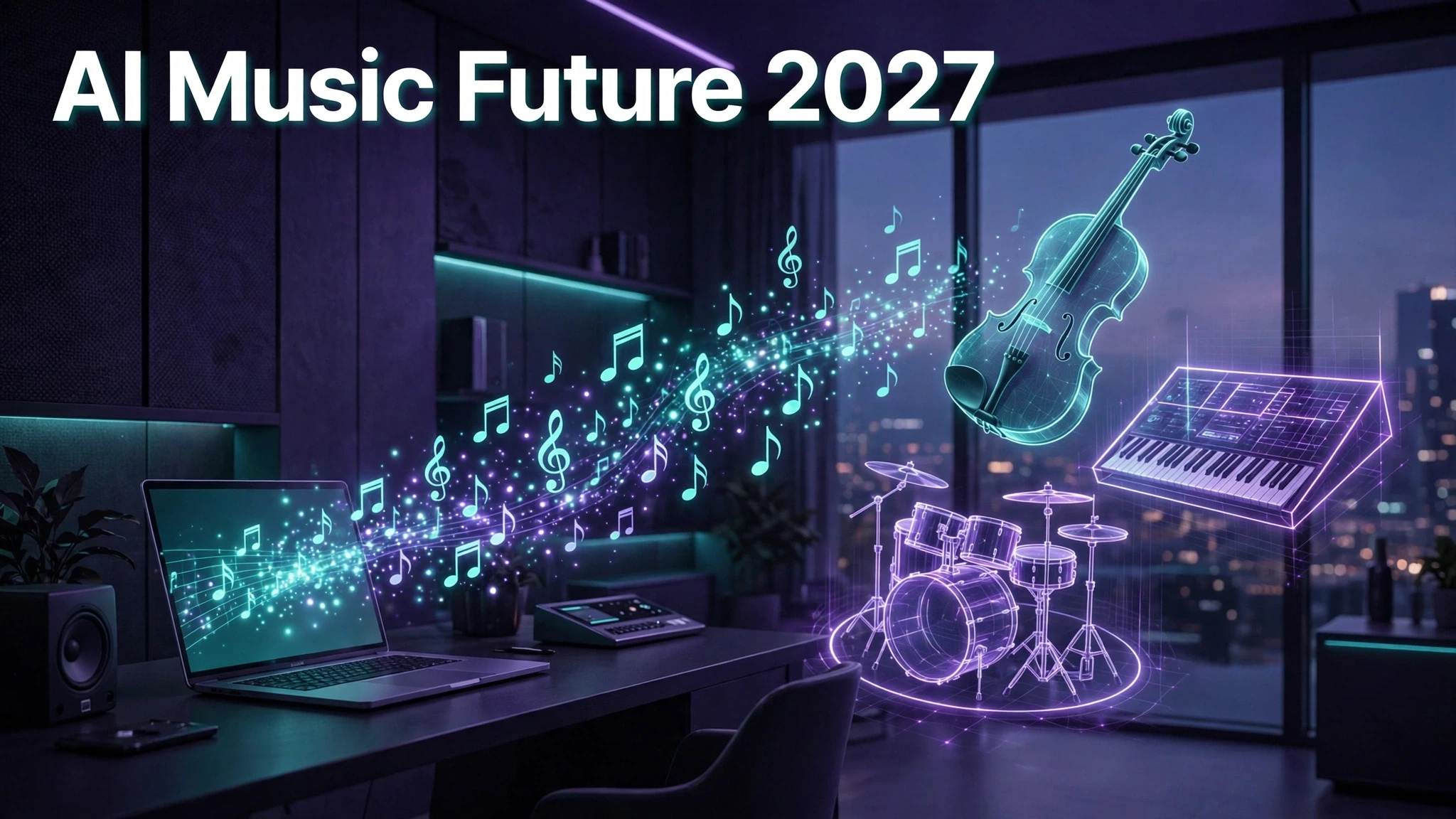
AI Generated Music and Its Future 2027
In this post
Music has always changed when a new tool arrives. The piano, the electric guitar, the synthesiser, the sampler, and the home studio each gave more people a way to make sound. Artificial intelligence is the latest tool in that long line, and it is also the most debated. In 2027, AI generated music is no longer a strange experiment hidden in a research lab. It appears in short videos, advertisements, games, background tracks for streams, and songs shared by independent creators. At the same time, many professional musicians, composers, and record labels are asking hard questions about credit, pay, and the value of human skill. This guide explains, in plain language, how AI music works, where it is useful, where it falls short, and what the future may look like for listeners, creators, and the music business.
The most important point to keep in mind is simple: AI music tools do not hear music the way a person does. They study patterns in large amounts of existing sound and text, then produce new sound that follows similar patterns. That can be impressive, and it can also be misleading. A track may sound polished, emotional, and complete, yet still be a statistical guess rather than a lived experience. Understanding that difference helps you enjoy AI music without overrating it, and helps creators use it without losing what makes their own work special.
How AI Music Generation Actually Works
Most AI music systems start with training. Developers feed a model many examples of music, often with labels for style, tempo, instruments, mood, or lyrics. The model learns relationships: which notes often follow others, how a chorus usually differs from a verse, how drums and bass tend to move together, and how a melody fits a chord. When a user gives a prompt such as “a calm piano piece for a rainy evening” or “an energetic pop song about travel”, the model uses those learned patterns to build a new sequence of sounds, note by note or in larger chunks, depending on the design.
Some tools work with symbolic music, meaning notes, chords, and timing written in a form similar to sheet music. Others work directly with audio waveforms, which is closer to a finished recording. Symbolic tools are often easier to edit, because a creator can change a single note or chord after generation. Audio tools can sound more realistic, because they produce the texture of real instruments and voices, but they are harder to adjust in small ways. Many modern products combine both ideas: they sketch a musical structure first, then render it as audio, then let the user extend, remix, or replace parts.
It is also important to separate two different jobs that AI can do. The first is generation: creating a melody, harmony, rhythm, or full song from a prompt. The second is assistance: helping a human composer by suggesting chords, finishing a phrase, cleaning a recording, separating vocals from instruments, mastering a track, or turning a hummed idea into a playable melody. Assistance tools are often less controversial, because the human remains clearly in charge. Full generation raises sharper questions, because the line between tool and author becomes harder to draw.
Quality has improved quickly, but limits remain. AI songs can repeat themselves, lose a clear structure over a long track, produce strange lyrics, or mix styles in a way that sounds odd to a careful listener. Short clips and simple styles often sound best. Longer songs with a strong story, surprising changes, and a distinctive vocal character are still difficult. That is why many experienced producers treat AI output as a starting draft, not a finished record.
What Listeners Will Notice in 2027
For ordinary listeners, the biggest change is abundance. Anyone with a phone can now create a birthday song, a workout playlist track, a calming background piece, or a funny parody in minutes. Social platforms are full of such tracks, and some of them are genuinely enjoyable. Personalised music is also growing: a game can change its soundtrack as the action changes, a fitness app can match tempo to a runner’s pace, and a relaxation app can generate endless calm music without repeating the same loop.
This abundance has a downside. When thousands of similar tracks flood a platform, discovery becomes harder. A listener may hear many songs that sound pleasant but forgettable, because they share the same safe patterns. Human artists have always faced competition, but AI increases the volume of competition dramatically. Playlists, charts, and recommendation systems will matter even more, because they decide which tracks reach an audience. Listeners may also need to ask a new question: am I listening to a person, a machine, or a mix of both? Clear labels could help, and several platforms are reportedly testing ways to mark AI generated content, though rules still differ by service and country.
Another change is language and style. AI tools can imitate many genres and languages, which lets small creators reach listeners far beyond their own region. A bedroom producer can try a jazz arrangement, a film score, or a folk melody without hiring a full band. That can be exciting for creativity. It can also raise concerns when a tool copies the distinctive sound of a living artist or a cultural tradition without permission or respect. A style is not always protected by law in the same way as a specific recording, but listeners and creators can still judge whether imitation feels fair or exploitative.
Copyright, Credit and Voice: The Hard Questions
Copyright is the most difficult part of AI music, and the law is still catching up in many places. Three questions come up again and again. First, was the training data used lawfully? If a model was trained on copyrighted songs without permission, artists may argue that their work was used without pay. Second, who owns a new AI generated song? The user who wrote the prompt, the company that built the model, the owners of the training data, or no one at all? Third, what happens when an AI voice sounds like a real singer? A voice is closely tied to identity, and many artists argue that cloning a voice without consent is wrong even if a particular melody is new.
Different countries and courts may answer these questions differently, so creators should not assume one rule applies everywhere. Some music companies have made licensing deals with AI firms, allowing models to train on catalogues under agreed terms. Others have filed legal challenges. Some AI companies say they train only on licensed or public material, or that they filter outputs to avoid copying. Listeners should treat bold claims with care and check the terms of the tool they use, especially before selling or distributing a track.
For independent creators, a practical approach is to keep records. Save prompts, drafts, edits, and the names of tools used. If a track will be sold, licensed, or used in a commercial project, check whether the tool allows commercial use and whether any human performance, sample, or voice in the track needs separate permission. Do not upload a track that imitates a famous singer’s voice and presents it as that singer, because that can mislead listeners and create legal risk even if the tool made it easy. Transparency is usually the safest creative choice: say when AI helped, and say what you did yourself.
Will AI Replace Musicians? A Calmer Answer
Headlines often suggest a simple contest: machines against musicians. Real music work is more varied than that. Composing, performing, recording, mixing, teaching, scoring films, playing live, and building a fan community are different skills. AI is strongest at producing plausible musical material quickly. It is weaker at live presence, personal storytelling, cultural judgement, stage craft, and the trust that grows between an artist and an audience over years. A concert is not only sound; it is memory, identity, and shared feeling. A machine cannot attend its own concert, and it cannot know what a song meant to a crowd ten years ago.
That said, some jobs will change. Stock and background music is an obvious area, because buyers often want a suitable track quickly and cheaply rather than a unique artistic statement. Simple jingles, generic loops, and filler music for videos may increasingly come from AI. Session work that is purely routine could also face pressure. On the other hand, new jobs are appearing: prompt craft, AI-assisted production, dataset curation, music supervision for AI content, and quality control for generated tracks. The musicians most likely to stay strong are those who use AI as a sketchbook while keeping a clear human voice, a live skill, or a community that values them as people.
History offers a useful warning against both panic and dismissal. Synthesisers did not end orchestras. Sampling did not end songwriting. Home recording did not end studios, although it changed who could enter the field. Each tool lowered one barrier and raised the value of something else: taste, performance, originality, or connection. AI is likely to follow a similar pattern, but at a faster pace and with a larger legal argument attached.
How Creators Can Use AI Music Well
A good way to use AI music is to start with a human idea. Write down the feeling, story, or scene you want before opening a tool. For example, instead of asking for “a nice song”, try “a slow, hopeful acoustic piece for a short film scene where a traveller returns home at dawn”. A clear brief leads to a more useful draft and makes your own judgement easier. After generation, listen critically: does the melody move in an interesting way, does the chorus earn its lift, does the ending feel finished, and does the lyric say anything specific? If not, edit the structure, replace weak lines, record a real vocal, or play a real instrument over the generated base.
Creators should also build a simple workflow. Use AI for early sketches, then move the best idea into a normal music editor where you can control timing, harmony, and arrangement. Keep the original human parts audible: a real voice, a played guitar line, or a melody you wrote by hand can turn a generic draft into something personal. If you collaborate with other musicians, agree early on how AI will be used and how credit and payment will be shared. A short written agreement, even between friends, prevents painful arguments later.
For beginners, AI can be a patient teacher. It can show chord options, suggest a bass line, or demonstrate how a melody changes when the tempo shifts. But learning still needs practice. Try to play or sing the AI idea yourself, change one chord and hear the result, and study why a progression feels tense or resolved. Tools can speed up discovery, but they cannot replace the ear training that lets a musician recognise a good idea quickly. The best AI users are often people who already know enough to reject most of what the machine offers.
AI Music in Films, Games and Everyday Apps
Beyond songs, AI music is becoming useful in media that needs flexible sound. A game world can generate music that rises when danger appears and calms when a player explores. A podcast can create a short intro that matches its topic without buying an expensive licence. A small business can generate background music for a shop or a video without hiring a composer for every clip. In these cases, the music is functional: it supports a scene, a mood, or a task rather than standing alone as art.
This functional use also raises quality questions. A game score needs to loop smoothly, avoid annoying repetition, and stay out of the way of dialogue. A film score needs to follow emotion precisely, not just stay in the right genre. AI systems are improving at these tasks, but human composers still lead when timing, drama, and subtlety matter. A likely future is hybrid: AI generates many options or adaptive layers, and a human composer selects, shapes, and finishes the final score. That mix could lower costs for small studios while keeping human craft where audiences notice it most.
Accessibility is another benefit. People with limited mobility, limited money, or no access to music lessons can now experiment with composition. A person who cannot play an instrument can still shape a melody by describing it, editing it, and sharing it. Music education may also change: teachers can generate examples in many styles instantly, and students can hear how a change in key or rhythm alters feeling. The challenge for educators is to keep students active creators rather than passive prompt writers.
What to Watch Next: Labels, Licences and Live Music
Three developments will shape the next few years. The first is labelling and detection. Platforms, regulators, and music firms are exploring ways to mark AI generated tracks, detect synthetic voices, and stop misleading uploads. No system is perfect, because a heavily edited track can hide its origin, but clearer labels would help listeners make informed choices. The second is licensing. If more AI companies pay for training data and share revenue with rights holders, the conflict may ease. If courts or laws take a stricter path, some tools may change their models, limit styles, or withdraw features.
The third is live music. As recorded music becomes easier to generate, live performance may become even more valuable. Audiences often pay for presence, energy, and the chance to see a real person take a risk on stage. Artists who build a live reputation, a loyal community, and a distinctive sound may find that AI abundance actually strengthens their appeal. At the same time, virtual concerts and AI performers could attract audiences who enjoy spectacle without a human star. Both paths can exist, but they are not the same experience, and honest labelling will matter there too.
Listeners can prepare by supporting artists they love directly: attending shows, buying from official stores, and sharing real artist pages rather than imitation accounts. Creators can prepare by learning the basics of copyright in their own country, keeping clear records, and building skills that AI cannot copy easily: live performance, songwriting from personal experience, collaboration, and a recognisable sound.
My Take:
My honest view is that AI generated music is neither a miracle nor a disaster. It is a powerful sketching tool that arrived before society agreed on fair rules, and that mismatch explains most of the anger around it. When I listen to AI tracks, I often admire the surface: the sound is clean, the harmony is safe, and the production feels modern. Then I notice what is missing. The melody rarely surprises me in a meaningful way. The lyric rarely says something only one person could say. The song feels like a well-made room with no one living in it. That is not a reason to ban the tool, but it is a reason not to confuse fluency with artistry.
I think the fairest future is one where training data is licensed or clearly permitted, voices are never cloned without consent, and AI involvement is labelled in a simple way that listeners can understand. That would not solve every argument, but it would remove the worst feeling many artists describe: discovering that their life’s work was used without asking, while someone else profits. If AI companies want musicians to trust them, they should show their sources, pay for value, and build tools that help artists rather than replace their identity. Transparency is not a burden here; it is the price of legitimacy.
For new creators, my advice is practical and a little old-fashioned: use AI to start faster, but finish slower. Let the machine give you ten ideas in ten minutes, then spend real time choosing one, changing it, playing part of it yourself, and asking why it works. Your taste is the product. Anyone can generate a pleasant track, but not everyone can hear which track deserves to exist, which line is honest, and which ending feels earned. That judgement comes from listening widely, practising, and paying attention to your own life. AI cannot live your life for you, and that is exactly why your perspective still matters.
I also believe listeners will develop a sharper ear over time. Right now, novelty makes many AI songs seem impressive. As the novelty fades, people will ask the same questions they always ask about music: does this move me, does it stay in my mind, would I return to it, and do I trust the person behind it? Songs that pass those tests will survive, whether AI helped make them or not. Songs that only sound correct will fade, no matter how cheap they were to produce. In that sense, AI does not change the deepest test of music. It only changes how quickly we reach it.
Finally, I would urge creators not to build their whole identity around a tool they do not control. A platform can change its rules, raise its price, or remove a feature. A skill, a community, and a catalogue of work you truly own will last longer. Use AI as one instrument among many, keep your own recordings and notes, learn an instrument or vocal skill if you can, and collaborate with real people whenever possible. The future of music will belong not to those who generate the most songs, but to those who make songs that listeners remember and trust.
A further question I think about often is how AI music will affect musical education and taste. If students can generate a finished-sounding track in seconds, will they still learn to play instruments, study harmony, or listen deeply to older music? I hope so, but only if teachers use AI as a demonstration tool rather than a replacement for practice. For example, a teacher could generate three versions of the same melody in different styles, then ask students to identify what changed and why one version feels sadder or more energetic. That kind of listening exercise builds taste. Simply asking AI for a song and accepting it builds nothing. Education must therefore focus on listening, analysis, and performance, not only on production speed. The students who learn to hear deeply will use AI wisely; those who only learn to prompt will struggle when a tool cannot capture what they actually want.
I also worry about homogenisation. AI models learn from what already exists, so they tend to favour common patterns and safe choices. If millions of creators use the same tools with similar prompts, music could become more uniform, even if it sounds polished. Human artists counteract that by bringing unusual influences, personal stories, imperfect performances, and cultural contexts that a model cannot fully understand. A slightly out-of-tune vocal, a rhythm learned from a local tradition, or a lyric about a specific street can make a song memorable in a way that statistical averages cannot. I hope listeners continue to reward that distinctiveness, because if they do not, the market will push creators towards safe, generic output, and music will become less interesting even as it becomes more abundant.
Another practical concern is the economics for small artists. Streaming already pays very little per play for most musicians, and AI abundance could dilute attention further. If platforms do not distinguish human work, label AI content, or share revenue fairly, small artists may find it harder to earn a living from recorded music, even as their live and community work becomes more important. That is why I support transparent labelling, fair licensing, and direct support for artists through concerts, merchandise, and official stores. Listeners have power here: where you spend attention and money shapes what kind of music gets made. Choosing to support a human artist you love is not nostalgia; it is a decision about the future musical landscape.
Finally, I would encourage musicians to experiment without fear, but with honesty. Try AI for a bridge, a string arrangement, or a demo vocal, and see what it sparks. Then keep what serves your song and discard the rest. Share your process openly, because audiences often appreciate hearing how a song evolved, including the role of tools. A song that is honest about its making, human at its core, and distinctive in its details will stand out in a crowded AI era. The future of music will not be decided by a single tool or law, but by thousands of small choices by creators, listeners, platforms, and policymakers. Make those choices with care, and music can become more diverse, not less, even in an age of machines that can sing.
Frequently Asked Questions
What is AI generated music?
AI generated music is music created, in whole or in part, by a computer model that has learned patterns from existing music and then produces new melodies, harmonies, rhythms, lyrics, or audio from a prompt or other input.
Can AI music be sold or used commercially?
It depends on the tool’s terms and on the rights in any voice, sample, or training material involved. Always check the tool’s licence, keep records of prompts and edits, and get separate permission for any real person’s voice or copyrighted recording.
Will AI replace human musicians completely?
AI is likely to change some routine music work, especially generic background tracks, but live performance, personal storytelling, cultural judgement, and long-term artist-audience trust remain strongly human strengths.
How can listeners tell if a song is AI generated?
Look for platform labels, check the artist’s official pages, listen for odd lyrics, unnatural vocal changes, or repetitive structure, and be cautious with accounts that imitate a famous artist without verification.
Is it legal to clone a singer’s voice with AI?
Cloning a real singer’s voice without consent can create serious legal and ethical problems, even if the melody is new. Do not present a cloned voice as the real artist, and seek legal advice before any commercial use.
What is the best way for beginners to start with AI music?
Start with a clear human idea, use AI for drafts and learning, then edit the result, play or sing part of it yourself, and study why the best version works rather than accepting the first output.