AI in Movies and the Future of Filmmaking 2027
In this post
- Scriptwriting and Story Development With AI
- Pre-Production: Casting, Locations and Visual Planning
- On Set: Virtual Production, Cameras and Performance
- Post-Production: Editing, Visual Effects and Sound
- Digital Actors, Voice Cloning and Audience Trust
- Jobs, Creativity and the Independent Filmmaker
- The Future of Cinema: What Might Change Next
- How Viewers Can Spot AI in a Film
- My Take:
AI in movies is no longer a distant idea. It is already helping writers brainstorm, helping editors find the best take, helping visual effects teams create worlds that would be too expensive to build physically, and helping smaller filmmakers produce work that once required a large studio. At the same time, it raises serious questions about actors, voices, jobs, creativity, and what audiences will accept as real. In 2027, the honest picture is mixed: AI is a powerful new tool for filmmaking, not a replacement for filmmaking, and its impact depends on how it is used, disclosed, and governed.
This guide explains, in plain language, where AI is used across the filmmaking process, from script to screen, what it does well, where it fails, and how it is changing jobs and creativity. It also looks at the debates around digital actors, voice cloning, and copyright, and at what the future of cinema might look like if AI tools keep improving. The aim is neither hype nor fear, but a clear map that helps viewers, students, and creators judge AI films for themselves.
A useful distinction runs through the whole guide: AI as a tool that assists human creators versus AI as a system that generates a film with little human direction. Most professional use today is the first kind. A director still decides the story, an actor still performs, and an editor still shapes pacing. AI speeds up, suggests, and expands, but human judgement remains central. Fully generated films exist as experiments and short works, but they are not yet a substitute for directed, acted, human storytelling at feature length.
Scriptwriting and Story Development With AI
Writers use AI as a brainstorming partner: generating ideas, exploring alternative plot turns, summarising research, and drafting dialogue that can then be rewritten. For a writer facing a blank page, an AI suggestion can break a block and reveal a direction they had not considered. For a production team, AI can analyse a script for pacing, character consistency, or location needs, and can help adapt a story for different formats. These uses save time in early development, where many ideas are explored and most are discarded.
The limits are important. AI-generated scripts often feel generic, because they draw on patterns from many existing stories. They may produce dialogue that sounds plausible but lacks a distinctive voice, cultural specificity, or emotional depth. They can also repeat clichés, flatten characters, or mishandle sensitive topics without understanding context. A professional writer’s job therefore shifts: less time on first-draft mechanics, more time on original voice, lived experience, structure, and revision. Audiences can often sense when a story has no human point of view, even if they cannot name why.
Ownership and credit are also unresolved in many cases. If an AI drafts part of a script, who is the author? Rules vary by country and by production agreement, and unions and studios have negotiated different terms in different places. Writers should keep records of their own contributions, check contracts carefully, and disclose AI use where required. For students and independent creators, the practical rule is simple: use AI to explore, but write the final story yourself, in your own voice, so the work is truly yours.
Pre-Production: Casting, Locations and Visual Planning
In pre-production, AI helps filmmakers visualise a film before shooting begins. Storyboard tools can turn a script description into images, helping directors and cinematographers discuss framing, lighting, and movement. Location tools can analyse photographs and suggest places that match a script, while scheduling tools can optimise shooting days around actors, weather, and locations. These tools are especially valuable for small productions, where a clear visual plan prevents costly mistakes on set.
Casting and performance planning are more sensitive. AI can help analyse audition tapes, organise casting databases, and suggest actors who fit a role, but final casting decisions involve chemistry, presence, and judgement that data cannot capture. Digital doubles and de-ageing, where an actor’s younger appearance is recreated, are used in some productions with the actor’s consent, and they raise questions about pay, control, and likeness rights. Consent and fair compensation are central: an actor’s face, voice, and movement are part of their livelihood, not raw material to be reused freely.
Budgeting and risk planning also benefit from AI analysis of past productions, though predictions should be treated cautiously. A model trained on past box office or streaming data can suggest patterns, but it cannot predict cultural moments, audience taste shifts, or the impact of a breakout performance. Producers who treat AI forecasts as guarantees risk greenlighting safe, formulaic projects and missing original work. The best use of pre-production AI is to clarify choices, not to make them automatically.
On Set: Virtual Production, Cameras and Performance
Virtual production is one of the most visible AI-adjacent changes on set. Instead of filming against a green screen and adding backgrounds later, actors perform in front of large LED screens showing a digital environment that moves with the camera. That environment may be created with AI-assisted tools, game engines, or traditional visual effects. The result is more realistic lighting and reflections on actors and props, and directors can see the world as they shoot, rather than imagining it for months.
Camera and lighting tools also use AI assistance: tracking a moving actor, stabilising a shot, suggesting focus, or adjusting exposure in changing light. These tools help small crews achieve smooth, professional results, and they help large crews work faster. They do not replace cinematographers, who still decide the look, mood, and meaning of a shot. A technically perfect shot that tells the wrong story is still a failure, and that judgement remains human.
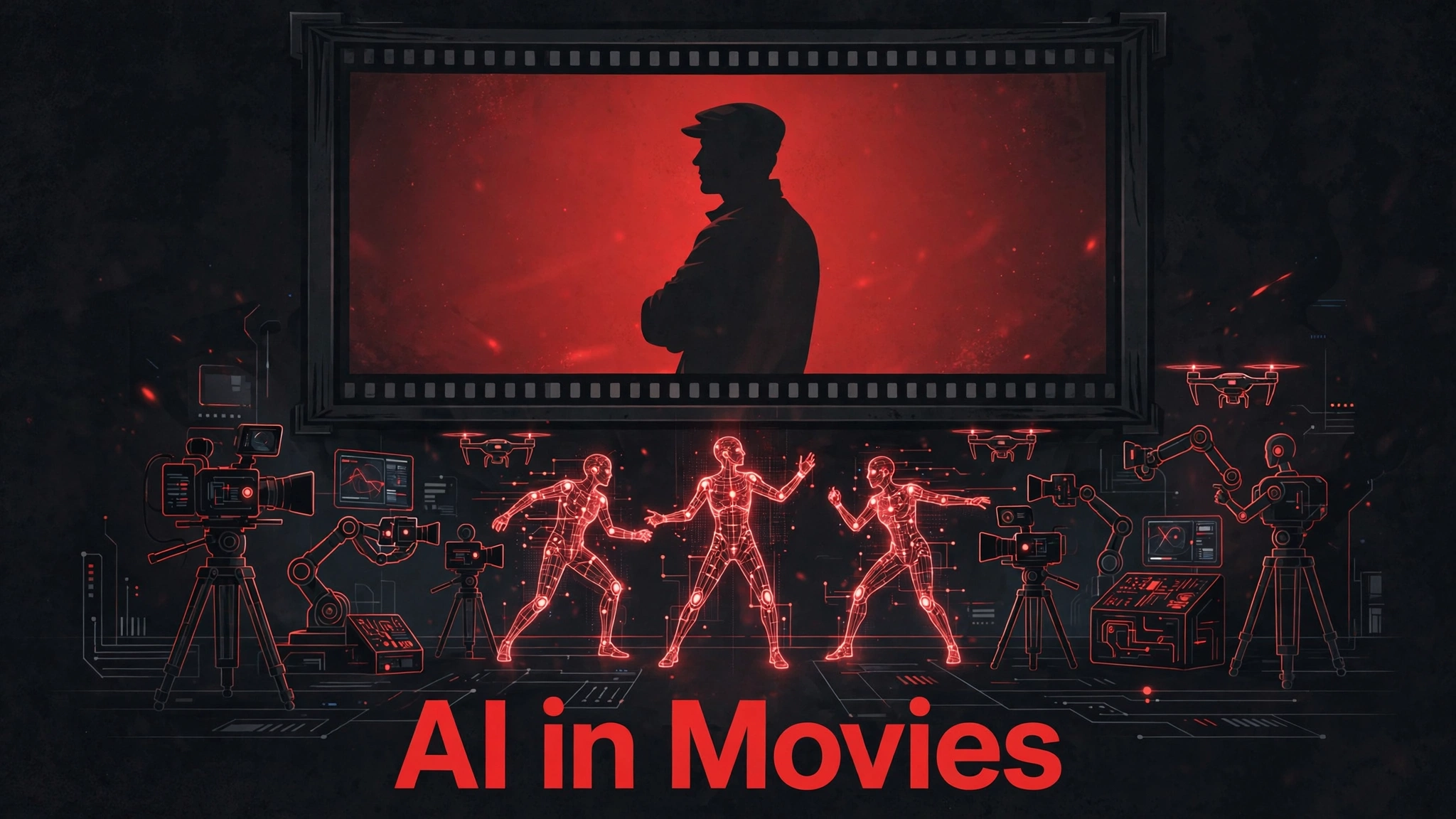
Performance capture, where an actor’s movements and expressions drive a digital character, is another area where AI helps clean and interpret data, making capture faster and more detailed. This expands what actors can play: creatures, older or younger versions of themselves, or characters in animated worlds. It also raises the same consent questions as digital doubles. An actor’s performance data is valuable and personal, and contracts should specify how it can be stored, reused, and paid for. The technology is exciting, but the ethics must keep pace.
Post-Production: Editing, Visual Effects and Sound
Post-production is where AI already saves the most time. Editing tools can transcribe dialogue automatically, find the best takes, assemble rough cuts based on a script, and suggest pacing changes. For documentary filmmakers, transcription and search across hours of footage is transformative: a moment that once took days to find can now be located in seconds. Editors still shape story, rhythm, and emotion, but they spend less time on mechanical searching and more on creative decisions.
Visual effects benefit enormously. AI tools can remove objects, extend sets, clean up footage, upscale older material, and generate backgrounds, crowds, or weather that would be expensive to film. For independent filmmakers, this levels the playing field: a small team can now create a convincing city, landscape, or historical setting without a huge budget. The risk is overuse: effects that look impressive in a demo can feel weightless or distracting in a story if they are not motivated by character and plot. Good effects serve the story; they do not replace it.
Sound is another quiet revolution. AI can clean dialogue recorded in noisy locations, separate voices from music, generate ambient sound, and assist with dubbing and translation. Voice cloning, where a synthetic voice mimics a real person, is powerful and controversial. With consent, it can help an actor complete a role after illness, or dub a film into another language while preserving vocal character. Without consent, it can impersonate, mislead, and harm livelihoods. Clear consent, labelling, and legal limits are essential, and audiences should be told when a voice they hear is synthetic.
Digital Actors, Voice Cloning and Audience Trust
Digital actors, sometimes called synthetic performers, are among the most debated AI developments in film. They range from fully digital characters voiced by actors, to digital recreations of deceased performers, to AI-generated faces with no human counterpart. Supporters argue they open new creative possibilities, allow stories that would otherwise be impossible, and preserve performances. Critics argue they threaten actors’ jobs, blur the line between real and fake, and risk exploiting likenesses without fair pay.
Audience trust is the practical test. Many viewers accept a digital creature or an animated character, because the artifice is clear. Fewer accept a digital recreation of a real person presented as if it were that person, especially without disclosure. Transparency helps: labelling synthetic performances, crediting the humans behind them, and obtaining consent from the person or their estate. Films that hide synthetic elements risk backlash when audiences discover them, while films that are open about their tools can be judged on their artistry.
The legal landscape is still evolving and varies by place. Some regions have introduced or proposed rules on likeness rights, voice cloning, and labelling, while others rely on contracts and existing law. Creators should not assume that a tool’s ability to clone a voice or face makes it lawful or fair to do so. For students and independent filmmakers, the safe and respectful path is to use original characters, obtain written consent for any real likeness, and label synthetic elements clearly. Creativity does not require impersonation.
Jobs, Creativity and the Independent Filmmaker
AI changes film jobs unevenly. Routine post-production tasks, such as transcription, basic cleanup, and first-pass effects, are becoming faster and cheaper, which may reduce demand for entry-level roles in those areas. At the same time, new roles are emerging in AI supervision, virtual production, data management, and the integration of AI tools into workflows. Directors, writers, actors, and editors who learn to direct AI tools, check their output, and add human judgement are likely to remain central, while workers who only perform routine tasks face more pressure.
For independent filmmakers, AI is genuinely empowering. A filmmaker with a strong story can now produce a short film, a music video, or a documentary with tools that once required a studio. That lowers barriers, diversifies voices, and allows stories from places and communities that major studios overlook. The challenge is distribution and attention: when many people can generate content cheaply, standing out requires originality, craft, and marketing, not only technical ability. A good story, well told, still matters more than a flashy effect.
Creativity itself is also changing. Some creators fear that AI will homogenise films, because models trained on past successes favour familiar patterns. Others argue that AI frees creators from drudgery to focus on original ideas. Both can be true. The antidote to homogenisation is human taste: lived experience, cultural specificity, risk-taking, and the willingness to make something strange or personal. AI can suggest the average; only a human can choose the surprising, meaningful exception. That choice is the heart of filmmaking.
The Future of Cinema: What Might Change Next
Looking ahead, several trends seem likely. Headsets and immersive formats may offer new kinds of film experiences, where viewers explore a scene rather than watch a fixed frame. Personalised trailers, posters, and recommendations will become more sophisticated, though personalised films themselves raise questions about shared cultural experience: if everyone watches a different version, what do we discuss afterwards? Interactive films, where viewers influence a story, may grow as a niche, while traditional linear films remain the main form for shared storytelling.
Production may become more distributed. Small teams in different countries could collaborate on a film using shared virtual sets, cloud editing, and AI translation, reducing travel and cost. That could diversify cinema, bringing more languages, locations, and perspectives to global audiences. It could also concentrate power in the platforms and tool providers that control the infrastructure, which is why open standards, fair licensing, and creator ownership matter for the future.
The most important future question is not technical but cultural: what do we want films to be? If films are records of human experience, performed by humans and directed by humans, then AI should remain a tool in service of that experience, with transparency about its use. If films become fully synthetic products optimised for engagement, they may still entertain, but they will mean something different. Audiences, creators, and regulators will decide that balance together, film by film, contract by contract, and choice by choice.
How Viewers Can Spot AI in a Film
Viewers do not need technical training to notice AI assistance, though they should avoid jumping to conclusions from a single odd detail. Look for patterns: dialogue that sounds generic or oddly smooth, faces or hands that shift subtly between shots, backgrounds that feel too perfect or inconsistent, and voices that lack natural breath, hesitation, or emotion. A single flaw may simply be a low-budget effect or a compression artefact, but a cluster of flawless yet lifeless elements can suggest heavy synthetic generation. The most reliable signal, however, is disclosure: reputable productions increasingly credit AI use, and a lack of credits does not prove AI use, but transparent credits help viewers judge fairly.
Rather than playing detective, viewers can ask better questions: does the story feel human and specific? Do performances carry intention and imperfection? Are creators credited, and were real performers consented and paid? Those questions matter more than spotting a technical glitch, because they focus on the ethics and artistry behind a film, not only on its surface. As AI tools improve, surface flaws will fade, and the human questions, about authorship, consent, and meaning, will become the lasting way to judge a film.
My Take:
My view is that AI is a wonderful assistant and a poor author. I would happily use it to transcribe footage, clean dialogue, visualise a set, or brainstorm a plot turn, because those tasks free time for the real work: story, performance, and judgement. I would not let it write the final script, perform the final role, or decide the final cut, because those choices are where a film becomes human. A film without a human point of view may look polished, but it will feel empty, and audiences notice emptiness even when they cannot explain it.
I am firm on consent and labelling. If a voice or face belongs to a real person, that person should agree, be paid fairly, and be credited. If a performance is synthetic, audiences should be told. Secrecy may win a short-term surprise, but it destroys trust when it is discovered, and trust is the currency cinema runs on. Openness is not a burden; it is a sign of respect for actors and viewers alike.
For independent filmmakers, I am genuinely optimistic. AI lowers the cost of effects, editing, and visualisation, which means a strong story from a small team can now look professional. That is a real democratisation, and it should bring new voices to cinema. The challenge will be standing out in a flood of generated content, and the answer is not more effects but more originality: a personal story, a specific place, a distinctive voice that no model can average away.
I also think jobs will change more than vanish. Routine post-production roles will shrink, new supervision and virtual production roles will grow, and the most valuable filmmakers will be those who can direct tools and judge output. Students should learn both: traditional craft and AI literacy, so they can use the tools without being used by them.
In the end, cinema has survived every technology wave, from sound to colour to streaming, by adapting while keeping its human core. AI will be another wave, not the end of film. If we keep humans directing, actors consenting, and audiences informed, AI can make films more diverse, more ambitious, and more accessible. That is a future worth making, carefully, together.
If I were a young filmmaker tomorrow, I would learn traditional craft first and AI tools second, in that order, because a tool cannot supply taste, story sense, or judgement about performance. I would study how a scene is structured, how an actor’s choice changes meaning, and how editing shapes emotion, and then I would use AI to transcribe footage, visualise a set, or clean dialogue, so that craft has more time to breathe. A filmmaker who understands story and then uses AI well will always outperform a filmmaker who only knows how to prompt a tool and hopes the output will be art.
The mistake I would avoid is hiding synthetic elements from audiences or using a real person’s voice or face without clear consent. Secrecy may create a short surprise, but discovery destroys trust, and trust is the foundation on which cinema, acting careers, and audience loyalty are built. I would label synthetic performances, credit the humans behind them, and obtain written consent for any real likeness, even when a tool makes cloning technically easy. Respect is not a brake on creativity; it is what allows creativity to be shared without harm.
After finishing a project with AI assistance, I would judge it by whether a human point of view survives in the final film. Does the story say something specific, from a lived perspective, that a model averaging past films would not say? Do performances feel chosen, not generated? Does an effect serve character and plot, or does it merely show off? If the film feels personal and intentional, AI has served it well. If it feels polished but generic, I would revise with more human choices, not more generated material, because more of the same will not fix emptiness.
I would also stay curious about distribution and attention, because making a film is now easier than being seen. When many creators can generate content cheaply, originality, community, and honest marketing matter more than technical novelty. I would build an audience around a specific story, place, or voice, share work-in-progress honestly, and invite viewers into the process. A small, engaged audience that cares about a human story is worth more than a large, passing audience for a synthetic spectacle, and it is the audience most likely to return for the next film.
If a friend asked me in two minutes whether AI will ruin movies, I would say: no, but it will change how movies are made, and the outcome depends on choices about consent, credit, and creativity. AI already helps with transcription, effects, and visualisation, and it will help small filmmakers tell stories that once needed a studio. The danger is not the tool itself, but using it to replace human judgement, impersonate performers without permission, or flood audiences with generic content. Those are choices, and choices can be made well.
What changed my mind over time is how much I used to separate technology from art, as if a new tool automatically meant a new kind of film. In reality, cinema has absorbed every technology, from sound to colour to digital effects, by keeping its human core: a story, a performance, and a director’s judgement. AI will follow the same pattern if we insist on it. A film made with AI tools but directed by a human, performed with consent, and judged by human taste is still a human film. A film generated without intention, however polished, is a product, not a story.
Looking five years ahead, I expect AI tools to become invisible parts of production, like editing software today, while debates about likeness rights, labelling, and fair pay become more settled, though not fully resolved. I also expect audiences to become more discerning, valuing films with a clear human voice over synthetic spectacles that feel interchangeable. Independent filmmakers who combine craft with AI literacy, and who build audiences around specific stories, will have more opportunities than ever, even as competition for attention grows.
My final decision rule is simple: use AI to serve a human story, obtain consent for real likenesses, label synthetic elements honestly, and judge the result by whether it feels personal and intentional. If a film passes those tests, AI has helped it. If it feels generic, hidden, or exploitative, no amount of technical polish should excuse it. Cinema’s future will be decided not by what tools can do, but by what creators and audiences choose to value, film by film.
Frequently Asked Questions
Is AI replacing filmmakers?
Not as a whole. AI assists with drafting, editing, effects, and visualisation, but directing, acting, writing with original voice, and final creative judgement remain human roles in professional filmmaking.
What is virtual production in movies?
Virtual production films actors in front of large LED screens showing digital environments that move with the camera, giving realistic lighting and letting directors see the world while shooting.
Are digital actors legal?
Legality varies by place and depends on consent, contracts, and likeness rights. Using a real person’s face or voice without permission can create legal and ethical problems, even if a tool makes it technically easy.
Can AI write a good movie script?
AI can generate ideas and drafts, but professional scripts still need human originality, voice, structure, and revision. AI drafts often feel generic without strong human rewriting.
How does AI help independent filmmakers?
AI lowers costs for editing, transcription, visual effects, and visualisation, letting small teams produce professional-looking work. Originality and distribution remain the main challenges.
Will audiences accept AI-generated films?
Audiences accept digital characters and effects when artifice is clear, but trust drops when synthetic performances are hidden. Transparency and consent help audiences judge work fairly.