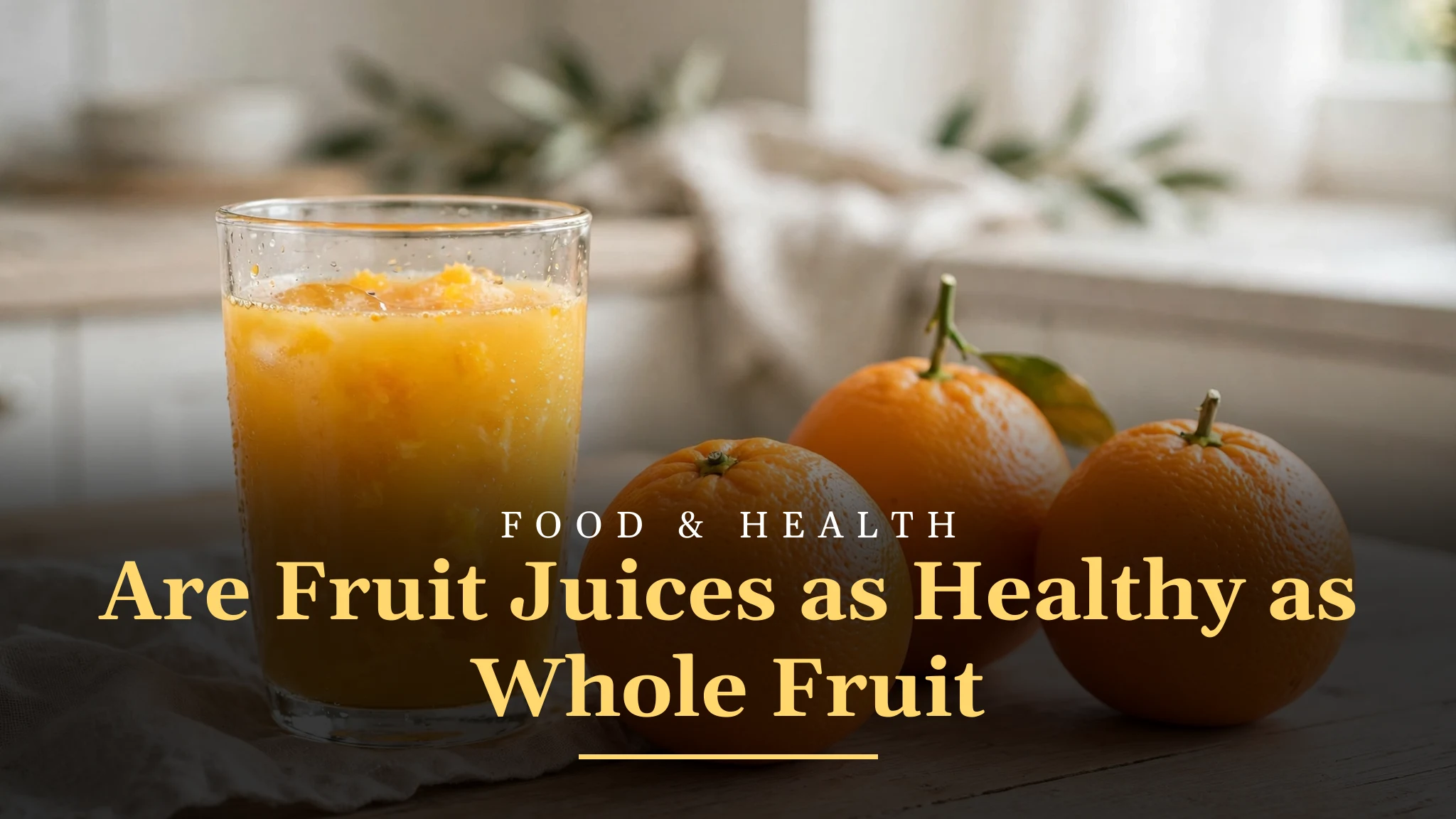
Are Fruit Juices as Healthy as Whole Fruit
In this post
A glass of orange juice looks like health in a glass. It is bright, it is cold, it is made from real fruit, and the carton often shows pictures of oranges picked straight from a tree. So it is easy to believe that drinking juice is just as good as eating the fruit itself, only quicker and easier. The truth is more mixed. Juice and whole fruit start from the same place, but they do not do the same thing inside your body. Juice keeps the water, the sweetness and much of the vitamin C from the fruit, but it throws away the fibre, which is one of the most useful parts. It also packs the sugar of several pieces of fruit into one small glass, and you can drink that sugar in a minute, without chewing, without feeling full, and without the slow digestion that makes whole fruit so steady. That does not make juice poison, and it does not make it useless. It makes it a different food, and once you understand the difference, you can decide when juice is a pleasant treat, when it is a useful shortcut, and when eating the fruit is simply the better choice.
What Happens When You Turn Fruit Into Juice
Think about an orange. When you eat it, you peel it, you pull it apart, you chew each segment, and you swallow flesh, juice and fibre together. The whole process takes several minutes. Your mouth, your stomach and your gut all take part, and by the time you have finished one orange, you feel that you have eaten something. Now think about a glass of orange juice. To fill that glass, someone squeezed three or four oranges. All of their juice went into the glass, and all of their pulp and fibre stayed behind in the juicer or the strainer. You pick up the glass, you drink it in less than a minute, and you have taken in the sugar of four oranges without ever feeling that you have eaten four oranges. That is the first and biggest difference, and it is a difference of amount as much as anything else. Nobody sits down and eats four oranges in a row, one after another, without stopping. But plenty of people drink the juice of four oranges with breakfast and think nothing of it, because it feels like one small drink.
Juicing also changes the shape of the food. Whole fruit is a solid. Your teeth break it down, your saliva starts to work on it, and your stomach has to break the solid pieces apart before the sugar can pass into your blood. Juice is already a liquid. There is nothing to chew and very little to break down, so the sugar reaches your blood much faster. This matters because the speed of sugar matters. A slow rise in blood sugar gives your body time to respond calmly. A fast rise asks your body to deal with a lot of sugar at once, and then, often, your blood sugar falls again quite quickly, which can leave you feeling hungry or tired an hour later. Whole fruit gives you the slow version. Juice gives you the fast version. They contain similar sugars, but your body meets them in completely different ways.
There is also the question of what is left out. When you juice a fruit, you keep the water and the soluble parts, and you lose the solid parts. That solid part is not waste. It is the fibre, the skin, the membranes between segments, and the pulp that gives fruit its body. In an orange, the white pith and the thin skins around each segment are full of fibre. In an apple, the skin holds much of the fibre. In a mango, the flesh around the stone is firm and fibrous. All of that is removed or left behind when you make juice. So juice is not whole fruit in liquid form. It is whole fruit with its most filling part taken away, and that changes how it behaves in your body from the first sip.
Fibre: The Part Juice Leaves Behind
Fibre is the part of plant food that your body cannot digest, and it is easy to overlook because it does not give you energy and it does not taste of anything in particular. But fibre does several quiet, important jobs. First, it slows digestion down. When fibre is mixed in with sugar, as it is in whole fruit, the sugar is released into your blood gradually, instead of all at once. That is why an apple keeps you steady for an hour or two, while apple juice can leave you hungry again much sooner. Second, fibre adds bulk to your food, so your stomach feels full. A whole apple takes up space, and your stomach sends a signal that you have eaten. A glass of apple juice takes up far less space for the same amount of sugar, and that fullness signal is much weaker. Third, fibre feeds the good bacteria that live in your gut, and those bacteria help with digestion and with keeping your gut healthy. Juice gives those bacteria almost nothing to work with, because the fibre they feed on has been removed.
The numbers make this clear. A medium orange gives you about 3 grams of fibre. A glass of orange juice made from three oranges should, in theory, contain the fibre of three oranges, but in practice it contains almost none, often less than half a gram, because the fibre stays in the pulp. An apple gives you about 4 grams of fibre, most of it in the skin and the flesh. A glass of clear apple juice gives you almost none. This is not a small detail. If you eat two pieces of fruit a day, you get a useful share of your daily fibre from them. If you drink juice instead, you get almost no fibre from that serving, and you have to find it somewhere else in your diet, from vegetables, beans, lentils or whole grains. Many people do not, which is one reason juice can be a poor swap for fruit, even though both come from the same plant.
Fibre also helps with chewing, and chewing matters more than people think. Chewing slows you down, it makes you notice what you are eating, and it gives your brain time to register that food is coming in. A person who eats an orange is doing a small piece of work. A person who drinks juice is doing almost no work at all. That difference in effort is also a difference in satisfaction. People who eat whole fruit tend to feel they have had a snack. People who drink juice often feel they have had a drink, and then they go looking for a snack as well. That is how juice can add calories without adding fullness, and over weeks and months, that pattern can add up. It is not that juice is fattening on its own. It is that juice does not fill you, so you eat more on top of it.
Sugar: Same Fruit, Faster Effect
The sugar in fruit is natural sugar, and it is worth being clear about what that means. Natural sugar is not a different kind of sugar once it is inside your body. Your body treats the sugar from an orange in the same way as it treats sugar from a spoon, once that sugar reaches your blood. What is different is the package it arrives in. In whole fruit, sugar arrives with fibre, water and bulk, so it enters your blood slowly. In juice, sugar arrives with water and almost no fibre, so it enters your blood quickly. In a sweet fizzy drink, sugar arrives with water and nothing else at all. So juice sits in the middle: it is better than a fizzy drink, because it brings vitamins and it comes from real fruit, but it is not the same as whole fruit, because it has lost the fibre that slows sugar down.
A glass of orange juice contains about 20 to 25 grams of sugar, which is roughly five teaspoons. That is about the same as a small can of fizzy drink, though the juice also brings vitamin C and potassium, which the fizzy drink does not. A glass of apple juice is similar. A glass of grape juice can contain even more, sometimes 30 grams or more, because grapes are very sweet. None of this means you should never drink juice. It means you should think of juice as a concentrated source of sugar, even when it is natural and unsweetened. The label may say no added sugar, and that may be true, but no added sugar does not mean low sugar. It means all the sugar came from the fruit itself, and fruit is sweet. Four oranges contain a lot of natural sugar, and when you squeeze them into one glass, all of that sugar is still there.
For most healthy people, a small glass of juice now and then is fine, especially with a meal, because food in the stomach slows things down a little. The problem comes when juice becomes the daily replacement for fruit, or when it is drunk in large glasses, several times a day, or on an empty stomach first thing in the morning. Then the fast sugar, the lack of fibre and the lack of fullness all work together, and you get the sugar of many pieces of fruit without the benefits that make fruit so steady. If you are watching your blood sugar, this matters even more, because juice raises blood sugar faster than whole fruit does, and it is harder to judge how much you have taken in. One orange is one portion. One glass of juice is three or four portions, and it does not feel like it.
Vitamins, Water and What Juice Keeps
It would be unfair to say juice keeps nothing good, because it does keep some useful things. The main one is vitamin C. Oranges, lemons, grapefruit and many other fruits are rich in vitamin C, and much of that vitamin passes into the juice, especially if the juice is fresh. A glass of fresh orange juice can give you most of your daily vitamin C in one go. Juice also keeps potassium, a mineral that helps with blood pressure and muscle function, and it keeps water, so it does help you stay hydrated, in the same way that eating a juicy fruit does. For a person who finds it hard to eat fruit, perhaps because of sore teeth, a sore mouth, or a small appetite, juice can be a useful way to get some vitamins and fluid in. That is a real benefit, and it is worth naming honestly.
What juice does not keep, apart from fibre, is the full range of plant compounds that live in the skin and the solid flesh of fruit. The skin of an apple, the pith of an orange, the dark colour of berries and grapes, all of these carry compounds that are studied for their role in general health, and many of them stay behind with the pulp. Juice also loses some vitamin C over time, especially once it has been open in the fridge for a few days, or once it has been heated and stored in a carton for weeks. Fresh juice, drunk soon after it is made, keeps more vitamin C than juice that has sat on a shelf. This is another reason fresh juice and long-life carton juice are not quite the same thing, even when the label looks similar.
Water is another point worth understanding. Both whole fruit and juice give you water, and both help with hydration. A whole orange is about 85 percent water. A glass of orange juice is also mostly water. So if your only goal is to drink more fluid, juice does the job. But hydration is not the whole story of fruit. Fruit is food as well as drink, and when you turn it into juice, you keep the drink part and lose much of the food part. You lose the chewing, the bulk, the fibre and the slow fullness. That is why nutrition guidance in many countries counts juice as only one portion of fruit a day at most, no matter how many glasses you drink. The rule is a simple way of saying what this article has been explaining: juice can stand in for fruit once, but it cannot stand in for fruit all day.
It is also worth saying that juice can be a helpful bridge. A child who refuses to eat fruit may drink a small glass of juice, and that is better than no fruit at all. An older person who cannot chew well may manage juice when whole fruit is hard. A person recovering from a stomach upset may find juice gentler than solid fruit. In these cases, juice is doing a useful job, and nobody should feel guilty about using it. The point is not to ban juice. The point is to know what it gives you and what it does not, so you can use it where it helps and eat whole fruit where that is the better choice.
Fresh Juice, Shop Juice and Sweetened Drinks Are Not the Same
Not all juice is equal, and the differences matter. Fresh juice, squeezed at home and drunk straight away, is the simplest kind. It contains only fruit, it keeps the most vitamin C, and it has no added sugar, salt or preservatives. It still lacks fibre and it still contains the sugar of several pieces of fruit, but at least you know exactly what went into it. Shop-bought pure juice, the kind that says 100 percent juice on the carton, is the next step. It is also made only from fruit, but it has usually been heated to make it last longer, and it may have been stored for weeks before you buy it. It still has no added sugar, but it has lost some vitamin C in processing, and it may taste flatter than fresh juice. It is still a better choice than a sweetened drink, but it is not the same as fresh.
Then there are juice drinks, nectars and squash, and these are where the confusion really starts. A juice drink may contain only 10 or 25 percent real juice, and the rest is water, added sugar, flavourings and colour. A carton may show a picture of a mango or a guava, and it may say mango drink in large letters, but the small print tells a different story. These drinks are much closer to fizzy drinks than to real juice. They give you sugar and water with very little vitamin C and no fibre at all. Squash and cordial are similar: a small amount of fruit flavour mixed with a lot of sugar and water. They are drinks, not fruit, and they should be judged as drinks. If you are buying juice, read the label. If the first ingredient is water and sugar, you are not buying juice. If it says 100 percent juice, you are buying real juice, with all its strengths and all its limits.
Smoothies are a different case again, and they deserve a mention because many people think they are the same as juice. A smoothie made at home from whole fruit blended with yoghurt or milk is not juice. The blender breaks the fruit up, but it does not remove the fibre. The fibre is still in the glass, just in smaller pieces. That makes a smoothie much closer to whole fruit than juice is, because it keeps the fibre, the bulk and the slow digestion. A shop-bought smoothie can be different, because some are made from juice concentrate and puree with added sugar, and some are very large, containing the sugar of many pieces of fruit. But a small home-made smoothie, made from one or two pieces of fruit and some yoghurt, is a genuinely useful food, and it is a far better swap for fruit than juice is.
Juice and Teeth, Hunger and Blood Sugar
Juice affects your teeth in a way whole fruit does not, and this is a practical point that parents should know. Fruit juice is acidic, especially citrus juice, and acid softens the surface of teeth. When you eat a whole orange, the acid is in your mouth for a short time, and your saliva washes it away. When you drink juice, especially if you sip it slowly over a long time, your teeth sit in acid for much longer. That is why dentists often advise drinking juice in one go, with a meal, rather than sipping it through the day, and why they advise against giving juice in a bottle to a small child to sip for hours. A glass of juice with breakfast is far kinder to teeth than the same juice sipped slowly all morning. Rinsing your mouth with water after juice helps too, and waiting a little while before brushing your teeth gives the enamel time to settle.
Hunger is another place where juice and whole fruit part company. Whole fruit fills you because it has bulk and fibre, and because eating takes time. Juice does not fill you in the same way. Many people drink a glass of juice and feel hungry again within the hour, and then they eat a snack on top of the juice. That is not a failure of willpower. It is the natural result of drinking calories instead of eating them. Liquid calories are easy to take in and easy to forget, and that is why they can add up without you noticing. A person who eats an apple at mid-morning may not need anything else until lunch. A person who drinks apple juice at mid-morning may well reach for biscuits as well, and that is an extra serving of food that the juice did not replace.
Blood sugar follows the same pattern. Whole fruit raises blood sugar gently, because the fibre slows everything down. Juice raises it faster, because there is nothing to slow it down. For a healthy person, this is a small effect, and the body handles it. For a person who is watching their blood sugar, or who has been told to be careful about it, the difference matters more. A glass of juice on an empty stomach can raise blood sugar quite sharply, while a whole orange eaten after a meal has a much gentler effect. This does not mean a person with blood sugar concerns can never drink juice. It means a small glass, with food, is a much safer choice than a large glass on its own, and it means whole fruit is usually the better daily habit.
How to Use Juice Sensibly in a Real Day
So where does juice fit? The honest answer is that it fits as a small, occasional pleasure, not as the main way you eat fruit. A small glass, about 150 millilitres, which is roughly half a normal drinking glass, is a sensible serving. One small glass a day, with a meal, is a reasonable limit for most people. That gives you the taste and the vitamin C without the sugar of four oranges on an empty stomach. If you like juice in the morning, have it with breakfast, when there is other food in your stomach to slow things down. Do not drink it instead of breakfast, and do not drink a large glass first thing and then nothing else, because that is when the fast sugar hits hardest.
If you make juice at home, there are ways to make it a better choice. Keep the glass small. Mix fruit juice with water or sparkling water, so you get the flavour with half the sugar. Add vegetables to the mix, such as carrot or cucumber, which add bulk and nutrients without as much sugar. If you have a blender rather than a juicer, use it, because blending keeps the fibre. A blended drink made from a whole orange, a little water and some yoghurt is a far better breakfast than a glass of strained juice. And if you are buying juice, choose 100 percent juice, check the size of the serving, and avoid juice drinks that are mostly water and sugar.
Children need a little extra care here. Small children do not need juice at all, and whole fruit is always the better choice for them, because it teaches them to chew, it fills them, and it is kinder to their teeth. If a child does drink juice, a very small glass with a meal, and not in a bottle to sip through the day, is the safest pattern. Older children and adults can enjoy juice as a treat, but the same rule holds: small glass, with food, not all day. And for everyone, the best habit is simple. Eat your fruit most of the time, and drink juice sometimes. That way you get the fibre, the fullness and the slow energy from the fruit, and you still get to enjoy the taste of juice without letting it replace the real thing.
My Take:
If you ask me whether fruit juice is as healthy as whole fruit, my answer is plain: no, it is not, and I say that as someone who enjoys a glass of fresh juice. I like the taste, I like the colour, and I like the feeling of a cold glass on a hot day. But liking something is not the same as thinking it is equal to the real thing, and juice is not equal to whole fruit. The fruit is the whole package: the flesh, the fibre, the skin, the chewing, the slow filling feeling, and the steady energy that follows. Juice is that package with the best part taken out. It keeps the sweetness and some of the vitamins, but it leaves behind the fibre, and fibre is what makes fruit work so well in your body. When I think about it that way, the answer is clear, and I do not need a complicated chart to see it.
I think the reason so many people believe juice is just as good is that the carton tells them so. The picture shows fresh fruit, the words say natural and no added sugar, and the drink looks like health. I understand why that is convincing. It is convincing because it is partly true. Juice does come from fruit, and it does contain real vitamins. But a picture of an orange is not an orange, and a glass of juice is not the same as eating the fruit. The marketing leaves out the part that matters most, which is that four oranges went into one glass and all their fibre stayed behind. Nobody would eat four oranges for breakfast, but many people drink four oranges for breakfast and feel they have been healthy. I think that is the real trick of juice: it makes a large amount of fruit feel like a small amount, and that feeling is what makes it easy to take in too much sugar without noticing.
In my view, the most honest way to think about juice is to think of it as a treat, not as a health food. A treat can be enjoyed, and it does not have to be perfect. A glass of fresh mango juice on a summer afternoon is a pleasure, and I would not tell anyone to give it up. But I would not call it a health habit either. A health habit is the thing you do every day without thinking, and for fruit, that habit should be eating the fruit, not drinking it. An apple in a school bag, an orange after lunch, a banana in the afternoon: those are health habits, because they give you fibre, fullness and steady energy day after day. A glass of juice is a nice extra, and that is where it belongs.
I also think we should be honest about who juice helps and who it does not. For a person who cannot chew well, or who has a very small appetite, juice can be genuinely useful, because it gets vitamins and fluid into a body that needs them. For a child who will not eat fruit, a small glass of juice is better than nothing. I respect those uses, and I would not criticise them. But for a healthy adult who can eat fruit perfectly well, swapping fruit for juice every day is a step backwards. It gives you faster sugar, less fibre, less fullness, and more strain on your teeth, all for the sake of saving a few minutes of chewing. That trade is not worth it, in my view, and I think most people would agree once they see it clearly.
There is one more thing I want to say, and it is about how we judge food. We are often told to judge food by one number: how much vitamin C it has, or whether it has added sugar, or whether it is natural. But food is not one number. It is a whole package, and the package matters. Whole fruit is a good package: sugar with fibre, water with bulk, sweetness with chewing. Juice is a weaker package: sugar with water, sweetness without fibre, flavour without fullness. When I judge food, I try to look at the whole package, not just the label. That is why I would always choose the orange over the orange juice, the apple over the apple juice, and the mango over the mango drink. The fruit is the real thing. The juice is a shadow of it, pleasant but not equal.
I also want to be fair to the people who make juice, because not all juice is the same. Fresh juice made at home is the best kind, because you know what went into it and you drink it straight away. Shop-bought pure juice is still real juice, though it has been heated and stored. Juice drinks are the ones I worry about, because they pretend to be juice while being mostly sugar and water. If you are going to drink juice, choose the real kind, keep the glass small, and drink it with a meal. Those three simple rules make juice a much safer pleasure, and they are easy to remember.
My final view is simple, and I will say it plainly. Eat your fruit. Drink juice sometimes, in a small glass, with food, and enjoy it. Do not let juice replace fruit, and do not let a carton convince you that it has. The fruit is cheap, it is simple, it fills you, it gives you fibre, and it treats your blood sugar and your teeth far more kindly than juice does. Juice is a pleasant drink, and a pleasant drink has its place. But it is not the same as the fruit it came from, and once you know that, you can enjoy both in the right way, without fooling yourself about which one is doing the real work. If a friend asked me whether they should swap their morning fruit for a glass of juice, I would say no, and I would give them a simple test. Eat an orange tomorrow, and drink a glass of orange juice the day after, and notice how you feel an hour later. After the orange, you will probably feel steady and satisfied. After the juice, you will probably feel hungry again, and you may feel a little tired as the fast sugar fades. That is not a theory. It is your own body telling you the difference, and I trust that test more than any label. The body knows when it has eaten real food and when it has only drunk something sweet, and it tells you in the simplest way: by how long you stay full.
I would also tell that friend to think about their children, because children learn their food habits from what they see at home. If a child sees fruit on the table and juice only sometimes, they learn that fruit is the normal food and juice is the treat. If a child sees juice every morning and fruit rarely, they learn the opposite, and that lesson can stay with them for years. I think that is worth thinking about, because food habits are not just about today. They are about the pattern a child carries into adult life. A child who grows up eating fruit will find it easy to keep eating fruit. A child who grows up drinking juice may find it harder to sit down and eat a whole piece of fruit later. The small choice at breakfast is also a choice about the future, and I would rather make the choice that teaches the better habit.
There is a money point here too, and I think it matters. Juice is expensive. A carton of pure juice costs far more than the fruit it came from, and a glass of juice uses three or four pieces of fruit at once. Eating the fruit is cheaper, because one piece of fruit is one serving, and it fills you. Drinking the juice is dearer, because you need several pieces of fruit to fill one glass, and the glass does not fill you. For a family watching its budget, that difference is real. I would rather buy four oranges and eat one a day for four days than squeeze all four into one glass on one morning. The money goes further, the food lasts longer, and the body gets more from it. That is practical thinking, and I think practical thinking belongs in health advice just as much as vitamins do.
I also want to say something about guilt, because I do not want this article to make anyone feel bad about liking juice. Liking juice is normal, and enjoying a glass of fresh juice is a simple pleasure. I enjoy it myself. The problem is not enjoyment. The problem is confusion, when a person thinks juice is doing the same job as fruit and then wonders why they still feel hungry, or why their blood sugar jumps, or why their teeth ache. Once the confusion is gone, the enjoyment can stay, and it can stay in the right place. A small glass of juice with breakfast, enjoyed slowly, is a fine thing. A large glass of juice instead of fruit, drunk alone, is a different thing. The difference is not about being good or bad. It is about knowing what you are doing, and then choosing freely.
I also think about the way juice is sold to families, because that is where the habit often starts. A carton with a picture of fresh fruit and the words pure and natural feels like a safe choice for a parent, and I understand why a busy parent reaches for it. It is quick, children like it, and it feels better than a fizzy drink. And it is better than a fizzy drink. I would never say otherwise. But a parent who buys juice thinking it is the same as fruit is being misled by the picture, not by their own judgement. If that parent knew that one glass used four oranges and left all the fibre behind, they might still buy it sometimes, as a treat, but they would also buy whole fruit, and they would put the fruit on the table first. That is the difference knowledge makes. It does not take away enjoyment. It puts enjoyment in its proper place, and it protects the daily habit that actually feeds a child.
There is a seasonal point too, and it is a pleasant one. Fruit tastes best in its season, and eating fruit in season is one of the simple pleasures of the year. Mangoes in summer, oranges in winter, apples in autumn: each season brings its own fruit, and each fruit is at its sweetest and cheapest when it is in season. Juice flattens that pleasure, because carton juice tastes the same all year, and it is made from fruit that may have travelled a long way and sat in storage for weeks. Eating the fruit connects you to the season, to the market, to the simple act of choosing a ripe piece and eating it there and then. Juice cannot give you that. It gives you the flavour, but not the experience, and the experience is part of what makes eating fruit satisfying. I think that matters, because satisfaction is what stops us from eating more than we need. A person who enjoys a real orange is satisfied. A person who drinks juice may still feel that something is missing, and that missing feeling is often what sends them looking for another snack.
I also want to say something about the way we talk about natural sugar, because it confuses many people. Natural does not mean harmless in any amount. Honey is natural, and it is still sugar. Fruit is natural, and it still contains sugar. The word natural tells you where something came from, not how much of it you should eat. A whole fruit is a natural package that limits how much sugar you take in, because you have to chew it, because it fills you, and because you would not eat four of them at once. Juice removes those natural limits, and that is why it is easy to take in too much. I think it is better to judge food by its whole package, not by one word on the label. Does it fill you? Does it give you fibre? Does it make you chew? Does it raise your blood sugar slowly or quickly? Those are the questions that matter, and whole fruit answers them far better than juice does.
So here is my final view, in plain words. Fruit juice is not as healthy as whole fruit, because it loses the fibre, packs in the sugar of several pieces of fruit, and does not fill you. It keeps some vitamins, it tastes good, and it can help people who cannot eat fruit easily. But for most of us, the better daily habit is to eat the fruit and save juice for sometimes. Keep the glass small, drink it with a meal, choose real juice over juice drinks, and use a blender instead of a juicer when you can, so the fibre stays in. That is my view, and I think it is an honest one. The fruit is the real food. The juice is a pleasant drink made from it. Enjoy both, but do not confuse them.
Frequently Asked Questions
Is are fruit juices as healthy as whole fruit something I should think about every day?
Not every day in a worried way, but it is worth knowing the basic difference once: whole fruit gives you fibre, fullness and slow sugar, while juice gives you faster sugar with almost no fibre. Once you know that, the daily choice is simple — eat fruit most of the time and keep juice to a small glass with a meal.
How long does it take to notice anything from are fruit juices as healthy as whole fruit?
You can often notice the difference within an hour. After whole fruit you usually feel steady and satisfied, while after a large glass of juice on an empty stomach you may feel hungry again quite soon as the fast sugar fades. The longer pattern, over weeks, is about whether juice is replacing fruit and fibre in your diet.
Can are fruit juices as healthy as whole fruit fit into a busy workday?
Yes, in a small form it can. A small glass of real juice with breakfast or lunch fits a busy day well. The version that does not fit so well is a large glass drunk alone, or juice sipped all day, because it gives you sugar without fullness and is harder on your teeth.
What is the simplest way to start with are fruit juices as healthy as whole fruit?
Start by eating the fruit instead of drinking it most days, and keep juice to one small glass with a meal. If you make juice at home, use a blender rather than a juicer so the fibre stays in, or mix juice half and half with water.
Does are fruit juices as healthy as whole fruit work the same way for everyone?
No, it does not feel the same for everyone. A person who cannot chew well or has a small appetite may get real benefit from juice, while a person watching their blood sugar will feel the fast rise from juice much more. Children, older people and people with blood sugar concerns all need a smaller glass and a little more care.
What should I do if are fruit juices as healthy as whole fruit does not suit me?
If juice leaves you hungry, tired or with a fast rise in blood sugar, the sensible step is to stop drinking large glasses of it and go back to eating whole fruit, which is slower and more filling. General information can never replace advice about one person’s situation, so if you have a health concern, speak to a qualified health professional.
Sources
- NHS — Eat Well
- World Health Organization — Nutrition
- Centers for Disease Control and Prevention — Nutrition
- Healthline — Nutrition
- Mayo Clinic — Nutrition and Healthy Eating
This article is general information only. It is not medical advice and it does not diagnose, treat, or cure anything. For personal concerns, speak to a qualified health professional.