Bae Doona: The Life Story Behind Korea's Global Star
In this post
Bae Doona is the most global actress Korea has ever produced. She has worked in Korean, Japanese, and English, in Seoul, Tokyo, Berlin, and Hollywood, and in every language she brings the same gift: a face that can be funny and sad in the same moment, a body that moves like a dancer, and a mind that understands stories from many cultures. She played a girl who barks at dogs, a sister fighting a monster in the Han River, a doll who comes to life in Tokyo, a clone in a future world, a fighter in a global series, and a detective in a zombie kingdom. In each role she is different, and in each role she is completely believable.
She grew up in the theatre, because her mother was a stage actress, and she learned early that acting is a craft, not a pose. She began as a model, she moved into film with Bong Joon-ho, and she became known for choosing strange, brave films that other actresses would avoid. Then she went abroad, and she did what very few Korean actors have done: she built a real international career, not as a guest, but as a leading actress in her own right. She worked with the Wachowskis, with Hirokazu Kore-eda, and with directors in many countries, and she did it by learning languages, by being patient, and by being fearless.
This is the story of a Seoul girl who became a citizen of world cinema, and who did it without losing herself. It is a story about theatre, about modelling, about monsters and dolls, about global television, and about an actress who proves that a Korean star can belong to the whole world.
Growing Up in Seoul in a Theatre Family
Bae Doona was born on 11 October 1979 in Seoul, South Korea. Her mother, Kim Hwa-young, was a well-known stage actress, and Bae grew up in and around the theatre, watching rehearsals, meeting actors, and learning how a play is made. That childhood gave her something that most young actors do not have: an understanding that acting is work, not magic, and that it takes discipline, repetition, and respect for the text. She saw her mother work hard, and she learned that the stage is a place of craft, not only of applause.
As a young woman, she was noticed for her looks and her height, and she began working as a model. Modelling in Korea in the late 1990s was a growing world, and Bae had a distinctive face, a face that was not conventionally pretty but was interesting, strong, and memorable. She appeared in photo shoots and on runways, and she learned how to stand in front of a camera without freezing. Modelling taught her about light, about posture, and about the strange feeling of being looked at by strangers, and it gave her a public face before she had any acting skill at all.
She did not stay a model for long. People in film noticed her, and she was offered acting roles. She took them, and she found that she liked the work more than she had expected. Acting asked her to think about other people, to imagine their lives, and to speak words that were not her own. That was harder than posing for a photograph, but it was also more interesting. She began to study, to watch older actors, and to take the work seriously, even when the roles were small.
She also studied at Hanyang University, and she took her education seriously even as her career grew. She understood that an actress who wants a long career must keep learning, must read, and must understand the world. That understanding stayed with her, and it is one reason her performances have always felt intelligent as well as emotional.
Barking Dogs Never Bite and the First Films
Bae Doona made her film debut in 2000, in Barking Dogs Never Bite, directed by Bong Joon-ho, a dark comedy about a man who is annoyed by a barking dog in his apartment building. She played a young woman who works in an office and who becomes involved in the strange story, and her performance was fresh, funny, and natural. The film was not a big commercial hit, but it was praised by critics, and it introduced Bae as an actress to watch. She had worked with Bong Joon-ho in her first film, and that connection would shape her career.
In 2002 she starred in Sympathy for Mr. Vengeance, directed by Park Chan-wook, a dark thriller about a deaf man who tries to save his sister. She played a young woman who helps him, and her performance was praised for its intensity and its sadness. The film was violent and difficult, and it showed that Bae was willing to take on dark, adult stories, not only light comedies. She was building a reputation as a brave actress, one who chose interesting films over safe ones.
She continued to work in Korean films in the early 2000s, taking on roles that were different from each other. She played a young woman in a love story, a woman in a thriller, and a woman in a drama about modern life, and each time she brought a different energy. She was not repeating herself. She was exploring, and the exploration made her filmography one of the most interesting of her generation.
By the mid-2000s, she was one of Korea’s most respected young film actresses, known for her natural style and her willingness to take risks. She had not become a television star, but she had become something rarer: an actress whose name promised quality, and whose presence in a film made it better.
The Host, Air Doll, and the International Turn
In 2006, Bae Doona appeared in The Host, another film by Bong Joon-ho, about a monster that comes out of the Han River in Seoul. She played Nam-joo, a national archery champion and the sister of the family whose daughter is taken by the monster, and her performance was funny, brave, and deeply human. The Host became the biggest Korean film of its time, breaking box-office records, and it introduced Bae to audiences around the world. She was part of a film that changed Korean cinema, and she played her part with a physical skill that came from her modelling and her athletic training for the role.
In 2009 she starred in Air Doll, a Japanese film directed by Hirokazu Kore-eda, about a life-size doll who comes to life and begins to explore Tokyo. She played the doll, a character who has no experience of the world and who must learn what it means to be human, and her performance was extraordinary. She played innocence without being silly, and sadness without being sentimental, and the film was praised at the Cannes Film Festival. It was a turning point, because it showed that Bae could carry a film in a foreign language, in a foreign country, and that she could do it with the same honesty she brought to Korean films.
Air Doll opened the door to international work, and Bae walked through it. She learned English, she learned Japanese, and she began to work with directors in many countries. She did not do it by accident. She did it by studying, by being patient, and by being willing to start again in a new place, as a stranger, and to earn her place through her work. That willingness to start again is rare, and it is the reason her international career succeeded where many others failed.
By the early 2010s, she was a global actress, known in Korea, in Japan, and in the West, and she was still growing. She had not left Korea behind. She had taken Korea with her, and she had shown the world what Korean acting could be.
Cloud Atlas, Jupiter Ascending, and Hollywood
In 2012, Bae Doona starred in Cloud Atlas, a large international film directed by the Wachowskis and Tom Tykwer, based on the novel about six stories across time, from the past to the future. She played several roles, including a clone named Sonmi-451 in a future Korea, a woman who is created to serve and who begins to think for herself. Her performance was praised for its power and its sadness, and the film introduced her to Hollywood audiences. She had played a Korean woman in a future world, speaking English, and she had made the character feel real, not like a fantasy.
In 2015 she appeared in Jupiter Ascending, another film by the Wachowskis, a large science-fiction adventure, and she played a supporting role with the same commitment she brings to every part. The film was a big production, and it showed that Bae could work in Hollywood without losing her identity. She did not try to become an American actress. She remained a Korean actress working in America, and that distinction mattered. She brought a different energy to Hollywood films, a quieter, more thoughtful energy, and audiences noticed it.
In the same period she starred in Sense8, a Netflix series created by the Wachowskis, about eight people around the world who are mentally linked. She played Sun Bak, a businesswoman from Seoul who becomes a fighter, and her performance was loved by fans around the world. The series ran from 2015 to 2018, and it built a devoted global audience. Bae’s character was strong, loyal, and brave, and she played her with a physical skill and an emotional depth that made her one of the most popular characters in the show. Sense8 made her a global star, not only in film but in television, and it showed that a Korean actress could lead a worldwide series.
Those years were the height of her international fame, and they showed what she had built: a career that crossed languages, cultures, and genres, without losing its centre. She was still the girl from Seoul who had grown up in the theatre, and she was still acting with the same honesty she had learned there.
Kingdom, Stranger, and the Return to Korean Drama
After her international success, Bae Doona returned to Korean television, and she showed that she could do powerful work at home as well as abroad. In 2017 she starred in Stranger, a crime drama about a prosecutor who cannot feel emotions, and a detective who helps him solve a case. She played the detective, Han Yeo-jin, a warm, honest, and determined woman, and her performance was praised for its realism and its heart. The drama was a hit, and it showed that Bae could carry a long television series with the same skill she brought to film.
In 2019 she starred in Kingdom, a Netflix series about a zombie plague in Joseon-era Korea, playing a physician who tries to understand the disease and to save people. The series was a global hit, and it introduced Korean historical drama to audiences around the world. Bae played her character with intelligence and courage, and she became one of the faces of the Korean wave on Netflix. She was not only an actress in a zombie show. She was a scientist, a healer, and a leader, and she played all of those things with conviction.
She continued to work in both Korean and international projects, including The Silent Sea in 2021, a Netflix science-fiction series about a mission to the Moon, and Rebel Moon in 2023, a large science-fiction film directed by Zack Snyder. In each project she brought the same professionalism and the same honesty, and she showed that she could move between languages and cultures with ease. She was a global actress, but she was still a Korean actress, and she was proud of that.
Today, Bae Doona remains one of Korea’s most respected and most international stars. She works less often than she once did, and she chooses more carefully, but when she appears, people pay attention around the world. She has shown that a Korean actor can belong to the whole world, and that the world is richer because she does.
Learning Languages and Living Between Worlds
One of the most remarkable things about Bae Doona’s career is how much of it has been built on learning new languages and living in new places, and that story deserves to be told in full, because it explains why she is different from almost every other Korean star. Most actors stay at home, where the language is theirs, where the food is familiar, and where the audience already knows their name. Bae left home again and again, to Japan, to Germany, to America, and to many other places, and each time she had to start again as a stranger. She had to learn new words, new manners, and new ways of working, and she had to earn the trust of directors and crews who did not know her. That takes a kind of courage that is easy to admire and hard to practise, and she practised it for more than twenty years.
Her Japanese work came first, and it is worth remembering how difficult it was. She starred in Air Doll, a film in Japanese, directed by a Japanese master, about a doll who learns what it means to be human, and she played the role in a language that was not her own. She had to learn not only the words but the rhythm of Japanese speech, the politeness, the pauses, and the small sounds that make a sentence feel natural. She did that work, and the result was a performance that Japanese audiences believed, and that critics at Cannes praised. She did not play a Korean woman pretending to speak Japanese. She played a character who lived in Tokyo, who spoke Japanese, and who belonged in that world, and that belonging was earned through study and through care.
Her English work came next, and it was harder still, because English is a language of many accents, many rhythms, and many cultures, and because Hollywood is a place that often asks foreign actors to play stereotypes. Bae refused those stereotypes. In Cloud Atlas she played a clone in a future Korea, a woman who is created to serve and who learns to think, and she played her in English with a clarity and a sadness that made the character feel real. In Sense8 she played a Korean businesswoman who becomes a fighter, and she played her in English, in Korean, and in the language of action, which is a language of the body. She learned to fight on screen, to move with speed and with power, and to make that movement feel like a part of her character, not like a trick. That physical learning, like her language learning, was a form of respect for the work.
Living between worlds also changed her as a person, and that change shows in her acting. She has said in interviews that living abroad taught her to see Korea from the outside, to understand what is special about it and what is strange about it, and to carry that understanding into her roles. An actor who has only lived in one place sees the world from one angle. An actor who has lived in many places sees it from many angles, and that wider view makes her performances richer. When she plays a Korean woman in Kingdom, she brings the knowledge of how the world sees Korea. When she plays a global character in Sense8, she brings the knowledge of what it means to be Korean in a world that is not Korean. That double vision is rare, and it is the heart of her gift.
There were also lonely times, and it is honest to say so. Living abroad is not only an adventure. It is also a life of hotels, of long flights, of meals eaten alone, and of missing home. Bae has spoken about that loneliness, about the difficulty of being far from family and friends, and about the pressure of representing Korea in a foreign industry. She did not let that loneliness stop her. She used it, as actors use everything, and she turned it into performances about women who are far from home, who are strangers in a strange place, and who must find their own way. That is why her characters often feel like outsiders, even when they are at the centre of the story, because she knows what it feels like to be an outsider, and she plays it with truth.
Finally, her life between worlds has made her a bridge, and that bridge matters for Korean cinema. She has shown young Korean actors that they can work abroad, that they can learn new languages, and that they can be respected in many countries without losing themselves. She has shown foreign directors that Korean actors are not only talented but professional, patient, and brave. And she has shown audiences around the world that a Korean woman can be a hero, a fighter, a lover, and a leader, in any language and in any story. That is a legacy that goes beyond any single film, and it is one that will last long after her own career is over.
Her role in Stranger also deserves a closer look, because it shows her at her warmest and her most grounded. She played Han Yeo-jin, a detective who is honest, determined, and kind, a woman who works with a prosecutor who cannot feel emotions, and who helps him learn to care. The drama was a hit, and her performance was praised for its realism and its heart. She played a detective who is not a superhero, but a person who does her job well, who listens, and who stands up for what is right, and that ordinariness made the drama work. It was a reminder that Bae can play a modern Korean woman with the same honesty she brings to a science-fiction clone or a Japanese doll, and that her range covers the everyday as well as the fantastic.
She has also become a bridge for younger Korean actors who want to work abroad, and that bridge matters, because it shows them that it is possible to learn new languages, to work in new countries, and to be respected without losing themselves. Young actors who watch Bae Doona see that the world is open to them, if they are willing to learn, to travel, and to start again as strangers, and that is a hopeful message. She has shown them that a Korean actor can belong to the whole world, and that the world is richer because she does.
My Take:
I think Bae Doona is one of the most remarkable actresses in the world, and I have thought about why that is while writing her story. She grew up in the theatre, she began as a model, she worked with Bong Joon-ho in her first film, and then she went abroad and built a career in Japanese, in English, and in Korean, without losing herself. That is an extraordinary achievement, and it takes a special kind of courage. It is easy to stay at home, where people know you and where the language is yours. It is hard to go to another country, to learn a new language, and to start again as a stranger. Bae did that, again and again, and she did it with grace. I admire her for it, and I think her story should give hope to anyone who feels that the world is too big for them. The world is big, but it is also open, if you are willing to learn and to try.
What moves me most is her performance in Air Doll. I have thought about that film a great deal, because it is a story about a doll who comes to life and who must learn what it means to be human. Bae plays that doll with an innocence that is not silly, and a sadness that is not sentimental, and the result is deeply moving. She shows us what it feels like to see the world for the first time, to feel rain, to feel love, and to feel loss, and she does it without words, mostly through her face and her body. I think that is a profound kind of acting, because it asks the audience to feel, not only to understand. I believe that film changed the way many people think about what an actress can do, and I believe it proved that Bae was not only a Korean star, but a world-class artist.
I also admire her work in Sense8, because it showed her as a fighter, a businesswoman, and a loyal friend, all at once. Sun Bak is a character who is strong in a physical way, who can fight, but who is also gentle and loyal, and Bae played both sides with equal skill. I think that balance is important, because too often women in action stories are either tough or gentle, but not both. Bae played both, and she made it feel natural. I think that performance helped many viewers see a Korean woman as a hero, not as a side character, and that matters. Representation matters, and Bae has given the world a strong, complex Korean heroine, in a global series, watched by millions.
Her work in Kingdom stayed with me for a different reason. She plays a physician in a time of plague, a woman who tries to understand a disease while everyone around her is afraid. I think that is a powerful image, especially after the years we have all lived through, when doctors and scientists became heroes in real life. Bae plays her character with intelligence and with care, and she does not make her into a superhero. She makes her into a person who is trying, who is tired, and who keeps going because people need her. I respect that honesty. It is easy to play a hero who never doubts. It is harder to play a hero who doubts and keeps going anyway, and Bae does that.
I think about her theatre childhood a lot, because I believe it is the reason her acting feels so solid. She grew up watching her mother work, and she learned that acting is a craft, not a pose. She learned that you must rehearse, you must listen, and you must respect the text. That learning shows in her work, in the way she prepares for a role, in the way she learns a language, and in the way she treats her colleagues. She is not a star who expects the world to come to her. She is a worker who goes to the world, and who earns her place through her work. I admire that deeply.
There is a lesson here about languages, too. Bae learned Japanese and English, and she worked in both, not perfectly at first, but with courage. I think that is a beautiful thing. Too many people are afraid to speak a new language because they might make a mistake, and so they never try. Bae tried, she made mistakes, and she kept going, until she could carry a film in a foreign language. That is a lesson for all of us. Do not be afraid to be a beginner. Be a beginner, make mistakes, and keep learning, and one day you will be fluent, not only in a language, but in a whole new world.
If I could meet her, I would ask her what it felt like to play Sonmi-451 in Cloud Atlas, a clone who learns to think for herself. I suspect her answer would be simple, and that the simplicity would be the lesson. She would probably say that she thought about what it means to be human, and about how a person who is told she is only a tool can still find her own mind. I think that is a profound idea, and it applies to all of us. We are all told, in different ways, that we are only tools, only workers, only what others want us to be. Bae’s performance in Cloud Atlas says that we are more than that, and that thinking for yourself is the most human thing you can do.
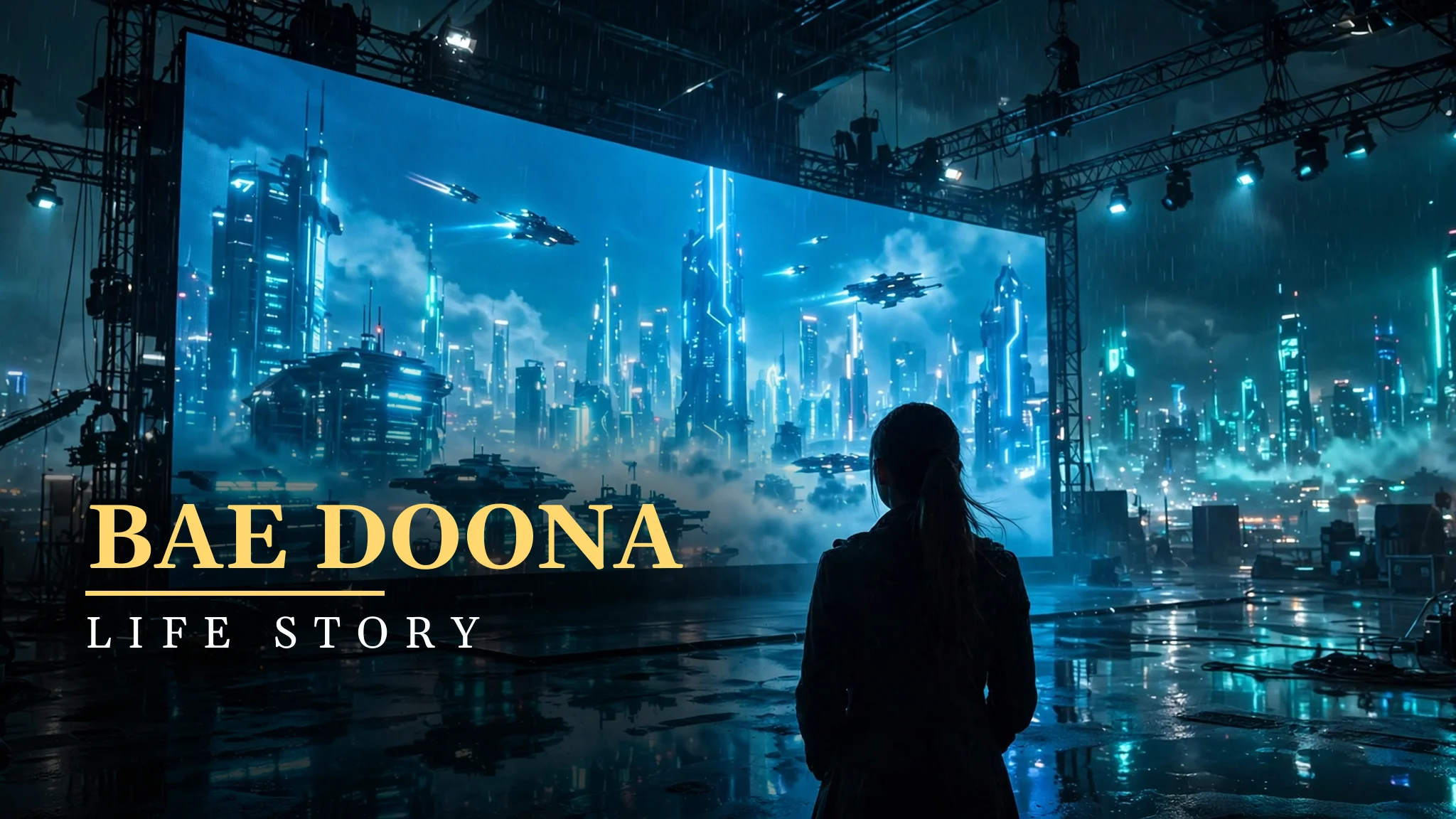
In the end, I come back to the image of her on a wet film set at night, looking at a huge screen showing a future city. That image fits her, because she has always seemed like a woman looking at the future, at a world that is bigger than the one she was born into, and at a screen that shows what is possible. She is not afraid of the future. She is looking at it, and she is ready. I hope she keeps looking, and I hope her next roles are as brave and as global as the ones that came before. I think world cinema is better because she is in it, and I think anyone who dreams of a bigger world will find hope in her story.
One last thought stays with me. Bae Doona’s career shows that you can belong to many places at once, and that belonging to many places does not mean belonging to none. She belongs to Korea, to Japan, to Hollywood, and to the world, and she belongs to all of them fully, because she brings herself to each one. That is a lesson for a world that is often divided. Be yourself, learn other languages, respect other cultures, and you will find that the world is not as far away as it seems. Bae Doona has lived that lesson, and her films prove it.
I also keep thinking about the loneliness of her life between worlds, because I think it is easy to envy a global star and to forget what that life costs. She has spent years in hotels, on planes, and on sets far from home, eating alone, missing her family, and working in languages that are not her own. That is not a glamorous life, even if it looks glamorous in photographs. It is a hard life, and it takes a strong person to live it for twenty years without becoming bitter or lost. I admire Bae for doing that, and I think her performances carry that loneliness in them, in the way her characters often seem a little apart from the people around them, a little watchful, a little careful. That watchfulness is the mark of a person who has lived as a stranger, and who has learned to observe before she speaks.
There is another lesson in her story that I want to name plainly, and it is about learning. Bae Doona learned Japanese, she learned English, she learned to fight on screen, she learned to shoot a bow, and she learned to work with directors from many cultures, and she did all of that as an adult, after she was already a star. That is a powerful example, because too many people believe that learning stops when school stops, or that a star does not need to learn anything new. Bae proves the opposite. She kept learning, and her learning made her career possible. I think that should give hope to anyone who feels that they are too old to learn a new language, a new skill, or a new way of working. You are not too old. You are only at the beginning of the next thing, and Bae’s life proves it.
I also think about her mother, and about growing up in the theatre, because I believe that childhood gave her a gift that many actors do not have. She saw her mother work, she saw rehearsals, she saw the hard, unglamorous work of making a play, and she learned that acting is not magic. It is craft, and craft takes time, repetition, and respect. That learning shows in everything she does, in the way she prepares, in the way she treats a crew, and in the way she never seems to think that she is above the work. I respect that deeply. In a world full of stars who believe their own praise, Bae remains a worker, and that is why directors trust her, and why audiences trust her too.
One more thought stays with me, about the future city on the screen in her cover image, and about the way she looks at it. She is not afraid of the future. She is looking at it, with curiosity and with calm, and she is ready for whatever it brings. I think that is a good image for her whole career. She has always looked at the future, at a new language, a new country, a new genre, and she has walked toward it, even when it was frightening. I hope she keeps doing that, and I hope her next roles take her to places she has never been, because she has shown that she can belong anywhere, and that belonging is a choice, not an accident.
In the end, I think Bae Doona’s story is a story about the world getting smaller and about one woman getting bigger. The world got smaller because of streaming, because of festivals, and because of the Korean wave, and Bae got bigger because she was ready, because she had learned, and because she was brave enough to go where the work was. I hope young actors in Korea and everywhere else look at her and understand that the world is open to them, if they are willing to learn, to travel, and to start again as strangers. That is a hopeful message, and it is one that I am glad her life tells.
I also keep thinking about her role in Stranger, because it showed her at her warmest and her most grounded. She played a detective who is honest, determined, and kind, a woman who does her job well, who listens, and who stands up for what is right, and that ordinariness made the drama work. I think that is a valuable lesson. Heroes do not need to be superheroes. They can be ordinary people who do their jobs well, who listen, and who care, and Bae played that kind of hero with great heart. I believe that performance helped many viewers see their own work differently, and to understand that doing a job well, with honesty, is a form of heroism.
If I could watch only one of her performances again, it would be Air Doll, because it is the film in which her innocence and her sadness come together most beautifully, and because it is the film that changed the way I think about what an actress can do. I would watch it and be reminded that cinema can be as simple as a doll learning what it means to be human, and as deep as a whole life. That is a simple lesson, and it is one that I will not forget.
Frequently Asked Questions
What is Bae Doona best known for?
She is best known internationally for Sense8, where she played Sun Bak, and for Cloud Atlas, where she played the clone Sonmi-451. In Korea she is known for The Host, Kingdom, and Stranger. Her global career across Korean, Japanese, and English productions makes her one of Korea’s most international stars.
Did Bae Doona start as a model?
Yes, she began as a model in the late 1990s before moving into film. Her mother was a stage actress, so she grew up around theatre, and that background shaped her serious approach to acting. She made her film debut in Bong Joon-ho’s Barking Dogs Never Bite in 2000.
What was Bae Doona’s role in Air Doll?
In Air Doll from 2009, directed by Hirokazu Kore-eda, she played a life-size doll who comes to life and explores Tokyo. Her innocent, moving performance was praised at the Cannes Film Festival and opened the door to her international career. It remains one of her most acclaimed roles.
Has Bae Doona worked in Hollywood?
Yes, she starred in Cloud Atlas in 2012 and Jupiter Ascending in 2015, both directed by the Wachowskis, and in the Netflix series Sense8 from 2015 to 2018. She also appeared in Rebel Moon in 2023. She works in English as well as in Korean and Japanese.
What is Bae Doona’s role in Kingdom?
In the Netflix series Kingdom from 2019, she played Seo-bi, a physician who tries to understand the zombie plague and to save people in Joseon-era Korea. Her intelligent, brave performance made her one of the faces of the series, which was a global hit.
Which Bae Doona role is the best introduction to her international career?
A new fan should start with The Host for her early Korean film work, then watch Air Doll for her most acclaimed international performance. Sense8 shows her global television fame, and Kingdom shows her in a Korean Netflix hit. Together, they give a full picture of her range.


