Best Coffee Brewing Methods, Explained Simply
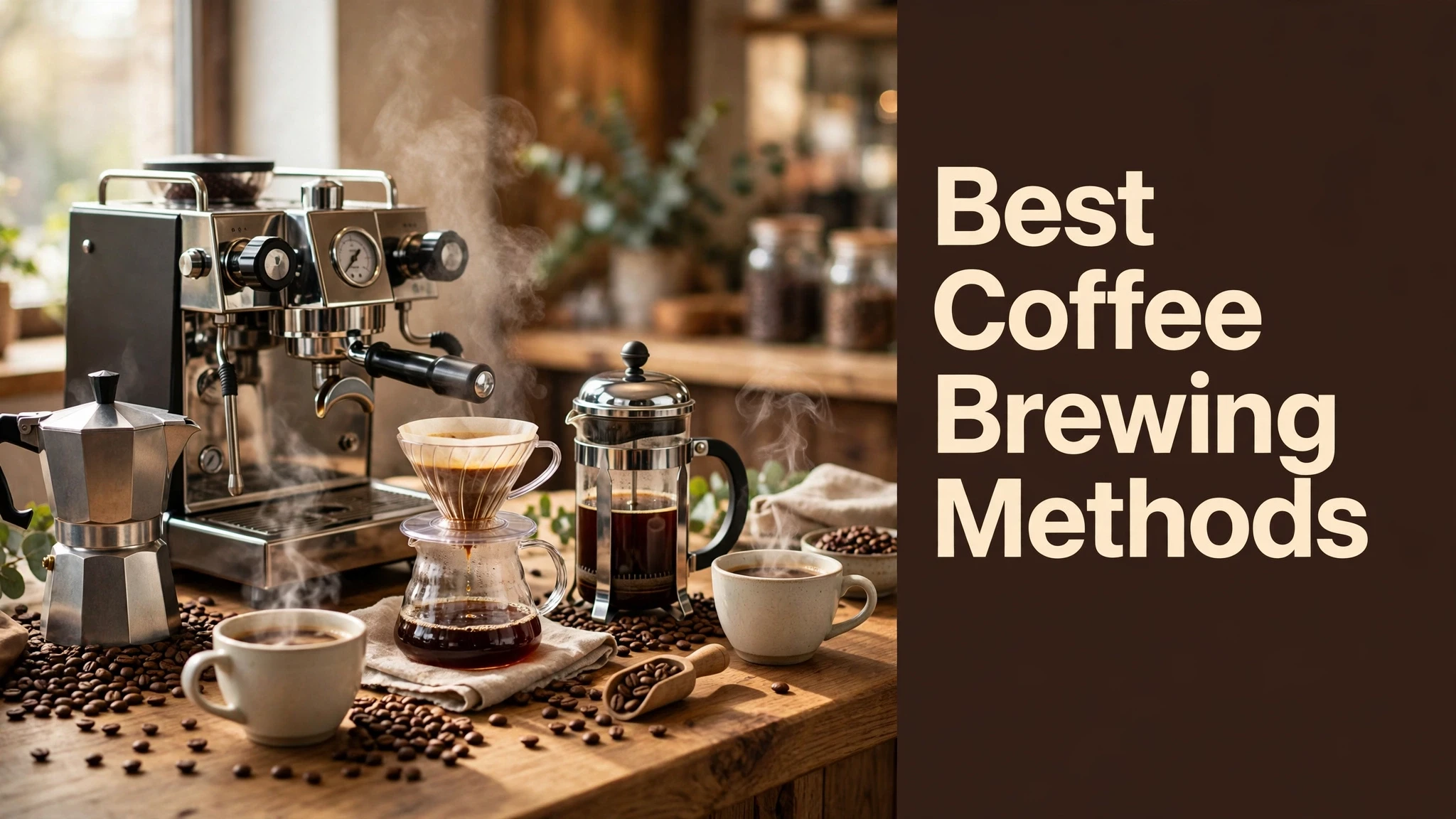
In this post
Coffee is the most popular drink in the world after water, and yet most people drink it without ever thinking about how it is made. They buy a bag, they press a button, and they drink what comes out, and they assume that is what coffee tastes like. But coffee is not one taste. It is many, and the way you brew it changes it completely: the same beans can taste bright and fruity as a pour over, rich and heavy as a French press, or small and intense as an espresso, and each version is a different experience.
This guide explains the best coffee brewing methods, simply, from French press to pour over, from espresso to cold brew, and it helps you choose the method that suits your taste, your time, and your budget. It also explains the beans, the roast, and the freshness, because the method is only half the story, and the beans are the other half.
What Changes the Taste of Coffee
Four things change the taste of coffee more than any others: the beans, the grind, the water, and the time. The beans determine the flavour: where they were grown, how they were roasted, and how fresh they are. The grind determines how fast the water extracts flavour: a fine grind extracts quickly, and a coarse grind extracts slowly, and the wrong grind for your method will make the coffee bitter, or sour, or weak. The water should be clean, and just off the boil, around 93 to 96 degrees, because water that is too hot will burn the coffee, and water that is too cool will under-extract it.
Time is the fourth factor, and it is the one most people ignore. A French press needs four minutes. A pour over needs three. An espresso needs thirty seconds. Too long, and the coffee becomes bitter. Too short, and it becomes sour, and weak. The ratio also matters: about 60 grams of coffee per litre of water is a good starting point, and you can adjust it to your taste. Once you understand these four factors, you can brew good coffee with any method, and you can fix a bad cup, by changing one thing at a time, until it tastes right. That understanding is the real skill, and it is more valuable than any gadget.
Pour Over: Clean and Bright
Pour over is the method for people who like a clean, bright cup, with clarity, and complexity. You place a paper filter in a dripper, add medium-fine coffee, and pour hot water over it, slowly, in circles, so that the water passes through the coffee, and drips into a cup, or a carafe, below. The paper filter removes oils, and fine particles, which is why the cup is clean, and why the flavours are distinct: you can taste fruit, flowers, and acidity, in a way that other methods do not reveal.
Pour over takes a little practice, and a little patience, because the pour must be slow, and even, and the grind must be right, but it is not difficult, and it is rewarding. It is best with light, or medium, roast beans, from a single origin, because those beans have the complexity that pour over reveals. It is not the fastest method, and it is not the best for making coffee for many people at once, but for a single, careful cup, in the morning, it is hard to beat. If you enjoy the ritual of making coffee, and you like to taste the difference between beans, pour over is the method for you.
French Press: Rich and Full
French press is the simplest method, and the most forgiving, which is why it is a good choice for beginners. You add coarse coffee to a jug, pour in hot water, wait four minutes, and then press the plunger down, slowly, to separate the grounds from the coffee. There is no paper filter, so the oils, and the fine particles, stay in the cup, which is why French press coffee is rich, full, and heavy, with a body that pour over cannot match. It is a comforting, satisfying cup, and it is easy to make, for one person, or for several.
The key to a good French press is the grind: it must be coarse, like sea salt, because a fine grind will pass through the filter, and make the coffee muddy, and bitter. The ratio is also important: about 60 grams per litre, and the water should be just off the boil. After four minutes, press slowly, and pour the coffee immediately, so that it does not continue to brew, and become bitter. French press is not the best method for tasting delicate flavours, but it is the best for a rich, warming cup, on a cold morning, and it is the method I would recommend to anyone who is starting out, because it is simple, and it rarely goes wrong.
Espresso: Small, Strong and Fast
Espresso is a small, strong coffee, made by forcing hot water, under pressure, through finely ground coffee, in about thirty seconds. The result is a concentrated shot, with a layer of golden foam, called crema, on top, and a flavour that is intense, and complex. Espresso is the base for many other drinks: a latte is espresso with steamed milk, a cappuccino is espresso with milk foam, and an Americano is espresso with hot water. If you like milk coffee, you are drinking espresso, whether you know it or not.
Making good espresso at home requires a machine, and a grinder, and it takes practice, because the grind, the amount, and the pressure must all be right, and a small change can make a large difference. That is why espresso is the most expensive method to start, and the most demanding to learn. But it is also the most rewarding, if you love strong coffee, and if you enjoy the craft. For most people, a good espresso is best enjoyed in a cafe, where the equipment, and the skill, are already there. At home, a simpler method, such as French press, or pour over, will give you a better cup, for less money, and less effort.
Cold Brew: Smooth and Gentle
Cold brew is coffee steeped in cold water, for twelve to twenty-four hours, and then strained, and it is the smoothest, and gentlest, of all the methods. Because the water is cold, it extracts fewer of the bitter compounds, and more of the sweet ones, so the result is low in acidity, naturally sweet, and very easy to drink, even for people who find hot coffee too bitter, or too acidic. It is served over ice, often diluted with water, or milk, and it is perfect for summer, or for anyone who prefers a milder cup.
Making cold brew is simple: mix coarse coffee, and cold water, in a jar, in a ratio of about one part coffee to eight parts water, leave it at room temperature, or in the fridge, for twelve to twenty-four hours, and then strain it, through a fine filter, or a cloth. The result will keep in the fridge for up to a week, which makes it convenient, because you can make a batch, and drink it over several days. Cold brew is not the best method for tasting delicate flavours, because its smoothness hides them, but it is the best for a refreshing, easy cup, and it is a good choice for anyone who finds hot coffee too harsh.
Instant and Filter: The Everyday Options
Instant coffee, and filter coffee, are the everyday options, and they deserve respect, because they are what most people actually drink, most of the time. Instant coffee is made by dissolving dried coffee in hot water, and it is fast, and convenient, and modern instant coffee is far better than it used to be, especially the freeze-dried kind, which preserves more flavour. It will never match a fresh pour over, but it is a perfectly good cup, when you are in a hurry, and it is better than no coffee at all.
Filter coffee, made in a drip machine, is the standard in many homes, and offices, because it is easy, and it makes a large amount, at once. The key to good filter coffee is fresh beans, ground for the method, and a clean machine, because old coffee, and a dirty machine, will make a bitter cup, however good the beans. A filter machine with a good filter, and fresh coffee, can make a very good cup, and it is the best choice for a household, or an office, where several people drink coffee, at different times. Do not dismiss these methods because they are simple. Simple, done well, is often the best choice.
Choosing the Method for You
Choosing a coffee method is about matching it to your life, not about finding the best one, because there is no best one, only the one that suits you. If you are busy in the morning, and you want coffee quickly, a French press, or a filter machine, is a good choice, because they are fast, and forgiving. If you enjoy a ritual, and you have time, a pour over is rewarding, because it is slow, and careful, and it lets you taste the beans. If you love strong coffee, and milk drinks, an espresso machine, or a visit to a cafe, is the answer. And if you prefer a smooth, cold cup, cold brew is ideal.
It also helps to think about cost, and about how much coffee you drink. A French press costs very little, and it will last for years. A pour over set is also cheap, though it needs paper filters. An espresso machine is expensive, and it needs a good grinder, and regular maintenance. Start with a simple, cheap method, learn what you like, and then, if you want, invest in something more elaborate. The best method is the one you will use, every day, and enjoy, every day, and that is a personal choice, not a technical one. Choose what fits your life, and your taste, and you will drink good coffee, every morning.
The Beans: Origin, Roast, and Freshness
The most important factor in a good cup of coffee is not the brewing method, but the beans, because a great method cannot save stale, poor-quality beans, and good beans will taste good, however you brew them. The first thing to understand is origin: where the beans come from, and how that affects their flavour. Beans from Ethiopia often taste fruity and floral, beans from Colombia are often balanced and sweet, and beans from Brazil are often nutty and chocolatey. Those are generalisations, and there is variation within each origin, but they are a useful starting point, and they can help you find the flavours you like. Try beans from different origins, and notice what you enjoy, because your taste is the best guide.
Roast is the second factor, and it has a major impact on flavour. A light roast preserves the origin character, and it often tastes bright, acidic, and complex, with notes of fruit or flowers. A medium roast is balanced, with sweetness, body, and a little acidity, and it is a good choice for most brewing methods. A dark roast is bold, smoky, and bitter, with less origin character, and more roast flavour, and it is often used for espresso, or for people who prefer a strong, dark cup. There is no best roast, only the roast you prefer, and that preference will depend on your brewing method, and on your taste. A light roast may be excellent as a pour over, but disappointing as a French press, and a dark roast may be perfect for espresso, but too bitter as a cold brew. Experiment, and find what works for you.
Freshness is the third factor, and it is the one that is most often overlooked. Coffee beans begin to lose flavour as soon as they are roasted, and they are at their best within two to four weeks of roasting. After that, they become stale, flat, and dull, however you brew them. Buy beans that have a roast date on the bag, not only a best-before date, and buy in small quantities, so that you use them while they are fresh. Store them in an airtight container, in a cool, dark place, and do not store them in the fridge or freezer, unless you are storing them long term, because moisture and odours will damage them. Fresh beans, ground just before brewing, will make a noticeable difference, and it is the single easiest improvement you can make to your coffee.
Grinding is also important, and it should match your brewing method. A coarse grind is for French press and cold brew, a medium grind is for drip, and a fine grind is for espresso. A grind that is too fine for your method will over-extract, and taste bitter. A grind that is too coarse will under-extract, and taste sour and weak. A good burr grinder, which grinds evenly, is a worthwhile investment, because an uneven grind, with some fine and some coarse particles, will extract unevenly, and the coffee will taste muddled. If you cannot afford a grinder, buy pre-ground coffee, ground for your method, and use it quickly, because pre-ground coffee goes stale faster than whole beans.
Finally, remember that the beans are the foundation, and the brewing method is the way you express them. A good bean, fresh, well roasted, and well ground, will make a good cup, however you brew it, and a poor bean will not be saved by any method. Invest in good beans, learn what you like, and treat them well, and your coffee will improve more than any new gadget could achieve. That is the secret to great coffee, and it is simpler than it seems: start with good beans, and the rest will follow.
My Take:
The beans are the foundation, and that is the point I would insist on, because too many people spend money on equipment, on brewers, on grinders, and on gadgets, when the simplest improvement is to buy better beans, and to use them fresh. A great brewing method cannot save stale beans, and good beans will taste good in any method, even a simple one. I would urge anyone who wants better coffee to start with the beans, to buy from a local roaster, to look for a roast date, and to grind just before brewing. That change alone will improve your coffee more than any new brewer, and it is the best investment you can make.
I also think we should be honest about the fact that coffee is a matter of taste, and that there is no single best bean, roast, or method. A light, fruity Ethiopian may be perfect for one person, and too acidic for another. A dark, bold roast may be ideal for espresso, and too bitter for pour over. Your taste is yours, and it is the only guide that matters. Try different origins, different roasts, and different methods, and pay attention to what you enjoy. Do not let anyone tell you that your taste is wrong, because it is not. It is yours, and it is valid, and the best coffee is the coffee you enjoy, however you make it.
Another point I would make is about freshness, because it is the factor that is most often ignored, and the one that makes the biggest difference. Coffee that was roasted months ago, or ground weeks ago, will taste flat, however you brew it, and no method can restore the flavour that has been lost. Buy small amounts, buy often, and use them while they are fresh. Store them properly, in an airtight container, in a cool, dark place, and grind just before brewing. Those habits are simple, they cost nothing, and they will transform your coffee. Freshness is not a luxury. It is a necessity, and it is the secret that good coffee drinkers know.
And the final thing I would say is to enjoy the exploration, because coffee is a world, with origins, roasts, and methods to discover, and that discovery is a pleasure. Try a new origin, try a new roast, try a new method, and see what you find. You may discover a flavour you love, or a method that suits you, and that discovery will make your mornings better. Coffee is not only a drink. It is a ritual, a pleasure, and a small, daily luxury, and it deserves to be enjoyed well. Start with good beans, treat them well, and enjoy the cup. That is the best advice I can give, and it is the simplest.
The cafe is worth visiting, even if you make good coffee at home, because a good cafe offers something that a kitchen cannot: a skilled barista, a professional machine, and the pleasure of being served. Watching a barista work is a small education in itself, and it can teach you about grind, and temperature, and milk texture, in a way that a book cannot. And a cafe is a social place, a place to meet friends, to read, or to work, and the coffee is only part of the experience. Do not think of a cafe as a competitor to your home brewing. Think of it as a teacher, and as a treat.
It is also worth learning to taste coffee, in the same way you might learn to taste wine, by paying attention to what you are drinking. Notice whether a coffee is sweet, or bitter, or acidic, and whether it reminds you of fruit, or chocolate, or nuts, and write down what you notice, even if your descriptions feel clumsy at first. That attention will sharpen your palate, and it will help you choose beans, and methods, that suit you. And it will make your morning cup more enjoyable, because you are not just drinking it. You are noticing it, and that noticing is a small, daily pleasure, available to anyone, with a cup, and a little attention.
Frequently Asked Questions
What is the best coffee brewing method?
There is no single best method. French press gives a rich, full cup, pour over gives a clean, bright cup, and espresso gives a strong, concentrated one. The best method is the one that matches your taste, your time, and your budget.
Is pour over better than French press?
It depends on what you like. Pour over produces a cleaner, brighter cup with more clarity, while French press produces a fuller, richer cup with more body. Try both with the same beans and see which flavour you prefer.
How do I brew coffee at home?
Start with fresh beans, grind them for your method, use clean water just off the boil, and follow the ratio of about 60 grams of coffee per litre of water. Brew with your chosen method, taste, and adjust the grind or amount until it suits you.
What is cold brew coffee?
Cold brew is coffee steeped in cold water for 12 to 24 hours, then strained. It tastes smooth, sweet, and low in acidity, because cold water extracts fewer bitter compounds. Serve it over ice, diluted with water or milk.
Which coffee method is easiest for beginners?
The French press is the easiest, because it needs only coarse coffee, hot water, and four minutes, with no paper filters or precise pouring. A simple drip machine is also easy, and both forgive small mistakes while you learn.