Best Desert Destinations in the World
In this post
- Sahara, Morocco: Dunes, Oases and Berber Culture
- Atacama, Chile: The Driest Desert and the Clearest Skies
- Namib, Namibia: Ancient Dunes and Desert Wildlife
- Wadi Rum, Jordan: Red Sands, Rock Bridges and Bedouin Life
- White Sands, Monument Valley and Deserts of the USA
- Gobi, Simpson and Other Great Deserts
- Desert Safety, Seasons and Responsible Travel
- My Take:
Deserts are often imagined as empty places, but anyone who has spent a night in a desert knows how wrong that idea is. A desert can hold towering dunes, salt flats that stretch to the horizon, canyons carved by ancient rivers, oases fed by hidden water, and skies so clear that the Milky Way looks close enough to touch. Deserts are also places of deep human history, with nomadic cultures, caravan routes, rock art, and oasis towns that have survived for centuries by understanding water, wind, and shade. The best desert destinations in the world are not only the largest or the hottest. They are the ones that offer a clear, safe, and memorable way to experience desert beauty, whether that is a camel trek, a stargazing night, a salt flat drive, or a quiet walk among dunes at dawn.
Desert travel needs more respect than many other kinds of travel, because deserts are fragile and unforgiving. Heat, cold, dehydration, and remoteness can turn a small mistake into a serious problem, and desert ecosystems recover slowly from damage such as off-road driving, litter, or walking on fragile crusts. This guide covers famous deserts on several continents, explains what makes each special, and gives practical advice on seasons, safety, and responsible travel. It also notes that desert conditions vary greatly: a coastal desert, a high-altitude desert, and a sand sea are very different places, and a trip that works in one may not work in another. Always check official travel advice, local conditions, and guide recommendations before travelling, especially for remote desert regions.
One idea runs through every desert in this guide: go with a guide where guidance matters, and go slowly where slowness matters. A desert rewards early mornings, late afternoons, and nights, while midday is often a time for shade, rest, and water. Travellers who respect that rhythm, who carry more water than they think they need, and who listen to local people who know the desert, will find deserts far more welcoming than their reputation suggests. Deserts are not empty. They are full of light, silence, history, and life adapted to extremes, and they repay patience with some of the most beautiful landscapes on Earth.
Sahara, Morocco: Dunes, Oases and Berber Culture
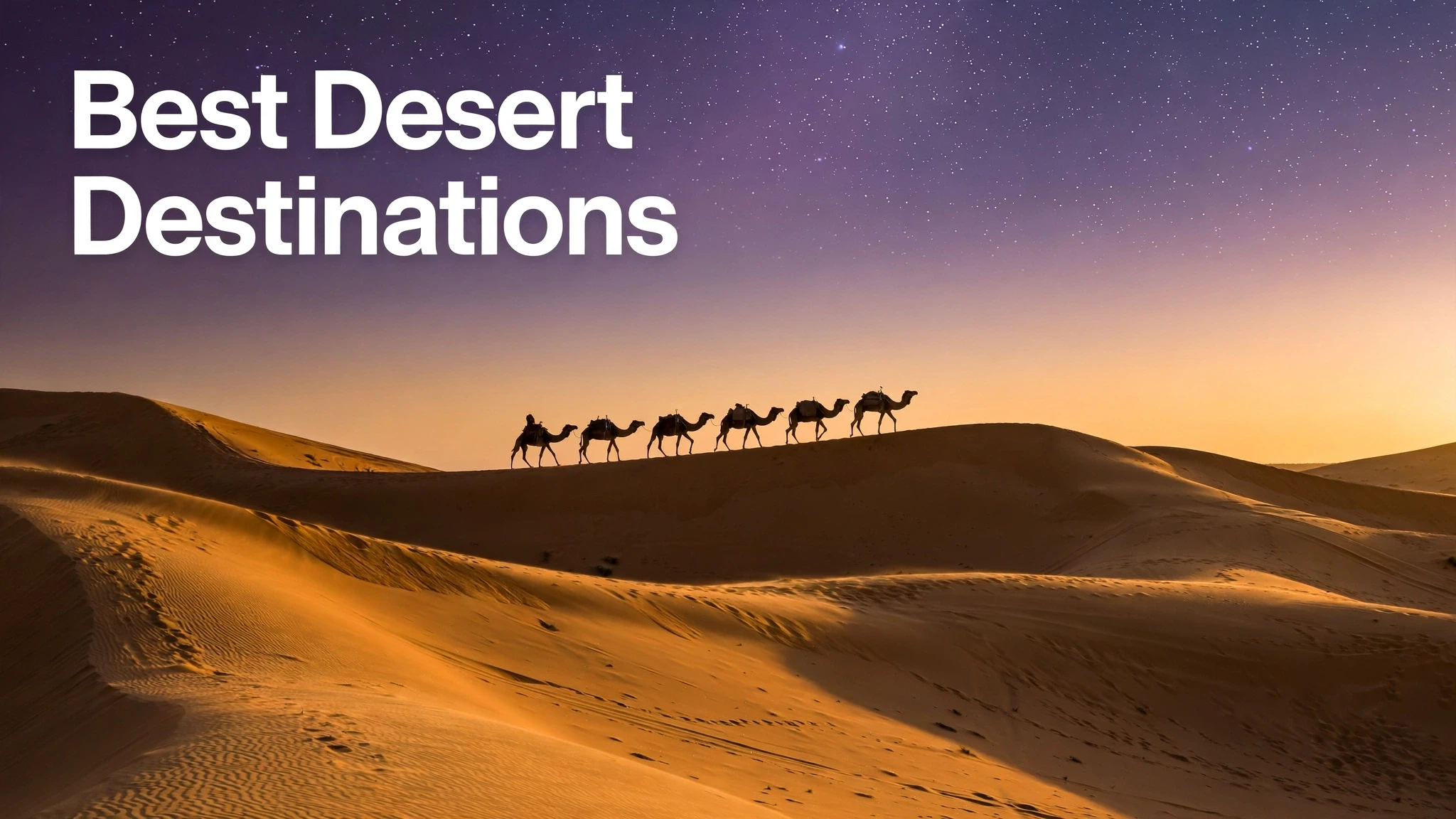
The Sahara, the world’s largest hot desert, stretches across North Africa, and its most accessible dunes for many travellers are in Morocco, near Merzouga and Zagora. Merzouga, on the edge of the Erg Chebbi dunes, offers towering orange sand dunes that change colour with the light, from gold in the morning to deep red at sunset. A typical visit includes a camel trek into the dunes, a night in a desert camp, traditional music, and a sky full of stars far from city lights. Zagora, further west, offers smaller dunes and a gateway to longer desert journeys, and it suits travellers who want a quieter, less famous desert experience.
Moroccan desert travel is also a cultural experience. Berber, or Amazigh, communities have lived in and around the Sahara for centuries, and desert camps, oasis towns, and markets reflect that history. Travellers should choose camps and operators that respect local communities, pay fair wages, and avoid staged cultural performances that feel exploitative. A good desert camp offers simple comfort, good food, and knowledgeable guides who explain desert life, rather than luxury that hides the desert itself. It is also wise to check what is included in a desert tour, such as transport, meals, water, and bedding, because prices and standards vary widely.
Practical planning for the Moroccan Sahara includes season, transport, and health. Spring and autumn offer the most comfortable temperatures, while summer can be extremely hot and winter nights can be very cold, even when days are warm. Reaching Merzouga takes a long drive from Marrakech or Fes, often with an overnight stop, so a rushed day trip is not realistic. Travellers should carry water, sun protection, and layers, and should follow guide advice about walking on dunes, especially in heat. The Sahara in Morocco suits first-time desert travellers, photographers, and stargazers, and it offers a powerful introduction to desert scale without requiring expedition-level preparation.
Atacama, Chile: The Driest Desert and the Clearest Skies
The Atacama Desert, in northern Chile, is often described as the driest non-polar desert on Earth, and it offers landscapes that feel almost lunar: salt flats, geysers, coloured valleys, high-altitude lagoons, and volcanoes on the horizon. The town of San Pedro de Atacama is the main base, with tours to Valle de la Luna, or Moon Valley, at sunset, the Tatio geysers at dawn, and high lagoons where flamingos feed in salty water. Atacama is also one of the best places in the world for astronomy, with observatories, stargazing tours, and skies that are exceptionally clear due to low humidity and minimal light pollution.
Altitude is the key challenge in Atacama. San Pedro itself sits at high altitude, and many tours go higher, to geysers and lagoons above 4,000 metres, where altitude sickness can affect visitors. Travellers should acclimatise slowly, drink water, avoid alcohol and heavy meals on arrival, and rest if they feel headache, nausea, or dizziness. It is important to seek medical advice if symptoms worsen, and to follow guide instructions about pace and time at high altitude. This is general information only, not medical advice, and travellers with heart, lung, or other health conditions should check with a health professional before travelling to high-altitude deserts.
Atacama suits travellers who enjoy geology, photography, astronomy, and otherworldly landscapes, and who are prepared for altitude, sun, and cold nights. The desert is not a beach destination, and it rewards travellers who plan tours with reputable operators, who respect fragile salt and geyser areas by staying on paths, and who allow rest days for acclimatisation. Atacama’s beauty is quiet and strange: a valley of salt and rock, a lagoon of pink flamingos, a geyser field steaming at dawn, and a night sky that makes the desert feel both empty and infinite.
Namib, Namibia: Ancient Dunes and Desert Wildlife
The Namib Desert, in Namibia, is one of the oldest deserts in the world, and it offers some of the most photographed dunes on Earth. Sossusvlei, with its towering red dunes, dead camelthorn trees in Deadvlei, and white clay pan, is the most famous area, and climbing a dune at dawn, when light and shadow create sharp contrasts, is a highlight for many visitors. The nearby Sesriem Canyon, carved by the Tsauchab River, offers a cooler walk and a glimpse of how water, even in a desert, shapes rock over time. The Namib also meets the Atlantic Ocean at places such as Swakopmund, where desert dunes, fog, and cold ocean currents create a unique coastal desert climate.
Namibia’s desert wildlife is another surprise. Desert-adapted elephants, oryx, springbok, and ostriches survive in harsh conditions, and guided tours can explain how animals find water, shade, and food in a landscape that looks lifeless. The Namib also has a remarkable small world: beetles that collect fog water, lizards adapted to sand, and plants such as the welwitschia, which can live for centuries. Travellers should use guides for wildlife viewing, keep a safe distance from animals, and avoid driving off-road, because desert soil and plant life are fragile and slow to recover from tyre tracks.
Practical planning for Namibia includes long distances, self-drive care, and safety. Roads in desert areas can be gravel, corrugated, and remote, with limited fuel, water, and phone signal, so travellers should plan fuel stops, carry extra water, and check vehicle condition before long drives. Heat, sun, and dehydration are real risks, and travellers should not walk alone in remote dunes in midday heat. Namibia suits self-drive travellers, photographers, and wildlife lovers who enjoy space, silence, and long horizons, and who are comfortable with planning, early starts, and responsible driving in remote areas.
Wadi Rum, Jordan: Red Sands, Rock Bridges and Bedouin Life
Wadi Rum, in southern Jordan, is a protected desert of red sand, towering sandstone mountains, narrow canyons, and natural rock bridges, and it is one of the most accessible and rewarding desert destinations in the Middle East. The area is famous for its association with Lawrence of Arabia and for its use as a filming location for desert planets in movies, but its real appeal is simpler: a landscape of colour, silence, and scale that can be explored by four-wheel-drive tour, camel trek, hiking, or, for experienced climbers, rock climbing with guides. Bedouin camps offer nights under stars, traditional meals, and stories about desert life, and many visitors say the night sky in Wadi Rum is as memorable as the daytime landscape.
Bedouin culture is central to Wadi Rum, and respectful travel matters. Camps and guides are usually run by local Bedouin families, and choosing a camp that is locally owned, that follows park rules, and that treats staff fairly supports the community that protects the desert. Travellers should follow guide advice about climbing, walking in canyons, and respecting archaeological sites and rock inscriptions, some of which are ancient and fragile. It is also important to dress modestly and respectfully, especially in villages and camps, and to ask permission before photographing people.
Wadi Rum is often combined with Petra, the Dead Sea, and the Red Sea resort of Aqaba, making it part of a varied Jordan trip rather than a standalone desert expedition. Spring and autumn offer the most comfortable weather, while summer can be very hot and winter nights can be cold. Travellers should carry water, sun protection, and layers, and should book camps and tours in advance in peak season. Wadi Rum suits first-time desert travellers, families with older children, photographers, and anyone who wants a dramatic desert that is also culturally rich and relatively easy to reach.
White Sands, Monument Valley and Deserts of the USA
The deserts of the United States offer extraordinary variety, from white gypsum dunes to red rock canyons and high desert plateaus. White Sands National Park, in New Mexico, is a vast field of white gypsum sand dunes, where visitors can walk, sled down dunes, and watch the landscape turn pink and gold at sunset. The park is accessible, with a scenic drive, boardwalks, and marked trails, and it suits families, photographers, and travellers who want a desert experience without a long expedition. Heat in summer is intense, so early morning and late afternoon visits are best, and carrying water and sun protection is essential even for short walks.
Monument Valley, on the Navajo Nation in Arizona and Utah, offers iconic red buttes and mesas that have become symbols of the American West. The valley is best explored with a Navajo guide, who can explain the land’s cultural significance, history, and stories, and who can take visitors to areas not accessible on the public scenic drive. Travellers should respect that Monument Valley is a living community and a sacred landscape, not only a film set, and should follow guide rules about photography, sacred sites, and behaviour. Nearby deserts, including Death Valley, Joshua Tree, and the Mojave, offer further variety, from below-sea-level salt flats to Joshua trees and dark night skies, each with its own season, hazards, and park rules.
American deserts illustrate an important planning point: deserts in the same country can have very different climates. Death Valley is one of the hottest places on Earth in summer, while high desert areas can be cold in winter, and monsoon rains in late summer can cause flash floods in canyons. Checking official park information, carrying extra water, and never entering a canyon during flood warnings are essential safety habits. These deserts suit road travellers, photographers, stargazers, and families, and they offer a good introduction to desert travel with visitor centres, marked trails, and ranger programmes.
Gobi, Simpson and Other Great Deserts
Beyond the most famous deserts, other great deserts offer unique experiences for travellers who want something different. The Gobi, spanning Mongolia and northern China, is a cold desert of steppe, dunes, canyons, and dinosaur fossil sites, with a nomadic culture based on ger camps, horses, and camels. A Gobi trip is usually a multi-day journey with a guide, because distances are long, roads are rough, and infrastructure is limited. The best time is usually summer, when temperatures are milder, although nights can still be cold, and travellers should be prepared for basic accommodation, long drives, and a landscape that is vast, quiet, and deeply different from a sand-sea desert.
The Simpson Desert, in central Australia, offers red dunes, salt lakes, and remote outback travel that requires serious preparation, permits, and, for many routes, a well-equipped four-wheel-drive vehicle and experience. It is not a casual desert destination, and travellers should only attempt remote Simpson crossings with proper planning, local advice, and emergency equipment. For a more accessible Australian desert experience, Uluru-Kata Tjuta National Park offers the famous Uluru rock, Kata Tjuta domes, and Anangu cultural experiences, with marked walks, a cultural centre, and guided tours that explain the land’s spiritual significance. Visitors should respect climbing closures and cultural guidance, and should plan for heat, flies, and long distances.
Other deserts worth noting include the Negev in Israel, with craters, canyons, and stargazing, the Danakil Depression in Ethiopia, which is one of the hottest and most extreme places on Earth and should only be visited with specialist guides and official advice, and the deserts of the Arabian Peninsula, including the Empty Quarter, which offer vast dunes and oasis culture but require careful planning and local guidance. The lesson from these deserts is that remoteness increases both reward and risk, and that the most extreme deserts are best visited with experienced operators, proper permits, and a clear understanding of conditions. A desert does not need to be extreme to be beautiful, and a well-planned trip to a more accessible desert is often more enjoyable than a risky trip to a remote one.
Desert Safety, Seasons and Responsible Travel
Desert safety starts with water, shade, and time of day. Carry more water than you think you need, drink regularly even before feeling thirsty, wear a hat and sunscreen, and plan strenuous activity for early morning or late afternoon. Heat illness can develop quickly, especially for children, older travellers, and people with health conditions, and symptoms such as dizziness, nausea, confusion, or stopped sweating need immediate shade, cooling, and medical help. Cold is also a desert hazard: nights can be very cold, even after hot days, so layers, a warm sleeping bag in camps, and protection from wind are essential. This is general information only, not medical advice, and travellers should check official health guidance for their destination.
Navigation and communication are equally important in remote deserts. Do not rely only on a phone, because signal may fail, batteries drain faster in heat, and maps may be incomplete. Carry a paper map where available, tell someone your route and expected return, and travel with a guide or in a group for remote areas. Vehicles in deserts need special care: check fuel, tyres, water, and spare parts before long drives, avoid driving on soft sand without experience and recovery equipment, and never leave a vehicle in a remote area without a plan. Flash floods, although rare, are a serious desert hazard: never camp in a dry riverbed during rain warnings, and never drive through flooded roads.
Responsible desert travel protects fragile life. Stay on marked tracks, avoid driving over desert crusts, plants, and archaeological sites, and carry out all rubbish, including food waste, which can attract animals and harm ecosystems. Respect water sources, which may be vital for wildlife and local communities, and avoid washing with soap in natural water. Support local guides, camps, and communities fairly, and learn about the desert’s cultural history before visiting, so that a desert is understood as a homeland, not as an empty backdrop. A desert trip that follows these principles is safer, more enjoyable, and more respectful, and it helps ensure that deserts remain wild and beautiful for future travellers.
My Take:
My take on deserts is that they are the best cure for a busy mind, because they remove almost everything that usually distracts us. In a city, there is always another shop, another notification, another queue, another noise. In a desert, there is sand, sky, wind, and silence, and that simplicity can feel strange at first, then deeply calming. I think many people avoid deserts because they fear emptiness, but the emptiness is the point. A desert does not entertain you. It gives you space to notice light changing on a dune, to hear your own footsteps, to see stars without light pollution, and to realise how little you actually need to feel content. That is a rare gift in modern travel, and it is why deserts stay with travellers long after other trips fade.
I also believe desert travel should be humble. A desert is not a playground to be conquered with a fast vehicle, a loud party, or a photograph taken at any cost. It is a fragile, ancient landscape where life survives by patience, adaptation, and respect for water. I have more respect for a traveller who walks slowly, listens to a guide, carries extra water, and leaves no trace than for a traveller who drives fast, leaves tracks, and boasts about extremes. Deserts reward humility with beauty: a sunrise that changes colour minute by minute, a fox track in the sand, a Bedouin story told by firelight, or a night sky that makes you feel small in a good way. Those moments cannot be forced. They come to travellers who slow down.
Another belief I hold is that desert nights matter as much as desert days. Many itineraries focus on dunes, camels, and sunsets, and then treat the night as a time to sleep. I think the night is half the desert experience. A sky without city lights, a campfire conversation, the cold air after a hot day, and the silence between sounds are all part of what makes a desert special. Stargazing, whether with a guide, a telescope, or simply lying on a blanket, is one of the most accessible wonders in the world, and it requires no expensive equipment, only darkness, patience, and a willingness to look up. If your desert trip includes only daytime, you have missed half of it.
Finally, I think deserts teach an important lesson about resources. In a desert, water is precious, shade is precious, fuel is precious, and every decision about carrying, sharing, and wasting matters. That lesson is useful far beyond travel, because it reminds us that comfort in ordinary life depends on resources we often take for granted. A desert trip that leaves you more careful with water, more grateful for shade, and more respectful of people who live in harsh environments has done more than provide photographs. It has changed how you see the world, and that, in my view, is the highest purpose of travel: not to collect places, but to learn from them, and to carry that learning home.
Another desert experience that deserves more attention is desert food and hospitality, because eating in a desert reveals how people survive and celebrate in harsh conditions. A meal cooked in a camp, bread baked in sand or in a clay oven, tea served slowly in small glasses, and dates offered as a welcome are not tourist performances. They are traditions shaped by scarcity, generosity, and the need to share resources. I think travellers should approach desert meals with gratitude and curiosity, asking about ingredients and methods, eating slowly, and accepting hospitality graciously where it is offered. Food in a desert tastes different because it is earned by effort, water, and care, and that taste stays with you long after the trip ends.
Desert art and history are another layer that many visitors miss. Rock paintings, ancient trade routes, abandoned villages, and oasis irrigation systems tell stories of people who crossed deserts for trade, pilgrimage, and survival long before modern transport. A guide who explains a rock inscription, a fossil, or a water channel can turn a landscape from empty sand into a library of human history. I believe desert travellers should seek out that history, through museums, cultural centres, and local guides, rather than treating a desert as only a backdrop for photographs. Understanding that a desert has been home, workplace, and sacred place for thousands of years changes how you walk through it, and it makes you more careful about where you step, what you touch, and what you take away.
Finally, I think deserts are ideal places to learn about climate and change, because their extremes make environmental shifts visible. A drying oasis, a shifting dune, a changing rainfall pattern, or a glacier-fed river that no longer reaches a desert can all be signs of larger changes, and local people often notice those changes before scientists publish them. Listening to those observations, without turning a holiday into a lecture, can deepen a trip and make climate issues feel personal rather than abstract. A desert does not need to be a lesson to be enjoyable, but it can be both beautiful and instructive, and a traveller who leaves a desert with greater respect for water, land, and the people who live with scarcity has gained something far more lasting than a photograph of dunes.
One more desert thought that stays with me is the importance of silence, and how rarely modern life allows us to experience it fully. In a city, silence is usually just a pause between noises, but in a desert, silence has depth: wind over sand, a distant bird, your own breathing, and then a quiet so complete that it feels like a presence rather than an absence. I think travellers should deliberately seek that silence, by walking a short distance from a camp, sitting still for ten minutes without a phone or camera, and simply listening. That practice may feel awkward at first, especially for travellers used to constant stimulation, but it often becomes the most memorable part of a desert trip, because it allows the landscape to speak without competition. Silence is not emptiness. In a desert, it is one of the most valuable experiences a place can offer, and it is worth protecting from noise, haste, and distraction.
Frequently Asked Questions
Which desert is best for a first desert trip? The Moroccan Sahara near Merzouga, Wadi Rum in Jordan and White Sands in the USA are strong first choices because they combine dramatic dunes, guided tours and accessible camps.
When is the best time to visit deserts? Spring and autumn are often most comfortable, because summer can be extremely hot and winter nights can be very cold, although timing varies by desert and altitude.
Is desert travel safe? It can be safe with preparation: carry extra water, avoid midday heat, travel with guides in remote areas, check weather and official advice, and never rely only on a phone for navigation.
What should I pack for a desert trip? Water, sun protection, a hat, layers for cold nights, comfortable walking shoes, a headlamp for camps, and a basic first-aid kit, plus any medicines and travel insurance details.
Can I stargaze in every desert? Many deserts offer excellent stargazing due to low light pollution and clear skies, but moon phase, cloud, dust and camp lighting all affect visibility, so check conditions and choose a dark-sky location.
Do I need a guide for desert travel? For accessible parks and short walks, a guide may not be essential, but for remote dunes, high-altitude deserts, wildlife areas and cultural sites, a local guide greatly improves safety and understanding.