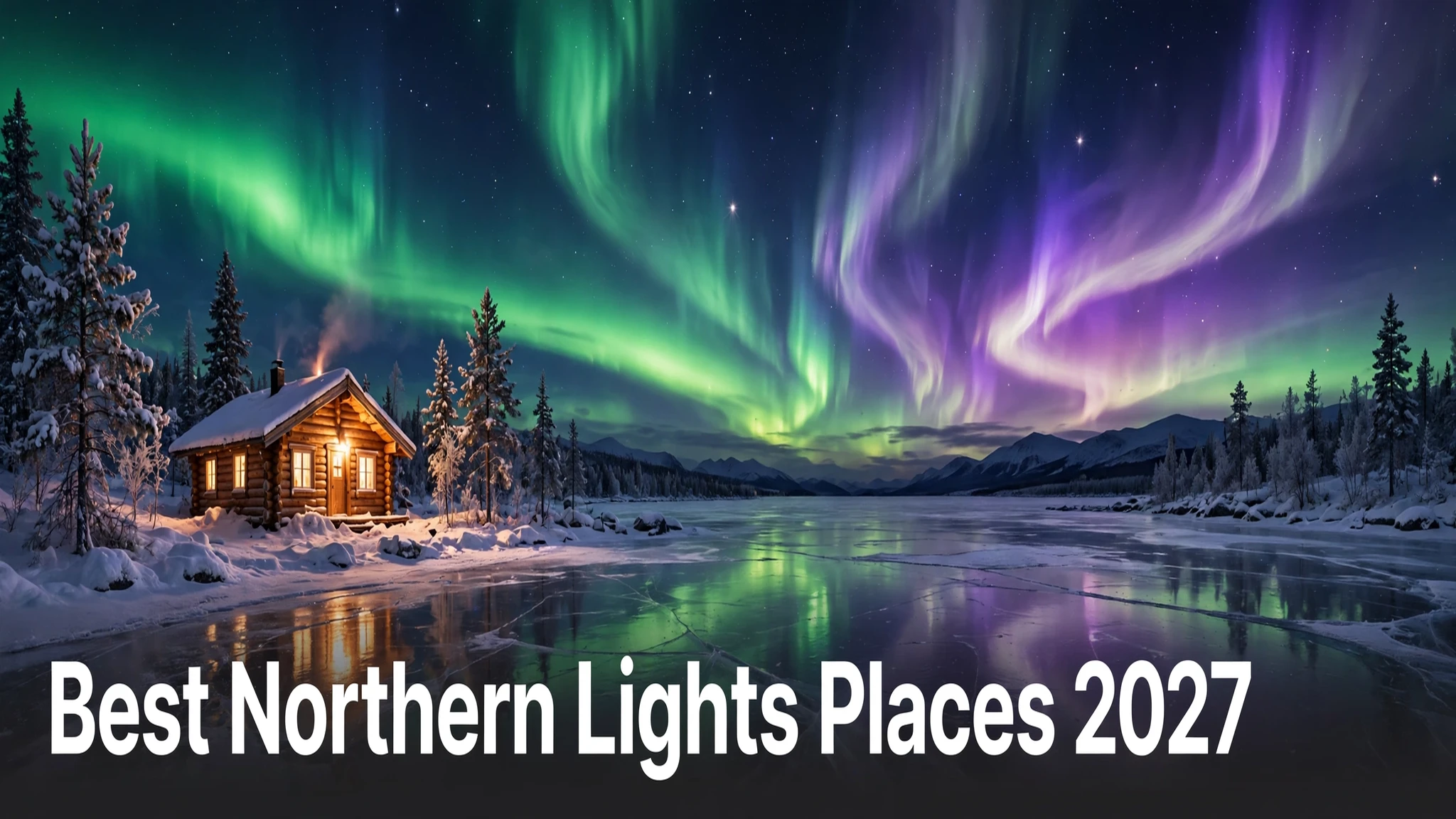
Best Places to See the Northern Lights 2027
In this post
- What the Northern Lights Are, in Simple Terms
- When to Go: Darkness, Season and Moonlight
- Norway: Tromsø, Lofoten and the North Cape
- Iceland: Accessible, Dramatic and Weather-Dependent
- Finland, Sweden and Finnish Lapland’s Quiet Advantage
- Alaska, Canada and North America’s Aurora Belt
- Russia, Greenland and Other, Harder-to-Reach Options
- How to Maximise Your Chances: Forecasts, Nights and Patience
- Photography, Tours and Costs Without Hype
- My Take:
What the Northern Lights Are, in Simple Terms
The northern lights, or aurora borealis, are glowing curtains, arcs and rays in the night sky, caused by charged particles from the Sun interacting with gases in Earth’s upper atmosphere. The Sun constantly releases a stream of charged particles called the solar wind, and during solar storms it releases larger bursts. When those particles reach Earth, most are deflected by Earth’s magnetic field, but some are funnelled toward the polar regions, where they collide with oxygen and nitrogen high above the ground. Those collisions excite the gases, which then release light as they return to normal: oxygen typically gives green and, more rarely, red light, while nitrogen gives blue and purple. The result is a display that can last minutes or hours, and can change shape, colour and brightness in seconds.
The lights appear in an oval ring around the magnetic north pole, called the auroral oval, which expands toward lower latitudes during strong solar activity and contracts during quiet periods. That is why the best places are usually within or near the Arctic Circle, and why a strong storm can occasionally push the lights far south, to places that rarely see them, while a quiet night may show nothing even in the far north. No place guarantees the lights on a given night; every aurora trip is a gamble with weather, solar activity and darkness, and honest guides say so from the start.
The solar cycle also matters. The Sun goes through an approximately 11-year cycle of activity, with a maximum when sunspots and storms are more frequent, and a minimum when they are rarer. The most recent solar maximum was around 2024 to 2025, and activity in 2027 is expected to remain relatively high as the cycle declines, though exact levels cannot be forecast years in advance with precision. That makes 2027 a promising year in general terms, but it does not guarantee a display on any particular trip. A traveller who plans for several nights, in a dark location, in the right season, has the best chance, regardless of the exact solar forecast.
When to Go: Darkness, Season and Moonlight
The single most important factor, after location, is darkness. Aurorae are faint compared with daylight, so they are best seen when the sky is truly dark, which in the Arctic means autumn, winter and early spring. In high summer, many northern locations experience midnight sun or twilight all night, and the lights, even if active, are washed out. The main season therefore runs roughly from September to March or April, depending on latitude, with the darkest months, December and January, offering the longest nights but also the coldest weather and, in some places, the most storms.
Within that season, there are trade-offs. September and March offer a balance of darkness and milder weather, plus the chance of autumn colours or spring snow, and they are often recommended for first-time travellers who dislike extreme cold. December and January offer the longest dark hours, which means more time each night to wait for a display, but also short days for other activities and higher chances of severe weather. February is often a sweet spot: still dark, slightly less extreme than midwinter, and with good snow cover for daytime activities. There is no single best month for everyone; the best month is the one that fits your tolerance for cold, your other interests, and your ability to stay several nights.
Moonlight is a secondary factor. A full moon brightens the sky and can wash out faint aurorae, though a strong display will still show through moonlight, and moonlight can actually make a landscape photograph more beautiful by lighting snow and mountains. A new moon gives the darkest sky and the best chance to see faint lights, but it also means a darker landscape for walking and photography. Many experienced aurora hunters prefer a moon that is not full, but they do not cancel a trip for moonlight alone, because solar activity and clear skies matter far more. Cloud cover is the real enemy: a cloudy night, however active the Sun, shows nothing, while a clear night with moderate activity can show a beautiful display.
Norway: Tromsø, Lofoten and the North Cape
Norway is often ranked first for northern lights trips, because it combines reliable auroral location, relatively mild coastal climate for its latitude, good infrastructure and dramatic scenery. Tromsø, a city well inside the Arctic Circle, sits directly under the auroral oval and offers flights, hotels, guided tours and a university, making it accessible for first-time visitors. From Tromsø, tours drive inland to darker, drier skies when coastal cloud is a problem, a flexibility that improves chances. The city itself has light pollution, so serious viewing usually means leaving town, but the combination of city comfort and nearby dark skies is hard to beat.
The Lofoten Islands, farther south but still in the auroral zone, offer a different experience: fishing villages, sharp mountains rising from the sea, and beaches where the lights can reflect in water. Lofoten is more exposed to coastal weather, so cloud can be an issue, but when skies clear, the scenery is among the most photogenic in the Arctic. The North Cape, at the northern tip of mainland Europe, offers a remote, windswept experience and long dark nights, but it is less accessible and more weather-dependent. For most travellers, Tromsø as a base, with day trips and night tours, offers the best balance of chance, comfort and cost.
Norway’s coastal climate, warmed by the Gulf Stream, means winter temperatures in Tromsø are often milder than in inland Arctic locations at the same latitude, though wind and rain can still make it feel cold. Travellers should still pack for sub-zero wind chill, waterproof layers and warm boots, because standing outside for hours waiting for lights is very different from walking between heated buildings. Guided tours provide warm suits, hot drinks and local knowledge of microclimates, which can be valuable for visitors who do not know where cloud is likely to break.
Iceland: Accessible, Dramatic and Weather-Dependent
Iceland is one of the most popular aurora destinations, because it is relatively easy to reach from Europe and North America, it offers a compact country with many other attractions, and the whole island lies in or near the auroral oval. From Reykjavík, tours drive to dark locations within an hour, and self-drivers can explore the south coast, with waterfalls, black beaches and glaciers as daytime scenery. The island’s small size means a traveller can combine aurora hunting with hot springs, ice caves and volcanic landscapes in a single trip, which is a major advantage over more remote Arctic bases.
The main drawback is weather. Iceland’s maritime climate brings frequent cloud, wind and rain, even in winter, and a week of cloud can hide the lights entirely, however active the Sun. Successful Iceland aurora trips therefore need flexibility: several nights, a willingness to drive to a clearer region, and a forecast strategy that checks both aurora activity and cloud cover, not only one. The north of Iceland, around Akureyri, is often drier than the south, and the east fjords can also offer clearer skies, so a multi-base trip can improve odds. Winter driving in Iceland requires care, with icy roads, short daylight and sudden storms, and visitors should follow local road and weather warnings.
Iceland also offers unique aurora settings, such as lights over the Jökulsárlón glacier lagoon, where icebergs float in a lagoon and reflect the sky, and over Kirkjufell, a distinctive mountain on the Snæfellsnes Peninsula that is famous in photographs. These locations are beautiful, but they are also popular, and a photographer seeking solitude may prefer a less famous roadside pull-off with dark skies and a clear northern horizon. The lights themselves are the same everywhere; the difference is the foreground, the crowd and the cloud.
Finland, Sweden and Finnish Lapland’s Quiet Advantage
Finnish Lapland, centred on Rovaniemi, Levi, Saariselkä and Kilpisjärvi, offers a quieter, more inland aurora experience, with stable cold, frequent clear skies in the north, and a strong tradition of glass igloos and aurora cabins where visitors can watch the sky from a warm bed. Kilpisjärvi, in the far northwest, is often cited as having some of Finland’s clearest skies, because it lies in a drier microclimate, though it is remote and requires planning. Rovaniemi, on the Arctic Circle, is more accessible and offers Santa Claus Village and other family attractions, but it has more light pollution and cloud than the far north, so serious hunters often go farther north.
Sweden offers a similar inland experience, centred on Abisko National Park, which is famous for its blue hole, a patch of sky that often stays clear even when surrounding areas are cloudy, thanks to local mountains and wind patterns. Abisko has a dedicated aurora station, reachable by chairlift, with a sky station, restaurant and viewing tower, and it is a favourite of scientists and photographers. Swedish Lapland also offers the ICEHOTEL in Jukkasjärvi, dog sledding, and Sami cultural experiences, which add depth beyond aurora hunting. The Swedish mountains can be cold and windy, but the dry inland climate often gives more clear nights than coastal Norway or Iceland.
Both Finland and Sweden offer a different cultural experience from Norway and Iceland: Sami heritage, reindeer herding, quiet forests and lakes, and a slower pace. For travellers who want to combine aurora hunting with cross-country skiing, snowshoeing or ice fishing, Lapland is ideal. For travellers who want dramatic coastal scenery, Norway or Iceland may be better. The aurora itself does not favour one country; it favours dark skies, clear weather and patience, and Lapland’s inland climate gives it an edge on clear nights, even if its latitude is slightly lower than Tromsø’s.
Alaska, Canada and North America’s Aurora Belt
In North America, the auroral oval passes over Alaska and northern Canada, offering world-class viewing with a different logistical feel. Fairbanks, Alaska, is a classic base: it lies under the oval, has an international airport, offers aurora tours and lodges, and has a long season from late August to April. The interior climate is cold and dry, which gives many clear nights, though temperatures can fall far below freezing in midwinter. From Fairbanks, visitors can drive to dark locations, stay in remote lodges, or combine aurora viewing with hot springs at Chena, dog sledding and snowmobiling.
Canada offers several strong bases, including Yellowknife in the Northwest Territories, Whitehorse in Yukon, and Churchill in Manitoba, each with its own character. Yellowknife, on the shore of Great Slave Lake, is known for clear skies and aurora villages with heated viewing facilities. Whitehorse offers a mix of wilderness and town comfort, with tours that drive to dark lakes and viewpoints. Churchill, famous for polar bears in autumn, also offers aurora viewing in winter, though access is more limited. Canadian aurora trips often involve longer travel and colder temperatures than European trips, but they reward visitors with vast, dark skies and fewer crowds.
North American trips require careful planning around distances, winter road conditions and daylight. Flights to Fairbanks or Yellowknife are less frequent than to Tromsø or Reykjavík, and accommodation in remote lodges books early. On the other hand, North America offers aurora viewing in English-speaking settings with familiar road and safety systems for many travellers, and it combines well with national parks, wildlife and winter sports. For travellers based in North America, Alaska and Canada are often cheaper and simpler than flying to Europe, even if the aurora itself is equally spectacular in both regions.
Russia, Greenland and Other, Harder-to-Reach Options
Russia’s Murmansk region, on the Kola Peninsula, lies under the auroral oval and has been a popular, relatively affordable aurora destination, with tours from Murmansk city to dark tundra locations. Access, visas and geopolitical conditions change, and travellers should check current government travel advice, visa requirements and safety information before planning a Russia trip, as conditions in 2027 may differ from earlier years. Greenland offers spectacular aurora viewing, especially from Nuuk, Ilulissat and Kangerlussuaq, with dark skies, icebergs and Inuit culture, but it is expensive, remote and weather-dependent, with limited flights and infrastructure. Both destinations can offer excellent lights, but they require more planning and flexibility than the main European and North American bases.
Other locations, such as Scotland’s northern isles, can occasionally see aurorae during strong storms, but they are not reliable aurora destinations, because they lie south of the oval and depend on rare, strong activity. Similarly, northern England, Denmark and the Baltic states may see lights during exceptional storms, but a trip planned specifically for aurorae should target the oval, not a southern location hoping for a storm. The rule is simple: the farther north and the darker the sky, within the oval, the better the odds, and a southern location with a famous name is not a substitute for latitude and darkness.
For most readers, the practical choice is among Norway, Iceland, Finland, Sweden, Alaska and Canada, based on budget, travel time, cold tolerance and other interests. All six offer good odds with several nights and clear skies. The differences are in scenery, culture, cost and weather, not in the lights themselves, which are the same solar phenomenon everywhere. Choosing a destination that you will enjoy even if the lights do not appear is the wisest strategy, because it turns a gamble into a good trip regardless of outcome.
How to Maximise Your Chances: Forecasts, Nights and Patience
Maximising aurora chances is less about secret spots and more about stacking probabilities. Stay at least three to five nights, because a single night can be cloudy even in the best location, while several nights give cloud and activity time to align. Choose a location with dark skies, away from town lights, with a clear view to the north, because the lights usually appear in the northern sky first, though strong displays can fill the whole sky. Check both aurora forecasts, which predict solar activity on scales such as Kp, and cloud forecasts, which predict whether you will see the sky at all. A high Kp with cloud is useless, and a clear sky with low Kp may still show a faint arc.
The Kp index, from 0 to 9, measures geomagnetic activity, with higher numbers meaning stronger activity and a larger oval. A Kp of 2 to 3 can produce visible lights in the far north, while a Kp of 5 or more is considered a storm and can push lights farther south. Forecasts are available from space weather agencies and aurora apps, but they are probabilistic and short-term: a forecast for tonight is useful, a forecast for next month is not. Experienced hunters check forecasts in the evening, stay flexible about driving to clearer skies, and are willing to wait until after midnight, when activity often peaks, though lights can appear at any dark hour.
Patience and warmth are the real skills. Dress in layers, with a warm base layer, insulation, a windproof outer layer, warm boots, gloves and a hat, and bring hand warmers, hot drinks and a headlamp with a red light, which preserves night vision better than white light. Avoid looking at phone screens for long periods, because bright screens ruin dark adaptation, and use a camera with manual settings if photographing. Most importantly, do not give up after an hour: aurorae can appear suddenly after hours of quiet, and many of the best displays are reported by people who stayed out late while others went to bed.
Photography, Tours and Costs Without Hype
Photographing the northern lights is rewarding but requires preparation. A camera that allows manual exposure, a sturdy tripod, a wide-angle lens with a large aperture, and spare batteries kept warm are the basics. Typical starting settings are a wide aperture, a high ISO and an exposure of several seconds, adjusted by trial, but exact settings depend on display brightness, moonlight and lens. A phone can capture strong displays with night mode, but it will struggle with faint arcs, and a phone’s screen and battery suffer in cold. Practice manual settings at home, in the dark, before the trip, because fumbling with a new camera in minus twenty degrees is frustrating and can cost a display.
Guided tours offer local knowledge, transport to clear skies, warm clothing and safety, and they are recommended for first-time visitors, solo travellers and anyone without winter driving experience. Self-driving offers flexibility and privacy, but it requires winter driving skill, knowledge of road closures and a willingness to navigate in darkness. Costs vary widely: a budget trip staying in a hostel in Tromsø or Rovaniemi and joining a group tour can be affordable, while a luxury glass igloo, private tour and remote lodge can cost several times more. Neither guarantees lights, so spending more does not buy a display, only comfort and convenience while waiting for one.
A realistic budget should include flights, accommodation for several nights, tours or car hire, warm clothing if you do not own it, food and travel insurance that covers winter activities and cancellations. Travellers should also check whether their chosen destination requires any special preparations, such as winter tyres, local guides for remote areas, or permits for certain parks. The cheapest aurora trip is not always the best value if it offers only one night in a cloudy coastal town, while a slightly more expensive trip with five nights inland may offer far better odds. Value, in aurora travel, is measured in clear dark hours, not in luxury alone.
My Take:
My take is that the northern lights are the best kind of travel gamble, because even losing is beautiful. If you go to Tromsø, Iceland or Lapland for five nights and see no lights, you still get Arctic scenery, snow, hot springs, Sami culture, dog sledding and long, quiet nights that are rare in modern life. If you go to a beach resort and it rains for five days, you get little else. That asymmetry makes aurora travel unusually forgiving: the destination is worth visiting for its own sake, and the lights are a bonus that can turn a good trip into an unforgettable one. I think that is the right way to plan: choose a place you want to visit anyway, then give the lights the best chance within that trip.
I also think the aurora industry sometimes oversells certainty, and that overselling harms travellers. A tour that promises lights, a hotel that guarantees a wake-up call as if that guarantees a display, or a photograph that shows a once-in-a-decade storm as if it were nightly, all create expectations that reality cannot meet. The honest promise is different: dark skies, clear forecasts, experienced guides and several nights, which together give a good chance, not a guarantee. I prefer that honesty, because a traveller who understands the gamble will enjoy a faint arc as a success, while a traveller promised a sky-filling storm may feel cheated by a beautiful but modest display. Expectation management is part of good aurora travel.
My worry is about light pollution and overcrowding in famous aurora spots. As more people chase the lights, more lights are installed for safety and comfort, which ironically makes the sky brighter and the lights harder to see. Popular viewpoints can become crowded with cars, headlights and camera flashes, ruining dark adaptation for everyone. The solution is not to stop visiting, but to visit thoughtfully: choose darker, less famous spots, use red lights, switch off car headlights when parked, and respect quiet hours in viewing areas. Dark skies are a shared resource, like clean water, and they require shared care.
On a personal note, I find the science of the aurora more moving than the photographs, because it connects the Sun, Earth’s magnetic field and our atmosphere in a visible way. A solar storm that left the Sun days ago, travelled through space, and then lit up gases above a snowy lake is a reminder that Earth is not isolated; it is part of a solar system weather system. Watching the lights, you are watching space weather, not just a pretty sky. That knowledge does not diminish the beauty; it deepens it, because the curtains you see are made of particles from a star, shaped by a magnetic field you cannot see, in air so thin it barely exists. It is physics made visible, and it is free to anyone willing to stand in the cold and look up.
Finally, I think 2027 is a good year to go, not because of a single forecast, but because solar activity should still be relatively high, infrastructure in the main destinations is mature, and you have time to plan properly: several nights, a dark base, flexible tours and warm clothing. Do not rush a one-night trip on a cloudy forecast, and do not spend a fortune on a guarantee that no one can give. Plan a trip you will love even without lights, check forecasts nightly, stay out late, and let the sky surprise you. If it does, you will remember it for life. If it does not, you will still have stood under some of the darkest, quietest skies on Earth, and that, in itself, is a rare and valuable experience in a bright, noisy world.
There is one more practical thought I want to leave: go with someone, or join a group, if you can. Aurora hunting involves cold, darkness and remote roads, and company makes it safer and more enjoyable. A shared gasp when the sky suddenly brightens, a shared hot drink while waiting, and a shared photograph afterwards are part of the memory. Solo aurora hunting can be wonderful too, but it requires extra care with driving, warmth and safety. Whichever way you go, tell someone where you are going, check local conditions, and do not drive into a storm for a forecast. The lights will return on another night, in another year, but a safe return from a winter road matters more than any single display.
One more practical idea can improve any aurora trip: treat the trip as a night-shift job, not as an evening outing. Aurora hunters who succeed tend to shift their sleep, rest in the afternoon, eat a good evening meal, and then stay awake and alert from late evening until the early hours, when activity often peaks. That shift is tiring, especially in cold and darkness, and it requires planning: a hotel that allows late checkout or afternoon rest, a tour that returns late without an early morning departure, and a group that agrees on the plan. Travellers who try to combine a full day of sightseeing with a full night of aurora hunting often fall asleep before the best display, or become too cold and tired to enjoy it. Resting for the night is not laziness; it is strategy, and it is the difference between seeing a faint arc at nine o’clock and seeing a sky-filling storm at one in the morning.
I also think about the environmental footprint of aurora travel, which is easy to ignore in excitement. Flights to the Arctic, heated lodges, snowmobile tours and car journeys all have emissions, and a trip that celebrates the natural sky should not needlessly damage the climate that shapes it. Travellers can reduce that footprint by staying longer in one base rather than hopping between many, by using public transport or shared tours where possible, by choosing accommodation with good insulation and renewable energy, and by offsetting flights through reputable schemes if they choose to do so. None of these steps guarantees lights, but they align the trip’s values with its purpose: to appreciate a fragile, dark, cold environment without harming it more than necessary. A thoughtful aurora traveller leaves only footprints in snow, which melt, and takes only photographs, which last.
Frequently Asked Questions
When is the best time to see the northern lights in 2027?
The main season is roughly September to March or April, when nights are dark. February often balances darkness and slightly milder weather, but any month in that season can work with several nights and clear skies.
Which country is best for first-time northern lights travellers?
Norway, especially Tromsø, is often recommended for first-timers because it sits under the auroral oval, has good flights and tours, and offers city comfort with nearby dark skies. Iceland and Finnish Lapland are also strong first-time choices.
Do I need a strong solar storm to see the lights in the far north?
No. In the far north, under the auroral oval, even moderate activity with a Kp of 2 to 3 can produce visible lights on a clear, dark night. Strong storms mainly push the lights farther south and make displays brighter and more active.
How many nights should I plan for aurora hunting?
At least three to five nights is recommended. A single night can be cloudy even in the best location, while several nights give weather and solar activity time to align for at least one clear, active night.
Can I photograph the northern lights with a phone?
A phone with night mode can capture strong displays, but faint arcs are harder. A camera with manual settings, a tripod and a wide-angle lens gives far better results, especially for faint or fast-moving lights.
Does a full moon ruin northern lights viewing?
Not completely. Moonlight brightens the sky and can wash out faint lights, but strong displays still show through, and moonlight can improve landscape photographs. Clear skies and solar activity matter far more than moon phase alone.