Deepest Lakes in the World Explored
In this post
- Lake Baikal: the deepest and oldest
- Lake Tanganyika: Africa’s deep rift lake
- The Caspian Sea: lake or sea, and why it counts
- Other deep lakes: Vostok, O’Higgins, Malawi, and more
- How deep lakes form: rifts, ice, volcanoes, and impacts
- Life in the deep: darkness, pressure, and adaptation
- Deep lakes, water, and climate
- My Take:
When people think of extreme depths, they usually think of oceans. Yet some lakes plunge to depths that rival ocean trenches in their own way, reaching more than a mile down, holding water that has been isolated for thousands or millions of years, and sheltering life found nowhere else on Earth. The deepest lake, Lake Baikal in Siberia, reaches 1,642 metres, deeper than many seas, and contains about a fifth of the world’s unfrozen fresh surface water. It is not alone: a handful of other lakes, formed by rifts, glaciers, and ancient seas, also descend to extraordinary depths.
This guide explores the deepest lakes in the world, how they formed, what lives in them, and why their depths matter for science, water supplies, and climate. It also clears up a common confusion: the Caspian Sea, often listed among lakes, is a special case, and depth rankings depend on whether you count it, and on how depth is measured.
Lake Baikal: the deepest and oldest
Lake Baikal, in southern Siberia, Russia, is the deepest lake in the world by maximum depth, at about 1,642 metres, and also one of the oldest, estimated at 20 to 25 million years old. It sits in a rift valley, where Earth’s crust is slowly pulling apart, and the basin continues to deepen as the rift widens. Baikal is also the largest lake by volume, holding roughly 23,600 cubic kilometres of water, about 20 percent of the world’s unfrozen fresh surface water, more than all the North American Great Lakes combined.
Baikal’s age and isolation have produced extraordinary biodiversity. More than half of its species are endemic, meaning they occur nowhere else, including the Baikal seal, the only freshwater seal in the world, and hundreds of species of amphipods, flatworms, and fish, such as the omul, a whitefish prized locally. The lake’s water is exceptionally clear in winter, when ice covers the surface and allows visibility to tens of metres, and it is low in nutrients, which helps keep it clear but also makes its ecosystem sensitive to pollution and warming.
Baikal is also a scientific treasure for climate history. Sediments at the bottom of the lake, accumulated over millions of years, record past climates, volcanic eruptions, and changes in the surrounding landscape in layers that can be drilled and studied like pages in a book. That record, combined with the lake’s ongoing rifting, makes Baikal not just a lake but a natural laboratory for geology, evolution, and climate, and a UNESCO World Heritage site recognised for its outstanding universal value.
Lake Tanganyika: Africa’s deep rift lake
Second on most depth lists is Lake Tanganyika, in East Africa, bordered by Tanzania, the Democratic Republic of the Congo, Burundi, and Zambia. It reaches about 1,470 metres deep, making it the second deepest lake in the world and the longest freshwater lake, stretching about 673 kilometres. Like Baikal, Tanganyika sits in a rift valley, part of the East African Rift system, where tectonic plates are pulling apart and the crust is thinning and subsiding.
Tanganyika is also ancient, estimated at 9 to 12 million years old, and its long isolation has produced a spectacular radiation of cichlid fish, with hundreds of species, many endemic, that have evolved to fill different niches: algae grazers, snail crushers, scale eaters, and open-water predators. The lake supports important fisheries that feed millions of people in surrounding countries, and its deep waters are largely anoxic, meaning they contain very little oxygen below a certain depth, which limits life to the upper layers but preserves sediments that record past climates.
The lake’s depth also makes it vulnerable to warming. As surface waters warm, the mixing that brings nutrients from deep water to the surface can weaken, reducing productivity for fish and plankton. Researchers studying Tanganyika have reported declines in fish catches linked to warming and reduced mixing, a warning that even a vast, deep lake is not immune to climate change. Protecting Tanganyika therefore requires cooperation among four countries, sustainable fishing, and control of sediment and pollution from surrounding land.
The Caspian Sea: lake or sea, and why it counts
The Caspian Sea, bordered by Russia, Kazakhstan, Turkmenistan, Iran, and Azerbaijan, is often included in deepest lake lists, with a maximum depth of about 1,025 metres, which would place it third. Strictly speaking, the Caspian is an enclosed inland sea, a remnant of the ancient Paratethys Sea, cut off from the oceans millions of years ago. It is saline, although far less salty than seawater, and its legal status has been debated for decades, because whether it is treated as a sea or a lake affects how its resources, especially oil and gas, are shared among bordering states.
By surface area, the Caspian is by far the largest enclosed water body on Earth, about 371,000 square kilometres, and by volume it is also enormous, holding about 78,000 cubic kilometres of water, more than three times Baikal’s volume, despite being shallower. Its basin is divided into northern, middle, and southern parts, with the southern basin reaching the greatest depths. The Caspian supports unique species, including the Caspian seal and sturgeon, whose caviar has been prized for centuries, although overfishing and habitat change have put many sturgeon species at risk.
Whether you count the Caspian as a lake changes the ranking below it, but its inclusion is useful because it shows how depth alone does not determine importance. A shallower but vast lake can hold more water, support more fisheries, and influence regional climate more than a deeper but smaller one. The Caspian also illustrates how human politics, resource extraction, and environmental protection intersect in large lakes, where decisions in one country affect water levels, pollution, and wildlife across the whole basin.
Other deep lakes: Vostok, O’Higgins, Malawi, and more
Beyond the top three, several other lakes deserve mention for their depth, origins, or scientific interest. Lake Vostok, in Antarctica, lies buried under about 4 kilometres of ice and reaches depths estimated at over 500 metres, with some estimates approaching 1,000 metres in its deepest basin. It has been isolated from the surface for millions of years, and scientists who drilled into it found microbial life in the water, raising questions about life in extreme, dark, cold environments and about what might live in similar subsurface oceans on icy moons such as Europa and Enceladus. Drilling Vostok is controversial, because of the risk of contaminating a pristine environment, and it is done with extreme precautions.
Lake O’Higgins, also known as San Martin, on the border of Chile and Argentina in Patagonia, reaches about 836 metres deep, making it one of the deepest lakes in the Americas. It is a glacial lake, carved by ice and fed by glaciers, with milky turquoise water coloured by glacial flour. Its remote location and dramatic mountain scenery make it a destination for adventurous travellers, although access is difficult and weather can be harsh.
Lake Malawi, also called Lake Nyasa, in southeast Africa, reaches about 706 metres deep and is famous, like Tanganyika, for its cichlid diversity, with hundreds of species, many endemic, that have become a model system for studying evolution. Other deep lakes include Lake Issyk-Kul in Kyrgyzstan, about 668 metres deep, a saline lake in the Tian Shan mountains that never freezes despite its altitude, and Crater Lake in Oregon, USA, about 594 metres deep, formed in the caldera of a collapsed volcano and known for its intense blue colour and clarity. Each of these lakes formed differently, by rifting, glaciation, volcanism, or tectonic subsidence, and each tells a different story about Earth’s history.
How deep lakes form: rifts, ice, volcanoes, and impacts
Deep lakes form by several mechanisms, and their origin explains much of their character. Rift lakes, such as Baikal and Tanganyika, form where Earth’s crust pulls apart, creating a long, deep basin that fills with water and continues to deepen as rifting proceeds. Because rifting is a slow, ongoing process, rift lakes can become very old and very deep, and their steep sides and great depths create distinct habitats, from shallow shores to dark, cold, high-pressure depths.
Glacial lakes, such as O’Higgins and many lakes in Patagonia, Canada, and Scandinavia, form where ice has gouged a deep basin or dammed a valley with moraine. They tend to be younger than rift lakes, often only thousands of years old, since the last ice age, and their depths reflect the power of the glacier that carved them. Volcanic lakes, such as Crater Lake, form in calderas left when a volcano collapses, or in craters that fill with rainwater, and their depths reflect the size of the volcanic depression. A few lakes form in impact craters, although none of the very deepest are primarily impact lakes, and some, such as Issyk-Kul, form in tectonic basins without a simple rift or glacial explanation.
Depth is measured in different ways, which can cause confusion. Maximum depth is the deepest single point, while mean depth is the average depth across the whole lake, calculated from volume divided by surface area. A lake can have a great maximum depth but a shallow mean depth if most of it is shallow, or a large mean depth if it is uniformly deep. Baikal is exceptional on both measures, with a mean depth of about 744 metres, far greater than most lakes. When comparing lakes, it is worth checking which measure is being used, because rankings can change depending on the choice.
Life in the deep: darkness, pressure, and adaptation
Life in a deep lake faces challenges similar to life in the deep ocean, but with important differences. Below a certain depth, sunlight does not penetrate, so photosynthesis stops and food must come from sinking organic material from above, from chemical energy in sediments, or from organisms that migrate vertically. Pressure increases with depth, about one atmosphere for every 10 metres, so at 1,000 metres the pressure is about 100 times surface pressure, requiring adaptations in cell membranes, proteins, and buoyancy.
In Baikal, deep-water species include amphipods, isopods, and fish such as the golomyanka, an oil-rich, translucent fish that lives at depth and migrates vertically, and that has no swim bladder, instead using lipids for buoyancy. In Tanganyika and Malawi, most fish life is confined to the upper, oxygenated layers, because deep water is anoxic, but the sheer diversity of cichlids in those upper layers compensates for the lack of deep life. In Vostok, life is microbial, adapted to cold, darkness, high pressure, and isolation, and its study may reveal how life can persist in environments once thought sterile.
Deep lakes also act as refuges. During past ice ages and climate swings, deep, stable lakes provided habitats where species could survive while shallower waters dried or froze, and then recolonise surrounding areas when conditions improved. That refuge role helps explain why ancient lakes like Baikal and Tanganyika have such high endemism: they have been stable long enough for species to evolve in isolation, and deep enough to buffer against surface changes. Losing such a lake, or degrading its deep waters, would therefore lose evolutionary history that cannot be recreated elsewhere.
Deep lakes, water, and climate
Deep lakes are major water stores, and their health affects people far beyond their shores. Baikal alone holds a fifth of the world’s unfrozen fresh surface water, and Tanganyika and Malawi together support fisheries and water supplies for tens of millions of people. Because deep lakes mix slowly, pollutants, nutrients, and warming can persist in them for decades or centuries, and recovery from damage is slow. A shallow lake may flush and recover in years; a deep lake may retain a pollutant in its deep waters for generations.
Deep lakes also record climate history in their sediments, as noted for Baikal, and they respond to climate change in ways that affect regional weather. Large lakes moderate temperatures nearby, produce lake-effect snow in some regions, and influence rainfall through evaporation. Warming surface waters can strengthen stratification, the layering of warm water over cold, deep water, reducing mixing and oxygen supply to deep layers, and potentially releasing nutrients or gases stored below. In some lakes, warming has already been linked to declines in fish productivity, algal blooms, and changes in species composition.
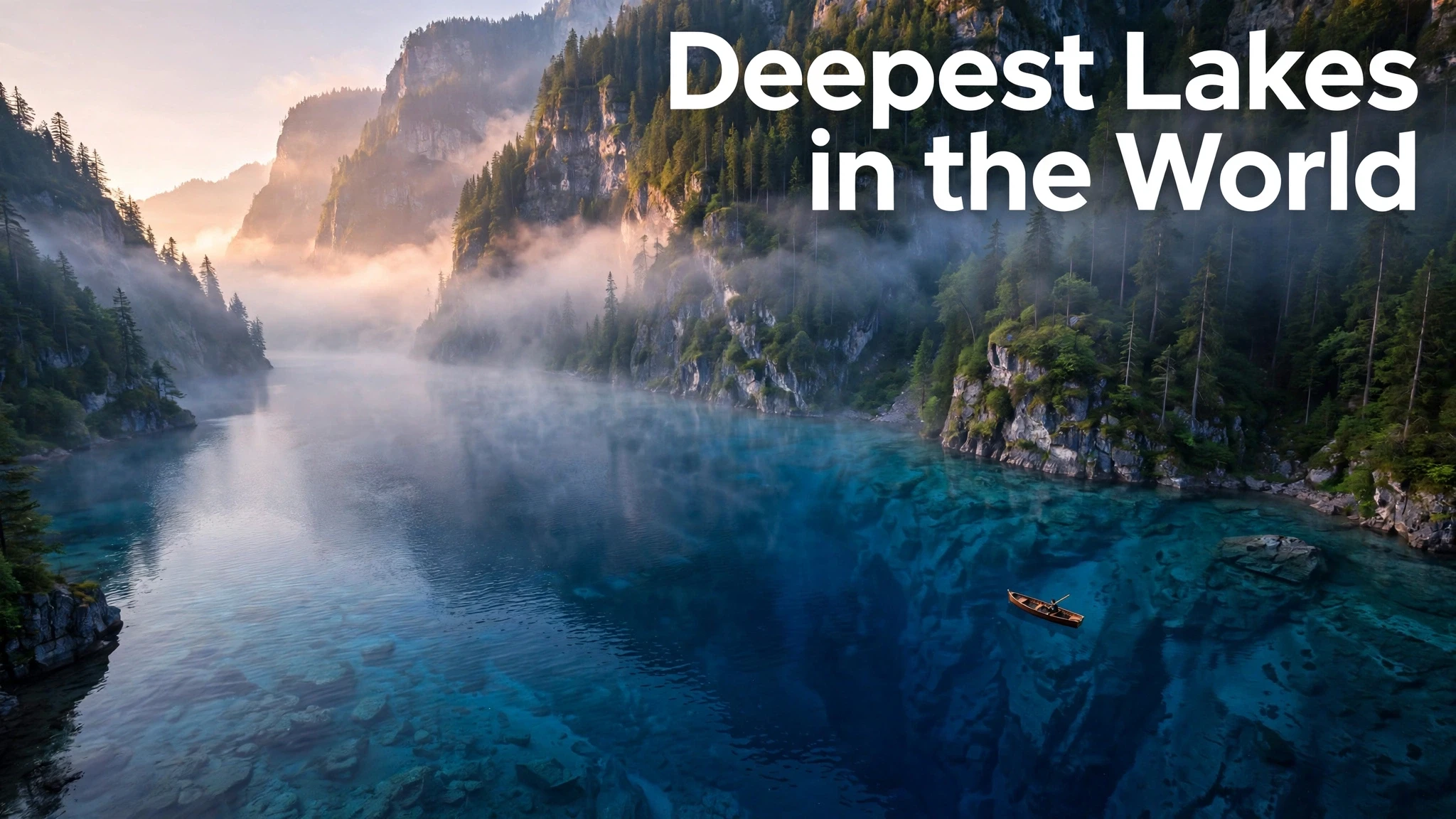
For travellers and readers, deep lakes offer a different kind of wonder from oceans: they are enclosed, often remote, and their depths are hidden beneath a calm surface that gives no hint of what lies below. A boat on Baikal floats above more than a kilometre of water, much of it in darkness, holding species found nowhere else and sediments recording millions of years. That contrast, between a quiet surface and a profound depth, is part of what makes deep lakes so compelling, and why protecting them is not just about water, but about preserving archives of Earth’s past and reservoirs of life for its future.
My Take:
My first judgement is that depth rankings, while fun, miss the most important point about deep lakes: age matters as much as depth. Baikal and Tanganyika are not just deep; they are ancient, and that age is what allowed their extraordinary endemic species to evolve. A newly formed deep lake, such as a glacial lake only a few thousand years old, may be deep but biologically ordinary, because evolution has not had time to fill it with unique life. When we rank lakes by metres alone, we reward a single number and ignore the millions of years that make Baikal and Tanganyika irreplaceable. A better ranking would combine depth, age, volume, and endemism, and on that combined measure Baikal stands even further ahead.
My second judgement concerns the Caspian, and I think its ambiguous status as lake or sea is actually useful, because it forces us to define our terms. If we call it a lake because it is enclosed, we include a saline, sea-like body with oil platforms and sturgeon fisheries. If we call it a sea because of its size and salinity, we exclude the world’s largest enclosed water body from lake lists altogether. Neither choice is wrong, but the choice should be stated openly, because it changes every ranking below it. Too many popular lists present a single ranking without explaining whether the Caspian is counted, or whether depth means maximum or mean depth, and readers are left comparing numbers that were never measured in the same way.
I also think deep lakes are undervalued as climate archives compared with ice cores and ocean sediments, which receive far more attention. A sediment core from Baikal can record millions of years of climate, vegetation, and volcanic activity in a single location, with a resolution that complements ice cores, which cover shorter periods, and ocean cores, which cover different regions. Funding and publicity tend to follow ice and oceans, while lake drilling projects struggle for support, even though they can answer questions about continental climates that neither ice nor ocean records can answer alone. That imbalance should be corrected, not because lakes are more important, but because they fill a gap no other archive fills.
A further point is about protection, and here I want to be direct: deep lakes are slow to recover, so prevention matters far more than cleanup. A pollutant spilled into a shallow river may wash away in weeks, but the same pollutant entering Baikal’s deep waters may persist for decades, because mixing is slow and the volume is vast. The same logic applies to warming: once a deep lake’s stratification strengthens and its deep oxygen declines, reversing that change may take generations, even if surface temperatures stabilise. Policies that treat deep lakes as if they were ordinary, fast-flushing waters therefore underestimate the risk, and the precautionary principle, often dismissed as overcautious, is exactly right for systems with such long memories.
I would also argue that the fisheries of Tanganyika and Malawi deserve the same international attention as ocean fisheries, which they rarely receive. Millions of people depend on those lakes for protein, yet their fish stocks are threatened by overfishing, warming, and sedimentation, with far less monitoring and management than comparable ocean fisheries. International aid and conservation funding still tend to picture fisheries as ocean boats, not as small canoes on a rift lake, and that picture needs updating. A collapse in a lake fishery is not a local story; it is a food security crisis for whole countries, and it should be treated with the urgency that phrase implies.
My practical takeaway for readers is to visit a deep lake, if you can, with depth in mind. Stand on the shore of Baikal, Tanganyika, or even Crater Lake, and remember that beneath the calm surface lies a kilometre or more of water, darkness, and life that has evolved in isolation for millions of years. That mental image changes the experience from a scenic view to a confrontation with deep time, and it makes the case for protection visceral rather than abstract. You do not need to dive to the bottom to appreciate a deep lake; you need only to know what is below you, and to resolve that such a place, once damaged, cannot easily be repaired.
Finally, I think deep lakes offer a lesson about hidden worlds that applies far beyond geography. We live on the surface of things, literally and figuratively, and we judge places by what we can see: a calm lake, a quiet forest, a clear sky. Deep lakes remind us that the most important parts of a system may be invisible, in darkness, under pressure, and evolving slowly over millions of years. Whether the system is a lake, an ocean, a soil network, or a human community, the surface rarely tells the whole story. Learning to respect what lies below, and to protect it before we fully understand it, is perhaps the deepest lesson these lakes have to teach.
There is also a tourism question that deep lakes raise, and it deserves honest handling. Baikal, Crater Lake, and Patagonian lakes attract visitors precisely because of their clarity, colour, and depth, yet tourism itself can pollute, disturb wildlife, and strain local water systems if unmanaged. The answer is not to ban visitors, which would remove the constituency that cares about these lakes, but to manage access carefully: limits on boats and shoreline development, treatment of wastewater, and education that explains why a lake that looks pristine can still be fragile below the surface. A visitor who understands depth is more likely to respect it than one who sees only a pretty view.
I would also note the role of deep lakes in the search for life beyond Earth, which is often presented as science fiction but is grounded in Vostok and similar environments. If microbes can live for millions of years in cold, dark, high-pressure water under Antarctic ice, then similar life might exist in subsurface oceans on Europa or Enceladus, where conditions are also cold, dark, and pressurised, but where chemical energy from rock and water could sustain it. That does not prove extraterrestrial life exists, and scientists are careful not to claim it does, but it expands the range of places where life is plausible, and it makes the protection of Vostok from contamination a matter of scientific integrity, not just environmental caution. Contaminating Vostok would not only damage a unique Earth ecosystem; it could compromise our ability to recognise truly alien life if we ever find it, by blurring the line between Earth microbes and anything else.
Frequently Asked Questions
What is the deepest lake in the world? Lake Baikal in Siberia, Russia, at about 1,642 metres maximum depth. It is also the oldest and largest lake by volume, holding about 20 percent of the world’s unfrozen fresh surface water.
Is the Caspian Sea a lake? It is an enclosed inland sea, a remnant of an ancient sea, and is often included in lake lists. At about 1,025 metres deep, it would rank third if counted as a lake.
How deep is Lake Tanganyika? About 1,470 metres, making it the second deepest lake in the world. It is also the longest freshwater lake, at about 673 kilometres, in the East African Rift.
What lives in Lake Baikal? Many endemic species, including the Baikal seal, the only freshwater seal, hundreds of amphipod species, and fish such as omul and golomyanka, found nowhere else.
What is Lake Vostok? A subglacial lake in Antarctica, buried under about 4 kilometres of ice, isolated for millions of years, where microbial life has been found in extreme cold and darkness.
Why are deep lakes important for climate science? Their sediments record past climates over millions of years, and their waters store vast amounts of freshwater. Warming can strengthen stratification, reduce mixing, and affect fisheries and oxygen in deep layers.