Best Plants for Dark Rooms That Actually Survive
In this post
- Snake Plant: The Plant That Thrives on Neglect
- Pothos: The Trailing Plant for Shelves and Corners
- ZZ Plant: Glossy, Slow, and Nearly Indestructible
- Peace Lily, Cast Iron Plant, and Other Shade Lovers
- What Low Light Really Means, and How to Judge It
- Watering, Feeding, and the Mistakes That Kill Shade Plants
- Light Meters, Grow Lights and the Darkest Corners
- Choosing the Right Pot and Soil for Shade Plants
- Designing With Dark-Room Plants: Style, Pots, and Placement
- My Take:
Every home has a dark corner: a north-facing room, a hallway with no windows, a bathroom that never sees the sun. Most plants would die there, and most people assume that means no plants at all. That is not true. A small group of plants has evolved to survive in shade, on forest floors where sunlight barely reaches, and those plants will thrive in a dark room, if they are given the right care. The trick is choosing the right plant, and understanding what low light actually means.
This guide brings together the best plants for dark rooms that actually survive, from the nearly indestructible snake plant to the trailing pothos and the elegant ZZ plant. It explains how much light they need, how to water them, and the mistakes that kill them, even in shade. You do not need a bright windowsill to have plants. You need the right plant for the room you have, and a little patience. A dark room with a living plant in it feels different, and it is worth the small effort.
Snake Plant: The Plant That Thrives on Neglect
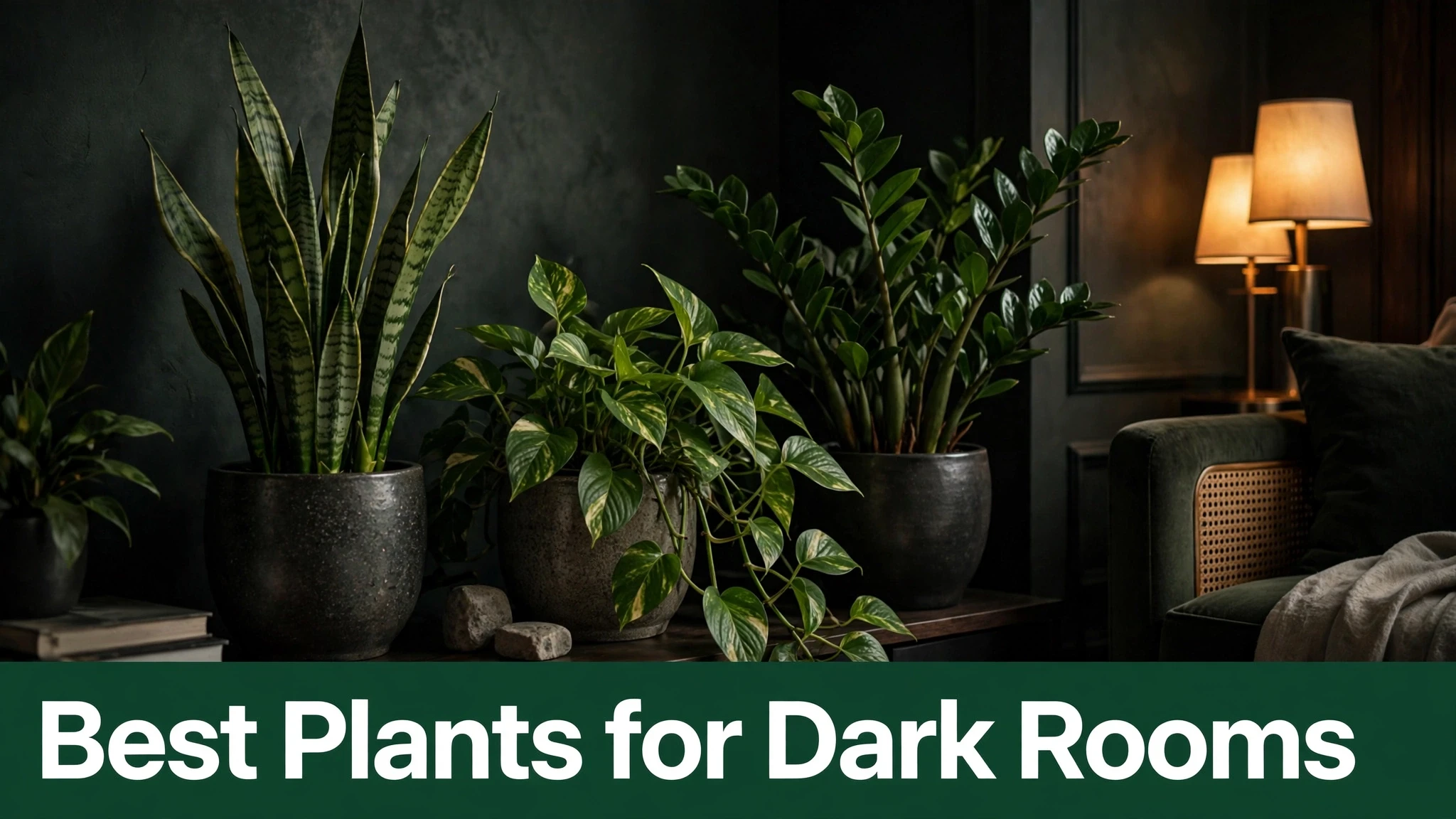
The snake plant, also called mother-in-law’s tongue, is the best plant for a dark room, and it is almost impossible to kill. It has tall, upright leaves, in green and yellow, and it stores water in those leaves, which means it needs very little watering. It tolerates low light, it tolerates irregular watering, and it tolerates being forgotten. In a dark corner, it will grow slowly, but it will survive, and it will look good doing it. That is why it is the most recommended houseplant for beginners, and for dark rooms in particular.
Care is simple: water it only when the soil is completely dry, which may be once every two to three weeks, and sometimes less in winter. Do not overwater it, because that is the one thing that will kill it: the roots rot in wet soil. Use a pot with drainage holes, and a gritty, well-draining compost. It does not need feeding often, once or twice a year is enough. A snake plant is not a fast grower, and it will not fill a room quickly, but it is a reliable, architectural plant that looks good in a modern home, and it is the safest choice for a dark room.
Pothos: The Trailing Plant for Shelves and Corners
Pothos, also called devil’s ivy, is a trailing plant with heart-shaped leaves, and it is one of the best plants for a dark room. It grows in low light, it tolerates irregular watering, and it can be trained to trail from a shelf, climb a wall, or hang from a hook. Its leaves are green, or variegated with yellow or white, though the variegation fades in low light, and the plant becomes greener. That is normal, and it does not mean the plant is unhealthy. Pothos is fast-growing, forgiving, and easy to propagate: cut a stem, place it in water, and it will root in a week.
Care is easy: water when the top few centimetres of soil are dry, and let it drain. It prefers a bright spot, but it will survive in low light, growing more slowly. It does not need much feeding, and it is happy in a normal room temperature. Pothos is ideal for a shelf, a bookcase, or a hanging basket in a dark room, because its trailing stems add life to a space that would otherwise feel bare. It is also one of the easiest plants to share: a cutting in a jar of water is a gift that costs nothing and grows into a new plant.
ZZ Plant: Glossy, Slow, and Nearly Indestructible
The ZZ plant is a modern favourite, with glossy, dark green leaves on thick stems, and it is one of the toughest houseplants there is. It stores water in its thick stems and in underground rhizomes, which means it can survive weeks without water, and it tolerates low light better than almost any other plant. In a dark room, it will grow very slowly, but it will stay green and healthy, and it looks elegant in a simple pot. It is a good choice for an office, a hallway, or a room that is often forgotten.
Care is minimal: water only when the soil is dry, which may be once a month in winter, and use a pot with drainage. Do not overwater, because the rhizomes will rot. It does not need feeding often, and it prefers to be left alone. The ZZ plant is slow, and a new leaf may take weeks to appear, but that slowness is part of its charm: it is a plant that asks for almost nothing and gives a great deal in return. If you want a plant for a dark room that you can forget about, and that will still be alive in a year, this is the one.
Peace Lily, Cast Iron Plant, and Other Shade Lovers
The peace lily is a flowering plant that tolerates low light and is one of the few shade plants that blooms indoors. It has dark green leaves and white flowers, and it is a good choice for a bathroom or a bedroom, because it likes humidity. It will tell you when it needs water: its leaves droop dramatically, and they recover within hours of watering. That makes it a good plant for a beginner, because it communicates. Keep it out of direct sun, water it when the soil is dry, and wipe its leaves occasionally to keep them glossy.
The cast iron plant, as its name suggests, is one of the toughest plants there is. It has dark green, leathery leaves, it tolerates low light, cold, and neglect, and it was a favourite in Victorian homes, where it survived gas lighting and draughty rooms. It grows slowly, it needs little water, and it is almost impossible to kill. Other shade lovers include the spider plant, which produces baby plants on long stems, and the Chinese evergreen, which has patterned leaves and tolerates low light well. Together, these plants offer a range of shapes, sizes, and colours for a dark room, and they are all forgiving of a beginner.
What Low Light Really Means, and How to Judge It
Low light does not mean no light. A plant in a dark room still needs some light, and the difference between a room that is dim and a room that is truly dark matters. A north-facing window, a room with a small window, or a corner a few metres from a window is low light, and the plants in this guide will survive there. A windowless room, a cupboard, or a basement with no natural light is not low light. It is no light, and no plant will survive there without a grow light. Be honest about your room: if you can read a book comfortably without a lamp during the day, there is probably enough light for a shade plant. If you cannot, you will need a light.
It helps to understand the signs of too little light. A plant that is stretching towards the window, with long, pale stems and small leaves, is not getting enough light. A plant that is dropping leaves, or that has stopped growing entirely, may also be light-starved. Moving it closer to a window, even by a metre, can make a difference. A grow light, run for twelve hours a day, is a simple solution for a truly dark room, and it is inexpensive. The goal is not to give a shade plant full sun. It is to give it enough light to live, and the plants in this guide need far less than most.
Watering, Feeding, and the Mistakes That Kill Shade Plants
The most common cause of death for a shade plant is not darkness, but overwatering. In low light, a plant grows slowly, and it uses less water, so the soil stays wet for longer. Watering on a schedule, rather than checking the soil, is the fastest way to kill it. The rule is simple: check the soil before you water, and water only when it is dry. For a snake plant or a ZZ plant, that may be once a month. For a pothos or a peace lily, it may be once a week. Always use a pot with drainage holes, and empty the saucer after watering, so that the plant is not sitting in water.
Feeding should also be light: a weak liquid feed once a month in spring and summer is enough, and no feeding is needed in winter, when growth slows. Do not move a shade plant into direct sun to help it, because the leaves will scorch. Do not mist it excessively, because that can encourage rot. And do not repot it often: shade plants grow slowly, and they prefer to be slightly pot-bound. The care for a dark-room plant is mostly about restraint: less water, less food, less interference. A plant that is left alone, in the right spot, with occasional water, will thrive. That is the beauty of shade plants: they ask for little, and they give a great deal.
Light Meters, Grow Lights and the Darkest Corners
A light meter is a small, inexpensive tool that measures how much light a spot receives, and it can help you decide whether a dark corner is dark enough to be a problem, or bright enough for a shade plant. Most houseplants need a certain level of light, measured in foot-candles, or lux, and a meter will tell you, in seconds, whether a spot meets that level. It is a useful tool, if you are unsure, and if you want to place plants correctly, rather than guessing, and losing them. A reading of less than 50 foot-candles is very dark, and only the most tolerant plants will survive there, while a reading of 100 to 200 is low light, and suitable for many shade plants.
A grow light is the next step, if your room is too dark, even for shade plants. A small LED grow light, on a timer, for ten to twelve hours a day, can make a real difference, and it is not expensive, or difficult to use. Place it above the plant, about 30 centimetres away, and turn it on during the day, so that the plant gets a consistent light cycle. A grow light will not make a dark room bright, but it will give your plants the light they need, to grow, and to stay healthy. It is a practical solution, and it is worth considering, if you love plants, but your home is dark, and you do not want to give up on them.
Choosing the Right Pot and Soil for Shade Plants
Shade plants need a pot, and soil, that suit their low-light conditions, because they grow slowly, and they use water slowly, and they are more prone to root rot, if they are overwatered. A pot with drainage holes is essential, and it should be only slightly larger than the plant, because a pot that is too large holds too much soil, and too much moisture, and the roots will rot. A terracotta pot is a good choice, because it is porous, and it allows the soil to dry out, which is important for slow-growing plants, in low light.
The soil should be light, and well-draining, with perlite, or bark, mixed in, to improve airflow, and to prevent it from staying wet. A standard potting mix, with extra perlite, is usually enough, and it is better than a heavy, dense soil, which will suffocate the roots. Water shade plants sparingly, and only when the top few centimetres of soil are dry, and always let the excess drain away. And do not feed them often, because they grow slowly, and they need very little fertiliser, perhaps once a month, in spring, and summer, and not at all, in winter. The right pot, and the right soil, will help your shade plants survive, and thrive, even in the darkest room.
Designing With Dark-Room Plants: Style, Pots, and Placement
Plants for dark rooms are not only about survival. They are about design, and a well-chosen plant, in the right pot, in the right place, can transform a dark room, making it feel alive, warm, and welcoming. The key is to think about scale, shape, and texture, and to choose plants that complement the room, rather than fighting it. A tall snake plant in a corner can add height, and structure, to a room that feels flat. A trailing pothos on a shelf can soften a hard edge, and add movement. A ZZ plant on a desk can add a touch of green, without taking up much space. Each plant has a role, and choosing the right role is part of good design.
Pots matter as much as plants, because a pot is part of the look, and it can change how a plant is perceived. A simple, elegant pot in a neutral colour will let the plant speak for itself, while a bold, colourful pot can make a statement, and become a feature in its own right. The material also matters: ceramic pots are heavy, and stable, and they retain moisture, while terracotta pots are porous, and dry out faster, which can be good for plants that dislike wet roots. Plastic pots are light, and cheap, but they may not look as good. Choose a pot that suits the plant, the room, and your taste, and remember that a pot should have drainage, or the plant should be in a nursery pot inside a decorative one, so that water does not collect, and cause rot.
Placement is also important, especially in a dark room, where light is limited. Place plants as close to the window as possible, even if the window does not get direct sun, because the light near a window is brighter than the light in the centre of a room. Avoid placing plants in the darkest corners, unless they are truly shade-tolerant, and rotate them occasionally, so that they grow evenly, and do not lean towards the light. Grouping plants together can also help, because they create a microclimate, with higher humidity, and they look better as a group than alone. A cluster of plants, in different heights, shapes, and textures, can make a dark corner feel like a small garden, and it is more interesting than a single plant, alone.
It also helps to think about the room as a whole, and to use plants to solve design problems. A dark hallway can be brightened with a trailing plant, a bare wall can be softened with a hanging plant, and an empty corner can be filled with a tall plant. Plants can also be used to divide a space, to create privacy, or to draw the eye to a particular area. They are versatile, and they are forgiving, and they can be moved, rearranged, and changed, as your taste changes. Do not be afraid to experiment, and to move a plant if it does not work in one place. A plant is not furniture. It is alive, and it can be moved, and it will tell you, by how it grows, whether it is happy where it is.
Finally, remember that a dark room with plants is better than a dark room without them, and that even a single plant can make a difference. You do not need a jungle to enjoy the benefits of plants, and a few well-chosen, well-placed plants can transform a space, making it feel more alive, more comfortable, and more like home. Start with one or two, learn how they grow, and add more as you gain confidence. The design will evolve, as you do, and your dark room will become a place you enjoy, not a place you avoid. That is the power of plants, and it is available to anyone, even in the darkest room.
My Take:
Let me tell you the mistake that killed my first three houseplants, because it’s the mistake almost everyone makes. I watered them on a schedule, every Sunday, whether they needed it or not. In a dark room, they didn’t need it. The soil stayed wet, the roots rotted, and the plants died, and I concluded I was bad with plants. I wasn’t. I was watering a slow-growing plant as if it were a thirsty one. The day I started checking the soil with my finger before watering, everything changed. That single habit, touch the soil first, is worth more than any plant book.
Here’s the thing about dark rooms that most guides get wrong. They list plants that tolerate low light, but they don’t tell you that low light still means some light. A plant in a windowless cupboard will die, however tough it is. A plant three metres from a north-facing window will live. The difference matters, and it’s worth being honest about your room before you buy. Can you read a book in there during the day without a lamp? If yes, a snake plant will be happy. If no, you need a grow light, or you need to accept that the room is for something else. That’s not failure. It’s information.
I’ll be direct about which plant to buy first. Buy a snake plant. Not because it’s the prettiest, but because it’s the most forgiving, and forgiveness is what a beginner needs. It survives low light, it survives forgotten watering, and it looks good in a modern home. The pothos is a close second, because it grows fast and tells you quickly when something is wrong. The ZZ plant is third, because it’s beautiful and nearly indestructible, but slow. Start with the snake plant, learn the watering habit, and then add the others. That’s the order that works.
What surprised me was how much a single plant changes a dark room. A hallway that felt bare felt alive with a pothos trailing from a shelf. A bedroom corner that felt empty felt finished with a snake plant in a simple pot. Plants don’t need to fill a room to change it. One plant, in the right place, is enough. And the care they ask for is small: a check of the soil, a watering every few weeks, a wipe of the leaves now and then. That’s a good return for a living thing in your home.
So my advice is simple. Be honest about your light. Buy a snake plant. Put it in a pot with drainage. Water it only when the soil is completely dry. Then leave it alone and watch it grow, slowly. That’s it. You don’t need a bright windowsill, you don’t need experience, and you don’t need a collection. You need one plant, in the right place, watered correctly. Start there, and the dark corner will stop being a problem and start being a favourite spot.
Overwatering kills more shade plants than darkness ever will, and it is the mistake almost every beginner makes. A plant in a dark room grows slowly, and it uses water slowly, and if you water it on the same schedule as a plant in a sunny window, the soil stays wet, the roots cannot breathe, and they rot. The plant looks thirsty, with drooping leaves, so you water it more, and the rot gets worse, and the plant dies while you are trying to save it. The fix is to check the soil before you water, every time, by pushing your finger two centimetres into the pot. If it feels damp, wait. If it feels dry, water thoroughly, and let the excess drain away. That one habit will save more plants than any fertiliser, or any grow light.
It also helps to learn what your plant is telling you, because the signs are clear once you know them. Yellow leaves that feel soft usually mean too much water. Brown, crispy leaf edges usually mean too little, or dry air. A plant that leans hard towards the window is asking for more light, and turning it regularly will help it grow evenly. A plant that has not grown at all in six months is not necessarily dying. It may be resting, or it may be pot-bound, and a look at the roots will tell you: if they are circling the bottom of the pot, it is time to repot, into a pot only slightly larger, with fresh soil. Plants are patient teachers, and they will tell you what they need, if you learn to read them, and the skill of reading a plant is worth more than any number of new plants bought to replace the ones that died.
Design is the part I would add, because a plant is not only a living thing. It is also a design object, and how you place it, what pot you choose, and how you group it with other plants, all affect how it looks, and how it makes a room feel. I would encourage anyone with a dark room to think about design, not only about survival, and to choose plants that suit the room, and pots that suit the plants, and to place them thoughtfully, where they will be seen, and enjoyed. A well-placed plant can transform a room, and a poorly placed one can be invisible, however healthy it is. Think about it, and your plants will reward you, not only by growing, but by making your home more beautiful.
I also think we should be honest about the fact that a dark room is a challenge, and that not every plant will thrive in it, however well you design it. Be realistic about the light you have, and choose plants that are truly shade-tolerant, rather than hoping that a sun-loving plant will adapt. That honesty will save you disappointment, and money, and it will ensure that your plants are healthy, and that your design works. Work with the light you have, not the light you wish you had, and you will find plants that suit it, and that make the room better, rather than struggling in it.
Another point I would make is about grouping, because plants look better together than alone, and they help each other, by creating humidity, and by providing shade. A group of plants, in different heights, shapes, and textures, is more interesting than a single plant, and it creates a focal point, a small garden, in a room that might otherwise feel bare. Group your plants, vary their heights, and use different pots, and you will create a display that is more than the sum of its parts. That grouping is a simple design trick, and it works, in any room, dark or bright.
And the final thing I would say is to start small, and to enjoy the process. You do not need to fill a dark room with plants overnight. Start with one or two, learn how they grow, and add more as you gain confidence. Your design will evolve, as you learn, and your room will become more alive, more comfortable, and more yours. Plants are a slow pleasure, and they reward patience, and care, and attention. Give them that, and they will give you a home that feels alive, even in the darkest room. That is a gift, and it is worth the effort.
Frequently Asked Questions
What is the best plant for a dark room?
A snake plant is the best choice for a dark room: it tolerates low light, needs very little water, and is almost impossible to kill. Pothos and ZZ plants are also excellent, forgiving choices for shady corners.
Can plants survive in a room with no windows?
No plant survives with no natural light at all. A dim room with a small or north-facing window is low light and suits shade plants, but a windowless room needs a grow light run for about 12 hours a day.
How often should I water low-light plants?
Water only when the soil is dry, not on a schedule. A snake plant or ZZ plant may need water only once every two to four weeks, while pothos and peace lilies need water about once a week. Always check the soil first.
Why do my houseplants keep dying?
Overwatering is the most common cause, especially in low light where plants grow slowly and use less water. Use pots with drainage, check the soil before watering, and empty the saucer so roots do not sit in water.
What is the easiest low-light plant for beginners?
Pothos is one of the easiest: it grows fast, tolerates low light and irregular watering, and is easy to propagate from cuttings. Snake plants and ZZ plants are even tougher, though slower growing.
Do low-light plants need feeding?
Feed sparingly: a weak liquid feed once a month in spring and summer is enough, and no feeding is needed in winter. Too much feed can harm a slow-growing shade plant more than too little.