Blur: The Life Story Behind the Britpop Stars
In this post
Blur are one of the cleverest, most stylish, and most interesting British bands of the last thirty years, and they are also one of the most surprising. They started as art students in London, they became Britpop stars with Parklife, they had a famous chart battle with Oasis, they reinvented themselves with a lo-fi American sound, they broke up, they came back, and they are still making music today. They have never stayed in one place for long, and that restlessness is what makes them so interesting.
Their story is about Damon Albarn, the singer and songwriter who became one of the most creative musicians in Britain, about Graham Coxon, the guitarist whose playing gave the band its edge, about Alex James, the bass player, and about Dave Rowntree, the drummer. It is about four friends who met at Goldsmiths College in London, who loved pop music, art, and London life, and who made songs about the city they lived in, about the people they saw, and about the Britain of the 1990s.
What makes their story worth telling is the music and the ideas behind it. They made Parklife, Girls and Boys, Song 2, and Tender, songs that are still loved today, and they made albums that changed from bright Britpop to dark, American-influenced rock to thoughtful, mature pop. They were never a simple band, and they never wanted to be. This is the story of how Blur became stars, and why they are still important.
Four Art Students Meet in London
Damon Albarn was born on 23 March 1968 in Whitechapel, in east London, and he grew up in Colchester, in Essex, where his parents were artists and teachers. He learned to play the piano and the guitar as a child, he loved pop music, and he was a bright, creative boy who wanted to be a musician. He went to Goldsmiths College in London to study art, and there he met Graham Coxon, a guitarist from Colchester who shared his love of music, and Alex James, a bass player, and Dave Rowntree, a drummer, and the four of them formed a band.
Graham Coxon was born on 12 March 1969 in Rinteln, in Germany, where his father was stationed with the British Army, and he grew up in Colchester, where he met Albarn at school. He was a talented guitarist, with a style that was noisy, melodic, and unlike anyone else’s, and he was also a shy, thoughtful young man who loved art and music. He and Albarn became close friends, and they shared a love of British pop, of the Beatles, of the Kinks, and of many other bands.
Alex James was born on 21 November 1968 in Bournemouth, and he grew up loving music, playing the bass, and dreaming of being in a band. He was a charming, funny, and sociable young man, who loved the lifestyle of a rock star, and he became the bass player in the band, giving it a solid, melodic foundation. Dave Rowntree was born on 8 May 1964 in Colchester, and he was the oldest member, a drummer who had studied law and who brought a steady, intelligent presence to the band.
The four men met at Goldsmiths in the late 1980s, when London was full of art, music, and new ideas, and they formed a band first called Seymour, and then called Blur, after their record label suggested a shorter, punchier name. They rehearsed, they wrote songs, and they played in small clubs in London, building a following among students and young people who loved their bright, catchy, and slightly odd pop music. They were not a typical rock band. They were art students who made pop, and that gave them a different perspective.
The band’s early gigs in London were also a time of learning how to play to a small crowd, how to win over students and young people who had never heard them before, and how to build a following one gig at a time, which is a skill that many bands never learn, and which Blur learned well in their first years.
The band’s early gigs in London were also a time of learning how to play to a small crowd, how to win over students and young people who had never heard them before, and how to build a following one gig at a time, which is a skill that many bands never learn, and which Blur learned well in their first years.
Leisure, There’s No Other Way, and the First Hits
In 1991, Blur released their debut album, Leisure, which included the hit singles There’s No Other Way and She’s So High, and which reached the top ten in the UK. The album was a mix of baggy, dance-influenced pop, with guitars, with keyboards, and with Albarn’s distinctive vocal, and it showed a young band that was still finding its sound. It was a success, but it was not yet the Blur that would become famous, and the band knew that they needed to find a clearer identity.
The early 1990s were a difficult time for Blur. Their second album, Modern Life Is Rubbish, released in 1993, was initially a commercial disappointment, even though it included good songs like For Tomorrow and Chemical World, and it showed the band moving towards a more British sound, with lyrics about London life, about English culture, and about the everyday. The album was praised by critics, but it did not sell as well as the band had hoped, and they were under pressure from their record label to make a hit.
The band’s fortunes changed with their third album, Parklife, released in 1994, which became one of the defining albums of Britpop, a movement that celebrated British music, British culture, and British life. Parklife included the songs Girls and Boys, Parklife, End of a Century, and This Is a Low, and it reached number one in the UK, selling millions of copies and making Blur one of the biggest bands in Britain. The album was bright, funny, clever, and full of observations about London life, and it captured a moment in British culture.
Parklife made Blur stars, and it also made them the leaders of Britpop, along with Oasis, Pulp, and Suede. They were on television, they were in the newspapers, and they were loved by young people who saw themselves in their songs. They were also stylish, with Albarn’s hair, with their clothes, and with their videos, and they became a symbol of Cool Britannia, a time when British music, art, and fashion felt exciting and new again. They were at the top, and they knew it.
The press coverage of the battle was intense, with newspapers, television, and radio all talking about it, and with fans choosing sides, wearing t-shirts, and arguing in pubs about which band was better, and that excitement made pop music feel important again, in a way that had not happened since the 1960s.
The press coverage of the battle was intense, with newspapers, television, and radio all talking about it, and with fans choosing sides, wearing t-shirts, and arguing in pubs about which band was better, and that excitement made pop music feel important again, in a way that had not happened since the 1960s.
The Battle of Britpop With Oasis
In August 1995, Blur and Oasis released singles on the same day, in what became known as the Battle of Britpop, a chart battle that captured the attention of the whole country. Blur released Country House, and Oasis released Roll With It, and the press presented it as a battle between the south and the north, between art students and working-class lads, between London and Manchester. Blur won the singles chart that week, selling more copies than Oasis, but Oasis won the album chart later that year, and the rivalry made both bands even more famous.
The battle was fun, it was exciting, and it was also a little silly, because both bands were friends, and both bands respected each other, even if they pretended not to in interviews. Albarn and the Gallagher brothers traded insults in the press, the fans argued about which band was better, and the whole country talked about pop music in a way that had not happened for years. It was a peak for Britpop, and it was a moment when British music felt important again.
Blur’s fourth album, The Great Escape, released in 1995, included Country House, The Universal, and Charmless Man, and it reached number one in the UK, but it was also seen by some critics as a step back from Parklife, a record that was too polished, too clever, and too focused on the charts. The band were tired, they were under pressure, and they were beginning to feel that Britpop had become a trap, a label that limited what they could do. They wanted to change, and they wanted to make music that was different.
The Great Escape period was also a time of personal problems for the band, especially for Graham Coxon, who was struggling with alcohol, and for Albarn, who was feeling the pressure of fame. They toured the album, they played huge concerts, and they were still one of the biggest bands in Britain, but they were not happy, and they knew that they needed to do something different if they wanted to survive as a band. They decided to change their sound, and that decision would lead to their next album, which was a complete reinvention.
The album Blur was recorded in London and in Iceland, with the band working quickly, playing live in the studio, and trying new sounds, and that spontaneity comes through in the finished record, which sounds raw, loud, and alive, unlike the polished pop of their earlier albums.
The album Blur was recorded in London and in Iceland, with the band working quickly, playing live in the studio, and trying new sounds, and that spontaneity comes through in the finished record, which sounds raw, loud, and alive, unlike the polished pop of their earlier albums.
Song 2, a New Sound, and Reinvention
In 1997, Blur released their fifth album, Blur, a record that was a complete change from Parklife and The Great Escape. The album was influenced by American indie rock, by bands like Pavement, and it had a lo-fi, noisy, and raw sound, with songs like Beetlebum, On Your Own, and Song 2. Song 2 became their most famous song in America, with its famous woo-hoo chorus and its loud, short, and explosive energy, and it was used in films, in advertisements, and in video games, making Blur known to a whole new audience.
The album was a success, reaching number one in the UK, and it showed that Blur could reinvent themselves, that they were not trapped by Britpop, and that they were willing to take risks. Coxon’s guitar playing was at the centre of the new sound, with noisy, distorted riffs, and Albarn’s songwriting was darker, more personal, and more experimental. The band were happier, they were more creative, and they felt free again, after years of being labelled as a Britpop band.
They followed it with the album 13 in 1999, which was even more experimental, with songs like Tender, a long, gospel-influenced ballad, Coffee and TV, and No Distance Left to Run, and with production by William Orbit, who gave the album a rich, layered sound. The album was praised by critics, and it showed a band that was growing up, writing about love, loss, and getting older, and making music that was thoughtful and mature. It was a high point for the band, and it is still regarded as one of their best albums.
The late 1990s were also a time of change in the band’s personal lives. Albarn began a new project called Gorillaz, with the artist Jamie Hewlett, creating a virtual band that would become hugely successful, and Coxon released solo albums, showing his own songwriting talent. The band were still together, but they were also working on their own projects, and they were beginning to drift apart, even as they made great music together.
Albarn’s work with Gorillaz also showed his interest in collaboration, working with musicians from many different backgrounds, from hip hop to world music to rock, and that openness to new ideas became a major part of his career, both with Gorillaz and with Blur.
Albarn’s work with Gorillaz also showed his interest in collaboration, working with musicians from many different backgrounds, from hip hop to world music to rock, and that openness to new ideas became a major part of his career, both with Gorillaz and with Blur.
Think Tank, Break-Up, and Solo Projects
In 2003, Blur released the album Think Tank, without Graham Coxon, who had left the band during the recording sessions, after years of tension and personal problems. The album was made mostly by Albarn, James, and Rowntree, with help from other musicians, and it included the songs Out of Time and Good Song, and it was a success, reaching number one in the UK. It was a different Blur, without Coxon’s guitar, and it showed Albarn’s growing interest in world music, in electronics, and in new sounds.
After Think Tank, the band went on hiatus, and the members worked on their own projects. Albarn became hugely successful with Gorillaz, releasing albums like Demon Days in 2005, and becoming one of the most creative musicians in Britain. Coxon released solo albums and toured as a solo artist, James became a writer and a cheese maker, and Rowntree became involved in politics and in other work. They were no longer a band, and many fans thought that Blur was over for good.
The band reunited in 2009, with all four original members, for a series of concerts in London, including two nights at Hyde Park, and the reunion was a huge success, with fans queuing for tickets and with the band playing their classic songs to huge crowds. They also released new singles, including Fool’s Day in 2010, and they toured the world, playing festivals and stadiums, and reminding everyone why they had been so loved in the first place.
In 2015, Blur released a new album, The Magic Whip, recorded in Hong Kong, which was a surprise return, and which was praised by critics and loved by fans. The album included the songs Go Out, Lonesome Street, and Ong Ong, and it showed a band that was still creative, still funny, and still able to make great pop music, even after many years apart. They toured the album, they played festivals, and they proved that they were still Blur, even after all the changes.
Their songs have also been used in films, in television, and in advertisements, introducing their music to new audiences, and songs like Song 2 have become familiar to people who may never have bought a Blur album, which shows how deeply their music has entered popular culture.
Their songs have also been used in films, in television, and in advertisements, introducing their music to new audiences, and songs like Song 2 have become familiar to people who may never have bought a Blur album, which shows how deeply their music has entered popular culture.
What Blur Leave Behind
Blur left behind a body of music that is still loved today, with songs like Parklife, Girls and Boys, Song 2, Tender, and The Universal still played on the radio, still sung by fans, and still loved by new generations. They made albums that changed British music, they led Britpop, they reinvented themselves, and they showed that a band could be clever, stylish, and popular all at the same time. They sold millions of records, they played to millions of people, and they became one of the most important British bands of the last thirty years.
Their legacy is also about creativity and about change. They showed that a band does not have to stay the same, that it can change its sound, its image, and its ideas, and that it can still be successful. They also showed that a band can be about more than just music, that it can be about art, about London, about Britain, and about life itself. Damon Albarn, in particular, has become one of the most creative musicians in Britain, with Gorillaz, with solo albums, and with many other projects, and his work with Blur is only one part of a long and interesting career.
For young musicians, Blur are an example of what is possible if you are creative, if you work hard, and if you believe in your own ideas. They started as art students in London, they made pop music, they became stars, they reinvented themselves, and they are still making music today. They did it with talent, with hard work, and with a love of music. They also did it with humour, with style, and with a sense of fun. They were not perfect, and their story has sad parts, but their music remains, and it will remain for as long as people listen to British pop.
Blur’s music also reminds me that pop can be about everyday life, about the park, the pub, the street, and the city, and that those ordinary things can be beautiful if you look at them with care and with humour, which is a lesson that Albarn has taught me through his songs.
The band also learned how to work with different producers, from Stephen Street on their early albums to William Orbit on 13, and each producer brought a new sound, a new way of working, and a new set of ideas, which helped Blur to keep growing and to keep changing, even when they were already famous and successful.
They also showed that a band can be successful without losing its sense of humour, that it can make fun of itself, that it can laugh at fame, and that it can still take its music seriously, which is a difficult balance to strike and one that Blur have managed better than most bands.
Their early days at Goldsmiths also taught them how to think about music as art, how to use images, how to design covers, and how to present themselves as a band with ideas, not just as four men with instruments.
My Take:
When I think about Blur, the first thing I think about is Parklife. It is a bright, funny, and clever album about London life, and it still makes me smile when I hear it. Girls and Boys is a song about nightlife, about dancing, and about being young, and it is full of energy and humour. Parklife, with its spoken-word verses, is a song that captures a moment in British life, and it is still loved today. I think Parklife is one of the great British albums, and it is one of the reasons Blur are remembered so fondly.
I admire Damon Albarn most of all, because he is one of the most creative musicians in Britain. He wrote Parklife, he created Gorillaz, he made solo albums, and he has worked with musicians from all over the world. He is not afraid to try new things, he is not afraid to fail, and he is always looking for new sounds and new ideas. I respect that kind of creativity, because it takes courage to keep changing, and it takes talent to make those changes work. Albarn has done it again and again, and he is still doing it today.
I also think about Graham Coxon, because his guitar playing is a major part of Blur’s sound. He plays with noise, with melody, and with a style that is unlike anyone else’s, and his solos are instantly recognisable. He was also a songwriter in his own right, and his solo albums show a talented musician who deserves more credit. He struggled with alcohol, he left the band, and he came back, and his story is a reminder that musicians are human beings, with real problems, and that they deserve support and understanding.
I think about the Battle of Britpop, too, because it was a fun and exciting time in British music. Blur and Oasis released singles on the same day, the press made a big deal of it, and the whole country talked about it. I think that rivalry was good for music, because it made people care about bands, about songs, and about British music. It was a time when music mattered, and when people argued about it in pubs and in schools. I miss that time, and I think Blur and Oasis both benefited from it.
There is a part of their story that I find interesting, and that is their reinvention with Song 2. They could have stayed as a Britpop band, making the same kind of music again and again, but they chose to change, to make a noisy, American-influenced album, and to take a risk. That risk paid off, because Song 2 became their biggest hit in America, and it introduced them to a whole new audience. I admire that kind of bravery, because it is easy to stay safe, and it is hard to change when you are already successful.
I also think about Tender, because it is one of the most beautiful songs Blur ever made. It is a long, gospel-influenced ballad about love, about loss, and about holding on, and it shows a different side of the band, a softer, more mature side. When I hear it, I think about getting older, about learning to be kind to yourself, and about the importance of tenderness in a hard world. That is a deep song, and it is one of my favourites.
If I have a criticism, it is that Blur sometimes get treated as a clever band, and their music can feel a little too clever at times, a little too focused on ideas and not enough on feeling. I understand why they do it. They are art students, they are thoughtful, and they like to make music with ideas in it. But as a listener, I sometimes want a song that is just a great song, without a big idea behind it. I think their best work is when the idea and the feeling work together, as they do in Parklife and in Tender, and I hope they keep finding that balance.
Another thing I think about is how their music has lasted. Parklife was released in 1994, thirty years ago, and it is still played today, still sung by fans, and still loved by people who were not born when it was made. That is a rare thing. Most music fades after a few years. Blur’s music does not fade. It stays, because the songs are well written, because the playing is superb, and because the feelings in them are true. I think that is the best test of great music. It lasts, and it keeps finding new listeners.
I think about their influence, too. They changed the way British bands sounded, the way pop music was made, and the way young people saw themselves. They showed that a band could be artful, could be stylish, and could be successful, all at the same time. Many bands that came after them learned from them, and many still do. They opened a door, and many other artists walked through it. That is a legacy that goes beyond their own songs.
For a young reader, I think the lesson from Blur is about being yourself and about not being afraid to change. They were art students who made pop music, they became Britpop stars, they reinvented themselves, and they are still making music today. They did not stay in one place, they did not follow trends, and they did not try to be like anyone else. They were themselves, they made music that sounded like them, and they trusted that people would find it. That is a hopeful message for anyone who feels different.
I also think their story teaches something about friendship. Damon, Graham, Alex, and Dave have been friends since they were students, they have argued, they have fallen out, and they have come back together, again and again. They have done it because they respect each other, because they need each other, and because they make great music together. That is a lesson for anyone who works in a team. You do not have to agree all the time. You have to respect each other, listen to each other, and keep working together.
In the end, I think Blur will be remembered as one of the greatest British bands ever, not only because they sold the most records, but because they made the cleverest music, because they changed British pop, and because their songs still make people happy. They were four art students from London who became stars, and they became stars because they were talented, because they worked hard, and because they made music that spoke to people. I love their music, I respect their story, and I will keep listening to them for as long as I can.
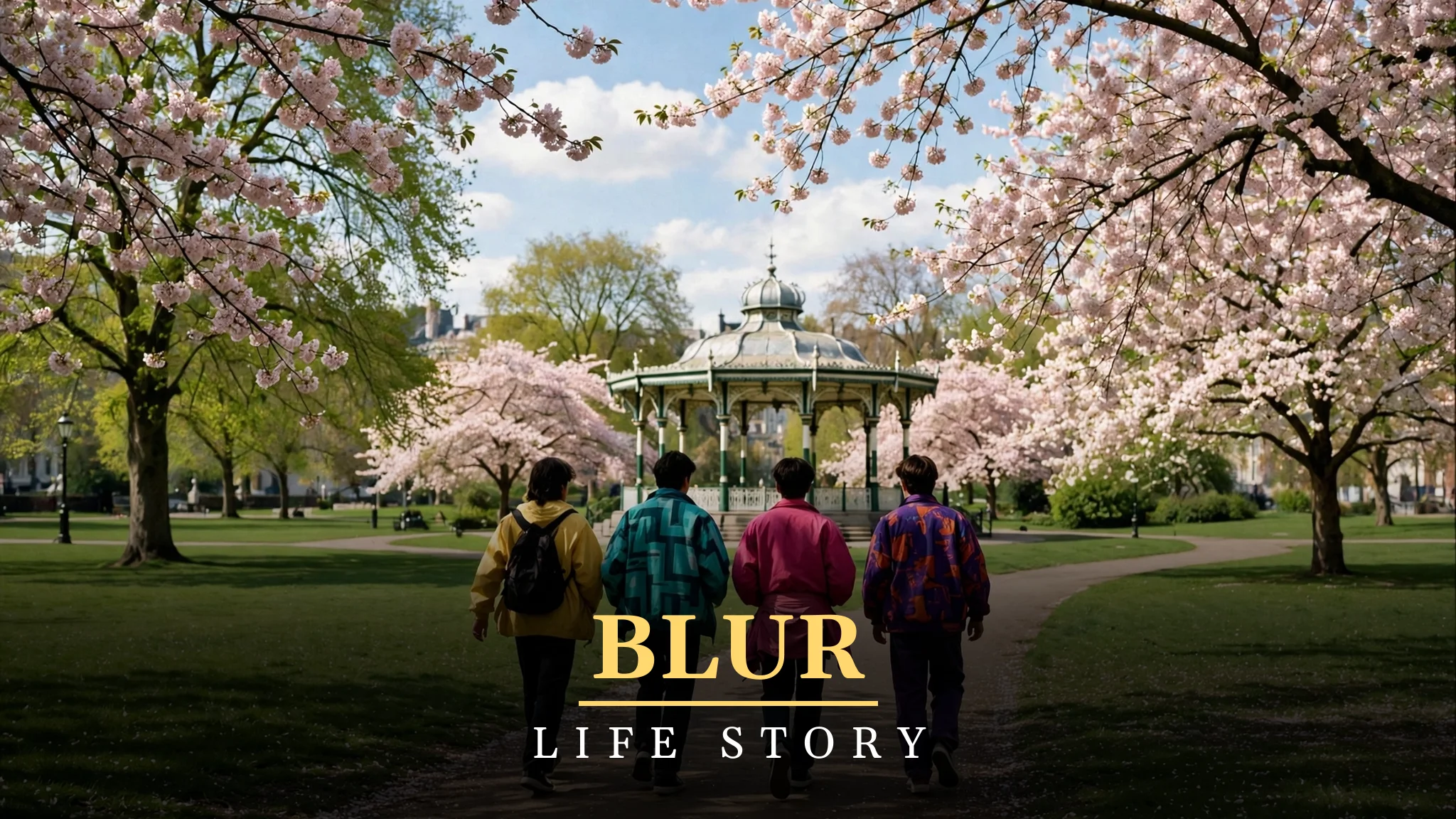
One more thought stays with me. When I think about Blur, I think about the image of four young men in bright jackets walking through a park under pink blossom trees, towards a bandstand, and I think about how that image captures their music: bright, youthful, stylish, and full of life. Their music is like that park, green and beautiful, and it is still there, still blooming, still loved. I think that is a beautiful image, and it is one I will always remember.
I also think about Gorillaz, because Damon Albarn’s work with Gorillaz shows how creative he is, and how he can take an idea, like a virtual band, and turn it into something real and successful. Gorillaz are a separate band, but they are part of Albarn’s story, and they show that he is not only a Blur singer, but a musician who can do many things. I admire that kind of creativity, and I think it is a major part of his legacy.
I think about the future, too. Blur are still playing, still making music, and still touring, and they are still Blur, even after all the changes. One day, they will stop, and that will be a sad day for British music. But their songs will remain, their albums will remain, and their concerts will be remembered. They have left a legacy that will last for generations, and they have shown that British pop can be clever, can be stylish, and can be beautiful. I am grateful that I have been able to hear their music.
Finally, I want to say that Blur teach me something about London. Their songs are about London life, about the city, about the people, and about the everyday, and they capture a London that is real, funny, and full of life. I love London, and I love songs about London, and Blur’s songs are among the best. They remind me that a city can be a muse, that everyday life can be art, and that pop music can be about the world around you. That is a lesson I will always remember.
I also think about the way Blur captured the 1990s, a decade when British music felt exciting, when London felt alive, and when young people believed that pop could change the world, and that feeling is still in their songs, even thirty years later, which is why I keep returning to them.
I think about their videos, too, because Blur made clever, funny, and stylish videos that matched their songs, with directors who understood their humour, and those videos helped to make them stars, in a time when music television was still important and a good video could make a band famous.
I think about the reunion concerts in Hyde Park in 2009, when the four members played together again after years apart, and how emotional it was for fans who had waited so long to see them, and how the band played with joy, with energy, and with a sense of homecoming that made those nights unforgettable.
I also think about Alex James, because he is often seen as the fun-loving bass player, but he is also a talented musician and a writer, and his bass lines give Blur’s songs their groove and their bounce, and his personality gives the band its humour and its warmth, which is a part of their appeal that should not be underestimated.
I think about Dave Rowntree, too, because he is the steady drummer who has kept the band together for more than thirty years, and he is also a thoughtful, intelligent man who has worked in politics and in other fields, and his calm presence is a balance to the more flamboyant personalities in the band.
I think about the way Blur’s songs are about ordinary people, about the man in the pub, the girl on the train, and the family in the suburbs, and how those ordinary stories become great songs when they are written with care, with humour, and with a love of everyday life, which is a gift that Damon Albarn has in abundance.
I think about their later albums, especially The Magic Whip, because it showed that Blur could still make a great record after many years apart, with songs that were fresh, funny, and full of life, and that proved that their creativity had not faded, even after all the changes and all the solo projects.
Finally, I want to say that Blur remind me that pop music can be smart and fun at the same time, that it can make you think and make you dance, and that a great pop song is a small work of art that can brighten an ordinary day.
I also think about how their music sounds best on a sunny day, in a park, with friends, which is fitting for a band whose cover image is a walk through blossom trees, and that feeling of sunshine and friendship is at the heart of what Blur do best.
That sunshine feeling, bright and warm and full of life, is why I will keep playing Blur on sunny days for many years to come.
Frequently Asked Questions
How did Blur form at Goldsmiths College?
Blur formed in the late 1980s when Damon Albarn, Graham Coxon, Alex James, and Dave Rowntree met at Goldsmiths College in London, first calling themselves Seymour, then changing to Blur after signing to a record label.
What is Parklife and why is it so important?
Parklife, released in 1994, is Blur’s third album and a defining Britpop record, with Girls and Boys, Parklife, and End of a Century, capturing London life in the 1990s and reaching number one in the UK.
What was the Battle of Britpop between Blur and Oasis?
In August 1995 Blur and Oasis released singles on the same day, Blur’s Country House beat Oasis’ Roll With It on the singles chart, and the rivalry became known as the Battle of Britpop, making both bands even more famous.
What is Song 2 and why did it change Blur’s career?
Song 2, from their 1997 self-titled album, is a loud, short, explosive song with a famous woo-hoo chorus, which became their biggest hit in America and showed they could reinvent themselves beyond Britpop.
Why did Graham Coxon leave Blur?
Graham Coxon struggled with alcohol and tension in the band, left during the recording of Think Tank in 2003, worked on solo albums, and later returned for the band’s reunion in 2009 and for The Magic Whip in 2015.
What is Gorillaz and how is it connected to Blur?
Gorillaz is a virtual band created by Damon Albarn with artist Jamie Hewlett, which became hugely successful with albums like Demon Days, showing Albarn’s creativity beyond Blur while he continued to work with the band.
Are Blur still playing today?
Yes, Blur reunited in 2009, released The Magic Whip in 2015, and continue to tour and play festivals, with all four original members performing their classic songs for new generations of fans.


