The Kinks: The Life Story Behind the You Really Got Me Band
In this post
The Kinks were one of the most original British bands of the 1960s, and their story is really the story of two brothers who could not stop arguing and could not stop writing great songs. Ray Davies wrote the words and sang most of the songs. Dave Davies played the guitar, and his loud, distorted sound on You Really Got Me changed rock music forever. Together with Pete Quaife on bass and Mick Avory on drums, they made music that was funny, sad, angry, and deeply English, all at the same time.
Their songs were not like the songs of other bands. They wrote about everyday life in Britain, about village greens, about Waterloo Station, about people who were lonely, about people who wanted a better life. Waterloo Sunset is often called one of the greatest songs ever written, and it is a quiet song about two people watching the sun go down over the River Thames. Lola, from 1970, is a funny and bold song about meeting a person in a club in Soho. Come Dancing, from 1983, is a warm song about Ray and Dave’s sisters dancing to the music of their youth. These songs are small stories, told with care, and they have lasted for sixty years.
The Kinks had a difficult career. They were banned from touring America for four years in the 1960s, they argued with each other, they changed record labels, and they were often less famous than they deserved to be. But they kept writing, and they kept performing, and their influence grew over time. Bands from later generations, from punk to Britpop, have named The Kinks as one of their biggest inspirations. This is the story of how two brothers from Muswell Hill in London made some of the most lasting music in British history.
Brothers in Muswell Hill
Ray Davies was born in 1944 and Dave Davies was born in 1947, in Muswell Hill, a part of North London. They grew up in a large family, with six sisters and one other brother. The house was full of music. Their sisters played records, they danced in the front room, and they sang along to the songs of the time. Ray later wrote about those days in the song Come Dancing, remembering his sisters going out to dance halls and coming home late, full of stories and laughter. Music was not a distant thing for the Davies brothers. It was part of home.
The brothers learned to play guitar, and they began to play together as teenagers. Ray was the older brother, thoughtful and serious, with a gift for words. Dave was younger, louder, and more restless, with a gift for guitar. They argued often, as brothers do, and those arguments would continue for the rest of their lives. But when they played music together, something worked. Ray’s songs needed Dave’s guitar, and Dave’s guitar needed Ray’s songs. The two halves fitted together, even when the two people did not.
London in the early 1960s was full of new music. The Beatles and the Rolling Stones were becoming famous, and young people across Britain were forming bands. The Davies brothers wanted to be part of that world. They played in small groups, they practised in bedrooms and in pubs, and they learned how to perform in front of people. They were not rich, and they did not have expensive equipment. Dave famously cut the speaker of his guitar amplifier with a razor blade to make it sound louder and rougher, and that raw sound would later become famous on You Really Got Me.
By 1963 the brothers had formed a band with Pete Quaife on bass and Mick Avory on drums, and they called themselves The Kinks. The name was bold and strange, and it suited a band that wanted to be different. They signed a record deal, and they began to record. The early singles did not do very well, and the band was still finding its sound. But Ray was writing songs all the time, and Dave was developing a guitar style that was louder and more aggressive than most British bands of the time. The pieces were in place. They just needed one song to bring them together.
You Really Got Me Changes Everything
That song came in 1964. You Really Got Me was a short, loud, simple song, built around a guitar riff that Dave Davies played with a distorted, snarling sound. It was unlike anything else on British radio at the time. It was raw, it was exciting, and it was impossible to ignore. The song went to number one in Britain, and it became a hit in America too. Overnight, The Kinks were famous.
The success brought a new life. The band toured, they appeared on television, and they recorded more songs in the same style. All Day and All of the Night followed, and it was another hit, with the same loud guitar and the same direct energy. Tired of Waiting for You, released in 1965, showed a softer side, with a slower tempo and a sadder melody. It also reached number one in Britain, and it proved that Ray Davies could write a beautiful ballad as well as a loud rock song.
But fame brought problems too. The band toured America in 1965, and the tour did not go well. There were arguments with promoters, with unions, and with each other. The band were banned from performing in America for four years, from 1965 to 1969, by the American musicians’ union. The reasons for the ban were never fully clear, and they involved disputes on tour, but the effect was clear. At the very moment when British bands were conquering America, The Kinks were shut out. The Beatles, the Rolling Stones, and the Who were building huge American audiences. The Kinks were stuck at home.
The ban hurt the band’s career and its income, but it also changed their music. Ray Davies began to write more about Britain, about English life, about small towns and ordinary people. He could not tour America, so he looked closer to home for his subjects, and he found a rich world to write about. The songs became more thoughtful, more detailed, and more English. That change would define the next part of their career, and it would produce some of their best work.
Sunny Afternoon, Waterloo Sunset, and the Village Green
In 1966 The Kinks released Sunny Afternoon, a lazy, funny song about a rich man who has lost his money and his yacht, and who is sitting in the sun drinking. It went to number one in Britain, and it showed Ray’s gift for writing about characters in a few short lines. The same year they released the album Face to Face, which was one of the first albums built around a set of linked songs about British life. The band were no longer just making singles. They were making albums that told stories.
In 1967 they released Waterloo Sunset, which many people now call their greatest song. It is a gentle song about two lovers, Terry and Julie, who meet at Waterloo Station and watch the sunset over the Thames. The song is quiet, tender, and full of detail, and it paints a picture of London that feels both real and dreamlike. Ray Davies has said that the song was inspired by his love of London and by the people he watched at the station. It did not reach number one, but it has lasted longer than many songs that did. Today it is played on radio, covered by other artists, and loved by listeners who were not even born when it was written.
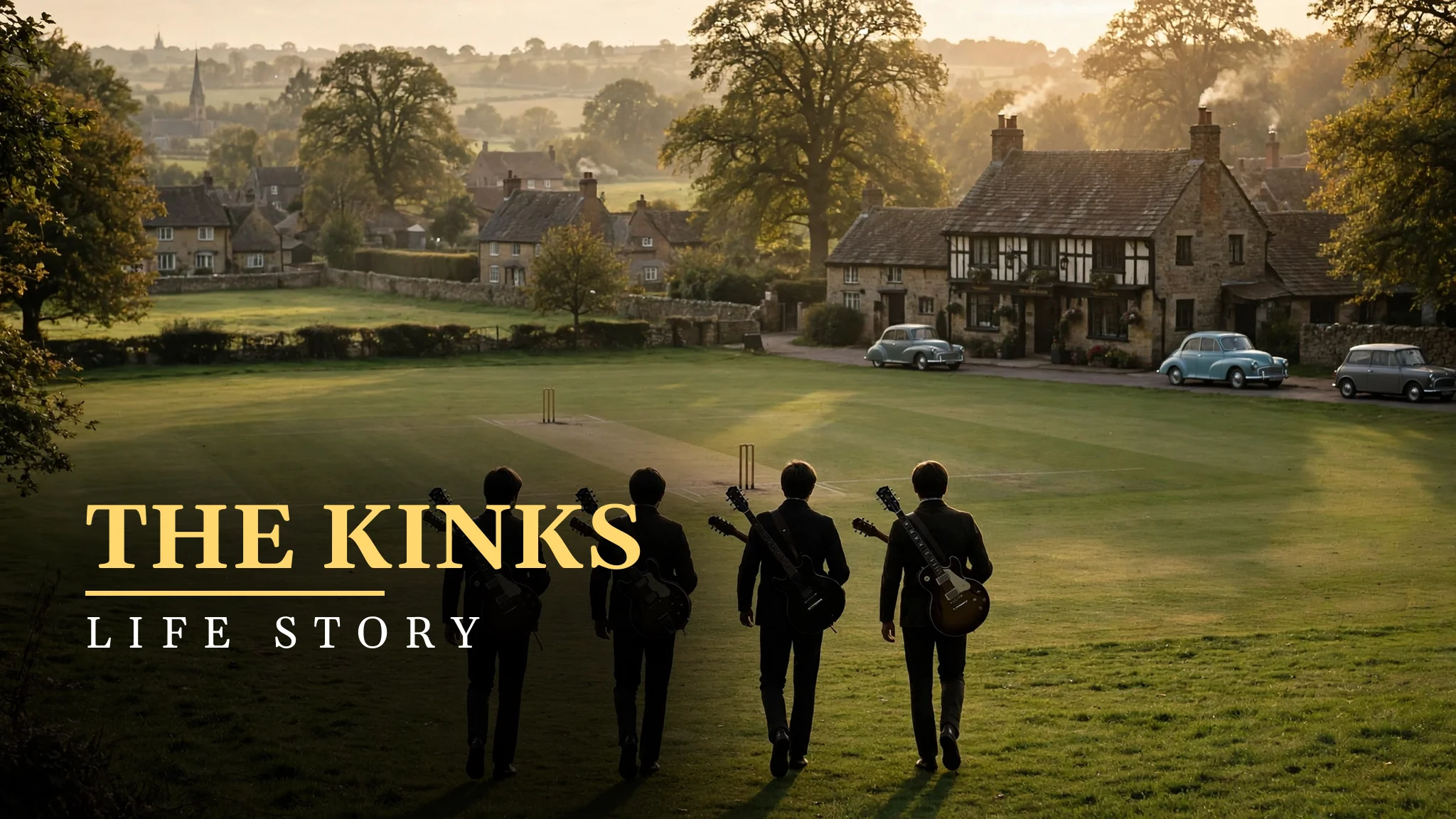
In 1968 The Kinks released The Kinks Are the Village Green Preservation Society, an album about English village life, about old customs, about cricket, about tea, and about a world that was disappearing. The album did not sell well at the time, and many people ignored it. But over the years it became one of the most loved albums in British music. Fans and critics now call it a masterpiece, a quiet and thoughtful record that captured a side of England that other bands ignored. The album was a commercial failure and an artistic triumph, and that contradiction would follow The Kinks for much of their career.
The band also released the album Arthur, in 1969, which told the story of a man who leaves Britain for Australia, and the album Lola Versus Powerman and the Moneygoround, Part One, in 1970, which included the hit Lola. Lola was a bold song about a man who meets a woman in a club in Soho and discovers that she is not who he thought she was. The song was funny, catchy, and brave for its time, and it became a hit in Britain and America. It also helped to end the American ban, because the band were able to tour America again after years away.
Lola, America Again, and a New Audience
The 1970s were a mixed time for The Kinks. They toured America again, and they built a loyal following there, especially among college students and rock fans who loved their songs and their attitude. They released albums that mixed rock, theatre, and storytelling, including Muswell Hillbillies in 1971, which was a warm and funny record about London life, and Preservation Act 1 and Preservation Act 2, which were ambitious theatre pieces that did not sell as well as the band had hoped.
Ray Davies became more and more the leader of the band, writing the songs, planning the shows, and shaping the sound. Dave Davies continued to play guitar and to sing, and he also released solo work. Pete Quaife left the band in 1969 and was replaced by other bass players. Mick Avory stayed on drums for many years, but he and Dave Davies had a difficult relationship, and their arguments on stage became famous. The band was held together by the music, but the people inside it were often unhappy with each other.
Despite the problems, The Kinks kept making good records. In the late 1970s they signed to a new record label in America, and they had a run of successful albums that brought them a new, younger audience. Sleepwalker in 1977, Misfits in 1978, and Low Budget in 1979 all did well in America, and the band toured large venues there. They were no longer a 1960s band living on old hits. They were a working rock band with a loyal following and a reputation for great live shows.
In 1983 they had one of their biggest late hits with Come Dancing, a song that reached the top ten in Britain and America. The song was a tribute to Ray and Dave’s sisters and to the dance halls of their youth, and it was warm, catchy, and full of memory. It brought The Kinks back to the charts after many years, and it introduced them to a new generation of listeners who had not been born when You Really Got Me was released.
Arguments, Splits, and a Long Silence
By the 1990s, The Kinks were tired. Ray and Dave Davies had been arguing for decades, and the arguments had not got easier with age. They disagreed about music, about money, about the direction of the band, and about old wounds that had never healed. Mick Avory had left in 1984, and other musicians had come and gone. The band continued to record and to tour, but the energy was fading, and the brothers were growing apart.
The Kinks released their last studio album, Phobia, in 1993, and they played their last concerts in 1996. After that, the band stopped. There was no formal announcement of a split, but there were no more albums and no more tours. Ray Davies worked on solo music and on other projects, including writing and theatre work. Dave Davies also worked on solo music, and he recovered from a stroke in 2004 that affected his health for a time. The brothers spoke about each other in public, sometimes kindly and sometimes angrily, and fans hoped for a reunion that never came.
The Kinks were inducted into the Rock and Roll Hall of Fame in 1990, which was a formal recognition of their importance. Their songs were covered by other artists, used in films and advertisements, and played on radio stations around the world. Younger bands, including Blur, Oasis, and many punk and indie groups, named The Kinks as a major influence. Ray Davies received awards and honours for his songwriting, including a CBE in Britain. The music had outlived the band, and it was still growing in reputation.
In the years that followed, Ray and Dave Davies occasionally spoke about the possibility of working together again. They recorded some music together, and they appeared on stage together at times, but a full reunion never happened. The brothers remained close in some ways and distant in others, and their relationship stayed complicated until the present day. Fans continue to hope, but they also accept that the story of The Kinks may already be complete.
What The Kinks Left Behind
The legacy of The Kinks is now clear. They were one of the great British bands, and their songs are part of the language of British music. You Really Got Me changed the sound of rock guitar. Waterloo Sunset is one of the most loved songs ever written about London. The Village Green Preservation Society is a quiet masterpiece about England. Lola is a bold and funny song that still sounds fresh. Come Dancing is a warm tribute to family and memory. These songs are different from each other, but they all come from the same gift, the gift of writing about real people in real places with honesty and humour.
Their influence is everywhere. Punk bands loved their directness and their anger. Britpop bands loved their Englishness and their melodies. Songwriters of all kinds have learned from Ray Davies, who showed that a pop song could be a short story, a character study, and a piece of social comment all at once. Dave Davies showed that a guitar could be loud, raw, and emotional, and that a simple riff could change music forever.
The Kinks also teach a lesson about success and failure. They were not always the most famous band, and they were not always the richest. They were banned from America, they argued with each other, and they made albums that few people bought at the time. But they kept going, and they kept writing, and the work they made has lasted longer than the work of many bands who were more famous in their day. That is a quiet kind of victory, and it is one that matters.
The Sound, the Sisters, and the Songs That Keep Growing
The Kinks’ sound was built on two things that belonged to the Davies brothers alone. Ray wrote words that sounded like short stories, full of small details about people, places, and feelings, and Dave played guitar with a raw, loud energy that gave those words a punch. That combination was unusual, because most bands of the time had either a good songwriter or a good guitarist, but not both in the same family. The Kinks had both, and the tension between Ray’s thoughtful writing and Dave’s wild playing made their music exciting. It was never smooth or safe. It was always a little rough around the edges, and that roughness was part of its charm.
Their sisters were also a central part of their story, and Ray wrote about them with love in Come Dancing. The Davies family had six sisters, and the house in Muswell Hill was full of music, dancing, and laughter. The sisters went to dance halls, they came home late, and they brought the music of the time into the house. Ray watched them, he listened to them, and he remembered those nights for the rest of his life. When he wrote Come Dancing in 1983, he was not just writing a pop song. He was writing a memory, a tribute to his sisters and to a time that had passed. That personal quality is why the song still moves listeners today.
The Kinks also had a relationship with their fans that was different from other bands. Their fans were not just teenagers who liked pop music. They were people who loved Ray’s writing, who recognised the places and the characters in his songs, and who felt that the band was singing about their own lives. Waterloo Sunset, for example, is a song about London, but it is also a song about any city where two people can find a quiet moment together. That universality is why the song has lasted, and why it is covered by new artists who discover it for the first time.
Their influence on later music is enormous, and it is worth talking about in detail. Punk bands loved The Kinks because they were direct, because they were angry, and because they wrote about real life. Britpop bands like Blur and Oasis loved them because they were English, because they wrote about British towns and British people, and because their melodies were strong and memorable. Songwriters of all kinds have learned from Ray Davies, who showed that a pop song could be a character study, a piece of social comment, and a beautiful melody all at once. That is a rare gift, and it is one that few songwriters possess.
The band’s albums also deserve more attention, because they were often ahead of their time. The Village Green Preservation Society, released in 1968, was ignored when it came out, but it is now regarded as a masterpiece. Arthur, released in 1969, told the story of a man who leaves Britain for Australia, and it was one of the first concept albums in rock. Muswell Hillbillies, released in 1971, was a warm and funny record about London life. These albums were not hits, but they were artistic triumphs, and they showed that The Kinks were willing to take risks, even when those risks did not pay off in the shops.
In the end, The Kinks’ sound, their family, and their influence are all part of the same story, a story about two brothers who made music that was honest, English, and lasting. Their songs are still played today, their albums are still discovered by new listeners, and their influence is still felt in the work of younger bands. That is a legacy that few bands achieve, and it is one that The Kinks earned through talent, through hard work, and through a refusal to be anything other than themselves.
My Take:
When I think about The Kinks, I think about two brothers who could not live with each other and could not work without each other. That is a very human situation, and it is one that many families will recognise. Ray and Dave Davies argued for decades, about music, about money, about old hurts. And yet, when they made music together, the result was something special. I find that both sad and inspiring. Sad, because the arguments cost them years of work together. Inspiring, because the music they did make was so good that it still matters sixty years later.
I love Waterloo Sunset more than almost any other song from the 1960s. It is a quiet song, and it does not shout for attention. It tells a small story about two people meeting at a station, and it paints a picture of London that feels true. When I listen to it, I can see the river, the station, and the sunset, and I can feel the calm of two people who are happy to be together. That is a rare gift in a pop song. Most songs try to be big and loud. Waterloo Sunset is small and gentle, and it is stronger because of that.
You Really Got Me is the opposite kind of song, and I love it for the opposite reason. It is loud, short, and direct, and it changed the sound of rock music. Dave Davies cut his amplifier speaker to get that distorted sound, and that simple, rough act created a guitar riff that people still play today. I admire that kind of boldness. He did not wait for permission, and he did not wait for better equipment. He used what he had, and he made it sound new. That is a lesson for anyone who wants to make something. You do not need perfect tools. You need a good idea and the courage to try it.
I also think a lot about the American ban, because it is one of the strangest parts of their story. At the very moment when British bands were becoming huge in America, The Kinks were banned from touring there for four years. The reasons were never fully clear, and the ban was never fully explained. It must have been frustrating and unfair. But Ray Davies turned that frustration into something good. He stopped writing for America, and he started writing about Britain, about village greens, about London, about ordinary people. Those songs are now his most loved work. Sometimes a closed door forces you to look in a new direction, and that new direction turns out to be the right one.
The Village Green Preservation Society is an album that I keep coming back to. When it was released in 1968, very few people bought it. It was a failure in the shops, and the band must have been disappointed. But over time, people discovered it, and they realised that it was a beautiful, thoughtful record. I find that story very hopeful. It says that good work does not always get recognised at once, and that it can wait. It says that a quiet album about English life can outlast loud albums that were hits for a few weeks. For anyone who makes something and feels ignored, that album is a reminder to keep going.
Lola is a song that I admire for its bravery. In 1970, it was not easy to write a funny, open song about meeting a person in a club and discovering that they are not who you expected. Many people would have avoided the subject, or they would have treated it as a joke in a cruel way. Ray Davies treated it with humour and with kindness, and he made a song that was catchy and human. It became a hit, and it is still played today. That tells me that audiences are more open than the music industry sometimes thinks, and that a song written with honesty will find its listeners.
Come Dancing is another song that moves me, because it is about family and memory. Ray wrote it about his sisters, who used to go dancing when he and Dave were boys. It is a song about growing up, about watching the people you love grow older, and about the music that ties a family together. When I hear it, I think about my own family, and about the songs that were played in my home when I was young. That is what good songwriting does. It takes one person’s memory and makes it feel like your own.
I also think about the arguments between Ray and Dave, and I feel sad about them. They are brothers, and they made great music together, but they could not stop fighting. I do not know the full story of their arguments, and I do not want to take sides, because I only know what has been reported in public. But I can say that it is a waste when talent is lost to anger. The Kinks could have made more music together, and they could have toured together for longer, if they had found a way to work through their differences. That they did not is a loss, not only for them but for their fans.
At the same time, I understand that some people cannot work together, even when they love each other. Brothers can be the hardest people to work with, because they know each other too well, and because old arguments never really go away. Ray and Dave knew each other from childhood, and they carried all of that history into the band. The music was better because they knew each other so well, and the arguments were worse for the same reason. That is a painful truth, and it is one that many families live with.
I admire Ray Davies as a songwriter more than almost any other British songwriter of his generation. He wrote about ordinary people with respect, and he wrote about England without making it sound like a postcard. His songs are full of detail, of small moments, of people waiting at stations, sitting in the sun, dancing in halls, and dreaming of a better life. He did not write about fame or about being a rock star. He wrote about life as most people live it, and that is why his songs still feel true today.
I also admire Dave Davies, because his guitar playing is often overlooked. People talk about Ray’s words, and they forget that Dave’s guitar gave the band its sound. Without Dave, You Really Got Me would not exist. Without Dave, the band would not have had the raw energy that made them different from other British groups. He was not just Ray’s younger brother. He was a musician in his own right, with his own style and his own voice, and he deserves to be remembered as one of the great guitar players of the 1960s.
One thing that stays with me is the way younger bands have honoured The Kinks. Blur, Oasis, and many punk and indie bands have said that The Kinks were a major influence. That is a special kind of success. It means that your music did not just sell records in your own time. It also taught the next generation how to write songs, how to play guitar, and how to be honest about where you come from. The Kinks did not just make hits. They made a path for others to follow, and that path is still being walked today.
If I have a criticism, it is that The Kinks were not always given the respect they deserved while they were active. They were often treated as a second-rank band, behind the Beatles and the Rolling Stones, and their albums were sometimes ignored. That was unfair, and it must have been frustrating for Ray and Dave. But time has corrected that mistake. Today, critics and fans place The Kinks among the greatest British bands, and their songs are taught, studied, and loved. That is a slow kind of justice, and it is one that I am glad to see.
In the end, I think The Kinks teach us that good work lasts, even when it is not recognised at once. Waterloo Sunset, You Really Got Me, Lola, and Come Dancing are songs that have survived sixty years, and they will survive for many more. They survive because they are honest, because they are well made, and because they speak about real life. Ray and Dave Davies may never fully agree with each other, but the music they made together agrees with itself, and it speaks to listeners in a clear and lasting voice. That is a legacy worth celebrating.
I also think about Pete Quaife, the bass player, because he is often forgotten in the story of The Kinks. He was there from the start, he played on You Really Got Me and on the early hits, and he gave the band a steady, reliable rhythm. He left in 1969, and his departure was a loss, because he was a key member of the original band. I think his contribution deserves to be remembered, because without him the band would not have had the sound that made them famous. He was not a star like Ray or Dave, but he was a musician who did his job well, and that matters.
Mick Avory’s drumming is another part of their sound that I admire, because he played with a steady, powerful style that held the band together, even when Ray and Dave were arguing. He stayed with the band for many years, from 1964 to 1984, and he played on most of their classic records. His relationship with Dave was difficult, and they argued on stage at times, but his playing was always strong. I respect him for staying as long as he did, and for giving the band a rhythm that it could rely on.
I think about the song Sunny Afternoon, because it is a funny song about a rich man who has lost his money, and it shows Ray’s gift for writing about characters in a few short lines. The song is lazy, it is humorous, and it is also a little sad, because the man in the song has lost everything and is sitting in the sun drinking. That mix of humour and sadness is typical of Ray’s writing, and it is why his songs are so memorable. He does not write about perfect people. He writes about real people, with real problems, and he does it with kindness and with wit.
Tired of Waiting for You is another song that I love, because it is a simple, beautiful ballad about waiting for someone you love. It reached number one in Britain, and it showed that The Kinks could write a love song as well as a rock song. The melody is gentle, the vocal is tender, and the whole song feels like a sigh. It is a reminder that Ray Davies was not only a rock songwriter. He was a songwriter who could write about love, about longing, and about the quiet moments in life, and he did it with great skill.
I also think about the album Arthur, because it is a concept album about a man who leaves Britain for Australia, and it is one of the first albums to tell a story in that way. It was not a hit, but it was an artistic achievement, and it showed that Ray was willing to take risks. He did not just want to write singles. He wanted to write albums that told stories, that had characters, and that meant something. That ambition is admirable, and it is one of the reasons why The Kinks are regarded as one of the great album bands of the 1960s.
The song Dead End Street is another favourite of mine, because it is about poverty, about a street where people have no hope, and about the struggle to survive. It is a serious song, and it shows Ray’s concern for ordinary people. He wrote about the poor, about the lonely, and about the forgotten, and he did it with respect. That is a rare quality in a pop songwriter, and it is why his songs still feel relevant today, when many people still live on dead end streets, in every country in the world.
I think about Dave Davies’ solo work as well, because he released music on his own, including the song Death of a Clown, which became a hit in 1967. That song showed that Dave was not just a guitarist. He was a songwriter and a singer in his own right, with his own voice and his own ideas. His solo work deserves more attention, because it shows a different side of The Kinks, a side that was more personal and more emotional. I admire him for trying to make music on his own, even while he was still in the band.
In the end, I come back to the idea that good work lasts, even when it is not recognised at once. The Kinks were not always the most famous band, and they were not always the richest, but their music has lasted for sixty years, and it will last for many more. Waterloo Sunset, You Really Got Me, Lola, and Come Dancing are songs that have survived, because they are honest, because they are well made, and because they speak about real life. That is a legacy worth celebrating, and it is one that Ray and Dave Davies created together, even when they could not agree on anything else.
Frequently Asked Questions
Who were the main members of The Kinks?
The Kinks were built around brothers Ray Davies, who wrote most of the songs and sang lead, and Dave Davies, who played lead guitar. Pete Quaife played bass in the early years, and Mick Avory played drums for many years, with other musicians joining later.
What made You Really Got Me so important?
You Really Got Me became a number one hit in 1964 with a loud, distorted guitar riff played by Dave Davies, who had cut his amplifier speaker to create the raw sound. The riff helped to shape the sound of rock guitar and influenced many later bands.
Why were The Kinks banned from touring America?
The Kinks were banned from performing in America from 1965 to 1969 after disputes during a 1965 tour involving promoters and the American musicians’ union. The ban kept them out of the United States at the height of the British Invasion, and it pushed Ray Davies to write more songs about British life.
What is Waterloo Sunset about?
Waterloo Sunset is a gentle song about two lovers, Terry and Julie, who meet at Waterloo Station in London and watch the sunset over the River Thames. It is widely regarded as one of Ray Davies’ finest songs and one of the greatest songs about London.
Why is The Village Green Preservation Society album so loved today?
The album, released in 1968, is a quiet and detailed portrait of English village life, old customs, and a world that was changing. It sold poorly at first, but over time fans and critics came to regard it as a masterpiece and one of the band’s finest works.
Did The Kinks ever reunite after they stopped in 1996?
The Kinks stopped touring and recording in 1996, and a full reunion has not happened, although Ray and Dave Davies have occasionally worked together and spoken about the possibility. Their music remains widely loved, and they were inducted into the Rock and Roll Hall of Fame in 1990.


