History and Meanings of Christmas Ornaments
In this post
- From Evergreens and Apples to the First Decorated Trees
- Glass Baubles: How a Craft Became a Christmas Industry
- Stars, Angels and the Tree Topper
- Colours and Shapes: What Baubles, Bells and Icicles Mean
- The Pickle, the Spider and Other Ornament Legends
- Heirlooms, Handmade Ornaments and Collecting Today
- Decorating with Meaning: How to Choose Ornaments for Your Tree
- My Take:
Every December, millions of people open a box of Christmas ornaments and, for a few happy hours, turn an ordinary tree into something glowing and personal. Inside that box are usually a mix of objects: shiny baubles, a star or an angel for the top, figures, ribbons, and at least one ornament that has survived for decades and carries a story. Those small objects look decorative, but they carry centuries of history, symbolism, and family memory. This guide traces where Christmas ornaments came from, what their most common shapes and colours mean, and how the tradition changed from handmade fruit and candles to glass baubles, mass production, and today’s keepsakes and collections.
It is worth saying at the start that ornament history is not a single straight line. Different countries developed different traditions, dates are often approximate, and some popular stories about ornaments are charming legends rather than proven history. Where a story is debated, this guide says so. That honesty does not spoil the tradition. It makes it richer, because it shows that ornaments were not invented once and frozen in time. They were shaped by craftspeople, traders, churches, families, and fashion, over hundreds of years, and they continue to change today. Understanding that history makes decorating a tree feel less like following a shop display and more like taking part in a long, living story.
A decorated tree is also a personal archive. Most families do not buy a whole new set of ornaments every year. They add one or two, keep favourites from childhood, and receive ornaments as gifts that mark weddings, births, travels, and other milestones. Over time, the tree becomes a timeline of a family’s life, told in glass, wood, and ribbon. That is why ornaments matter beyond their appearance. They are small, durable carriers of memory, and their history is partly the history of how ordinary people made a winter festival their own, one ornament at a time.
From Evergreens and Apples to the First Decorated Trees
Long before Christmas trees stood in living rooms, evergreen branches were used in winter celebrations in Europe as symbols of life continuing through the darkest months. Evergreens stay green when other plants lose their leaves, and that resilience made them a natural symbol of hope in winter. Early decorated trees are often associated with Germany, where trees were brought indoors and decorated in homes and churches from the 16th century onwards, although the exact first tree cannot be identified with certainty. Early decorations were simple and often edible: apples, nuts, paper roses, wafers, and sweets, hung on branches as both decoration and treats.
Apples were especially important, and their meaning is worth knowing. In medieval religious plays, a tree decorated with apples represented the Tree of Paradise, and red apples on a Christmas tree carried associations with that story as well as with fruitfulness and abundance. Over time, glassmakers began to make glass apples and balls as longer-lasting substitutes for real fruit, and those glass shapes gradually became the round baubles we know today. Candles were also added to early trees, their flames representing light in darkness, although they were, by modern standards, a serious fire risk, and families had to watch trees carefully and light candles only briefly. Electric lights, when they became available, made tree decoration far safer and allowed trees to glow for whole evenings.
The Christmas tree spread beyond Germany through royal and cultural connections. In Britain, the decorated tree became fashionable in the 19th century, helped by images of Queen Victoria and Prince Albert, who was German, celebrating Christmas with a decorated tree at home. In the United States, German immigrants brought the custom with them, and by the late 19th century, decorated trees were a familiar part of American Christmas. As the tree travelled, it absorbed local customs: different countries added their own foods, figures, and colours, so that a tree in one country might look quite different from a tree in another, even though the basic idea, an evergreen indoors, decorated for celebration, remained the same.
Glass Baubles: How a Craft Became a Christmas Industry
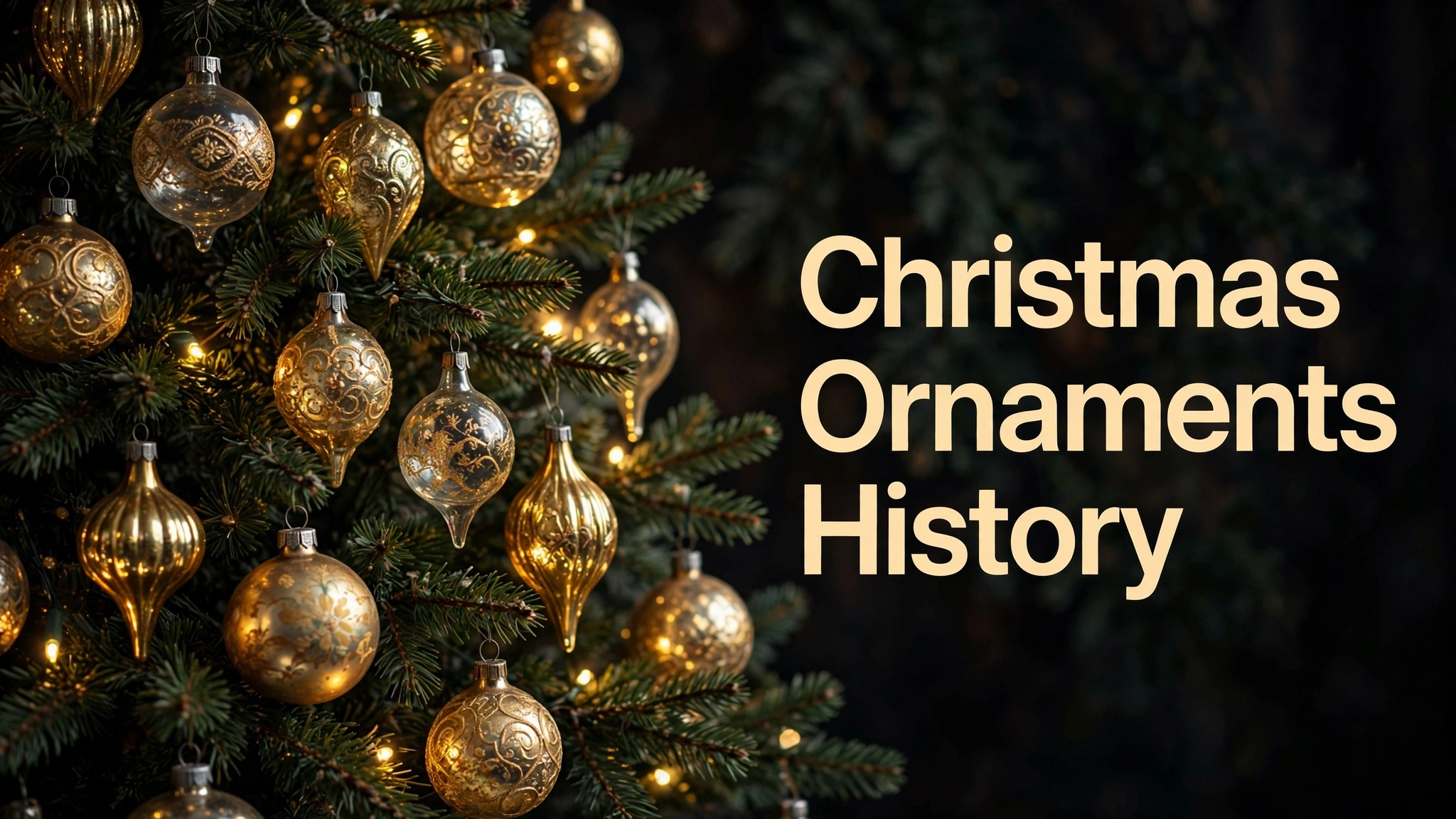
The glass bauble is the ornament most people picture first, and its history is closely tied to a small German town called Lauscha, in Thuringia, where glassblowing was an established craft. Glass ornaments from Lauscha became popular in the 19th century, as glassblowers made balls, fruits, and figures in shiny, colourful finishes, and traders exported them across Europe and to America. Early glass ornaments were mouth-blown and hand-painted, which made each one slightly different and gave them a quality that machine-made ornaments later struggled to match. Collectors still prize vintage Lauscha ornaments for that craftsmanship, and the town remains associated with glass Christmas ornament making today.
As demand grew, production expanded and changed. In the early 20th century, American retailers began importing large numbers of glass ornaments, and during and after the world wars, production shifted and diversified, with factories in several countries making ornaments in new materials, including plastic, which was cheaper, lighter, and safer for homes with children. Plastic baubles, often called shatterproof ornaments, made decorated trees accessible to far more families, and they allowed bold colours and large sizes that glass could not easily achieve. Purists sometimes prefer glass for its weight, shine, and tradition, while practical families prefer plastic for safety and durability. Both choices belong to the tradition, because the tradition has always balanced beauty with practicality.
Bauble shapes also multiplied over time. The classic round ball remains the most common, but teardrops, finials, onions, icicles, and figurative shapes such as birds, houses, and Father Christmas figures all became popular. Finials, the pointed ornaments often placed near the top of a tree, grew out of glassblowing skill, showing off the maker’s ability to shape delicate points and curves. Figurative ornaments allowed families to tell stories on their trees: a bird for nature, a house for home, a musical instrument for celebration. A tree decorated only with identical balls looks elegant, but a tree with varied shapes looks personal, and most families mix the two, using balls for colour and figures for character.
Stars, Angels and the Tree Topper
No ornament carries more meaning than the tree topper, the figure that crowns the tree. The two most traditional toppers are the star and the angel, and each tells a different part of the Christmas story. The star represents the Star of Bethlehem, which, in the biblical account, guided visitors to the birthplace of Jesus. A star topper therefore sits at the highest point of the tree, shining above everything else, as a symbol of guidance, hope, and light in darkness. Stars are made in many materials, from simple cardboard and paper to glass, metal, and illuminated plastic, and a light-up star topper often becomes the brightest point in a room on Christmas night.
The angel topper represents the angels of the Christmas story, who announced good news and sang of peace. An angel at the top of a tree emphasises the joyful, heavenly side of Christmas, and angel toppers are often dressed in white or gold, with wings spread and a gentle expression. In many families, the choice between star and angel is a tradition in itself, passed down through generations: one family always uses a star, another always uses an angel, and changing the topper would feel like changing the family’s Christmas. Some families use other toppers, such as a bow, a fairy, or a personal figure, and those choices are equally valid. The topper’s job is to complete the tree and to express what Christmas means to that household.
Below the topper, stars and angels also appear as hanging ornaments throughout the tree, often in gold, silver, or white. Small stars in particular are useful decorations because they catch light, fill gaps between larger baubles, and add sparkle without dominating the tree. Angels as hanging ornaments often appear as delicate figures with wings, sometimes made from glass, porcelain, or fabric, and they are popular as gifts, especially for christenings, weddings, and first Christmases. Whether at the top or among the branches, stars and angels remind decorators that ornaments were originally religious symbols before they became general festive decorations, and many families still value that religious meaning alongside the decorative one.
Colours and Shapes: What Baubles, Bells and Icicles Mean
Colour is one of the most expressive parts of ornament tradition, and each traditional colour carries associations that decorators use, consciously or not. Red is the most classic Christmas colour, associated with warmth, joy, and, in religious tradition, with love and sacrifice. Red baubles dominate many trees because they stand out against green branches and photograph beautifully in warm light. Gold represents light, richness, and celebration, and gold ornaments give a tree a warm, luxurious glow, especially when combined with warm-white lights. Silver represents winter, moonlight, and frost, and silver ornaments suit cooler, more modern tree styles, especially with white or blue lights.
Green, white, blue, and purple each add their own character. Green ornaments blend with the tree and create a natural, woodland feel, often paired with wooden ornaments and dried oranges. White and clear glass ornaments suggest snow, purity, and elegance, and they work well on flocked or white trees. Blue ornaments, especially deep blue and icy pale blue, evoke winter nights and are popular in contemporary and “winter wonderland” themes. Purple, historically associated with royalty and with the Advent season in some churches, appears less often but gives a tree a rich, distinctive look. There is no rule that a tree must use traditional colours. Modern trees in pink, black, copper, or mixed metallics are all part of today’s tradition, and the best colour scheme is usually the one that makes the household happy and suits the room.
Shapes also carry meaning. Bells represent the announcement of good news and the joy of church bells ringing at Christmas, and bell ornaments, whether glass, metal, or ceramic, add a musical association to the tree even when they do not ring. Icicles represent winter itself, hanging from branches like frozen water, and they catch light beautifully, adding a sense of cold sparkle. Hearts represent love and family, and heart ornaments are popular as gifts and keepsakes. Birds, especially doves, represent peace, while other birds recall the natural world in winter. Houses, churches, and cottages represent home and community. When families choose ornaments, they often choose shapes that reflect their values, memories, or interests, turning the tree into a small portrait of the household.
The Pickle, the Spider and Other Ornament Legends
Every tradition has legends, and Christmas ornaments have some of the best. The most famous is the Christmas pickle: a pickle-shaped ornament hidden in the tree, with the child who finds it on Christmas morning receiving an extra gift or being first to open presents. The story often told to explain it is that it is an old German custom, but researchers have found little evidence for a widespread German pickle tradition, and the more likely explanation is that the pickle ornament was popularised by American retailers in the late 19th century, with a charming origin story attached to help sell it. That does not make the pickle game less fun. It makes it a good example of how a marketing idea can become a genuine family tradition when families adopt it and pass it on.
Another beloved legend is the Christmas spider and its web, associated with Eastern European traditions, especially Ukrainian stories. In one version, a poor family could not decorate their tree, and spiders spun beautiful webs across it overnight, which turned to silver in the morning light. Families who tell this story sometimes hang a spider ornament or tinsel that represents a web, as a reminder of kindness, gratitude, and unexpected beauty. The story’s exact origins are folk tales rather than documented history, but its message resonates: that a tree made with love matters more than a tree made with money. Tinsel itself, thin strips of shiny metal or plastic hung on trees, is sometimes linked to this web story, although tinsel also developed as a way to mimic icicles and to catch candlelight and later electric light.
Other ornament legends include claims that certain ornaments were invented for specific reasons, such as striped candy canes as religious symbols, which are widely repeated but not firmly supported by historical evidence. The honest approach to these stories is to enjoy them as stories while recognising that their charm does not depend on their literal truth. Families who hide a pickle, hang a spider, or tell a story while decorating are keeping the storytelling side of Christmas alive, and that storytelling is itself a tradition worth preserving. A good rule for ornament legends is: enjoy the tale, share it with children as a tale, and do not worry if historians cannot prove every detail. The tradition lives in the telling, not in the footnote.
Heirlooms, Handmade Ornaments and Collecting Today
The most treasured ornaments in most homes are not the most expensive ones. They are heirlooms: ornaments that belonged to parents or grandparents, handmade ornaments from childhood, and ornaments received as gifts for special occasions. A fragile glass bauble from the 1950s, a salt-dough star made at school, or a wooden ornament carved by a relative carries a weight of memory that no new purchase can match. Families often have rituals for these ornaments: the oldest ornament is hung first, a particular ornament is always placed in a special spot, or children take turns hanging heirlooms while an adult tells the story behind each one. Those rituals turn decorating from a chore into a retelling of family history.
Handmade ornaments have also seen a revival in recent years, as people seek personal, sustainable, and affordable decorations. Dried orange slices, cinnamon sticks tied with ribbon, salt-dough shapes, felt figures, and wooden ornaments are all popular, and they suit homes that prefer a natural, rustic style. Handmade ornaments have practical advantages too: they are often cheaper, they can be made with children as a winter activity, and they can be composted or reused in ways that plastic cannot. They also make thoughtful gifts, because a handmade ornament carries the giver’s time and care. A tree decorated entirely with handmade ornaments may look less uniform than a shop-bought set, but it usually looks more loved, and that quality is visible to anyone who sees it.
Collecting ornaments is another modern tradition. Some people collect ornaments from every place they visit, building a tree that maps their travels. Others collect a particular type, such as birds, angels, or vintage glass, or buy one special ornament each year to mark the year. Limited-edition ornaments from heritage glassmakers, museums, and charities are popular with collectors, and vintage ornaments are traded online and at fairs. Collectors should store ornaments carefully, in divided boxes with tissue paper, away from damp and extreme heat, and should handle old glass ornaments gently, because replacement is often impossible. A collection built slowly, one ornament at a time, becomes a personal museum that can be enjoyed every December and passed on to the next generation.
Decorating with Meaning: How to Choose Ornaments for Your Tree
Choosing ornaments for a tree is easier when you start with a simple plan rather than buying everything at once. First, decide on a colour palette of two or three main colours, plus metallics, so that the tree looks coherent rather than chaotic. Second, mix sizes: large baubles for the lower, outer branches, medium ornaments for the middle, and small ornaments for the top and inner branches, where they add depth. Third, mix textures: shiny, matte, glittered, wooden, and fabric ornaments together create interest that a single finish cannot. Fourth, leave space for lights to show through. A tree packed so tightly with ornaments that no light escapes looks heavy, while a tree with breathing room glows warmly.
Sentimental ornaments should be given pride of place, not hidden behind newer purchases. If a family has heirlooms, hang them where they can be seen and talked about, even if their colours do not perfectly match the year’s palette. A tree that sacrifices memory for matching colours has lost something important. Children should also be allowed to hang some ornaments themselves, even if the result is not perfectly arranged. A tree decorated only by adults, to a professional standard, may look impressive, but a tree that children helped to decorate will be remembered more fondly. Perfection is not the goal of a family tree. Participation is.
Practical considerations also matter. Households with small children or pets often prefer shatterproof ornaments on lower branches, reserving fragile glass for higher branches out of reach. Homes with cats may need to secure the tree and avoid easily knocked-off ornaments at paw height. After Christmas, ornaments should be packed carefully, with fragile items wrapped individually and boxes labelled, so that next year’s decorating starts with joy rather than with broken glass. Taking a photograph of the finished tree each year is a simple way to remember arrangements and to track how the collection grows. Over time, those photographs become a record of the family’s Christmases, almost as valuable as the ornaments themselves.
My Take:
My opinion is that Christmas ornaments are the most underrated objects in the whole festive season, because they are small, quiet, and easy to dismiss as mere decoration, while in reality they carry more personal history than almost anything else in a home. A sofa is replaced, a television is upgraded, clothes wear out, but a glass bauble from a grandmother’s tree can survive for fifty years, travelling from house to house, being unwrapped every December by different hands, and still catching the light in the same way. That durability gives ornaments a power that larger, more expensive things do not have. They are proof that small things, kept with care, can outlast big things bought without thought, and I think that lesson applies far beyond Christmas.
I am also fond of the fact that ornament history is messy, with legends, marketing stories, and genuine folk customs all mixed together. Some people find that messiness disappointing, as if a tradition is only valuable when every detail can be proved. I take the opposite view. The pickle story is a good example: it may not be an ancient German custom, but it became a real family tradition because families enjoyed it, repeated it, and passed it on. That is how culture actually works. It is not handed down in a sealed package from history. It is made, remade, and sometimes invented by ordinary people who find something joyful and decide to keep it. I would rather celebrate a living, slightly invented tradition than preserve a perfectly documented one that nobody enjoys anymore.
On the question of glass versus plastic, my view is practical and unsentimental. I love old glass ornaments for their weight, their shine, and their craftsmanship, and I think a tree with some genuine glass has a quality that plastic cannot fully reproduce. But I also think insisting on glass everywhere is a mistake, especially in homes with small children, pets, or limited budgets. A broken glass ornament is not only a loss of an object; it is a safety hazard and, if the ornament was an heirloom, a source of real sadness. Shatterproof ornaments on lower branches and glass higher up is not a compromise to be ashamed of. It is sensible decorating, and it allows families to enjoy both beauty and peace of mind. The best tree is the one you can enjoy without anxiety, not the one that impresses a visitor for five minutes.
I have strong feelings about heirlooms, because I have seen how they work in families. When an adult unwraps an ornament their parent hung, and tells a child the story behind it, something important happens: the past becomes tangible. Children who might yawn at a family history lesson will listen intently to the story of a chipped angel or a faded bauble, because the object is in their hands. That is why I believe families should protect heirlooms deliberately: store them well, label them if necessary, and make sure the stories travel with them. An ornament without its story is just an old decoration. An ornament with its story is a piece of family history, and the difference is entirely in whether someone takes the time to tell it.
I am also a believer in handmade ornaments, not because they look better than shop-bought ones, which they often do not, but because making them is itself a winter activity worth doing. A family that spends an afternoon making salt-dough stars, drying orange slices, or painting wooden figures has done something together that buying a box of ornaments cannot replicate. The ornaments produced may be lopsided, the paint may be messy, and the tree may look less uniform, but the memories of making them will last longer than the ornaments themselves. In a season that often feels dominated by shopping, making something with your hands is a small act of resistance, and I think more families should try it, even if they only make one ornament a year.
On colour schemes and professional-looking trees, my advice is to relax. Social media has created a pressure for trees to look like magazine photographs, with perfect colour matching, professional ribbon, and not a single gap or cluttered branch. Those trees are beautiful to look at, but they can feel cold to live with, because they leave no room for the messy, sentimental ornaments that make a tree personal. A tree that matches perfectly but contains no memory is a display, not a family tree. I would always choose the tree with the school-made star, the chipped bauble, and the ornament from a holiday years ago, over a tree that looks perfect but means nothing. Perfection is for photographs. Memory is for homes.
Finally, I think ornaments teach us something about how to value things. In a culture that encourages constant buying and replacing, an ornament collection teaches the opposite: keep what matters, add slowly, repair when possible, and pass things on. A collection built over decades, one ornament at a time, is a rebuke to throwaway culture, and it is also a gift to the next generation, who will inherit not just objects but stories. When I think about what I would want to leave behind, it is not expensive furniture or the latest device. It is a box of ornaments, each with a story, that someone will unwrap next December and remember me by. That seems like a good legacy for a small, shiny object, and it is why I take Christmas ornaments far more seriously than their size suggests.
A final thought on buying: I would rather inherit one ornament with a story than buy twenty matching ones without any, and I think families should be honest about that when they shop each December. Shops want us to believe that a tree is finished only when every bauble matches this year’s trend, but a tree finished in that way will look dated next year and mean nothing the year after. A tree built slowly, with gifts, heirlooms, handmade pieces and one or two new favourites each year, never goes out of style because it was never following a style. It was following a family, and families, unlike trends, do not expire. Buy less, keep more, and let the box grow the way memories grow: one meaningful piece at a time.
Frequently Asked Questions
Where did Christmas ornaments originally come from?
Early decorated trees are often associated with Germany, where trees were decorated with apples, nuts, sweets and candles from the 16th century onwards. Glass ornaments later developed through glassblowing traditions, notably in Lauscha, Germany, and spread internationally through trade and migration.
What do the star and angel tree toppers mean?
The star represents the Star of Bethlehem, symbolising guidance and hope, while the angel represents the angels of the Christmas story, symbolising good news and peace. Many families keep one or the other as a long-standing tradition.
Is the Christmas pickle really an old German tradition?
Probably not as commonly told. Researchers have found little evidence for a widespread old German pickle custom, and the pickle ornament was more likely popularised by American retailers, with an appealing origin story attached. Many families still enjoy the pickle game as a fun modern tradition.
What do different Christmas ornament colours mean?
Red is associated with warmth and joy, gold with light and celebration, silver with winter and frost, green with nature, white with snow and elegance, and blue with winter nights. These are traditional associations rather than strict rules, and modern trees use many other colours too.
Should I choose glass or plastic ornaments?
Glass ornaments offer traditional shine and craftsmanship but break easily, while plastic ornaments are lighter, cheaper and safer for homes with children or pets. Many families mix both, placing shatterproof ornaments low and fragile glass higher up.
How should I store Christmas ornaments safely?
Store ornaments in divided boxes with tissue paper, wrap fragile glass individually, keep boxes away from damp and extreme heat, and label them clearly. Careful storage protects heirlooms and makes next year’s decorating easier and more enjoyable.