How Japan Celebrates Christmas 2026
In this post
Christmas in Japan looks familiar at first glance and then quietly surprises you. There are trees, lights, songs, and gifts, yet the holiday does not carry the same religious or family-home meaning it has in many Western countries. Japan is not a majority Christian country, and Christmas Day itself is not a national public holiday. Instead, Christmas has grown into a bright, romantic, commercial, and social season, shaped by department stores, bakeries, restaurants, and city light displays. Understanding that difference is the key to understanding Japanese Christmas: it is less about a single day at home, and more about a whole festive atmosphere in cities, shops, and relationships.
The season usually begins in November, when illuminations appear in shopping districts, stations, and parks. Trees are raised in malls, music plays in stores, and limited-edition cakes, sweets, and gifts appear on shelves. Many people still work or study on 25 December, so celebrations often happen on Christmas Eve, on a nearby weekend, or in the evenings after work. That timing gives Japanese Christmas a distinctive rhythm: daytime normality, followed by an evening that feels deliberately special, whether that means a dinner for two, a party with friends, or a walk through lights with family.
Visitors often ask whether Japanese Christmas is authentic. That question misses the point. Every country adapts Christmas to its own culture, climate, and calendar. In Japan, the adaptation has produced traditions that are now deeply local, from strawberry shortcake to a particular fried chicken dinner, and from illuminations as a major attraction to Christmas as a date night. These customs may have commercial roots, but after decades of repetition they carry real memory and meaning for the people who practise them. A tradition does not need ancient origins to matter; it needs people who look forward to it, and Japan has that in abundance.
Illuminations and the Winter City
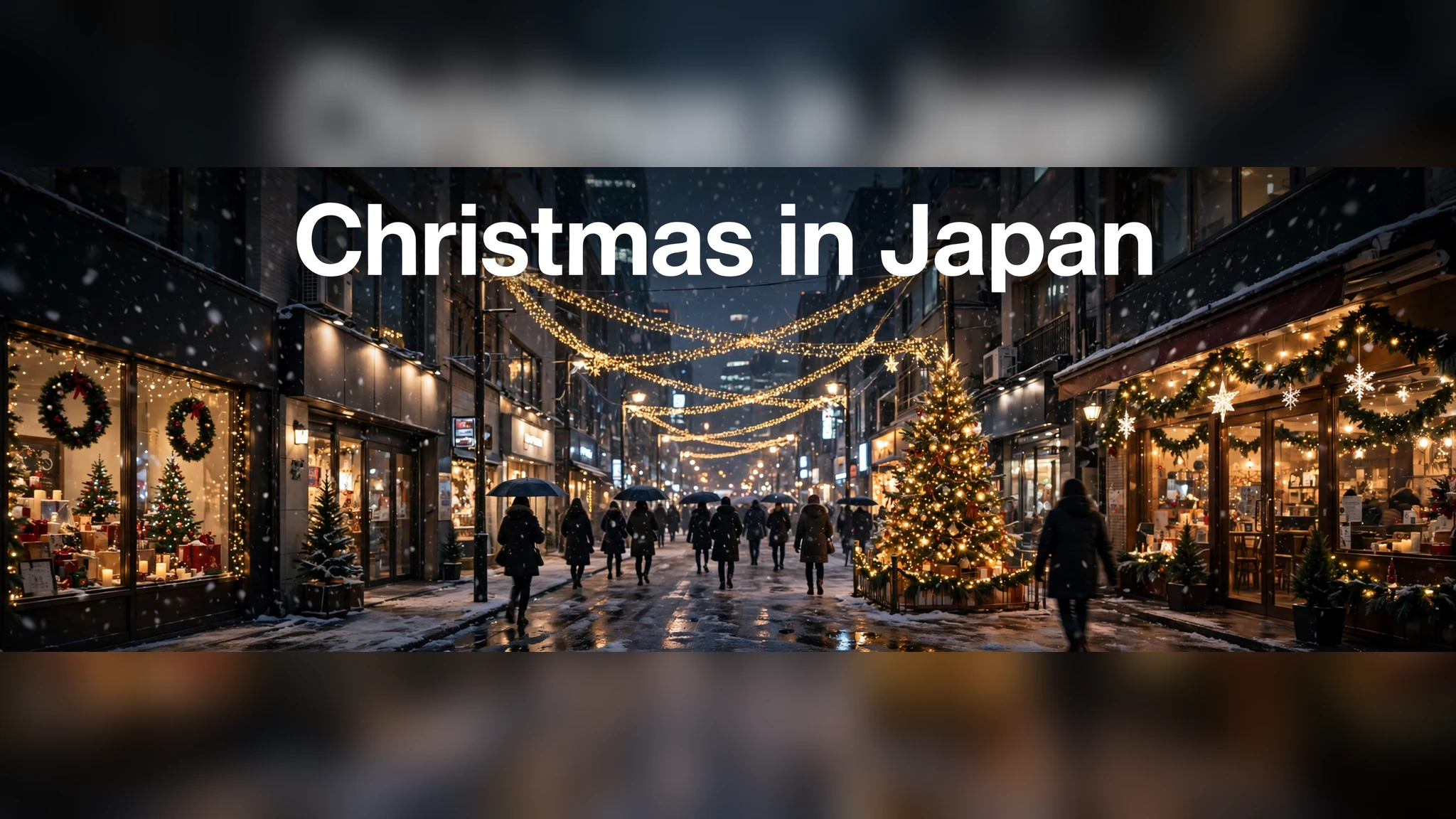
Illuminations, known in Japan as iruminēshon, are the most spectacular part of the season. Major cities turn shopping streets, station areas, parks, and waterfronts into light displays that draw large evening crowds. Tokyo areas such as Marunouchi, Shibuya, Roppongi, and Shinjuku are famous for elaborate displays, while other cities, including Osaka, Kobe, and Sapporo, have their own well-known events. Some displays use millions of small lights, arranged in tunnels, trees, arches, and themed scenes. Walking through them has become a seasonal outing in itself, similar to visiting a festival, rather than merely background decoration while shopping.
The scale and organisation of illuminations reflect Japanese urban culture. Displays are carefully timed, often running from November into January, and many are free to view. Crowds are managed, photographs are expected, and nearby shops and cafes benefit from evening visitors. Couples, friends, and families plan illumination walks as a main activity, sometimes travelling to another district specifically for a famous display. For visitors, the best approach is to arrive early in the evening, dress warmly, and check local listings for dates, because displays vary by year and location, and popular spots become crowded closer to Christmas Eve.
Illuminations also show how Christmas in Japan is a public, outdoor celebration. In many Western countries, the most important Christmas lights are on private homes. In Japan, the most impressive lights are usually public and commercial, in city centres where people gather. That difference shapes the feeling of the season: less private and domestic, more shared and urban. A person who has never seen a Japanese illumination may be surprised by how central lights are to the celebration, but once they walk through a glowing street on a cold night, the appeal becomes immediately clear, regardless of background or belief.
Christmas Cake, Fried Chicken and Festive Food
No discussion of Japanese Christmas is complete without Christmas cake. The classic Japanese Christmas cake is a light sponge cake layered with whipped cream and topped with strawberries, often decorated simply and elegantly. It is quite different from the dense, dark fruit cake associated with Christmas in Britain or North America. In Japan, the strawberry shortcake style became the standard festive cake, sold by bakeries, department stores, and convenience stores in many sizes, from small cakes for two people to larger cakes for families. Ordering in advance is common, especially for popular bakeries, and cakes are often collected on Christmas Eve.
The other famous food tradition is fried chicken, most famously associated with a fast-food chain whose Christmas campaign became a cultural phenomenon. The story, often repeated, is that the chain marketed a Christmas chicken dinner in the 1970s, and the idea caught on so strongly that many families now order fried chicken for Christmas Eve. Whether a family chooses that chain or another restaurant, the broader point is clear: a special takeaway meal has become a normal Christmas dinner for many households, especially where cooking a large roast at home is less practical. Some families still cook at home, but the idea of Christmas as a meal that can be ordered, collected, and enjoyed without a long day in the kitchen is widely accepted.
Other festive foods include roast chicken, pizza, sushi platters for parties, and seasonal sweets such as chocolate, biscuits, and limited-edition desserts. Department store food halls offer elaborate party sets, and convenience stores sell small Christmas items for people celebrating alone or with a partner. Drinks, sparkling wine, and festive soft drinks also appear in seasonal packaging. The variety reflects modern Japanese life: households differ in size, budget, and cooking time, so Christmas food has adapted to fit those realities rather than demanding one traditional menu. That flexibility is one reason the season feels accessible to so many people.
Christmas Eve, Couples and Gift Giving
Christmas Eve holds special importance in Japan, particularly for couples. For many young adults, Christmas Eve is closer to a romantic occasion, similar in feeling to Valentine’s Day, than to a family holiday. Couples may book a dinner, exchange gifts, walk through illuminations, or stay in a hotel. Restaurants often offer special Christmas menus, and popular venues require booking well in advance. This romantic character surprises some visitors who expect Christmas to be mainly about children and extended family, but it is a well-established part of modern Japanese Christmas culture.
Gift giving also follows a different pattern. Children may receive gifts from parents, and partners often exchange presents, but the large extended-family gift exchange common in some Western countries is less central. Many adults focus on one thoughtful gift for a partner or a close friend, rather than many gifts for many relatives. Department stores and online shops promote gift guides for partners, and small luxury items, accessories, and sweets are popular. For families with children, Santa Claus is a familiar figure, and children may receive gifts on Christmas Eve or Christmas morning, though the surrounding customs, such as stockings or a large family dinner, vary by household.
Friends also celebrate together, often through parties at home, in restaurants, or at karaoke venues. Office parties and school events may take place in December, though they are not necessarily tied to Christmas itself. The social calendar in December is busy, with year-end parties, known as bōnenkai, overlapping with Christmas events. That overlap means December can feel festive for weeks, with different gatherings serving different groups: colleagues, friends, couples, and family, each with its own style. A visitor who understands this social layer will see Japanese Christmas not as a single event, but as a season of overlapping celebrations.
Family, Children and Christmas Day Itself
For families with young children, Christmas in Japan often blends imported customs with local habits. A tree at home, decorations, Santa gifts, and a special cake are common, even if the family does not celebrate Christmas religiously. Children may learn Christmas songs at school or kindergarten, make decorations in class, and look forward to a cake and a present. Parents may keep the celebration modest and focused on the evening of 24 December, because the next day is usually a normal working day. That practical limit does not reduce excitement for children, who often remember the cake, the lights, and the gift more than the date itself.
Christmas Day, 25 December, is generally a normal weekday in Japan, unless it falls on a weekend. Shops, offices, and schools operate as usual in many cases, though some people take time off. Decorations may remain for a few days, but the festive season quickly gives way to preparations for the New Year, which is the most important traditional holiday in Japan. New Year involves family gatherings, special foods, shrine visits, and a period of closure for many businesses. In that calendar, Christmas functions as a bright prelude to New Year, rather than the main holiday itself, and that position explains why Christmas decorations often disappear quickly after 25 December.
Religious observance does exist, but it is a smaller part of public Christmas culture. Churches hold services, and Christian communities celebrate Christmas religiously, but they represent a minority of the population. For most people, Christmas is a cultural and seasonal event, not a religious obligation. That distinction is important for visitors to respect: enjoying lights, cake, and gifts does not imply a religious claim, and assuming that every Japanese person celebrates Christmas in a Western religious way would be inaccurate. Japanese Christmas is best understood on its own terms, as a modern, urban, and social festival that has been adapted to Japanese life.
What Visitors Should Know for Christmas 2026
Visitors planning a December trip to Japan should plan around crowds, bookings, and weather. Popular illumination spots, restaurants, and hotels are busiest on Christmas Eve and the weekends before Christmas. Booking restaurants and accommodation early is wise, especially for couples seeking a special dinner. Dress warmly, because evening illumination walks involve standing outdoors, and northern cities such as Sapporo can be very cold and snowy, while Tokyo and Osaka are cold but usually less extreme. Comfortable shoes matter, because illumination areas often involve considerable walking.
Shopping is another major part of the season. Department stores offer Christmas displays, gift wrapping, and seasonal food halls, while smaller shops sell local crafts and sweets. Visitors looking for a Japanese Christmas cake should order or buy early on Christmas Eve, because popular cakes sell out. Those who want fried chicken for Christmas Eve should also consider ordering in advance if they plan to follow that tradition, because queues and pre-orders are common. Carrying cash and cards, checking store hours, and confirming event dates through official local listings will prevent disappointment, since displays and opening times can change from year to year.
Finally, visitors should enjoy Japanese Christmas without expecting it to mirror their own traditions exactly. The pleasure lies in the differences: a strawberry cake instead of fruit cake, a city light tunnel instead of a home display, a romantic evening instead of a large family lunch, and a season that flows naturally into New Year preparations. Those differences are not a lesser version of Christmas. They are evidence of how a global festival can be remade by a different culture into something distinctive, joyful, and deeply local. A visitor who approaches Japanese Christmas with curiosity rather than comparison will leave with a richer understanding of both Japan and the festival itself.
Christmas Shopping, Displays and Seasonal Food Halls
Shopping is inseparable from Japanese Christmas, not because the holiday is only commercial, but because department stores have become part of its public stage. Large stores in Tokyo, Osaka, and other cities create elaborate window displays, indoor trees, and themed floors, with music, lights, and seasonal products arranged to invite browsing rather than hurried buying. Gift guides focus on partners, friends, and small luxury items, while food halls on basement floors offer cakes, party sets, chocolates, and seasonal sweets in beautiful packaging. For many visitors, wandering a department store food hall in December is as memorable as visiting an illumination, because it shows how food, design, and celebration combine in Japanese urban life.
Seasonal products also reveal how Japanese retail adapts to a short, intense season. Limited-edition cakes, chocolates, and drinks appear for a few weeks, then disappear, creating a sense of occasion that encourages people to try something new rather than buy the same item all year. Convenience stores play a surprising role, selling small cakes, fried chicken sets, and festive snacks for people celebrating alone, with a partner, or in a small household. That accessibility matters: a person living alone can still mark Christmas Eve with a small cake and a special meal, without needing a large family gathering or an expensive restaurant booking. The retail system, in this sense, supports inclusion, not just consumption.
For visitors, shopping wisely means planning around crowds and sell-outs. Popular cakes and party sets should be ordered early, especially from famous bakeries, and department store food halls are busiest in the late afternoon and evening before Christmas Eve. Morning visits are often calmer and offer better choice. Gift wrapping in Japan is famously careful, with paper, ribbon, and bags chosen to suit the occasion, and many stores offer wrapping as a service. Accepting that wrapping, rather than rushing, is part of the experience, and it turns a purchase into a present. A visitor who shops with patience, curiosity, and an eye for small seasonal items will understand Japanese Christmas retail not as a tourist trap, but as a cultural display in its own right.
My Take:
I find Japanese Christmas genuinely refreshing, because it shows that a festival does not need to be copied exactly to be meaningful. Too often, discussions about Christmas abroad turn into a checklist: does this country have the right dinner, the right tree, the right family gathering? Japan fails that checklist in several places, yet it passes a more important test: do people look forward to it, plan for it, and remember it fondly? The answer is clearly yes. Illuminations, cakes, and Christmas Eve dinners have become part of many people’s December, not because they were imposed, but because they were adapted, repeated, and made personal over decades. That, to me, is how traditions actually form, and Japan is a good example of it happening in living memory.
My strongest opinion is about the romantic character of Japanese Christmas Eve. Some visitors find it strange that Christmas Eve is a date night, but I think it reveals something interesting about how societies assign meaning to dates. In many Western countries, Christmas is anchored to family and childhood, so an adult couple celebrating alone can feel unusual. In Japan, where New Year carries the main family weight, Christmas Eve was free to become something else, and couples claimed it. That is not a distortion of Christmas. It is a division of labour between festivals: New Year for family and tradition, Christmas for romance, lights, and urban celebration. Once you see that balance, Japanese Christmas stops looking incomplete and starts looking well organised.
I also think illuminations deserve more attention than they usually receive in Western writing about Japan. They are often treated as mere shopping decoration, but for many people they are the main event, a reason to travel, dress up, and spend an evening outdoors with someone they care about. In a country where public space is used intensively and cities are dense, a well-designed light display creates a shared, temporary beauty that belongs to everyone who walks through it, regardless of income or background. That public quality matters. Private home displays can be beautiful, but they are seen mainly by neighbours. Japanese illuminations are deliberately public, and that openness gives the season a democratic, city-wide feeling that I admire.
Another belief I hold is that the famous fried chicken tradition should not be reduced to a joke. It is easy to laugh at a fast-food Christmas dinner, but laughter misses the social reality behind it. Many households do not have the time, space, or tradition of cooking a large roast, and a shared takeaway meal that everyone enjoys is a sensible, joyful solution. The fact that a marketing campaign started it does not make the resulting family memory fake. Many traditions began with a shop, a song, or a product, and then outgrew their commercial origin because people invested them with personal meaning. Judging a tradition only by its origin, rather than by what it means to the people who practise it now, is a narrow way to understand culture.
I also feel that visitors should resist the urge to rank Christmases. There is no single correct Christmas, and Japan does not need to be measured against Britain, America, or any other country to be valid. The strawberry cake is not a failed fruit cake; it is a different cake that suits Japanese tastes for light, fresh, and visually elegant desserts. The working Christmas Day is not a failed holiday; it reflects a calendar in which New Year is the main break. A visitor who arrives expecting a replica of home will be disappointed, but a visitor who arrives expecting Japan will be delighted. That openness is the most useful attitude for travel in general, not just at Christmas.
Finally, I think Japanese Christmas offers a useful lesson for anyone who feels their own festive season has become stressful or rigid. Japan shows that a festival can be reshaped to fit modern life: smaller households, busy work schedules, city living, and diverse beliefs. It keeps the joyful parts — lights, sweet food, gifts, time with loved ones — and drops the parts that do not fit, without apology. That flexibility is not a loss of tradition. It is tradition doing what it has always done: adapting to survive. If more festive writing recognised that adaptation as creativity rather than dilution, we would understand Christmas, and culture in general, far better, and we would enjoy December a great deal more.
I also want to note how Japanese Christmas handles scale. A small cake for two, a single fried chicken set for a small household, and a short illumination walk for a couple are all complete celebrations, not scaled-down versions of a larger ideal. That acceptance of small-scale celebration is valuable, especially for people living alone, in small flats, or far from family. In many Western Christmas narratives, a proper Christmas requires a large house, a large family, and a large meal, which can make smaller celebrations feel inadequate. Japan shows that a celebration can be small, urban, and commercial, and still feel special, because the people involved chose it deliberately and enjoyed it fully. Small is not lesser; small is often more sustainable, more affordable, and more honest about modern life.
There is also a lesson here about how festivals travel. Christmas did not arrive in Japan as a complete package and stay unchanged; it was translated, through shops, media, and social habits, into something Japanese. That translation involved loss — some religious and family elements faded — but it also involved invention, creating new customs that now feel traditional to those who practise them. The same process happens everywhere: festivals migrate, adapt, and become local, and that process should be studied with curiosity, not judged as authenticity or inauthenticity. A festival that adapts is a festival that lives, and Japanese Christmas, with its lights, cakes, and romantic evenings, is very much alive, even if it looks different from the Christmas of another country.
One final thought: a visitor who walks through a Japanese illumination, eats a strawberry cake, and shares a quiet Christmas Eve dinner will have experienced a complete festive season, even without a large family lunch or a day off work. That completeness, on a different pattern, is worth remembering when we judge other countries’ holidays. Festivals do not need to match our own to be whole, and recognising that wholeness is a form of respect, as well as a pleasure for the traveller who is willing to look closely.
Frequently Asked Questions
Is Christmas a public holiday in Japan? No, Christmas Day is not a national public holiday in Japan. Most people work or study on 25 December, so celebrations often happen on Christmas Eve or a nearby weekend evening.
What is a Japanese Christmas cake? It is usually a light sponge cake with whipped cream and strawberries, quite different from dense Western fruit cake. Bakeries and department stores sell many sizes, and popular cakes are often ordered in advance.
Why do people in Japan eat fried chicken at Christmas? A famous fast-food Christmas campaign in the 1970s helped make fried chicken a popular Christmas Eve meal. Many families now order fried chicken or another special takeaway as a convenient festive dinner.
What are Japanese Christmas illuminations? Illuminations are large public light displays in city centres, parks, and shopping districts, running from November into January. They are a major seasonal attraction and a popular evening outing for couples, friends, and families.
Is Christmas Eve more important than Christmas Day in Japan? For many adults, yes. Christmas Eve is often a romantic evening for couples, with dinner, gifts, and illuminations, while Christmas Day itself is usually a normal working day.
Do Japanese families celebrate Christmas religiously? Some Christian families do, but for most people Christmas is a cultural and social season rather than a religious holiday. New Year remains the most important traditional family holiday in Japan.