Country Ruled By Two Princes
In this post
- The Job Advertisement Nobody Ever Posted
- Meet the Two People Sharing the Job
- How Did a Bishop and a Count End Up Sharing a Country?
- What Do the Co-Princes Actually Do All Day?
- So Who Really Runs Andorra?
- The Small Print: Hams, Chickens and a Man Who Declared Himself King
- A Job-Share That Refuses to Retire
- Sources
The Job Advertisement Nobody Ever Posted
Imagine a job advertisement like this:
Wanted: Prince of a small European country. Duties: be head of state. Hours: very part-time. Office: you will not live in the country you rule. One important detail: you must share the job, at all times, with a second prince — and the two of you must agree, because neither of you can act alone.
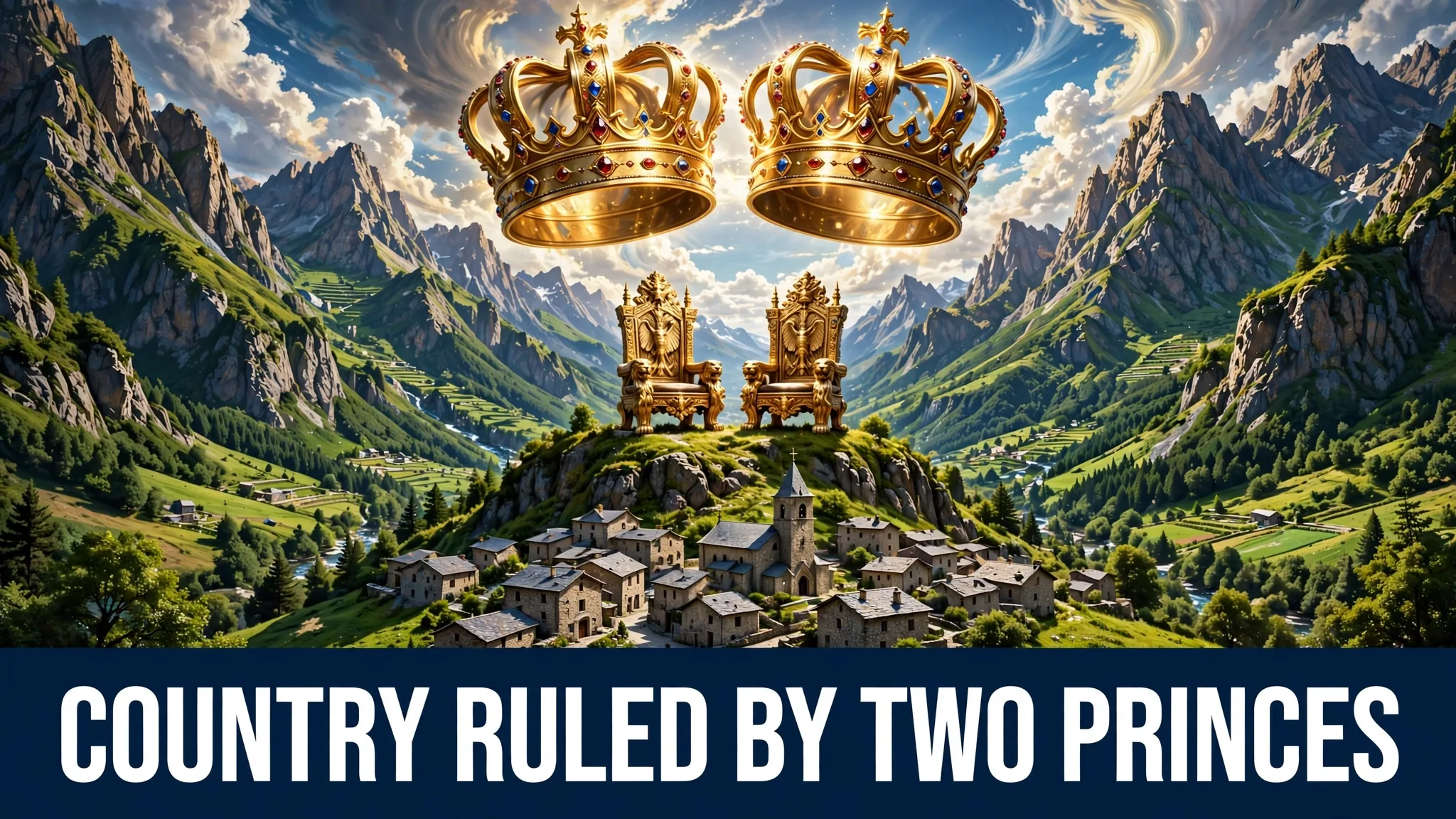
It sounds like a joke. It is, in fact, a real job description, and it belongs to Andorra, a tiny country hiding in the Pyrenees mountains between France and Spain. Andorra covers just 468 square kilometres and is home to around 80,000 people. Its official language is Catalan — in fact, it is the only country in the world where Catalan is the sole official language. And this small, mountainous nation has not one head of state, but two: a Spanish bishop and the President of France.
Welcome to the world’s longest-running job-share. It has been going, in one form or another, for more than 700 years.
Meet the Two People Sharing the Job
The first co-prince is the Bishop of Urgell, a Catholic bishop whose seat is in La Seu d’Urgell, a town in Spain, a short drive from the Andorran border. The current bishop, Josep-Lluís Serrano Pentinat, took the role in May 2025. He is chosen by the Pope, as bishops are — but the moment he becomes Bishop of Urgell, he automatically becomes a prince of Andorra too. Nobody in Andorra votes for him. The job simply comes with the bishop’s chair.
The second co-prince is even more surprising. It is the President of France. Today that means Emmanuel Macron, president since 2017, who governs a large republic from the Élysée Palace in Paris — and who is, at exactly the same time, a prince of little Andorra. When France elects a new president, Andorra automatically gets a new co-prince, without a single Andorran ballot being cast.
Pause and enjoy that thought. A president elected to lead a modern republic wakes up to find he is also royalty in the country next door. Andorra is believed to be the only country on Earth whose heads of state are two foreign nationals, and neither of them lives in the country they head.
How Did a Bishop and a Count End Up Sharing a Country?
The job-share began with a quarrel. By the 1200s, two lords both claimed power over the Andorran valleys: the Bishop of Urgell, who had held rights there for centuries, and the Count of Foix, a powerful French noble whose family had married into the region. Their dispute kept flaring into conflict, and the valleys in the middle suffered for it.
In 1278, King Peter III of Aragon stepped in as a judge between them, and the two rivals signed an agreement called a paréage — a medieval deal for sharing rule over the same land. The bishop and the count would govern together. Neither could act alone. Andorra would pay tribute to them in turn, one at a time, alternating. A second paréage in 1288 confirmed and strengthened the deal.
Neither man could have guessed what he was starting. That handshake in 1278 is still, at its heart, how Andorra is governed today.
The bishop’s side of the bargain simply stayed in the church. The count’s side went on a long journey. The rights of the Counts of Foix passed by marriage and inheritance to the kings of Navarre, and when Henry III of Navarre became King Henry IV of France, the Andorran title became tied to the French crown forever. From then on, the French head of state — king, emperor, or president — has been co-prince of Andorra. The system survived revolutions, republics and world wars. France threw away its kings, but it kept its little second job in the mountains.
For me, there is something quietly wonderful in that origin story: two strong neighbours, instead of fighting over a small valley until one of them swallowed it, agreed to share the keys — and because neither could grab the whole thing, the little country between them survived.
What Do the Co-Princes Actually Do All Day?
Very little governing, as it turns out — and that is exactly the point.
For centuries the arrangement was feudal and vague, but in March 1993 the Andorran people approved their first written constitution in a referendum. It kept the two co-princes as joint heads of state, in what it calls a “parliamentary co-principality,” and carefully wrote down what the princes may and may not do.
The co-princes formally sanction and enact the laws passed by Andorra’s parliament. They appoint the head of government whom parliament has elected. They can call elections and referendums, receive the credentials of foreign ambassadors, and formally agree to international treaties. Working together, they share the power to pardon criminals. Each co-prince may appoint one member of the country’s top judicial council and one member of its Constitutional Tribunal. Each also appoints a personal representative who lives in Andorra and handles princely business on the ground, and each receives an annual allowance from the Andorran parliament to run their princely offices.
But the limits matter more than the powers. The co-princes have no veto over laws properly passed by the elected parliament. Most of their official acts need the countersignature of Andorra’s head of government or the speaker of parliament, who carry the real legal responsibility. They are heads of state the way a chairman opens a meeting: with dignity, with a signature, and without running the company.
The arrangement produces at least one delightful piece of paperwork. When France sends an ambassador to Andorra, the letters of credence are, in effect, signed by the French president twice — once as the sender of the ambassador, and once as the Andorran co-prince receiving him.
So Who Really Runs Andorra?
Andorrans do. The real power sits with the General Council, the country’s parliament, which has 28 members elected by direct popular vote — some from a national list and some representing the seven parishes. The parliament elects the head of government, called the Cap de Govern, who leads the actual government, chooses the cabinet, and runs the country day to day. Elections are held every four years, and every citizen aged 18 or over can vote.
And life under this odd double crown is perfectly normal and rather prosperous. Andorra has no airport and no railway; you reach it by road through the mountains. It has no army of its own. It is not a member of the European Union, yet it uses the euro as its money under a formal agreement with the EU. Millions of visitors — around eight million a year by some counts, a hundred times the local population — pour in for skiing and duty-free shopping. None of them, crossing the border, would ever guess that the country is jointly headed by a bishop in Spain and a president in Paris.
The Small Print: Hams, Chickens and a Man Who Declared Himself King
Every long-running arrangement collects strange footnotes, and Andorra’s are excellent.
Until the 1993 constitution finally ended the custom, Andorra still paid its medieval tribute to the two princes. In odd-numbered years, it paid the French ruler roughly 460 dollars. In even-numbered years, it paid the bishop roughly 12 dollars — plus six hams, six cheeses and six live chickens. A country’s gratitude, delivered partly in groceries, well into the age of television and space travel.
And then there was the man who tried to take the whole job for himself. In 1934, a Russian adventurer named Boris Skossyreff arrived in Andorra, proclaimed himself “Boris I, King of Andorra,” and even declared war on the Bishop of Urgell. The bishop asked Spain for help, Spanish police arrested Boris within days, and the self-made king was thrown out of the country. The two princes, unmoved, carried on sharing.
A Job-Share That Refuses to Retire
Governments everywhere rise and collapse. Empires that once surrounded Andorra have vanished from the map. Yet the deal signed in 1278 — bishop on one side, French ruler on the other, neither allowed to act alone — has outlived castles, crowns, revolutions and constitutions, and is still printed in law today.
Perhaps that is the real charm of it. The co-princes do not exist to rule Andorra. They exist, in a way, to protect it: two powerful neighbours permanently watching each other across a tiny country, so that neither can ever take it. And so the world’s strangest job-share rolls on — one prince in a palace in Paris, one in a cathedral town in Spain, and a small, free country in the mountains between them, getting on with its life.
Frequently Asked Questions
Who are the two princes of Andorra?
The co-princes are the Bishop of Urgell in Spain — currently Josep-Lluís Serrano Pentinat, who took the role in 2025 — and the President of France, currently Emmanuel Macron. Together they are Andorra’s joint heads of state.
Why does Andorra have two heads of state?
Because of a medieval agreement called a paréage, first signed in 1278 and strengthened in 1288. The Bishop of Urgell and the Count of Foix were fighting over the Andorran valleys, so they agreed to rule jointly, with neither acting alone. The count’s rights later passed to the French crown and then to the French head of state.
Does the President of France really rule Andorra?
Not in daily life. The French president is co-prince and formal head of state, signing laws and appointing officials, but he has no veto over Andorra’s parliament and shares every duty with the Bishop of Urgell. Real governing power belongs to Andorra’s elected General Council and its head of government.
What language do people speak in Andorra?
Catalan is the official language, and Andorra is the only country in the world where Catalan is the sole official language. Spanish, Portuguese and French are also widely spoken.
Is Andorra part of the European Union?
No, Andorra is not an EU member. However, it has a formal monetary agreement with the EU and uses the euro as its official currency. It also has no airport and no railway, so visitors arrive by road.
Sources
- Wikipedia — “Co-princes of Andorra”: https://en.wikipedia.org/wiki/Co-princes_of_Andorra
- Andorra.com — “History of Andorra: what you should know before visiting”: https://andorra.com/en/blog/plan/history-of-andorra
- CountryReports — “Andorra — Facts, Capital, Population, Flag & Profile”: https://www.countryreports.org/country/Andorra
- Statvoo — “Andorra — Population, GDP & Country Data”: https://statvoo.com/countries/andorra