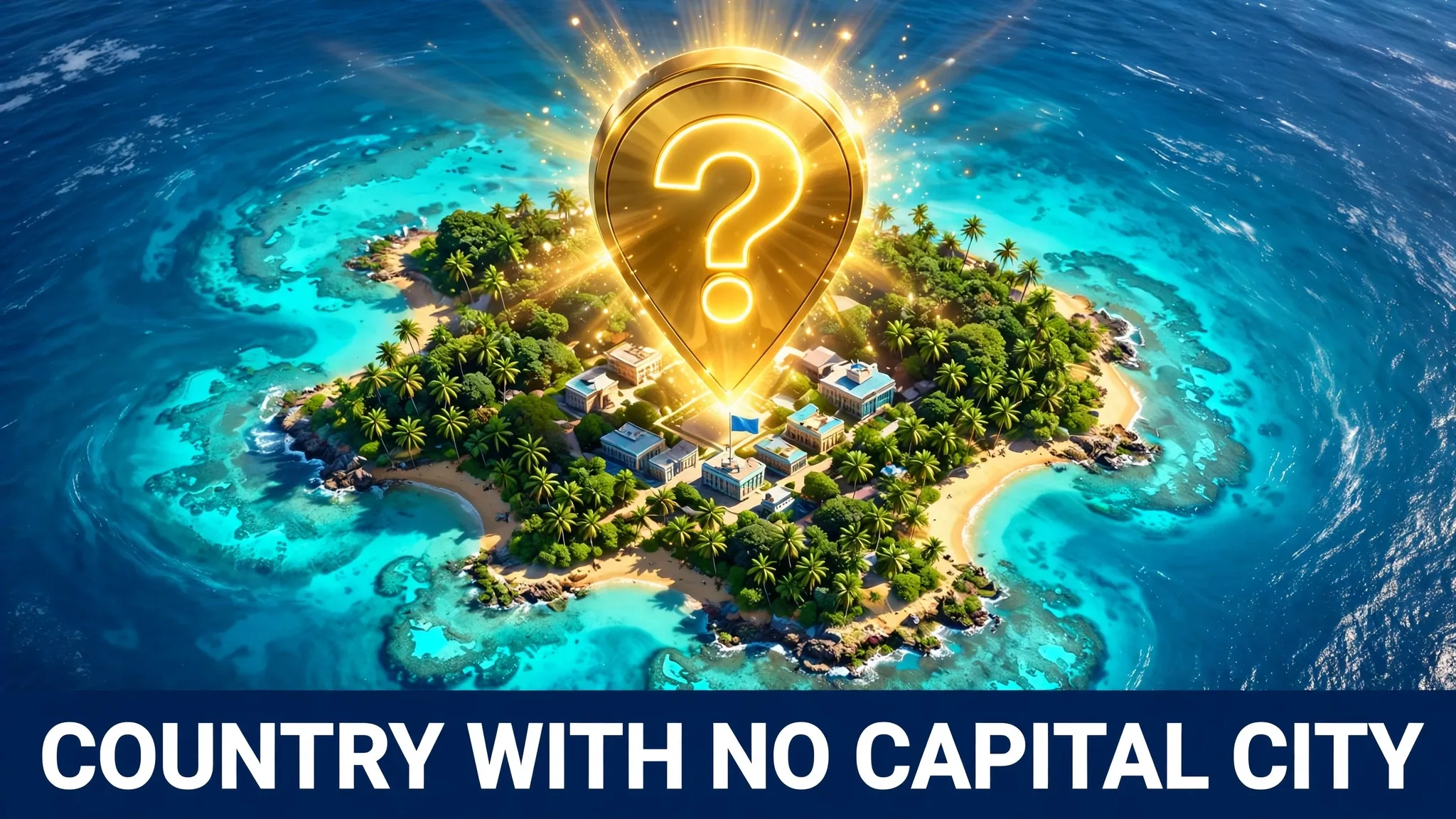
Country With No Capital City
In this post
Open any world atlas and play a simple game: pick a country, find its capital. France? Paris. Japan? Tokyo. Brazil? Brasília. The game works every single time — until your finger lands on one tiny island in the Pacific Ocean, and the space next to “capital” is just… empty.
That island is Nauru. It is a real, independent country with a president, a parliament, a flag and a seat at the United Nations. It simply never named a capital city. Let us answer, one by one, the questions everybody asks about it.
Nauru at a glance
| Fact | Detail |
|---|---|
| Area | 21 square kilometres |
| Population | About 10,000 people (9,930 in a 2025 estimate) |
| Official capital | None |
| Where the government sits | Yaren District |
| Languages | Nauruan (official); English widely spoken and used for government and business |
| Currency | Australian dollar |
| Position in the world | Third-smallest country on Earth; the world’s smallest island nation |
Is There Really a Country With No Capital?
Yes — and Nauru is the famous case. The CIA World Factbook, which lists the capital of every country on the planet, writes for Nauru: “No official capital; government offices in the Yaren District.”
Most reference lists handle it the same way. Where other countries have a proud city name, Nauru’s entry is left blank, or filled with the single word “none.”
How can a country run without a capital? The short answer is that Nauru is so small that the whole nation is effectively one small town. It is divided into 14 districts rather than cities and towns, and life spreads along one narrow ring of land around the coast. When your entire country is a single neighbourhood, choosing one street corner as “the capital” starts to feel unnecessary — so Nauru simply never did it.
Where Does Its Government Sit Then?
In the Yaren District, on the island’s south-western coast. Yaren holds the Parliament House, the government offices and the courts, and the country’s international airport sits nearby. If Nauru has a centre of power, Yaren is it.
But here is the careful point: Yaren is a district, not a city, and it has never been officially declared the capital. Writers call it the “de facto” capital — the capital in practice, not in law. Maps and websites often print “Yaren” in the capital slot because the form demands something, but Nauru’s own position is that the slot stays empty. It is a bit like a family that always gathers in the kitchen: everyone knows where the decisions happen, but nobody ever officially renamed the kitchen “headquarters.”
Can You Walk Across It in a Day?
Easily — and you could circle it too. Nauru covers just 21 square kilometres, making it the third-smallest country in the world, behind only Vatican City and Monaco. It is the smallest country in the Pacific, the smallest island nation anywhere, and the world’s smallest independent republic.
The island is a single oval of raised coral sitting just 53 kilometres south of the equator. Its coastline is only about 30 kilometres long, and most people live on the fertile green ring along the shore, especially the south-west coast. A ring road follows the water, so a determined walker could stroll around an entire sovereign nation before dinner, crossing no border, passing one airport, one port, and waving at a fair share of the population on the way.
Honestly, this is my favourite fact in all of geography: Nauru is proof that a country does not need size to be complete. It has districts instead of cities, one small parliament of 19 elected members, and a president chosen by that parliament — everything a state needs, packed into a place smaller than many city parks around the world.
Who Ruled Nauru Before It Ruled Itself?
Nauru’s people were there long before any flag arrived. Micronesian and Polynesian settlers inhabited the island by around 1000 B.C., and the community was divided among 12 clans. The island developed in deep isolation — ocean currents made landing difficult — which is why the Nauruan language does not clearly resemble any other language in the Pacific.
Europeans spotted the island in 1798, when a British mariner became the first to see it; its old name, “Pleasant Island,” dates from that era. Germany annexed Nauru in 1888, phosphate was discovered in 1900, and the mining era began under foreign control. Australian forces captured the island during the First World War, and after that war it was administered by Australia under an international mandate. During the Second World War, Japan occupied Nauru and used its people as forced labour elsewhere in the Pacific.
After the war, Nauru became a United Nations trust territory under Australian administration — and then came a remarkable moment. In 1962, knowing the phosphate would one day run out, Australia’s prime minister offered to resettle every Nauruan on an island off Queensland. The Nauruans refused. They chose their own scarred, tiny island and their own independence instead, which they won in 1968. A country small enough to walk around still had the pride of a giant — and that choice explains a lot about Nauru today.
How Did This Tiny Island Become So Rich, Then Struggle?
This is the most astonishing part of Nauru’s story, and it begins with birds.
For countless centuries, seabirds rested on this island, and their droppings slowly built up into thick rock rich in phosphate — one of the finest natural fertilisers on Earth. Phosphate was discovered on Nauru in 1900, and the digging began. For most of that era, the profits flowed to foreign companies and rulers; the Factbook notes that Nauruans themselves received only a tiny fraction — about one tenth of one percent — of the money their island’s treasure earned.
Independence changed that. Nauru became independent in 1968, and in 1970 it bought the phosphate mining business for itself. What followed sounds like a fairy tale: through the 1970s, income from the mines made the people of Nauru among the richest in the world per person. A population of a few thousand, sitting on a mountain of fertiliser the whole world wanted.
But a mine is a candle — bright, and burning down. The phosphate had taken ages to form, and it was dug away in decades. A series of unwise investments drained much of the fortune that had been set aside, and by around the year 2000, this once-fabulously-rich country stood near bankruptcy. Widespread phosphate mining officially ended in 2006, though digging of a deeper “secondary” layer began the following year and still brings in some income. The mining also scarred the island itself: intensive digging left most of the central plateau a wasteland of bare limestone pinnacles, where almost nothing can grow or be built.
So how does Nauru live today? Carefully, and from several smaller streams of money:
- The regional processing centre. Since 2001, with breaks, Nauru has hosted an Australian-run centre for asylum seekers, and Australia pays Nauru for it. The centre was restarted in 2023, and according to the CIA World Factbook it remains the Nauruan government’s largest source of income.
- Fishing licences. Foreign boats pay to catch tuna in Nauru’s wide ocean waters, under a “vessel day scheme,” and this money has become an important support for the government.
- Aid and remaining phosphate. Help from partner countries — above all Australia, Nauru’s former administrator and still its main supporter — plus earnings from the secondary phosphate layer, help keep the country running.
Nauru’s story carries a lesson far bigger than the island: wealth that comes out of the ground always has an end date, and the only real treasure is what a nation builds before that date arrives.
Frequently Asked Questions
What is the capital of Nauru?
Nauru has no official capital. Its government offices and parliament sit in the Yaren District, which acts as the capital in practice, but Yaren is a district and has never been declared a capital city.
Why does Nauru have no capital city?
Mainly because of its size. At just 21 square kilometres, the whole country works like one small coastal town divided into 14 districts, so there was never a practical need to name one place the capital.
How small is Nauru, really?
It is the third-smallest country in the world and the smallest island nation, with about 10,000 people, one airport, and a coastline of roughly 30 kilometres that you can travel around in a single trip.
How did Nauru become so rich in the 1970s?
Phosphate rock — formed over centuries from seabird droppings — was mined and sold worldwide as fertiliser. After independence in 1968, Nauru bought the mines in 1970, and the income briefly made its people among the richest per person on Earth.
What currency does Nauru use?
The Australian dollar. Nauru does not issue its own currency, and most necessities are imported, mainly from Australia.
Sources
- CIA World Factbook — Nauru: https://theworldfactbook.org/country/nauru.html
- Pacific Islands Heritage Foundation — Republic of Nauru: https://pih.foundation/leadership-pacific-chapters/m-pic-republic-of-nauru/
- Moneycontrol — “Nauru: The Only Country in the World Without a Capital City”: https://www.moneycontrol.com/travel/nauru-the-only-country-in-the-world-without-a-capital-city-here-s-why-article-13478007.html/amp