Country Where Voting Is Compulsory
In this post
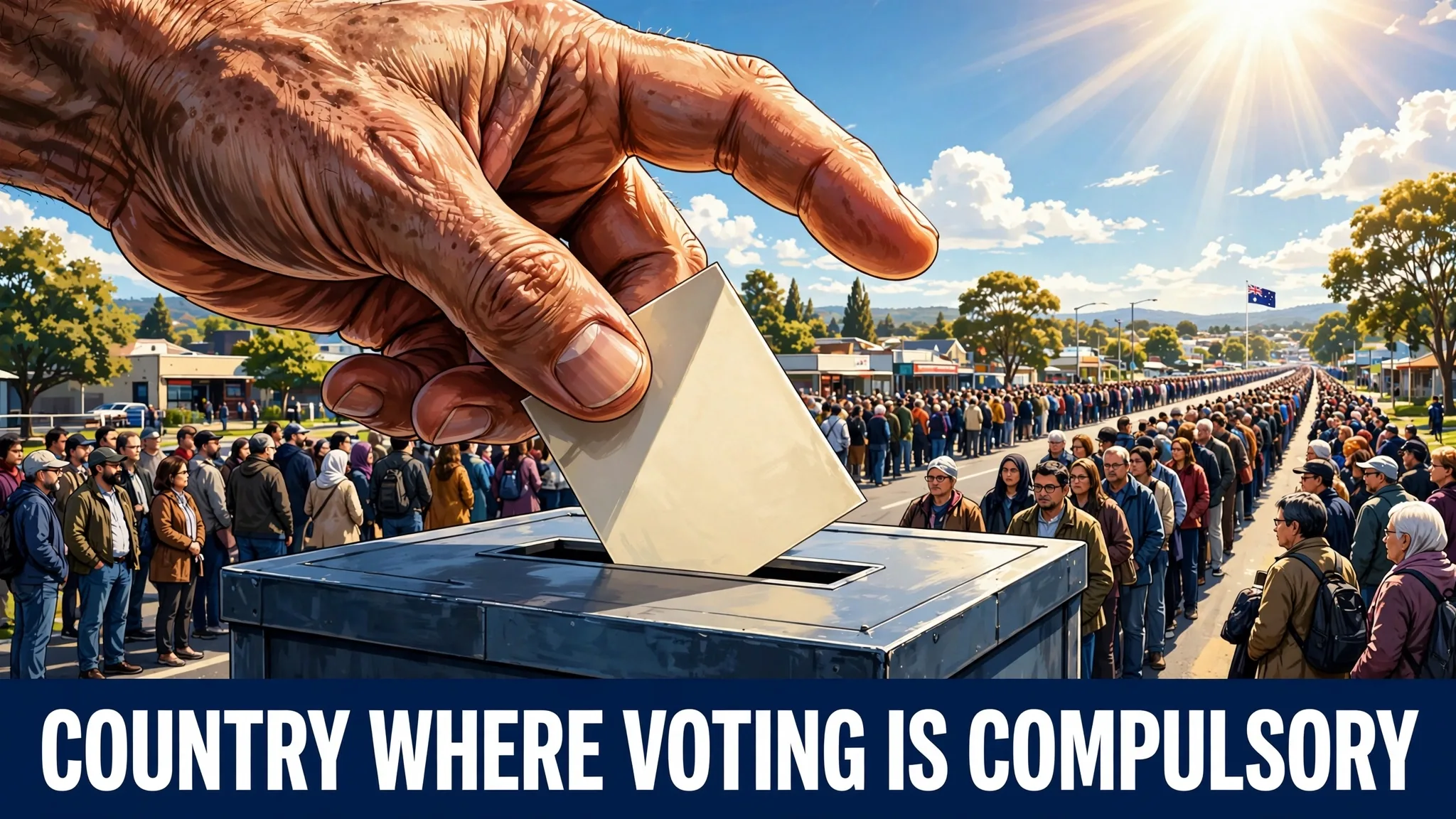
Picture a Saturday morning outside an Australian primary school. Volunteers are flipping sausages on a barbecue. A queue shuffles forward in the sunshine, past a trestle table of homemade cakes. It looks like a village fete.
It is actually a legal obligation. Nearly every adult in that queue is there because the law told them to be: Australia does not simply invite its citizens to vote — it requires them.
In most democracies, staying home on election day is a shrug. Perfectly legal. Nobody’s business. Australia looked at that arrangement more than a hundred years ago, chose the opposite path, and the argument over whether it chose wisely has never completely gone away.
How a Country of Non-Voters Changed Its Mind
Australia became a federation in 1901, and at first its federal elections ran the way elections run in the United States or the United Kingdom today: voting was voluntary. The trouble was that Australians kept not bothering. Turnout slid and slid, until at the 1922 federal election only about 59 per cent of registered voters actually cast a ballot. Four in ten people had stayed home, and the country’s government had been picked by barely half its citizens.
One small step had already been taken. Since 1912, it had been compulsory for citizens to put their names on the electoral roll — turning up was optional, but registering was not. Then the state of Queensland tried the stronger medicine in 1915, making voting itself compulsory in its state elections, and it worked well.
In 1924, the federal Parliament amended the Commonwealth Electoral Act to do the same nationwide. No grand party platform carried the change; it arrived through a private member’s bill and passed with surprisingly little fuss.
The verdict came at the very next election. In 1925, turnout leapt from about 59 per cent to about 91 per cent — and there it has stayed. For a hundred years, Australian federal elections have almost always drawn around 90 per cent or more of enrolled voters, numbers that voluntary-voting countries rarely approach.
What the Law Actually Asks of You
The machinery is gentler than the word “compulsory” suggests.
If you are a citizen aged 18 or over, your name belongs on the electoral roll, and the Australian Electoral Commission — the independent body that runs federal elections — works hard to keep that roll complete, even sending mobile polling teams out to faraway farms and remote communities.
Election day is always a Saturday. Federal law requires it, on the simple logic that most people are not at work. Polling places open in schools and halls across the country, and the day has grown a beloved tradition of its own: community groups sell sausages outside the polling places, a snack so woven into the ritual that “democracy sausage” was named Australia’s word of the year in 2016.
At the door, an official finds your name on the roll and marks it off. That mark — proof that you attended — is the real heart of the system.
Then comes the part that matters most. You take your ballot papers into a compartment, alone, and mark them in complete privacy. The ballot is secret. The law can make you attend, make you be marked off, make you accept the papers — but nobody can check what you wrote, or whether you wrote anything at all. Inside that booth, every Australian is entirely free.
And the system bends for real life: early voting centres and postal votes exist for people who will be away, unwell, working, or otherwise unable to reach a polling place on the day.
Skip the whole thing without a reason, and the consequences are deliberately mild. Your name lands on a list of apparent non-voters, and within three months a penalty notice arrives. You can answer that you did vote. You can offer a “valid and sufficient reason” — serious illness, an emergency, being unable to reach a polling place — and the law expressly accepts a religious duty to abstain from voting as such a reason. Or you can pay an administrative penalty of A$20 and close the matter. Only people who ignore every letter risk ending up in court, where a judge may set a penalty. In practice, habit and expectation do the heavy lifting; the fine is mostly a nudge.
Side One: Everybody In, Nobody Ignored
Now the contest — and the supporters of this system open with their strongest card: legitimacy. A government chosen by nine voters in ten can honestly claim to speak for the whole country. One chosen by half the roll speaks mainly for the motivated.
Fairness follows close behind. Where voting is voluntary, the empty chairs belong predictably to the busiest, the poorest, the youngest, and the people with the least connection to politics. Politicians notice who is missing — and whole neighbourhoods can be safely ignored when their residents rarely turn up. Make everyone vote, and every street and every group weighs exactly the same on election day. Nobody can be written off.
Supporters also file voting among the ordinary civic duties — beside paying taxes and serving on a jury — small shared tasks that keep a country running, none of them a burden worth the name.
And there is a practical bonus. Because parties know almost everyone will vote anyway, they spend less money and energy dragging their own supporters to the polls, and more of the campaign on actual policies. The quiet tricks that flourish in low-turnout elections — bad weather, hard transport, an employer who will not release you — lose most of their power when turnout is guaranteed.
Australia’s own Parliament has heard this case many times, and one parliamentary committee described compulsory voting as a corner-stone of the country’s democratic system.
Side Two: A Right You Must Use Is a Strange Right
The critics reply with equal conviction, starting from freedom itself. Voting is a right, they say — and a genuine right includes the freedom not to exercise it. A right you are punished for declining starts to look less like a right and more like an order.
Some reach for a comparison with speech. If freedom of speech means anything, it must protect the person who chooses to stay silent. Forcing a citizen to the ballot box, on this view, is forcing a political statement out of someone who may wish to make none.
Faith sharpens the objection. Certain religions teach their followers to keep out of politics entirely. Australia partly answers this by accepting a religious duty to abstain as a valid excuse — but critics point out that the citizen must still plead for permission to follow their own conscience.
Then there is the punishment. A$20 is a small fine, but small sums land hardest on the poorest citizens, the very people least able to pay, and critics warn that a carelessly run system can turn the penalty into little more than a tax on being poor.
Finally comes the emptiest point of all: the empty ballot. Drag an unwilling person to the booth and the law cannot follow them inside. They may hand back a blank paper, or number the boxes at random just to be done with the chore. Attendance can be legislated; thought cannot. A vote cast only to dodge a fine, critics ask, adds noise to the count — not wisdom.
The Wider Map
Australia keeps unusual company. Around 21 countries have compulsory voting in some form. Belgium runs the oldest such system, dating back to 1893; Brazil, Argentina, Singapore, Uruguay and Greece are among the others on the list. Enforcement, though, varies enormously — real fines in one country, a law that sleeps untouched in the books in another. Only around ten of these countries truly enforce the duty.
Some nations tried the experiment and walked away. The Netherlands dropped compulsory voting around 1970, and average turnout fell noticeably in the years that followed; Venezuela removed it in 1993.
Australia, by contrast, has kept its system for a century — and, when polled, most Australians want to keep it. Roughly six or seven out of every ten support the arrangement, usually somewhere between the barbecue queue and the ballot box.
My Honest View
I have turned this one over for a while, and the secret ballot is the part that settles it for me — mostly. The Australian state can march you to the door of the booth, but it is forbidden from following you inside. What it demands is presence, not agreement. And presence changes politics: a party that must face the poorest street in the country, not just the keenest, governs a little differently.
My honest hesitation sits with the fine. A$20 is nothing to a comfortable household and a genuine problem to a struggling one, and any penalty will always press hardest on the person with the least. That is a real cost, and supporters who wave it away are not being straight.
On balance, though, I would rather live with a small, soft-edged push that pulls everyone into the count than with a spotless freedom in which the quietest voices are simply never heard. But I hold that view loosely. The other side is defending something real — the right to be left alone — and a healthy democracy should never laugh that instinct out of the room.
Frequently Asked Questions
What actually happens to an Australian who does not vote? Failing to vote at a federal election without a valid and sufficient reason is an offence for citizens aged 18 and over. Most cases end simply: the person explains, or pays the A$20 administrative penalty, and the file closes.
Can the government find out who someone voted for? No. The ballot is secret. Officials record only that you attended and were given ballot papers — never what you marked on them.
Which excuses does the law accept? Serious illness, an emergency, or being unable to reach a polling place can all count as a valid and sufficient reason, and a religious duty to abstain from voting is expressly accepted. Early and postal voting cover people who know in advance that they cannot attend.
When did all of this begin? Enrolment became compulsory in 1912, Queensland made voting compulsory in its state elections in 1915, and federal voting became compulsory in 1924. Turnout jumped from about 59 per cent in 1922 to about 91 per cent in 1925.
Why do Australians vote on Saturdays? Federal law requires elections to be held on a Saturday, when most people are free from work, so that taking part costs as little disruption as possible.
Which other countries make voting compulsory? About 21 countries have such laws, including Belgium — the oldest, from 1893 — Brazil, Argentina, Singapore and Uruguay. Only around ten of them enforce the law in practice.
Sources
- Australian Electoral Commission, “Electoral Backgrounder: Compulsory Voting”: https://emailfooter.aec.gov.au/About_AEC/Publications/backgrounders/compulsory-voting.htm
- Parliament of Australia, “Voter Enrolment and Participation” (Joint Committee Report Chapter): https://www.aph.gov.au/Parliamentary_Business/Committees/Joint/Public_Accounts_and_Audit/Efficiency/Report/Section?id=committees%2freportjnt%2f024085%2f26059
- Louth and Hill, “Compulsory Voting in Australia: Turnout With and Without It”, Australian Review of Public Affairs: http://www.australianreview.net/journal/v6/n1/louth_hill.pdf
- Wikipedia, “Compulsory Voting”: https://en.wikipedia.org/wiki/Compulsory_voting
- Wikipedia, “Elections in Australia”: https://en.wikipedia.org/wiki/Elections_in_Australia
- The picture on this page is an original illustration made for Talha M Blog.