Country That Abolished Its Army
In this post
Almost every country on Earth keeps an army. It is treated as something a nation simply must have, like a flag or a capital city. But one country in Central America looked at its own army, fresh from winning a war, and made a decision that still astonishes the world: it got rid of the army completely — not for a year, not as an experiment, but forever, written into its constitution where no future leader could easily undo it.
That country is Costa Rica. This is the remarkable story of a hammer blow that ended an army, a barracks that became a museum, and the schools and clinics that were built with the money that soldiers no longer needed.
It Began With A Short And Bloody Civil War
The story starts, sadly, with violence. In 1948, Costa Rica held a presidential election, and when it looked as if the winning candidate, Otilio Ulate, would be prevented from taking office, an outspoken landowner named José Figueres Ferrer organised an armed uprising in his support. The fighting that followed lasted about six weeks — the 44-day civil war — and it was the bloodiest event in Costa Rica’s twentieth century, leaving more than 2,000 people dead in a small country.
Figueres and his forces won. The defeated side surrendered, and a governing junta led by Figueres took charge, promising to rebuild the country and then hand power to Ulate, the man who had actually won the election. Most victorious rebel leaders in history have used such a moment to build a bigger army and keep power for themselves. Figueres did the opposite — and that is why the world still talks about him.
One Hammer Blow That Ended An Army
On 1 December 1948, Figueres walked into the Cuartel Bellavista, the main army barracks in the capital, San José. In front of the gathered soldiers and officials, he picked up a heavy hammer and struck the barracks wall, knocking a symbolic hole in it. Then he announced that Costa Rica’s regular army was abolished, and that the army’s home would be given over to education and culture instead of weapons.
Think about what a strange and powerful picture that is. A man who had just won a civil war stood in the headquarters of his own victorious army — the very force that could have made him a dictator — and used his moment of greatest strength to dissolve it. The hammer blow was theatre, yes, but deliberate theatre: he wanted the whole country to see, in one unforgettable image, that the age of soldiers deciding Costa Rica’s future was over.
Locked Into The Constitution So No One Could Undo It
A speech can be forgotten, and a decree can be cancelled by the next government. So the following year, the decision was made permanent. Costa Rica’s new constitution, adopted in 1949, placed the abolition in its Article 12, which states that the army as a permanent institution is abolished. For watching over public order, the country would have police forces instead. The article does allow military forces to be organised in a true national emergency or under a continental defence agreement — but even then, they must always remain under civilian control.
The same constitution, Britannica records, also gave Costa Rican women the right to vote, as part of the same rebuilding of the country. And the date of the hammer blow, 1 December, is still celebrated in Costa Rica every year as a national holiday: Army Abolition Day. Few countries on Earth have a holiday for the day they stopped having soldiers.
The Barracks Became A Museum
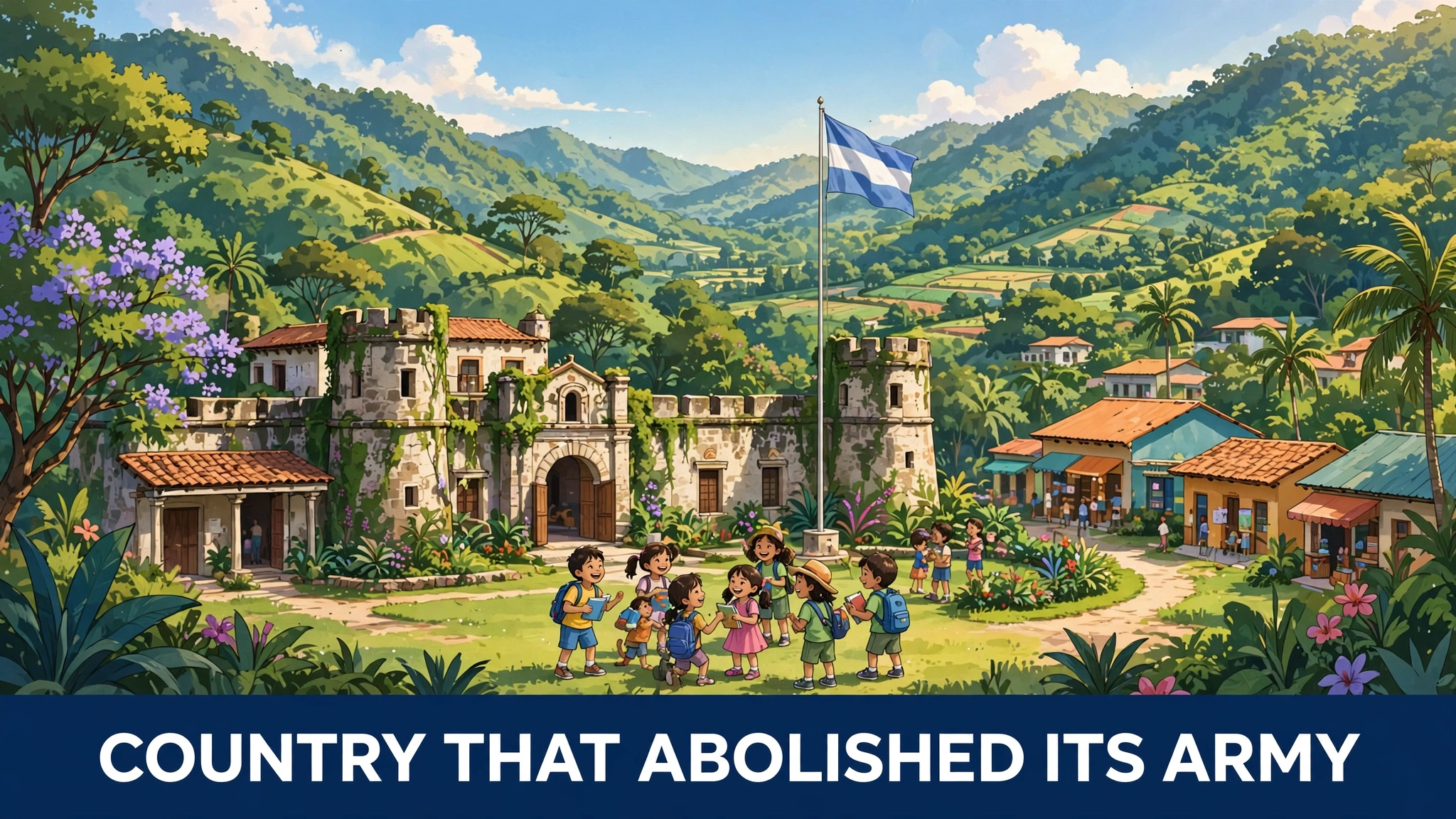
The Cuartel Bellavista did not fall down or become a prison. It became the National Museum of Costa Rica — the country’s greatest storehouse of history and pre-Columbian art. The fortress where soldiers once drilled now welcomes schoolchildren, tourists and researchers, and a memorial plaque of Article 12 is displayed there, so visitors can read the very words that ended the army while standing inside the building the army left behind.
It is hard to think of a clearer symbol of the whole idea. Guns out, history in. The keys of the stronghold were handed, in effect, to teachers and students — and Costa Ricans remain deeply proud of it, in a culture that strongly values peace.
Books And Clinics Instead Of Barracks
So where did the money go? An army is one of the most expensive things a government maintains — salaries, bases, equipment, pensions, year after year. Freed from that bill, Costa Rica directed its resources towards education, health and pensions instead, a shift that Costa Rican historian Ivan Molina of the University of Costa Rica notes had already been building since the early twentieth century and which the abolition completed.
The results are often praised across the region. Britannica notes that Costa Rica devotes large resources to education — roughly a quarter of the national budget — and that almost 98 percent of adult Costa Ricans can read and write. The country built a reputation for strong schools and public health while many of its neighbours were still spending on soldiers. Just as striking is the political result: Costa Rica has not suffered a coup since 1949, something unusual in its part of the world, and it is regarded as one of the region’s most stable democracies. Figueres himself later served as the country’s elected president, in 1953 and again in 1970 — chosen by voters, not carried by an army.
No Army Does Not Mean No Protection
A fair question follows: who keeps Costa Rica safe? The honest answer is that “no army” does not mean “no uniforms at all”. Britannica notes that the country maintains a civil guard with police duties, along with district police, and its Public Force handles law enforcement and some border and security tasks. What Costa Rica does not have is a standing military — no tanks, no warplanes, no generals building political power.
For defence against a foreign threat, the country leans on diplomacy, international law and treaties rather than soldiers. It is a choice built for a small nation: its leaders judged that its old army was too weak to defeat a real invader anyway, but strong enough to threaten Costa Rica’s own democracy — so the greater danger came from keeping it.
Costa Rica Is Not Alone, But It Is The Famous One
More than twenty countries and territories in the world manage without a standing army. Panama, Costa Rica’s neighbour, followed a similar path in 1990, after the fall of its military ruler, and also banned a permanent military in its constitution. Iceland has famously never had a standing army. And many of the others are tiny places — small European states such as Andorra, Monaco and San Marino, and small island nations in the Pacific and the Caribbean.
That is what makes Costa Rica stand out. It is not a microstate with a few thousand citizens; it is a full-sized country of more than five million people, with borders, ports, jungles and cities to protect. Among countries that are not microstates, Costa Rica and Panama are the rare exceptions — and Costa Rica, which has now lived without an army for over seventy-five years, is the example the whole world points to when the idea sounds impossible.
Frequently Asked Questions
When did Costa Rica abolish its army? The army was declared abolished on 1 December 1948, when José Figueres Ferrer symbolically struck the wall of the Bellavista Barracks in San José. The decision was made permanent a year later in Article 12 of the 1949 constitution.
Who made the decision to abolish the army? José Figueres Ferrer, the leader of the governing junta that took power after winning the 1948 civil war. Rather than use the army to hold power, he dissolved it. He later became Costa Rica’s elected president twice, in 1953 and 1970.
Does Costa Rica have any police or security forces? Yes. The country has police forces, including a civil guard and the Public Force, which handle public order and border security. What it does not have is a standing army — and its constitution only allows temporary military forces for national defence, always under civilian control.
What did Costa Rica gain from abolishing its army? The money once spent on the military was redirected to education, health and pensions. Costa Rica became known for strong schools, high literacy of almost 98 percent, and unusual political stability for its region, with no coup since 1949.
Which other countries have no army? More than twenty countries and territories have no standing army, including Panama, Iceland, Andorra, Monaco, San Marino and several small island nations. Most are very small, which is why Costa Rica — a country of over five million people — is the most famous example.
Sources
- Encyclopaedia Britannica (Britannica Kids), “Costa Rica”: https://kids.britannica.com/students/article/Costa-Rica/273827
- Wikipedia, “Article 12 of the Constitution of Costa Rica”: https://en.wikipedia.org/wiki/Article_12_of_the_Constitution_of_Costa_Rica
- Diplomat Magazine, “Imagine there’s no Army”: https://diplomatmagazine.com/imagine-theres-no-army/
- The picture on this page is an original illustration made for Talha M Blog.