How Do Birds Migrate Thousands of Miles
In this post
- Why migrate at all? Food, breeding, and survival
- Fuel: turning a small bird into a flying fuel tank
- Navigation: Sun, stars, magnetism, and memory
- Flyways: the great aerial highways
- Records, champions, and extreme journeys
- Dangers: storms, lights, hunters, and lost habitats
- How scientists track migration today
- Watching migration: what to look for
- My Take:
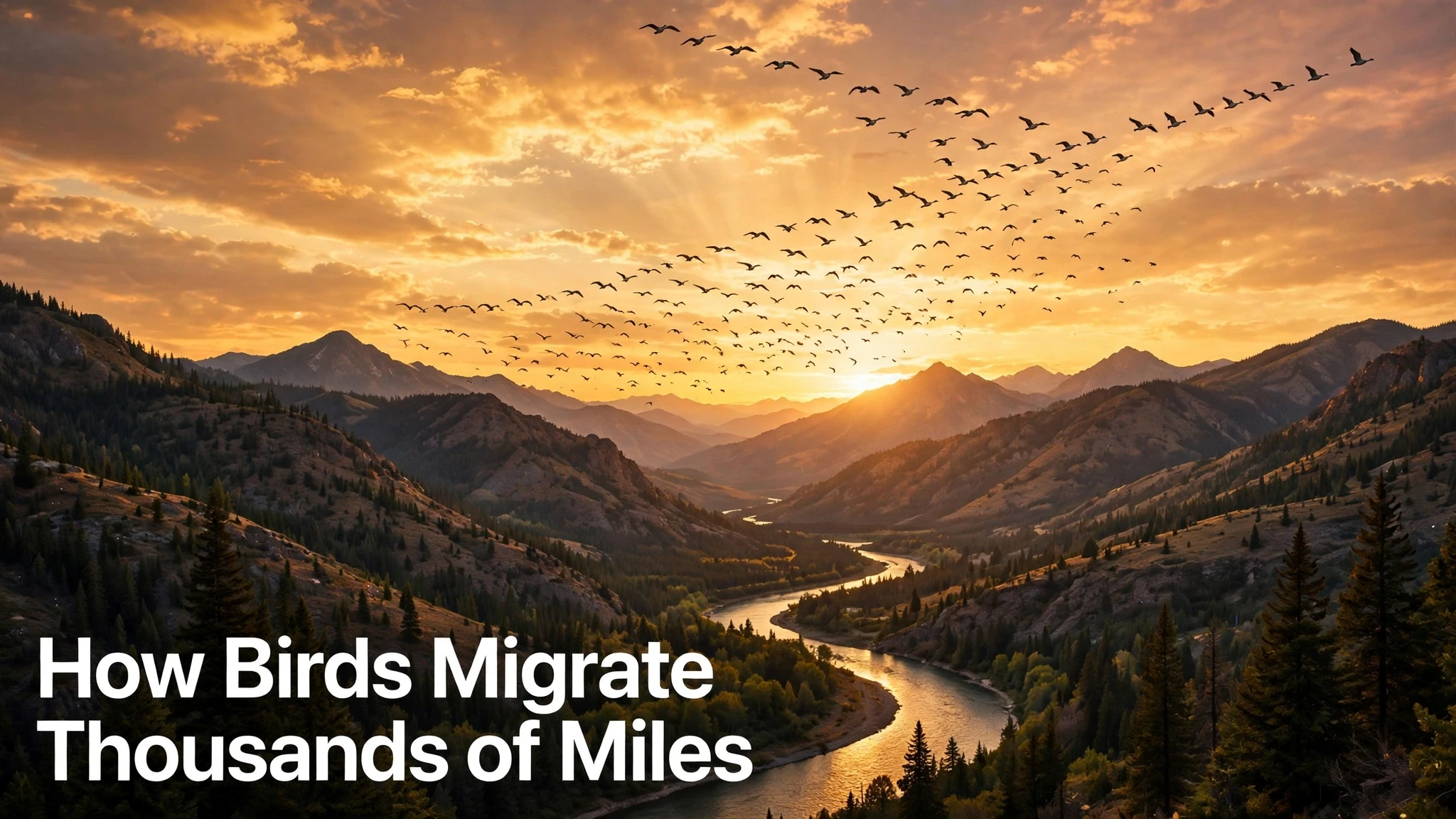
Twice a year, billions of birds undertake journeys that would defeat most human travellers without maps, fuel stations, or rest stops. Arctic terns travel from pole to pole, bar-tailed godwits fly non-stop across the Pacific for more than a week, and tiny songbirds weighing less than a coin cross deserts and oceans at night. They do it without a single road sign, and most young birds do it on their first journey, often without an experienced guide. How is that possible?
This guide explains how birds migrate thousands of miles: why they travel, how they fuel their bodies, how they navigate using the Sun, stars, Earth’s magnetic field, and landmarks, what routes they follow, and what dangers they face along the way. It is a story of biology, physics, and endurance that still contains genuine mysteries, even after decades of tracking with satellites and tiny electronic tags.
Why migrate at all? Food, breeding, and survival
Migration is, at its simplest, a response to seasons. In high-latitude summers, long days, abundant insects, and relatively few predators make breeding highly productive: a bird can raise more chicks in an Arctic summer than in a crowded tropical forest. But that abundance collapses in winter, when insects vanish, water freezes, and food becomes scarce. Migrating solves the dilemma: breed where summer is rich, spend winter where food remains available, and pay the cost of travel in between.
Not all birds migrate, and not all migrants travel the same distance. Some species are partial migrants, where only part of the population moves, often the young or the females, while others stay put. Some move only a few hundred kilometres, shifting altitude or latitude slightly to find food. Others are long-distance champions, travelling ten thousand kilometres or more each way. The strategy depends on food, climate, and competition: a bird that can survive winter at home, by switching diet or using stored food, has less reason to risk a long journey than a bird whose summer food simply disappears.
Migration also involves trade-offs that are easy to underestimate. Travelling exposes birds to storms, predators, exhaustion, and habitat loss at stopover sites. Yet for many species, staying would be worse: winter starvation, frozen water, or intense competition for scarce food. Evolution has therefore favoured migration again and again, in many different bird families, because the benefits of accessing two seasonal worlds outweigh the risks of travelling between them, at least for the species that have perfected the journey.
Fuel: turning a small bird into a flying fuel tank
A migrating bird is, in effect, a flying fuel tank. Before departure, many migrants enter a phase called hyperphagia, eating voraciously and converting food into fat, which is the most energy-dense fuel available. Some small songbirds double their body weight before a long flight, with fat making up a large proportion of their mass. That fat is then burned steadily during flight, along with some protein from muscle and organs, which can shrink during a long journey and regrow afterwards.
The scale of this transformation is extraordinary. A bar-tailed godwit, a shorebird about the size of a pigeon, has been tracked flying non-stop from Alaska to New Zealand, a journey of more than 11,000 kilometres in about eight days, without eating, drinking, or sleeping in any normal sense. During that flight, it burns fat stores built up in Alaska, shrinks its digestive organs to save weight, and may even sleep with half its brain at a time while flying, although how much sleep long-distance migrants actually get in the air is still studied. The fact that such a journey is possible at all rewrites our sense of what a small animal can endure.
Stopover sites are the fuel stations of migration. A bird that has just crossed a desert or an ocean must land, rest, and refuel quickly, often doubling its weight again in days or weeks before the next leg. Wetlands, estuaries, lakeshores, and coastal mudflats are critical stopovers for shorebirds, while forests, hedgerows, and gardens serve songbirds. If a stopover is drained, built over, or disturbed, migrants may arrive exhausted and find no food, turning a manageable journey into a fatal one. Protecting a breeding ground or a wintering ground alone is therefore not enough; the whole route must remain usable.
Navigation: Sun, stars, magnetism, and memory
How does a bird know where to go? The short answer is that it uses several systems at once, and if one fails, another can compensate. During the day, birds can use the Sun as a compass, adjusting for its movement across the sky with an internal clock. At night, many migrants use the stars, learning the pattern of constellations around the celestial pole and orienting by them, a skill demonstrated in planetarium experiments where birds changed direction when the artificial star pattern was rotated.
Earth’s magnetic field provides another compass. Birds appear to sense magnetic inclination, the angle at which magnetic field lines meet Earth’s surface, which varies with latitude and can therefore give information about position, not just direction. The exact mechanism is still debated, with leading hypotheses involving light-sensitive proteins in the eye that react to magnetic fields, and iron-containing structures in the beak. What is clear from experiments is that altering the magnetic field around a captive bird can alter its orientation, showing that magnetism is genuinely part of its navigation toolkit.
Landmarks, smell, and memory also matter, especially for experienced birds on familiar routes. Coastlines, rivers, mountain ranges, and even city lights can guide a migrant, and older birds may remember productive stopovers from previous years. Young birds on their first migration, however, often rely more on an inherited programme: a genetically encoded direction and distance, sometimes called a migratory restlessness or Zugunruhe, that tells them roughly where to go without ever having been there. That programme can be remarkably precise, guiding a young cuckoo, for example, to a wintering area it has never seen, after its parents have already left.
Flyways: the great aerial highways
Migratory routes are not random; they follow broad corridors called flyways, shaped by geography, winds, and food. Major flyways include the East Atlantic Flyway, linking Europe and Africa; the East Asian-Australasian Flyway, linking Siberia and Alaska to Southeast Asia, Australia, and New Zealand; and the Americas flyways, linking North America to Central and South America. Within each flyway, birds funnel through bottlenecks where geography narrows the route, such as the Strait of Gibraltar, the Bosphorus, or the Isthmus of Panama, where thousands of birds of prey, storks, and songbirds can be seen passing in a single day.
Winds shape flyways as much as land does. Birds prefer tailwinds and avoid headwinds, and many migrants time their departures to coincide with favourable weather, waiting days for a good wind before setting off over an ocean or desert. Soaring birds, such as storks, eagles, and vultures, depend on thermals, columns of rising warm air, and therefore avoid long sea crossings where thermals are absent, preferring to detour over narrow straits. Flapping birds, such as many songbirds and shorebirds, can cross open water directly, but at a higher energy cost, and they must be prepared for the possibility of being blown off course by storms.
Altitude also varies. Most migrants fly between a few hundred metres and a few kilometres high, but some, such as bar-headed geese crossing the Himalayas, have been recorded flying above 6,000 metres, where oxygen is thin and temperatures are far below freezing. How they sustain flight in such conditions, with enlarged lungs and efficient oxygen use, is a subject of ongoing research. Radar studies have revealed that the night sky over many regions is far busier than it looks, with millions of birds passing overhead unseen, a hidden migration that only technology has made visible.
Records, champions, and extreme journeys
A few species stand out even among migrants. The Arctic tern is often called the champion of migration, travelling from its Arctic breeding grounds to Antarctica and back each year, a round trip that can exceed 70,000 kilometres, and over a lifetime of 20 years or more, a distance equivalent to several trips to the Moon and back. Its journey is not a straight line; it follows a winding route over oceans, taking advantage of winds and food, and it experiences two summers a year, one in each hemisphere.
The bar-tailed godwit holds the record for the longest non-stop flight by a land bird, as noted above, flying from Alaska to New Zealand without landing. The common swift, by contrast, holds a different record: after leaving the nest, young swifts may stay airborne for years, eating, sleeping, and even mating on the wing, only landing when they first breed. The ruby-throated hummingbird, weighing only a few grams, crosses the Gulf of Mexico in a single flight of about 800 kilometres, a feat that seems impossible for a bird that small until you consider its fat stores and efficient flight.
These records are not just trivia; they reveal the limits of animal endurance and the power of natural selection. Each record-holder has evolved a different solution to the same problem: how to move between seasonal worlds without dying on the way. Some solutions emphasise fuel, some emphasise flight efficiency, some emphasise navigation, and some emphasise sheer toughness. Together, they show that migration is not one invention but many, evolved independently in different lineages facing similar seasonal pressures.
Dangers: storms, lights, hunters, and lost habitats
Migration is dangerous, and modern human activity has added new risks to ancient ones. Storms can blow birds far off course, exhaust them, or force them down over unsuitable terrain. Predators wait at bottlenecks and stopovers, where tired birds are easy prey. Natural dangers, however, are now joined by collisions with buildings, power lines, and wind turbines, by light pollution that disorients night migrants and draws them into cities, and by hunting along flyways, which in some regions still takes a heavy toll on songbirds and shorebirds.
Habitat loss is perhaps the greatest long-term threat. A wetland drained for farming, a mudflat reclaimed for a port, or a forest cleared for development removes a fuel station from a flyway, and migrants that depend on it may have nowhere else to refuel. Because many migrants travel thousands of kilometres, the loss of a single critical stopover can affect populations breeding continents away, a connection that is easy to miss when decisions are made locally. International agreements, such as those protecting wetlands and migratory species, exist precisely because migration crosses borders and requires cooperation.
Climate change adds a further complication: shifting seasons can create mismatches between migration timing and food availability. If a bird arrives at its breeding ground after the peak abundance of insects has passed, because spring advanced faster at the breeding site than the cues that triggered its departure, its chicks may starve. Some species are adjusting by migrating earlier or changing routes, but others, especially long-distance migrants with fixed inherited programmes, may adjust more slowly. Whether they can keep pace with rapid change is one of the most urgent questions in migration research.
How scientists track migration today
Our understanding of migration has been transformed by tracking technology. Early knowledge came from bird ringing, where a metal ring with a unique number is fitted to a bird’s leg, and recoveries, when the bird is found again, reveal its movements. Ringing still provides valuable data on survival and site fidelity, but it depends on recapturing or finding the bird, which is rare for long-distance migrants.
Modern tags are far more powerful. Satellite transmitters, GPS loggers, and light-level geolocators, some weighing less than a gram, can record a bird’s position, altitude, speed, and even body temperature throughout its journey. These devices revealed the godwit’s non-stop Pacific flight, the Arctic tern’s winding ocean route, and the fact that many songbirds migrate at night in numbers far greater than daytime counts suggested. Radar, stable isotope analysis of feathers, and genetic studies add further layers, showing where a bird grew its feathers, which population it belongs to, and how flyways have evolved over time.
Citizen science also plays a large role. Millions of birdwatchers report sightings to databases, creating a global picture of migration timing and distribution that no single research team could achieve alone. That data helps scientists detect shifts in migration dates, identify important stopovers, and assess population trends. For a reader who wants to help, joining a local bird count or reporting sightings to a recognised scheme is a practical contribution to migration science, turning a hobby into data that protects the very birds being watched.
Watching migration: what to look for
For anyone who wants to witness migration, timing and place matter more than equipment. In temperate regions, spring and autumn are peak seasons, with waves of birds passing over days or weeks, often following weather fronts. Coastal headlands, mountain passes, and wetland reserves are classic watchpoints, where geography funnels birds into view. Early morning is often best for songbirds, which migrate at night and land at dawn to rest and feed, while midday thermals are best for soaring birds of prey and storks.
Binoculars help, but they are not essential; many migrants, such as geese, cranes, and swifts, are visible and audible without them, and their calls at night can be recorded and identified. Learning a few common migrant calls, and recognising V-formations, flock shapes, and flight styles, will quickly improve what you see. Above all, patience matters: migration is not a show that runs on schedule, and a quiet day can be followed by a spectacular fall of birds after a night of favourable winds. The reward for patience is a direct connection to one of nature’s greatest journeys, happening overhead, often unnoticed, twice a year.
My Take:
My first judgement is that bird migration should change how we think about borders. A godwit that flies from Alaska to New Zealand, or a tern that travels from the Arctic to Antarctica, does not recognise national boundaries, passports, or protected area designations. It recognises only food, wind, and safe landing places. Conservation that stops at a border therefore fails by design for migrants. I think the flyway concept, treating a whole route as one conservation unit, is the most important idea in modern bird protection, because it forces countries that may have little else in common to cooperate on wetlands, hunting rules, and habitat protection for a shared bird.
My second judgement concerns tracking technology, which I think has done more than answer old questions; it has revealed how much we did not know. Before satellite tags, the godwit’s non-stop flight was suspected but not proven, the tern’s winding route was guessed at, and the scale of nocturnal songbird migration was underestimated. Each new tag has produced a surprise, which should humble us about other animal journeys we have not yet tracked. It also raises an ethical question: tags add weight and may affect the very birds they study, so researchers must balance the value of data against the welfare of the individual. The smallest, lightest tags, used only when the question justifies them, are the right standard, not the largest dataset at any cost.
I also think light pollution deserves far more public attention than it currently receives as a migration threat. We talk about habitat loss and hunting, rightly, but the glow of cities that draws night migrants off course, exhausts them, and causes collisions is a threat that every city can reduce quickly, by shielding lights, turning off unnecessary illumination during peak migration nights, and designing buildings with birds in mind. Unlike habitat restoration, which takes years, lights-out programmes can show results in a single season, and they save energy as well. That combination, good for birds and good for budgets, should make it an easy policy win, yet it remains underused in most cities.
A further point is about the inherited programme of young migrants, which I find both wonderful and worrying in a changing climate. A young bird that has never migrated before, guided only by an internal compass and a rough distance, is a marvel of evolution. But that same rigidity becomes a liability when seasons shift rapidly: a programme tuned over thousands of years to a stable seasonal calendar may now send birds to breeding grounds too late for the food peak, or to stopovers that have dried up. Species that can learn and adjust, by following experienced birds or responding to local cues, may fare better than those locked into a fixed programme. That difference may decide which species survive rapid change and which decline, and it is a prediction researchers are now testing in real time.
I would also argue that migration watching should be promoted as a gateway to nature, not as a specialist hobby for experts with expensive optics. A child who hears geese overhead at night, or sees swifts screaming over a town in summer, is encountering migration directly, without needing to identify a rare species. Schools, parks, and local groups can build on that encounter with simple activities: counting birds at a local pond in spring and autumn, recording first arrivals, or joining a citizen science count. Those activities cost little, but they create a constituency for flyway protection that no expert report can create alone, because people protect what they have seen and loved.
My practical takeaway is to look up, especially at night during migration seasons, and to think about what is passing overhead. Radar shows millions of birds moving unseen above cities, towns, and farmland, on journeys that dwarf human travel in endurance and precision. If you live near a wetland, a coast, or a river, learn which migrants use it and when, and support its protection, because that one site may be the fuel station that makes a ten-thousand-kilometre journey possible. A bird that can fly non-stop for eight days deserves, at the very least, a safe place to land when it finally does.
Finally, I think migration teaches a broader lesson about endurance and timing that applies beyond birds. Migrants do not fly constantly; they alternate between intense effort and intense rest, between fasting and feasting, between travelling and waiting for wind. That rhythm, effort followed by recovery, is a better model for sustainable work than constant exertion, whether for athletes, students, or anyone facing a long project. The godwit does not succeed by flying harder than other birds; it succeeds by preparing thoroughly, choosing its moment, and resting completely when it lands. There is wisdom in that rhythm, written in fat, feathers, and flight, for anyone willing to look up and learn from it.
There is also a question about how migration research should be shared with the public. Tracking maps, with animated routes sweeping across continents, are some of the most popular visualisations in nature science, and they do a superb job of making an abstract journey concrete. But they can also mislead if they show a single bird’s route as if it were the species’ route, when individual birds vary widely in timing, stopovers, and even destination. A map of one godwit is a story; a map of a hundred godwits is a pattern. I think popular reporting should show both: the individual story that captures attention, and the population pattern that supports conservation decisions, with the difference explained plainly.
I would also add a note about backyard action, which is often dismissed as too small to matter. A garden with native plants, a pond, or even a quiet corner where migrants can rest, a window with decals to prevent collisions, and lights turned off during peak migration nights are small steps, but multiplied across millions of homes they create a network of micro-stopovers in exactly the urban and suburban landscapes where natural habitat has been lost. No single garden saves a flyway, but a city full of bird-friendly gardens, parks, and dark skies at night is a flyway intervention in its own right, and it gives residents a direct, visible role in a global journey.
Frequently Asked Questions
How do birds know where to migrate? Birds use several systems together: the Sun and stars as compasses, Earth’s magnetic field, landmarks, smell, and memory, plus an inherited programme in young birds that gives a rough direction and distance.
What is the longest bird migration? The Arctic tern travels from the Arctic to Antarctica and back each year, a round trip that can exceed 70,000 kilometres, experiencing two summers annually.
How can a godwit fly non-stop for eight days? It builds up large fat stores before departure, shrinks its digestive organs to save weight, and burns fat steadily in flight, travelling more than 11,000 kilometres from Alaska to New Zealand without landing.
Do all birds migrate? No. Some species stay year-round, some migrate only short distances, and some are partial migrants where only part of the population moves, depending on food and climate.
Why are stopover sites so important? Migrants must land to rest and refuel after long flights. If a wetland, mudflat, or forest stopover is lost, birds may arrive exhausted and find no food, making the next leg impossible.
How do scientists track bird migration? By bird ringing, satellite transmitters, GPS loggers, light-level geolocators, radar, feather isotope analysis, and citizen science sightings reported by birdwatchers worldwide.