Diana Rigg: The Life Story Behind the Avengers Star
In this post
- A Childhood in Bikaner and a Return to Yorkshire
- RADA, the RSC, and the Long Apprenticeship in Verse
- Emma Peel, Leather, and a Heroine Who Answered Back
- Tracy di Vicenzo and the Bond Film That Ends in Tears
- Medea, Broadway, and the Night the Audience Gasped
- Mother Love, Rebecca, and a Damehood
- Olenna Tyrell and the Queen of Thorns
- A Daughter, Two Marriages, and the Last Years
- My Take:
Diana Rigg could silence a room with a single raised eyebrow, and she could do it in a leather catsuit, in a Greek tragedy, or in a wheelchair at a wedding feast in Westeros. The voice did half the work. It was low, clipped, amused, and it carried the suggestion that she had already worked out what you were going to say and found it wanting. People who met her often remembered the voice before they remembered anything else. It was the voice of someone who had read widely, argued often, and never once softened an opinion to make a stranger comfortable.
She was born Enid Diana Elizabeth Rigg in Doncaster on 20 July 1938, and she spent the first eight years of her life far from Yorkshire. Her father, Louis Rigg, was a railway engineer working in India, and her mother, Beryl, went with him. Diana crossed the sea as a baby of two months and grew up in Bikaner, in Rajasthan, where the heat, the dust, and the Hindi spoken around her became ordinary parts of childhood. She learned Hindi as a small child, picking it up the way children pick up anything, without lessons and without effort, and she kept it all her life. When the family came back to England in 1946, she was eight years old and had to learn a different kind of belonging, in a grey northern town, in a school where nobody else had spent their childhood in India.
That split beginning stayed with her. She was English and she was not quite English, a Yorkshire girl who had watched a different world from a veranda as a child. The distance gave her a watchful quality. She noticed things. She noticed the way people held themselves, the way they spoke when they thought nobody important was listening, and the small gap between what people said and what they meant. An actor lives on exactly that kind of noticing, and Rigg had been practising it since before she could read.
She went to Fulneck Girls’ School in Pudsey, and then, at seventeen, to the Royal Academy of Dramatic Art in London, where she trained from 1955 to 1957. RADA gave her the technical base: voice, movement, verse, the discipline of turning up and doing the work whether or not inspiration had arrived. What it could not give her was the steel, and she already had that. She joined the Royal Shakespeare Company in 1959, and over the next few years she played her way through the classical repertory, learning how to fill a large theatre with a voice that did not need to shout.
A Childhood in Bikaner and a Return to Yorkshire
Bikaner in the 1940s was a princely city of sandstone palaces and camel carts, and a railway engineer’s daughter lived there in a world that mixed British colonial routine with Indian life all around it. Diana’s father worked on the railways, and the family home sat inside that strange, insulated world of the British in India, where the servants spoke Hindi and the children of engineers played in gardens that smelled of dust after rain. She remembered the place vividly in later life, and she spoke Hindi with a fluency that surprised people who expected a Doncaster accent and nothing else.
Coming back to England at eight was a shock. The cold was the first thing, and the second was the smallness of it all after the scale of India. Doncaster was a railway town, solid and unglamorous, and her family settled back into English life as if the Indian years had been a long holiday. They had not been, and she knew it. She carried India with her in the way she pronounced certain words, in her ease with people from other places, and in a habit of looking at England as an outsider might, with affection and with a raised eyebrow.
At Fulneck she was clever and restless, good at lessons and better at performing, and she knew early that she wanted the stage. There was no family tradition to lean on. Her father built railways, not careers in theatre, and her mother had no connection to the profession. What she had was a decision, made young and held to with unusual firmness, and a voice that teachers noticed. She applied to RADA and was accepted, and at seventeen she moved to London to learn the trade properly.
London in the mid-1950s was still grey from the war, but its theatres were alive, and RADA was full of young people who believed, correctly, that British acting was about to change. Rigg trained hard, learned her craft, and left in 1957 with the tools she needed. She did not arrive in the profession with a famous name or a powerful protector. She arrived with technique, with nerve, and with a face that photographers loved and directors did not quite know what to do with, because it was too intelligent for the decorative parts they kept offering her.
RADA, the RSC, and the Long Apprenticeship in Verse
The Royal Shakespeare Company in 1959 was the best school a young classical actor could ask for, and Rigg treated it as one. She played in Stratford and in London, taking the parts that taught her something, and she learned the hardest lesson in classical acting: how to make verse sound like a person thinking aloud rather than a person reciting. Shakespeare’s women are not decorations. They argue, they scheme, they grieve, and they make jokes, and Rigg found the humour in them as quickly as she found the grief.
She played Cordelia in King Lear, and she played Helena in A Midsummer Night’s Dream, and she worked with directors who demanded precision. The RSC in those years was full of strong personalities, and a young actress had to hold her ground. Rigg held hers. She was not the easiest company member, by her own cheerful admission, because she said what she thought about a production, a costume, or a line that did not work. Directors forgave her for it, mostly, because the work on stage was so good.
The apprenticeship mattered because it gave her a foundation that television fame could never shake. When she later played Emma Peel, she was not a model who had wandered onto a set. She was a trained classical actor who knew how to stand, how to breathe, and how to make a line land at the back of a theatre. That training is audible in every performance she gave, even the lightest ones. She never mumbled, never rushed, and never let a sentence fall flat for want of thought behind it.
She also learned, in those years, how little the profession valued a clever woman. Parts for young actresses were often wives, girlfriends, or victims, and Rigg refused to be patient about it. She wanted the parts with brains in them, and she said so, in interviews and in rehearsal rooms, at a time when actresses were expected to be grateful for whatever came. The refusal became a theme of her whole career. She would rather leave a success than stay in it and be bored, and she proved it more than once.
Emma Peel, Leather, and a Heroine Who Answered Back
In 1965, Rigg took over the female lead in The Avengers, the stylish British spy series, playing Emma Peel, a scientist and secret agent who worked alongside John Steed, played by Patrick Macnee. She replaced Honor Blackman, whose Cathy Gale had set the pattern, and she made the part entirely her own. Emma Peel wore a leather catsuit, fought with judo, drove fast cars, and treated Steed as an equal, not as a master. In the mid-1960s, on British television, that was a small revolution.
The show was a hit, and Rigg became famous in a way that stage work had never made her. Emma Peel was on magazine covers, on lunch boxes, and in the imagination of a generation of girls who had never seen a woman like her on television before. She was clever, she was funny, she was physically brave, and she never waited to be rescued. She rescued Steed as often as he rescued her, and the programme never apologised for it.
Rigg played the part for two series, from 1965 to 1968, appearing in 51 episodes, and then she left. The decision startled people, because the show was at the height of its success and the money was good. She left because she wanted to go back to the theatre, and because she had discovered that she was being paid less than the cameraman, a fact she raised publicly and which embarrassed the producers. She was not willing to be a well-dressed ornament on a hit show while being treated as a lesser worker, and she walked away from one of the most famous roles on television to prove it.
The walkout became part of her legend, and it told the truth about her. She valued the work more than the fame, and she valued fairness more than comfort. Emma Peel stayed with her for the rest of her life, in the sense that strangers would always ask about the catsuit, but she never let it define her. She had played the part, she had done it brilliantly, and then she had moved on, which is exactly what a serious actor does.
Tracy di Vicenzo and the Bond Film That Ends in Tears
A year after leaving The Avengers, Rigg played Tracy di Vicenzo in On Her Majesty’s Secret Service, the 1969 James Bond film starring George Lazenby in his only appearance as Bond. Tracy was the daughter of a crime boss, a woman with a troubled past who had tried to take her own life, and Bond falls in love with her, marries her, and loses her in the final minutes of the film, when she is shot through the windscreen of their car on their wedding day.
It remains the strangest and the saddest of the Bond films, and Rigg is the reason it works. She plays Tracy as a grown woman, not a fantasy, a person who has made mistakes and who knows the price of them. The scenes between her and Lazenby have a warmth that the series rarely allowed, and the ending lands because she has made the audience believe in the marriage. When Bond cradles her body and says that everything will be all right, it is one of the few moments in the whole franchise that feels genuinely tragic rather than merely exciting.
The film was not a great success when it opened. Audiences missed Sean Connery, and Lazenby’s performance was judged harshly. Over the years, its reputation has grown, and Rigg’s performance is now recognised as one of the finest in any Bond film. She gave the series its only married Bond and its only widowed Bond, and she did it without ever playing the part as a victim. Tracy chooses Bond, chooses the marriage, and chooses her own life, and that choice is what makes her death matter.
Rigg did not stay in films after that. She made a handful of screen appearances over the years, including a sharp turn in The Hospital in 1971 and the comedy Theatre of Blood in 1973, but the cinema never held her the way the stage did. She was too particular about the work, and too unwilling to sit around waiting for a good film part, to build a film career on the usual terms. The stage paid less and demanded more, and she preferred it.
Medea, Broadway, and the Night the Audience Gasped
In 1992, Rigg played Medea at the Almeida Theatre in London, in a production that moved to the West End and then to Broadway, where it opened in 1994. Medea is one of the most difficult roles in all of drama: a woman betrayed by her husband, Jason, who takes revenge by killing her own children. It is a part that can easily become a shriek, and Rigg played it as a thinking woman, a person whose intelligence makes her crime more terrible rather than less.
The production was a triumph. Audiences gasped, critics reached for their largest words, and Rigg won the Tony Award for Best Actress in a Play, along with the Evening Standard Award in London. It was the peak of her stage career, and it came when she was in her mid-fifties, an age when many actresses find the good parts drying up. She had spent decades building the technique and the authority that Medea needs, and when the part finally came, she was ready for it in a way a younger actor could not have been.
She had already played many of the great classical women by then, and she went on to play more, including the title role in Mother Courage at the National Theatre in 1995, which she played with a grim humour that suited her, and parts in Pygmalion and The Misanthrope, in a string of productions that kept her at the centre of British theatre for decades. The stage was her home in a way that television and film never were. A play runs for weeks, the audience is there in the room, and an actor can feel, night by night, whether the work is landing. Rigg trusted that feeling more than she trusted reviews or ratings.
What made her Medea so powerful was the stillness in it. She did not rant. She reasoned, she waited, and she let the audience watch a clever woman decide to do something unforgivable. The horror of the play comes from understanding Medea, not from fearing her, and Rigg understood that. It was the same quality that made her Emma Peel work: intelligence, held in check, and then released at exactly the right moment.
Mother Love, Rebecca, and a Damehood
Television kept calling her back, and in 1989 she gave one of her finest screen performances in Mother Love, a BBC drama in which she played Helena Vesey, a mother whose love for her son curdles into something possessive and destructive. The part won her the BAFTA for Best Actress, and it showed a side of her that Emma Peel never had: a woman who was frightening not because she was strong, but because she was blind to her own damage. She played it without vanity, and audiences found it deeply unsettling.
She returned to the classics on television too, playing Mrs Danvers in a 1997 adaptation of Rebecca, a part that requires a particular kind of cold intensity, and she was nominated for an Emmy for it. Mrs Danvers is a woman who lives in the past and who hates the new wife for replacing her beloved Rebecca, and Rigg played her with a quiet menace that made the house itself seem haunted. It was another reminder that she could do far more than charm an audience. She could frighten one, too, and she could do it without raising her voice.
In 1994, the same year she won the Tony for Medea, she was made a Dame Commander of the Order of the British Empire. The honour recognised a career that had already lasted more than thirty years, and it placed her among the most respected actors in the country. She accepted it with her usual dry humour, and she went on working as if nothing had changed, because for her, nothing had. The title was pleasant, but the work was the point, and the work continued.
She also wrote books, including a collection of essays and a memoir, and she presented documentaries, and she kept up a public life that was never quite the same as other famous actors’ public lives. She said what she thought about the profession, about pay, about the treatment of older actresses, and about the scripts she was offered. She did not cultivate mystery. She cultivated honesty, and it made her interviews as entertaining as her performances.
Olenna Tyrell and the Queen of Thorns
In 2013, at the age of seventy-four, Rigg joined Game of Thrones as Olenna Tyrell, the grandmother of Margaery Tyrell and the sharpest tongue in Westeros. The part was written for a woman who could insult a king to his face and make the audience cheer for it, and Rigg played it as if she had been waiting all her life for someone to write her lines like that. Olenna, known as the Queen of Thorns, ran her family with a mixture of love and ruthlessness, and she did it from a wheelchair, with a shawl over her knees and a smile that could cut glass.
The role brought her to a new generation. Young viewers who had never seen The Avengers knew her as the grandmother who poisoned Joffrey, who told the truth about Cersei, and who died in the seventh season with one of the great exit lines in television history, confessing to the murder and telling Jaime Lannister to tell Cersei that it was her. The scene was played with total control: no tears, no pleading, just a woman who had done what she thought necessary and who was content to leave on her own terms.
She was nominated for an Emmy for the role, and she worked on the show from 2013 to 2017, filming in Northern Ireland and Croatia, and enjoying the company of a cast who treated her with open admiration. The younger actors spoke about how much they learned from watching her work, and how she could change a scene with a pause or a look. She was seventy-eight when she filmed her final scenes, and she was still the most interesting person on the screen.
The part also gave her a last great popular success, and she seemed to enjoy it without being dazzled by it. She had been famous before, and she knew what fame was worth. What she liked about Game of Thrones was the writing, the company, and the chance to play a woman who was old, clever, and unapologetic. Olenna was, in many ways, the last version of the heroine Rigg had been playing since Emma Peel: a woman who thinks faster than the men around her and who is not afraid to say so.
A Daughter, Two Marriages, and the Last Years
Rigg’s private life was her own, and she guarded it with a firmness that the press learned to respect. She was married twice: first to the Israeli painter Menachem Gueffen, from 1973 to 1976, and then to Archie Stirling, a Scottish landowner and theatre producer, from 1982 to 1990. Her daughter, Rachael Stirling, was born in 1977, during her marriage to Stirling, and grew up to become an actress herself, appearing on stage and in television dramas including The Bletchley Circle.
Rigg spoke about her daughter with pride and with a frankness that was typical of her. She knew that a working actor’s life makes motherhood harder, and she did not pretend otherwise. She worked, she travelled, and she tried to be present, and she admitted that the balance was never perfect. Rachael has spoken warmly about her mother, and about the example she set: a woman who worked hard, who said what she thought, and who never asked permission to be herself.
In her later years, Rigg continued to act, appearing in the film Last Night in Soho, which was released after her death, and in television dramas that used her presence sparingly and well. She smoked for many years, and in March 2020 she was diagnosed with lung cancer. She died on 10 September 2020, at the age of eighty-two, at her home in London, with her daughter at her side. The tributes that followed came from across the profession, from actors who had worked with her and from viewers who had grown up with Emma Peel and had grown old with Olenna Tyrell.
What remains is a body of work that is unusually varied and unusually consistent. A secret agent, a Bond wife, a Greek murderess, a possessive mother, a scheming grandmother: the parts have almost nothing in common except the woman who played them, and the intelligence she brought to each one. She never played a fool, and she never played a woman who did not know her own mind. That was her choice, and it was also her gift. The voice is gone now, but the performances are still there, and they still sound like nobody else.
My Take:
When I think about Diana Rigg, the first thing I feel is admiration for a woman who refused to be put in a box. I have watched plenty of performers settle into one part for life, because the money is steady and the work is comfortable. Rigg did the opposite. She played Emma Peel for two years, and then she left to return to the theatre, because she wanted to play serious roles. That kind of courage impresses me, because leaving a famous role behind is never a simple choice. She stepped away, and the career she built afterwards was deeper and more interesting for it.
I think her performance as Emma Peel is one of the most important things ever seen on British television, and I feel happy every time I watch The Avengers. Emma is a woman who fights, who thinks, and who is the equal of any man, and Rigg plays her with a wit that makes audiences laugh and cheer. I watched that series and I felt as if I was seeing a new kind of heroine, a woman who did not need to be saved. That was a radical idea in the 1960s, and it is still an important idea today, when many women are still told to be quiet and to wait for help.
I admire the way she played Medea, because it is one of the hardest roles in all of theatre, and she played it with a power that made audiences gasp. Medea is a woman who is betrayed, who is angry, and who takes a terrible revenge, and Rigg did not try to make her likeable. She made her real, and that made the play unforgettable. I think that is what great acting is: taking a character who could be a monster, and showing the pain and the intelligence underneath, so that the audience understands her even when they cannot agree with her.
I also think about her role as Tracy in On Her Majesty’s Secret Service, and I feel that it is one of the most moving Bond films ever made. Tracy is the only woman Bond ever marries, and Rigg plays her as a woman who has lived a hard life, who has tried to kill herself, and who finds happiness, only to lose it on her wedding day. I watched that film and I cried, because it is a love story that ends in tragedy, and because Rigg makes Tracy feel like a real person, not just a Bond girl. That is a rare gift.
What moves me most in her story is her childhood in India, and how it shaped her. She lived in Bikaner for eight years, she learned Hindi, and she saw a world very different from England. I think that gave her a wide view of life, and a deep understanding of people who are different. She knew that the world is larger than one town, and she brought that knowledge to every role she played. That is a gift that came from her family, and it made her work richer and more honest.
I also think about her work as Olenna Tyrell in Game of Thrones, and I smile when I remember it. She plays a sharp-tongued grandmother who can insult a king with a smile, and she does it with a wit that makes audiences laugh and cheer. I watched those scenes and I felt proud of Olenna, because she is an older woman who is not afraid to speak her mind. I think that is an important message for older women, who are often told to be quiet. Rigg shows that an older woman can be the most interesting person in the room, and that is a wonderful thing to see.
I think about her daughter Rachael Stirling, and how proud Rigg must have been of her. She spoke about her daughter with love, and she tried to be a good mother even when her work took her away. Keeping that balance must have been hard, and I respect the effort she made. She understood that fame is far from the most important thing in a life. Her family came first, and she held them close even while the whole world was asking for her time.
I also think about her Damehood, and I feel that it was well deserved, but I also think it does not tell the whole story. A title is a nice thing, but the real honour is the respect of other actors and the love of audiences who have seen your work. Rigg had both of those things, and they are harder to earn than a title. She won that respect by turning up, knowing her lines, paying attention to her colleagues, and giving each part everything she had.
Her story reminds me how much it matters to say what you think, even on the days when that feels difficult. Rigg was known for her sharp wit, and she was not afraid to say what she thought, even when it made people uncomfortable. The world could use more people like her, in ordinary life and at work, who say plainly what they believe to be true. That takes real courage, and I admire it enormously.
Her life also proves to me that glamour and intelligence can live in the same woman without any conflict. She was a fashion icon in The Avengers, and she was a serious stage actor in Medea, and she was both without apology. Young women should find that inspiring, because they are so often told they must pick beauty or brains, never both. Rigg chose both, and she did it with a grace that made audiences love her.
Looking at her later performances, I see an artist who kept developing right to the end. She played Olenna in her seventies, she played in Last Night in Soho in her eighties, and she was still able to surprise an audience. That gives hope to older people, because it proves a life can stay full well past sixty or seventy. Life can keep getting richer and more interesting, as long as you keep learning and keep working.
Thinking of her passing in 2020 still saddens me, because the acting world lost someone truly great. She was eighty-two, and she had lived a long and full life, yet I still wish I could have seen more of her work. I am also grateful for how much she left us to watch, and I am sure new viewers will keep finding her for years ahead. That is a fine legacy, and very few performers can claim anything like it.
I also think of the young performers who shared a stage with her, and what a gift that must have been. Many younger actors looked up to her, and she showed them by example what it means to work properly, to stay honest, and to take pleasure in the job. Passing the craft on like that matters more than any trophy, because it keeps theatre and film alive for the people who come next.
In the end, I think Diana Rigg’s story is about talent, courage, and wit. Fame never drove her, money never drove her, and neither did the comfortable parts. She went after strong parts, and she kept finding them, year after year, across six decades. She played secret agents and queens, Bond girls and grandmothers, and she played them all with a power and a wit that made audiences love her. I respect her deeply for it, and her example feels like a guide for anyone who wants to do good work.
One more idea stays in my mind, and it is about the quiet strength of her voice. I have watched plenty of noisy performers, and most of them have faded from my memory. Rigg’s voice was sharp and clear, and it stayed with you. That was the voice of someone who had studied the lines, grasped them fully, and turned them into her own. To me that is acting at its finest, and living at its finest too: honest, not noisy for the sake of noise.
I also think about how she made Emma Peel feel like a real heroine to a whole generation of viewers. Many people who saw The Avengers will never forget Emma’s catsuit, her wit, and her bravery, and that is a wonderful thing. She gave them a heroine who was strong and clever, and she made television feel like a place where women could be heroes. That feels like a gift that will keep giving for many years.
I also think about her love of the theatre, and how she kept returning to the stage even when television made her famous. She knew the stage was where an actor truly learns and grows, and she never lost sight of that. I hope young actors look at her career and understand that the stage is not a stepping stone to television. For her the stage was home, a room where strong work was made every single night.
In the end, what her life shows me is that decades of honest craft can outlast any sudden flash of celebrity. She worked for more than sixty years, she played hundreds of roles, and she left a legacy that will be remembered for a long time. I am thankful to have learned from her story, and I hope others take the same lesson from it, because it shows what talent can do when it meets hard work, and what courage can do when it meets wit.
I also think about the girl from Doncaster who lived in India, and how far she travelled from that small beginning. She became a Dame, she became Emma Peel, and she became one of the greatest actors of her time, yet she never forgot where she came from. Anyone who leaves home to chase a dream can learn from that: you can travel far, you can change, and you can still keep the best of home inside you.
A final thought lingers for me, and it is about how she listened while she was performing. From everything I have read about her performances, she gave her fellow actors her full attention, as though their words genuinely counted. Few actors have that gift, and it lifts every scene they are in. I think we could all learn from it, in our own lives, to listen more and to speak less, and to give other people the same attention that Rigg gave to her fellow actors.
I also wonder about all the women she inspired, and how thankful they must feel for the path she opened. She proved that one woman can be strong, funny, clever, and a leader, all at once. That message still carries weight today, when strong women still meet prejudice for being strong. Rigg did not apologise for her strength, and I think we should all learn from that.
Another lesson I carry from her is about leaving without fear. She left The Avengers after two years, she left a comfortable life to return to the theatre, and each time she did it with courage. We should all be ready to walk away when our hearts say so, even when it frightens us, because a new start can bring a better life and fresh room to grow.
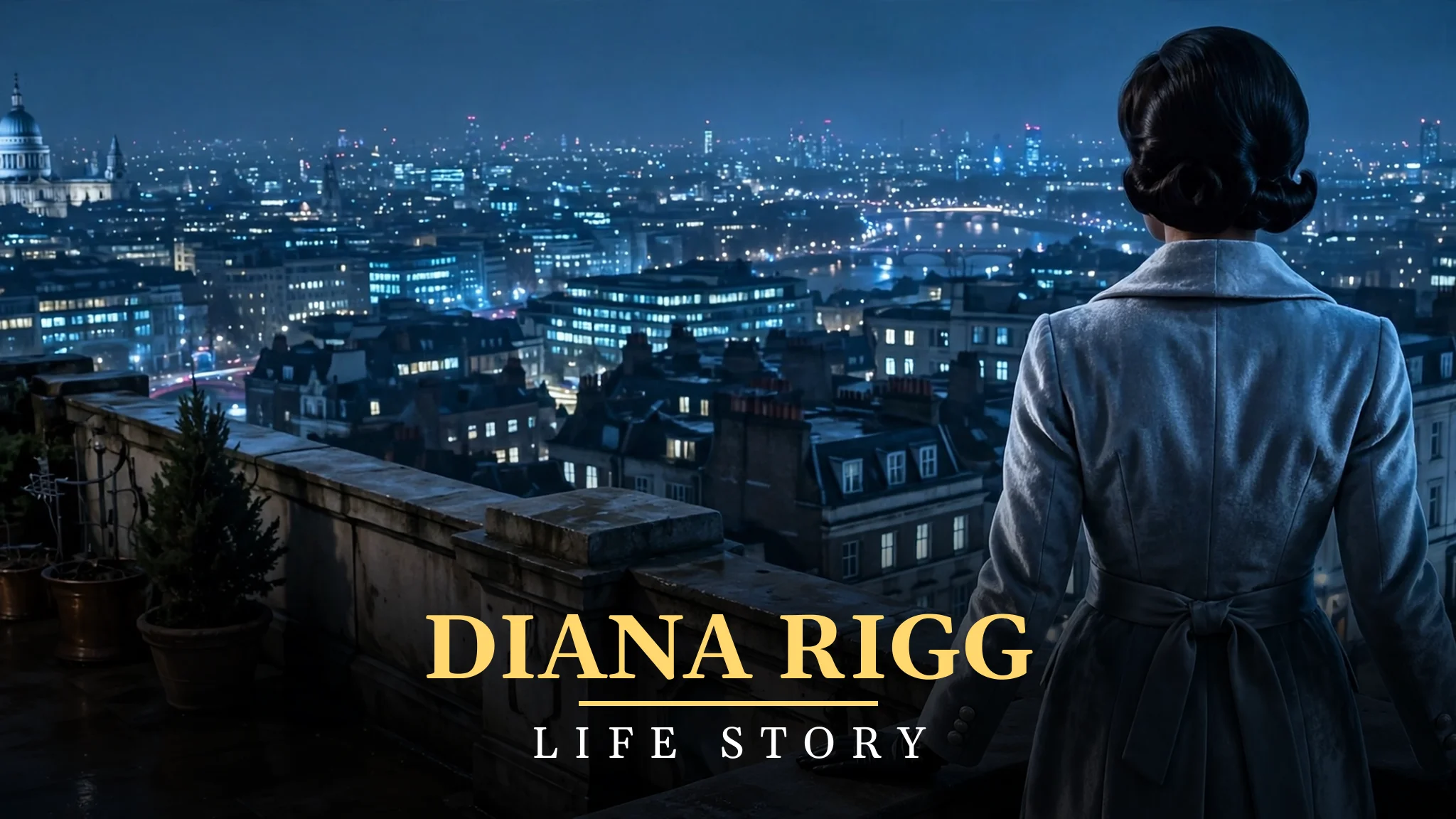
Finally, I think about the image of her standing on a rooftop at night, in a grey coat, looking over a glittering London skyline. It is a fitting image for a woman who lived in London, who loved the city, and who understood that a great city is full of stories. She knew that people are not simple, and that even a secret agent can have a kind heart. That is a truth worth remembering, and it is one that Rigg’s life and work teach us well.
I also think about how she has shown that an actor can be a sex symbol and a serious artist at the same time, and that those two things do not have to fight each other. She was Emma Peel in a catsuit, and she was Medea on Broadway, and she was both without apology. I hope that more actors will follow her example, and that more women will feel free to be both beautiful and clever, both strong and kind.
Frequently Asked Questions
Why was Diana Rigg’s Emma Peel so important on television?
She played a clever secret agent who could fight and think for herself in The Avengers, becoming a symbol of independent women in the 1960s.
What did Diana Rigg play in Game of Thrones?
She played Olenna Tyrell, the sharp-tongued grandmother known as the Queen of Thorns, from 2013 to 2017, winning praise for her wit.
Was Diana Rigg a Bond girl?
Yes, she played Tracy di Vicenzo in On Her Majesty’s Secret Service in 1969, the only woman James Bond ever marries in the films.
Did Diana Rigg win a Tony Award?
Yes, she won the Tony Award for Best Actress for playing Medea on Broadway, one of the hardest roles in Greek tragedy.
Where did Diana Rigg spend her childhood?
She was born in Doncaster and lived in India from the age of two months until she was eight, when her family returned to England.
Who is Diana Rigg’s daughter?
Her daughter is Rachael Stirling, who became an actress, and Rigg spoke with pride about her work in theatre and television.
When did Diana Rigg die?
She died on 10 September 2020 at the age of eighty-two from lung cancer, and she was mourned by actors and fans around the world.


