First Phone Call Ever Made
In this post
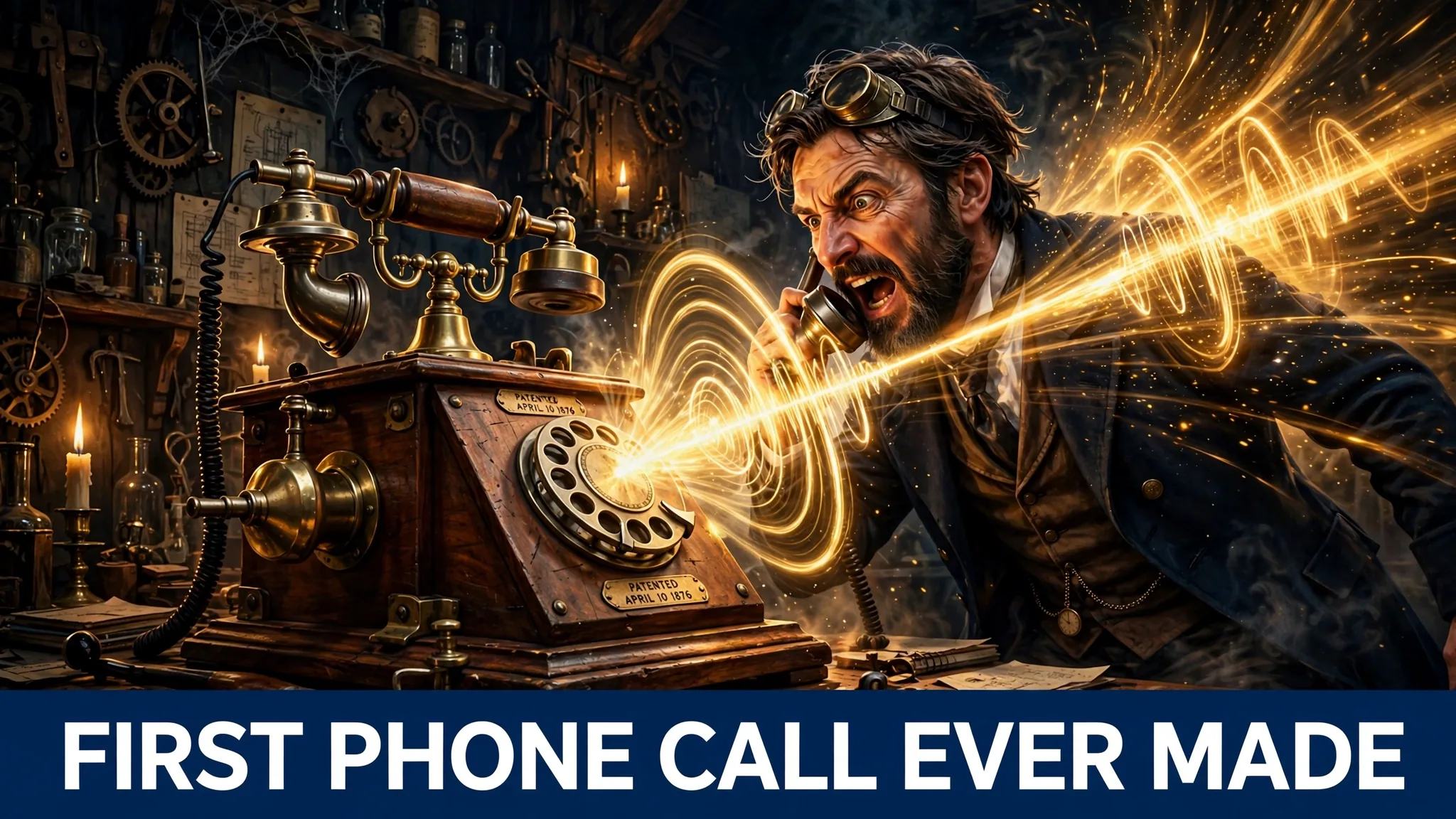
“Mr. Watson, come here, I want to see you.”
The words leave a man’s lips in a small Boston room. It is the night of 10 March 1876, and the man is not making a speech. He is calling for help — battery acid has just splashed onto his clothes, and it stings.
But hold the accident aside for one moment. Those plain words are doing something no spoken words have ever done before. They are travelling through a wire. In the next room, a second man sits with a receiver pressed to his ear — and he hears them. Clearly. Every word.
Human speech has just flown through metal for the first time in recorded history.
Before That Night: A Boy Raised Around Voices
To understand the man in that room, step backwards with me.
Alexander Graham Bell was born in Edinburgh, Scotland, on 3 March 1847. Speech was the family trade. His father and grandfather were both experts in elocution, the art of speaking well and clearly. And his mother lost her hearing through illness — so in Bell’s own home, sound was never a small thing. It was a daily question: how does a voice reach a person, and what happens when it cannot?
In 1870 the family crossed the ocean to Canada. Bell soon moved on to Boston, where he trained teachers of deaf students and became a professor of vocal physiology at Boston University. His working days belonged to helping deaf people speak. His evenings belonged to a stubborn private idea: a voice is only vibrations in the air — so why could those vibrations not be turned into electricity, sent down a wire, and rebuilt into a voice at the far end?
The Side Project That Swallowed the Main One
Bell’s paid work pointed somewhere else entirely.
The telegraph ruled the 1870s, yet it could only tap out coded clicks, and each wire carried just one message at a time. Wires cost money. So inventors chased the “harmonic telegraph” — a way to push several messages down a single wire at once, each one riding its own musical pitch. That chase was Bell’s official project, funded by two wealthy backers, Gardiner Greene Hubbard and Thomas Sanders.
Building the fiddly instruments fell to Thomas A. Watson, a young mechanic from a Boston electrical workshop with gifted hands. Watson built. Bell imagined. Night after night, the two of them edged forward together.
Then, in June 1875, came an accident of a luckier kind. Watson, in one room, was plucking at a metal reed that had stuck. Bell, listening at a receiver in the next room, heard the reed’s twang arrive through the wire — not as a click, but as a living sound, carried by an electric current that rose and fell like the sound itself. Bell came running, demanding to know exactly what Watson had touched. If a current could copy the twang of a spring, why not the far richer waves of a voice?
The Men Who Nearly Beat Him to It
Bell was racing, whether he liked it or not — and the field was crowded.
In Germany, Johann Philipp Reis had built a device back in 1861 and even named it the “telephon”. It could carry tones and fragments of sound, but never clear, dependable speech. In America, the Italian inventor Antonio Meucci had put together a voice-communication apparatus as early as 1849 and filed a patent caveat — a formal notice that an invention existed — in 1871. Meucci simply lacked the money to secure a full patent.
The nearest rival of all was Elisha Gray, a respected electrical inventor circling the same idea. On 14 February 1876, Bell’s lawyer delivered Bell’s patent application in Washington. A few hours later, that very same day, Gray filed his own notice for a similar telephone — one that, like Bell’s freshest experiments, worked with a liquid transmitter. The telephone’s future may have turned on a single morning.
On 7 March 1876, the grant arrived: United States Patent No. 174,465. Bell held the paper crown. But paper is not proof. Nowhere on Earth had anyone yet heard a complete sentence come through a wire, clean and understood. That proof was three days away.
Back in the Room: A Jar of Acid Water Does the Talking
The machine waiting on the bench that March night used a liquid transmitter, and its working parts can be explained in plain words.
A thin diaphragm — a disc like a tight skin — has a fine wire fastened to it. The wire dips into slightly acid water. Speak into the mouthpiece and your voice shakes the diaphragm; the wire bobs up and down in the liquid; and the electric current running through the circuit swells and fades in the exact pattern of your voice. At the far end, a receiver takes that swelling and fading current and turns it back into sound.
Now the famous moment — and honesty matters here. The account kept in the Bell System’s own history tells it this way: Bell was finishing the last connection on the new transmitter when battery acid spilled over his clothes, and in genuine pain and trouble he called out to his assistant — straight into the mouthpiece. That is how the Bell System itself preserved the tale, and it is as their record that we pass it on. The first telephone call was never a prepared line. It was a real cry for help: “Mr. Watson, come here, I want to see you.”
Watson heard every word distinctly at his end of the line. He burst in, overjoyed, and confirmed the sentence had come through clearly. Then the two men swapped places. Watson read passages aloud from a book into the transmitter while Bell listened — muffled sounds, yes, but unmistakably articulated speech. Before the night ended, Bell wrote the whole event into his laboratory notebook, exact words and all. That notebook survives today, held by the Library of Congress.
Why One Name Survived the Fight
Reis, Meucci and Gray each did genuine, important work, and quarrels over the telephone’s true father have never completely closed. So why does the world say “Bell”?
Two anchors hold his name in place. The first is documentation: his March 1876 trial is the earliest clearly recorded sending of a complete, intelligible sentence by telephone, written down the very night it happened, in a notebook anyone can still examine. The second is the law. Bell owned the patent, and he defended it without rest — between 1876 and 1890, hundreds of lawsuits attacked his claims, and the Bell side won every single one. A proven experiment plus a protected patent gave investors the confidence to build an industry around the invention.
To me, the near-misses are the saddest part of the tale. Gray missed by hours. Meucci missed by money. History is not always unkind — but it is rarely fair about second place.
Year by Year: The Wire Escapes the Laboratory
1877. The first commercial telephones go on sale — sold in pairs. One instrument for your house, one for your shop, joined by a private wire that belongs to you alone.
1877. The Bell Telephone Company is formed, the seed of the giant that would one day be known as AT&T.
28 January 1878. The first commercial telephone exchange opens in New Haven, Connecticut. An operator at a central office can now connect any telephone to any other — and the exchange starts with just 21 subscribers.
Within three years. The count of telephone lines in use climbs to nearly 50,000.
1915. The first coast-to-coast call crosses the United States — and the voices are the same two from that Boston night. Bell speaks from New York. Watson answers from San Francisco. A few rooms have become a continent.
Then and Now
Then: two rooms, one wire, nine spoken words. Now: the person you love, in your ear, from another country.
Then: telephones sold in matching pairs, tied together by a private line. Now: one small phone in your pocket can reach almost any human being alive.
Then: 21 subscribers in a single Connecticut town. Now: by EBSCO’s count, mobile phone subscriptions on Earth outnumber the people living on it.
Then: a sentence shouted in pain because acid burned through a man’s clothes. Now: countless everyday hellos — and every one of them walks the road that wire opened in 1876.
Frequently Asked Questions
What were the exact words of the first telephone call? “Mr. Watson, come here, I want to see you.” Bell recorded them in his laboratory notebook on the night itself, 10 March 1876, and that notebook is now kept by the Library of Congress.
Had anyone sent speech through a wire before that night? Earlier inventors had sent tones and partial sounds. Philipp Reis built his “telephon” in 1861 and Antonio Meucci had a voice apparatus decades before Bell — but Bell’s was the first clearly documented sending of a complete, understandable sentence, and he held the patent besides.
Why did Bell choose that particular sentence? He did not choose it at all. Going by the account preserved in the Bell System’s own history, he had just spilled battery acid on his clothes while finishing a connection, and he was truly calling his assistant for assistance.
Who was the Watson in the sentence? Thomas A. Watson, Bell’s young assistant — a skilled mechanic who built the experimental instruments by hand. He was stationed at the receiving end that night and heard the first telephone sentence ever sent.
Did Bell create the telephone entirely by himself? No. Several inventors were closing in on the same goal, and Elisha Gray filed his own telephone notice only hours after Bell’s application on 14 February 1876. Bell’s documented success, plus a patent that survived hundreds of legal challenges, is why his name leads the story.
When did telephones reach ordinary homes and shops? Commercial sets were sold in pairs starting in 1877, the Bell Telephone Company was formed the same year, and the first exchange opened in New Haven in January 1878 with 21 subscribers. Within three years, nearly 50,000 lines were working.
Sources
- Library of Congress, “Alexander Graham Bell Family Papers” (finding aid): https://tile.loc.gov/storage-services/service/gdc/gdcfindingaidpdfs/ms000011/ms000011.pdf
- Linda Hall Library, “Alexander Graham Bell — Scientist of the Day”: https://www.lindahall.org/about/news/scientist-of-the-day/alexander-graham-bell/
- EBSCO Research Starters, “Telephone — History”: https://www.ebsco.com/research-starters/history/telephone
- Wikipedia, “History of the Telephone”: https://en.wikipedia.org/wiki/History_of_the_telephone
- Western Electric, “Brief History of Communications” (textbook chapter): https://www.scribd.com/document/556667956/1-History
- The picture on this page is an original illustration made for Talha M Blog.