Footprints On Moon Last Forever
In this post
Press your foot into wet sand at the beach, then look back a minute later. The sea has already smoothed your footprint away, as if you were never there. On Earth, footprints are some of the shortest-lived marks we make. Wind, water and other feet destroy them within hours.
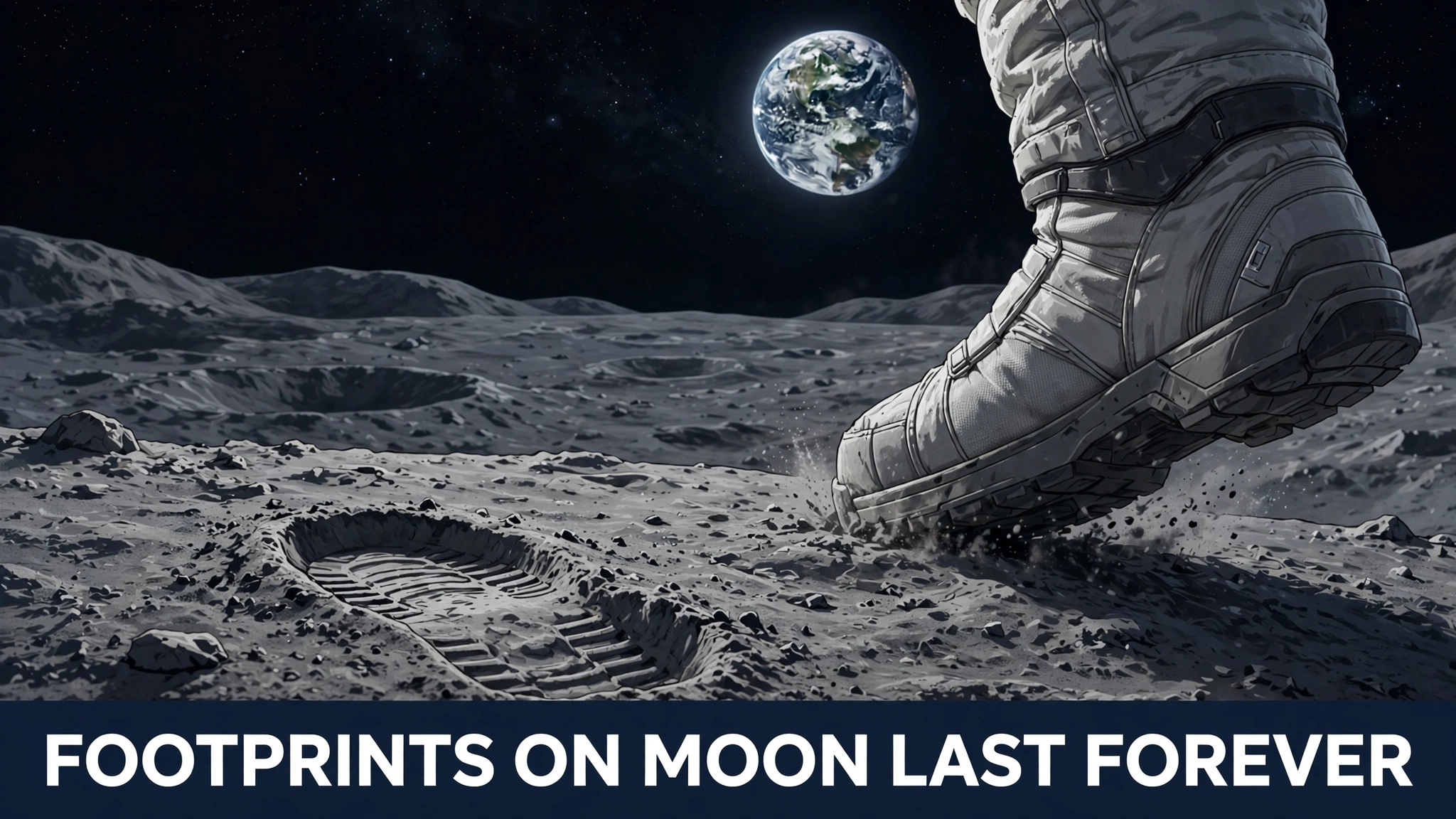
Now think about the strangest fact in this whole story: the footprints pressed into the Moon by Apollo astronauts in 1969 are still there today — every single one of them, sharp and clear, more than fifty years later. No storm has touched them. No rain has washed them. Scientists believe they may stay readable for millions of years. Here is why the Moon is the greatest footprint-keeper in the solar system.
July 1969: Humanity Steps Onto Another World
On 20 July 1969, Apollo 11 astronauts Neil Armstrong and Buzz Aldrin became the first people to walk on the Moon. Their landing craft, the Eagle, stayed on the surface for about 22 hours, and during their walk outside they crossed and recrossed the dusty ground around it, leaving trails of bootprints in every direction.
Apollo 11 was only the beginning. Between 1969 and 1972, six Apollo missions landed astronauts on the Moon. Each crew walked, worked and — on the last three missions — drove a small electric rover across the surface. Every step and every wheel pressed a mark into the dust. The final crew, Apollo 17, left the last human foot trails on the Moon in December 1972.
On Earth, all of those marks would have vanished before the astronauts even got home. On the Moon, they simply stayed.
The Most Famous Footprint In History
One footprint from Apollo 11 became world-famous as a photograph — and its story is not what most people guess. It was not a careless step captured by chance. Buzz Aldrin made that print on purpose.
During the moonwalk, Aldrin found a clean, untouched patch of dust. He pressed his boot firmly into it, stepped back, and photographed the result with great care. Soil scientists back on Earth wanted to study exactly how the lunar ground gives way under a person’s weight — how deep a boot sinks, and how the dust piles up and cracks at the edges. The crisp picture he took, catalogued by NASA as AS11-40-5877, did its scientific job, and then it did something more: it became the portrait of humanity’s first steps on another world.
That print is still sitting in the dust at the Apollo 11 landing site today. And the same is true of the millions of other marks — bootprints, rover tracks, and the scars left where equipment was dragged and set down.
Why Nothing Erases A Footprint On The Moon
A footprint is destroyed by movement — moving air, moving water, moving feet. The Moon, helpfully, has almost none of these.
First, the Moon has no real atmosphere. With no air, there is no wind. Nothing blows across the surface to fill in a bootprint or carry the dust away. Second, there is no liquid water on the surface — no rain, no rivers, no waves. Nothing flows, so nothing washes a footprint flat. Third, there is no life: no plants pushing roots through the ground, no animals walking over the marks, no tiny creatures churning the soil. And fourth, the Moon is geologically quiet, with no active volcanoes or shifting plates to remake its surface.
Even the dust itself helps. The lunar surface is covered in regolith — a layer of rock crushed to powder by billions of years of impacts. Unlike beach sand, whose grains are rounded and slippery, these grains are dry and sharp-edged. Pressed down under a heavy boot, they lock together and hold their shape with remarkable faithfulness, even keeping the fine tread pattern of the sole.
On Earth, nature deletes a footprint in hours. On the Moon, nature barely owns an eraser at all.
The Slow Erasers: A Rain Of Space Dust
Barely — but not quite zero. The Moon does have weather of a sort; it just arrives from space, and it works at a speed that makes glaciers look hasty.
The main culprit is a constant rain of micrometeorites: specks of rock and dust, often smaller than a grain of sand, slamming into the Moon at tens of thousands of kilometres per hour. Each impact is microscopic, but together, over immense spans of time, they sandblast the surface and slowly stir its top layer — a process scientists sometimes call gardening. Measurements from Moon rocks brought home by Apollo suggest the surface wears down at only about a millimetre every million years or so. Added to that are the solar wind and cosmic rays, which slowly weather exposed material, and the savage swing in temperature between the scorching lunar day and the freezing lunar night, which stresses the ground a little more with every cycle.
So how long can a bootprint survive all that? Estimates are only estimates — nobody can stand on the Moon in a million years and check — but they agree on the scale. A print pressed centimetres deep should stay recognisable for millions of years. Even the deepest tracks and equipment scars are expected to soften away completely only after tens of millions of years. There is one wildcard: a single larger meteorite striking a landing site could blast a crater over the marks in one violent second. Barring that unlucky hit, Apollo’s traces will outlast every building, every language and quite possibly our species’ time on Earth.
Proof From Orbit: A Camera Goes Back To Look
This is not just theory. We have photographs.
NASA’s Lunar Reconnaissance Orbiter, launched in June 2009, carries cameras sharp enough to pick out objects about half a metre across on the surface below. Within weeks of arriving, it photographed the Apollo 11 site and found the descent stage of the Eagle still sitting where Aldrin and Armstrong left it.
In 2011 the orbiter was dropped into a much lower orbit, at times skimming just 21 kilometres above the ground, and it took the sharpest views yet of the Apollo 12, 14 and 17 sites. In those images you can see the descent stages, the science instruments the crews set up, and — most moving of all — the dark trails where the astronauts walked. At Apollo 17, the twin tracks of the lunar rover show up as sharp parallel lines, clearly different from the wandering footpaths of the astronauts, including the very last path human feet ever made on the Moon. Bright marks reveal cables running between instruments, too reflective to hide even from orbit.
One honest detail: from that height, the camera cannot quite make out a single bootprint’s tread. What it sees are the trampled paths, tracks and scars as a whole — clear proof that the marks of Apollo are still there, decades on, exactly where history says they should be.
What Will Finally Fade Them
So the footprints are not eternal — they are simply on a very, very slow clock. The micrometeorite rain never stops, grain by grain, century by century. Edges will soften first. Then the tread patterns will blur into plain dents. Then the dents will blend into ordinary ground, and the rover tracks will follow, until one far-off age when the landing sites are just slightly disturbed dust that no eye could read.
Until then, the Moon keeps our first steps the way a museum keeps its treasures — untouched, in the dark, under a black sky. The next visitor to stand at Tranquility Base, whenever that may be, will find our footprints waiting.
Frequently Asked Questions
Are the Apollo footprints really still on the Moon? Yes. NASA’s Lunar Reconnaissance Orbiter has photographed the Apollo landing sites and found the landers, instruments, rover tracks and astronaut trails still in place, decades after the missions.
Why does the Moon have no wind or rain? Because it has almost no atmosphere. Wind is moving air, and rain needs air and water cycles. The Moon has neither, and no liquid water on its surface, so nothing blows or washes footprints away.
Can we see the footprints from Earth with a telescope? No. They are far too small for any Earth telescope. Only a spacecraft orbiting close to the Moon, like NASA’s Lunar Reconnaissance Orbiter, can photograph the landing sites — and even it sees trails and tracks rather than one single print in fine detail.
How long will the footprints last? Scientists can only estimate, but the numbers are enormous: the prints should stay recognisable for millions of years, and even the deepest Apollo traces may take tens of millions of years to be smoothed away completely by micrometeorite impacts.
Whose footprint is in the famous Apollo 11 photograph? Buzz Aldrin’s. He pressed his boot into an untouched patch of dust on purpose and photographed it himself, so scientists on Earth could study how the Moon’s soil behaves under weight.
Sources
- NASA Science, “Apollo 11 Landing Site”: https://science.nasa.gov/earth/earth-observatory/apollo-11-landing-site-39408/
- Arizona State University (LROC team) via Phys.org, “New LROC images offer sharper views of Apollo 12, 14, 17 sites”: https://phys.org/news/2011-09-lroc-images-sharper-views-apollo.html
- NASA photograph AS11-40-5877, “Buzz Aldrin’s bootprint on the Moon”, via Wikimedia Commons: https://en.wikipedia.org/wiki/File:Buzz_Aldrin%27s_bootprint_on_the_Moon,_AS11-40-5877.jpg
- The picture on this page is an original illustration made for Talha M Blog.