George C. Scott: The Life Story Behind the Patton Star
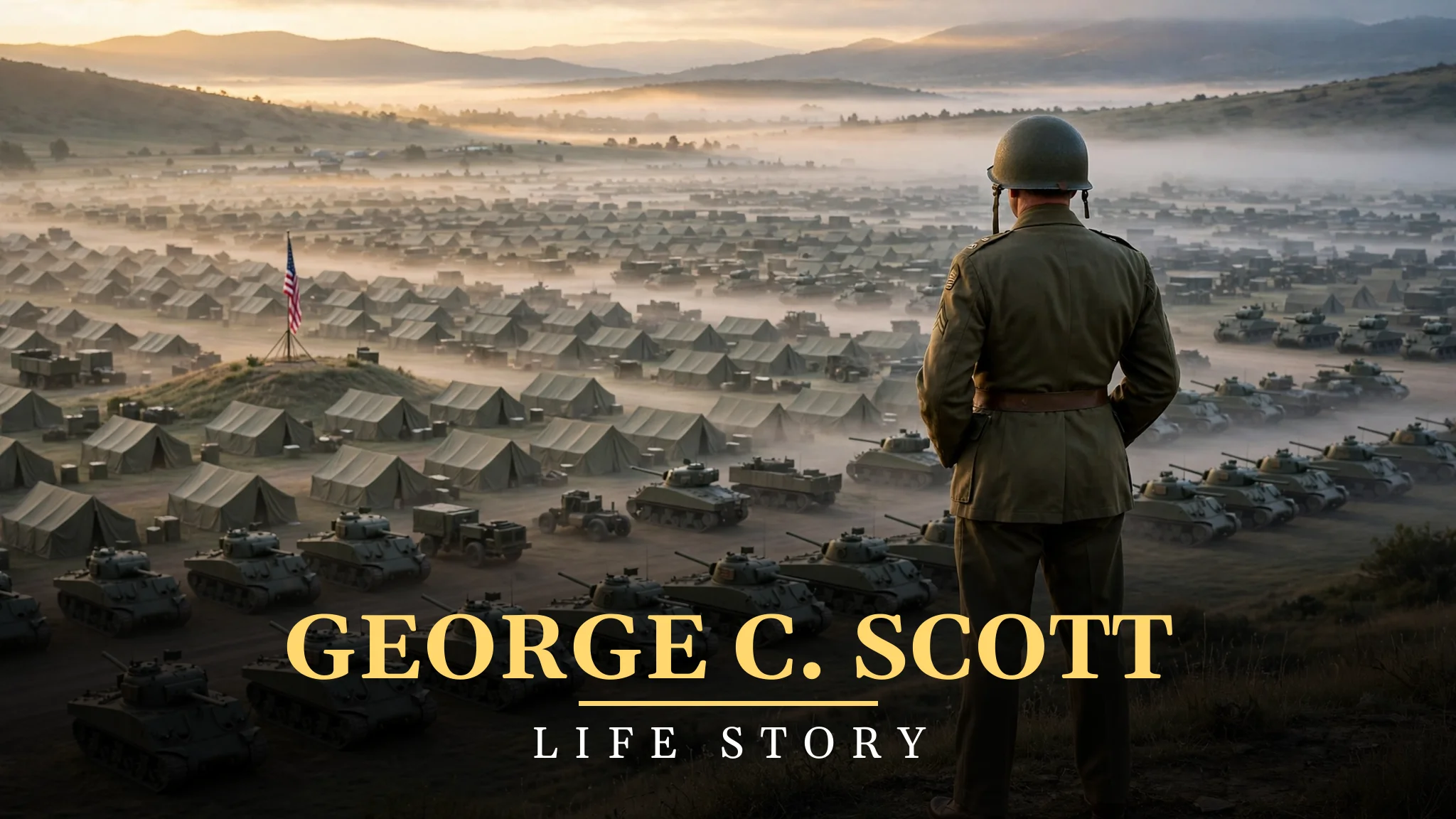
In this post
- A Virginia Boy Raised in Detroit
- The Marines, College, and the New York Stage
- Anatomy of a Murder, The Hustler, and Dr. Strangelove
- Patton and the Oscar He Refused
- Later Films, Stage Work, and a Restless Life
- A Christmas Carol, The Changeling, and the Stage at Heart
- The Director, the Father, and the Man at Home
- My Take:
George C. Scott had a voice that could fill a theatre without a microphone, and a presence that made other actors seem small by comparison. He was a big man, with a big temper, a big talent, and a big refusal to play by Hollywood’s rules. He won an Oscar for playing General Patton, one of the most famous roles in film history, and then he refused to accept it, because he believed that acting was not a competition. That single act tells you almost everything you need to know about him. He was a man who cared about the work, not about the prize.
He was born George Campbell Scott on 18 October 1927 in Wise, Virginia, a small town in the mountains of southwestern Virginia, and he grew up in Detroit, Michigan, after his family moved there when he was still young. His mother died when he was eight years old, a loss that shaped his childhood and that gave him a seriousness beyond his years. His father worked for the Ford Motor Company, and the family lived a modest life in a city that was built on cars, factories, and hard work. Young George learned early that life could be hard, and that a person had to be strong to get through it.
He joined the United States Marine Corps when he was still a teenager, and he served for four years, learning discipline, leadership, and the value of hard work. After the Marines, he went to university in Missouri, where he studied journalism and then drama, and he discovered that he had a gift for acting. He went to New York, he worked on the stage, and he became one of the most respected actors of his generation, on stage and on screen, before Hollywood finally made him a star.
A Virginia Boy Raised in Detroit
George C. Scott was born in Wise, Virginia, in the Appalachian Mountains, a place of coal, timber, and small towns where people lived close to the land. His family moved to Detroit when he was young, and he grew up in a city that was very different from the mountains of Virginia. Detroit was loud, busy, and industrial, full of factories, cars, and people who had come from all over America to work. The move gave young George a sense of two very different Americas, the quiet mountains and the noisy city, and that sense stayed with him.
His mother, Helena, died when George was eight, and the loss was a heavy one for a young boy. He was raised by his father, George Dewey Scott, who worked as an executive at the Ford Motor Company, and who tried to give his son a stable home. The family was not poor, but it was not rich either, and George learned to be independent, to look after himself, and to find his own way in the world. He was a bright boy, but he was also restless, and he often got into trouble at school for his behaviour and for his strong opinions.
At school in Detroit, he showed an interest in writing and in performing, and he took part in school plays, where he discovered that he liked being on stage. He was tall, strong, and confident, and he had a voice that carried well, even as a teenager. He also loved to read, and he was drawn to stories about history, about war, and about strong men who led other men. Those interests would later show up in the roles he chose, especially in the role of General Patton, a man who was both a hero and a difficult, controversial figure.
When he finished school, he did not go straight to university. He joined the Marine Corps in 1945, at the age of seventeen, and he served for four years, until 1949. The Marines gave him discipline, and they gave him a sense of what it meant to be part of a team, to follow orders, and to lead other men. He served as a guard at Arlington National Cemetery, and he also served in different posts, learning the military life from the inside. That experience would later help him to play military men with a realism that other actors could not match.
The Marines, College, and the New York Stage
After leaving the Marines, Scott went to the University of Missouri, where he studied journalism at first, and then switched to drama, because he had discovered that acting was what he really wanted to do. He was a good student, but he was also a man who had already lived a little, who had been in the Marines, and who did not want to waste time on things that did not matter to him. He worked hard at his acting classes, he took part in university plays, and he learned the craft of the stage, how to use his voice, how to move, and how to hold an audience.
He then went to New York, where he worked on the stage and where he quickly became known as a powerful and serious actor. He appeared in plays on Broadway, including a famous production of Richard III, in which he played the villainous king with a dark and compelling energy. He also worked in the new medium of television, appearing in live dramas that were popular in the 1950s, and he earned a reputation as an actor who could be trusted to give a strong performance, even in a difficult role.
New York in the 1950s was a hard place for a young actor, with many talented people chasing a small number of jobs, but Scott had a presence that made him stand out. He was tall, he was strong, and he had a voice that could be heard at the back of a large theatre. He was not a handsome leading man in the usual sense, but he had a power that directors wanted, especially for roles that asked for a man who could lead, who could command, and who could be both inspiring and frightening at the same time.
By the late 1950s, he was a respected stage actor, and Hollywood began to notice him. He took small film roles at first, learning how a film set worked, and how to adjust his big stage style to the smaller, more intimate world of the camera. He was patient, he was professional, and he was willing to wait for the right role, because he believed that one great film was worth more than ten forgettable ones.
Anatomy of a Murder, The Hustler, and Dr. Strangelove
Scott’s first major film success came with Anatomy of a Murder in 1959, a courtroom drama directed by Otto Preminger, in which he played Claude Dancer, a tough and clever prosecutor. The film was a success, and Scott was nominated for an Academy Award for Best Supporting Actor, a sign that Hollywood had noticed his talent. He played Dancer as a man who was smart, confident, and a little arrogant, and the performance showed that he could hold his own against some of the best actors in the business.
Two years later, he appeared in The Hustler in 1961, a film about a pool player played by Paul Newman, in which Scott played Bert Gordon, a cold and calculating gambler who controls the world of high stakes pool. The role was perfect for Scott, because Bert was a man who never raised his voice, who never showed emotion, and who used his intelligence to win. Scott played him with a quiet menace that made the film unforgettable, and he was nominated for another Academy Award for Best Supporting Actor. He refused the nomination, because he believed that acting should not be a competition, a sign of the principles that would later make him famous.
In 1964, he starred in Dr. Strangelove, a dark comedy directed by Stanley Kubrick about a nuclear war that starts by accident. Scott played General Buck Turgidson, a loud, aggressive, and slightly comic American general who argues for war in a meeting with the president. The role was very different from his earlier work, because it asked him to be funny, to be larger than life, and to play a man who was both frightening and ridiculous at the same time. Kubrick pushed him to go further, to be bigger and louder than he had ever been on screen, and the result was one of the most memorable performances in the film, a performance that is still quoted and imitated today.
These three films showed the range of Scott’s talent. He could play a lawyer, a gambler, and a general, and he could make each one feel real and different. He was not a star who played himself in every film. He was an actor who became the character, and who brought a deep understanding of human nature to each role. That range made him one of the most respected actors of his time, and it set the stage for the role that would make him world famous.
Patton and the Oscar He Refused
The role that defined George C. Scott’s career was General George S. Patton in Patton, released in 1970. The film told the story of the American general who led Allied forces in North Africa and Europe during the Second World War, a brilliant and controversial commander who was loved by his men and feared by his superiors. Scott played Patton as a complex man, a soldier who believed in war, who loved history, and who was both a hero and a difficult, arrogant figure. The opening scene, in which Patton stands in front of a huge American flag and gives a speech to his troops, became one of the most famous scenes in film history.
Scott prepared for the role with great care, studying Patton’s life, his speeches, and his manner, and he worked hard to capture the general’s voice, his walk, and his way of thinking. He did not play Patton as a simple hero. He played him as a man who was driven by a belief in his own destiny, who was impatient with politicians, and who sometimes made mistakes because of his pride. That honesty made the film powerful, and it made Scott’s performance one of the greatest in the history of cinema.
When Patton was released, it was a huge success, winning seven Academy Awards, including Best Picture. Scott won the Academy Award for Best Actor, but he refused to accept it. He had already said that he did not believe in awards for acting, because he thought that acting was not a contest, and that it was wrong to compare one actor’s work with another’s. He did not attend the ceremony, and he asked the Academy not to give him the award. The Academy gave it to him anyway, and he kept his refusal, a decision that made headlines around the world and that made him famous as a man of principle.
The refusal did not hurt his career. If anything, it made him more respected, because it showed that he cared more about the work than about the prize. He continued to act, he continued to direct, and he continued to speak his mind about Hollywood, about politics, and about the world. He was a man who did what he believed was right, even when it was unpopular, and that integrity became part of his legend.
Later Films, Stage Work, and a Restless Life
After Patton, Scott continued to work in films and on the stage, taking on a wide range of roles that showed his range and his restlessness. He starred in The Hospital in 1971, a dark comedy about a doctor in a chaotic city hospital, and he won praise for his performance as a tired and angry man trying to do his job in a broken system. He also directed films, including Rage in 1972, a drama about a man whose son is poisoned by a chemical company, and he showed that he was interested in stories about ordinary people fighting against powerful forces.
He also returned to the stage again and again, because the theatre was where he felt most at home. He played King Lear, he played Richard III, and he played other great roles in Shakespeare, bringing his big voice and his powerful presence to the stage in a way that audiences never forgot. He was a stage actor first, and a film actor second, and he never lost his love of live theatre, even when film made him famous and wealthy.
His personal life was often turbulent, and he was married five times, including twice to the actress Colleen Dewhurst, with whom he had two sons, and later to the actress Trish Van Devere, with whom he stayed until his death. He was known for his temper, for his drinking, and for his strong opinions, and he did not always get along with directors, producers, or other actors. He was a difficult man at times, but he was also a generous and loyal friend to those who knew him well, and he was deeply committed to his craft.
In his later years, he worked less often, but he continued to take on roles that interested him, including a part in the television film A Christmas Carol in 1984, in which he played Ebenezer Scrooge, a role that suited his age and his gravitas. He also appeared in films such as The Changeling in 1980, a ghost story, and Hardcore in 1979, a drama about a father searching for his missing daughter. Each role showed a different side of him, and each one reminded audiences that he was still one of the most powerful actors alive.
A Christmas Carol, The Changeling, and the Stage at Heart
George C. Scott never lost his love of the stage, and he returned to it again and again, even after film had made him famous and wealthy. He played King Lear, Richard III, and other great Shakespearean roles, bringing his big voice and his powerful presence to theatres in New York and in other cities, and audiences who saw him on stage never forgot the experience. He believed that live theatre was the true test of an actor, because there were no second takes, no editing, and no camera tricks, only the actor, the audience, and the words of the play. That belief kept him honest, and it kept him working hard, even when film offered him easier money and more fame.
On screen in his later years, he took on roles that suited his age and his gravitas, including Ebenezer Scrooge in A Christmas Carol, a television film released in 1984, in which he played the miserly old man who learns to be kind after being visited by three ghosts. The role was perfect for Scott, because Scrooge is a man who is angry, lonely, and afraid, and who changes, slowly, into a man who cares about other people. Scott played that change with a warmth and a depth that made the film a favourite with families, and it is still watched every Christmas by audiences who love his performance.
He also starred in The Changeling in 1980, a ghost story about a man who moves into a large, old house and discovers a terrible secret from the past. The film was a quiet, unsettling horror story, and Scott played the central role with a tired, sad dignity that made the film feel real, not like a simple scare. He also appeared in Hardcore in 1979, a drama about a father searching for his missing daughter in the world of adult films, a difficult and painful role that showed his willingness to take on subjects that other actors would avoid.
These later roles showed that Scott was still a powerful actor, even when he was in his fifties and sixties, and that he had not lost his love of acting, even when the big leading roles were fewer. He was a man who worked because he loved to work, not because he needed the money or the fame, and that love showed in every performance, whether it was on stage in Shakespeare, on television as Scrooge, or on film as a general, a lawyer, or a father searching for his child.
The Director, the Father, and the Man at Home
George C. Scott was also a director, and he directed films that showed his interest in stories about ordinary people fighting against powerful forces. He directed Rage in 1972, a drama about a man whose son is poisoned by a chemical company, and he brought the same intensity to directing that he brought to acting, working hard to make the film feel real and honest. He was a man who cared about justice, about fairness, and about the little man standing up to a big system, and those themes showed up again and again in the films he chose to make.
He was also a father, and he tried to be a good one, even when his career took him away from home and even when his temper made family life difficult. He had two sons with Colleen Dewhurst, Campbell and Alexander, and he loved them deeply, even when he did not always show it well. He was a complicated man, a brilliant actor, a difficult husband, and a loving father, all at the same time, and that complexity is part of what makes his story so human and so interesting.
He was also a man who loved to read, who loved history, and who spent hours studying the lives of the men he played, especially Patton, whose speeches, letters, and diaries he read again and again to understand how the general thought, how he spoke, and how he led his men. That preparation was a central part of his method, and it showed in the depth of his performance, which felt researched, thoughtful, and real, not like a quick imitation of a famous man.
He was also known for his generosity to young actors, sharing what he had learned about the stage, about film, and about how to survive in a business that can be cruel, and telling them to work hard, to be honest, and to never give up on a role they believed in, advice that came from a man who had lived it himself, from the Marines to Broadway to Hollywood.
My Take:
When I think about George C. Scott, I think about a man who refused to be owned by Hollywood. He won an Oscar, the biggest prize in film, and he said no to it, because he believed that acting was not a race. That takes a rare kind of courage, because most actors dream of winning an Oscar, and they would do almost anything to get one. Scott did the opposite. He said that the work itself was the reward, and that a prize could not make a performance better or worse. I admire that, because it shows a man who knew what mattered to him, and who was not afraid to say so in public.
I also think about his performance as Patton, because it is one of the greatest performances I have ever seen. He does not play Patton as a simple hero. He plays him as a man who is brilliant, arrogant, funny, and frightening, all at the same time. The opening speech, in front of the huge American flag, is famous, but it is not just a speech. It is a portrait of a man who believes in war, who loves his men, and who is willing to die for what he believes in. Scott makes you understand Patton, even when you do not agree with him, and that is a very hard thing to do.
What I find most impressive about Scott is his voice. He had a voice that could be soft and quiet, and then suddenly loud and powerful, and he used it like an instrument. On stage, that voice could fill a theatre, and on film, it could make a simple line sound important. I think his voice was one of the reasons he was so good at playing generals, lawyers, and kings, because those are men who need to be heard, and Scott made sure that people listened.
His refusal of the Oscar nomination for The Hustler is another part of his story that I admire. He was nominated, and he said no, because he did not want to be part of a competition. That is a principled stand, and it is one that few actors would take today, when awards are so important to a career. Scott did not care about his career in that way. He cared about the work, and he was willing to risk his standing in Hollywood to protect that belief. That is integrity, and it is rare.
I also think about his childhood, and how the death of his mother when he was eight must have shaped him. A boy who loses his mother young learns that life is not fair, and that the people you love can be taken away without warning. That lesson can make a person angry, or it can make a person serious about life. In Scott’s case, I think it did both. He was angry, and he was serious, and he brought both of those feelings to his acting. That is why his performances feel so real, because they come from a real place of loss.
His time in the Marines is another important part of his story. He served for four years, he learned discipline, and he learned what it meant to be part of a military team. That experience helped him to play Patton, because he understood the military from the inside, not just from books. He knew how soldiers talked, how they thought, and how they felt about their commanders. That knowledge made his Patton feel true, in a way that an actor without that experience could never have achieved.
There is a sadness in his story too, which is that his temper and his drinking sometimes hurt his career and his relationships. He was married five times, and he was known for being difficult on set, for arguing with directors, and for drinking too much. I do not say that to judge him, because many talented people struggle with those things, but I do think it is a reminder that great talent does not always come with an easy life. Scott was a brilliant actor, but he was also a troubled man, and the two sides of him were linked.
What I learn from his life is that principles matter, even when they cost you something. Scott could have accepted the Oscar, he could have smiled for the cameras, and he could have used the award to get more work and more money. Instead, he said no, and he kept saying no, because he believed that acting should not be judged like a sport. That is a brave choice, and it is one that I respect, even if I do not fully agree with it. I think awards can be a good way to recognise great work, but I also think Scott was right that they should not be the reason an actor works.
I think about his stage work, and how he kept returning to the theatre, even after he became a film star. That tells me that he loved acting for its own sake, not just for fame or money. The theatre is hard work, with long rehearsals, live audiences, and no second takes, and Scott loved that challenge. He played Shakespeare, he played modern dramas, and he gave everything he had to each performance. That love of the stage is a good lesson for any actor who thinks that film is the only place to be.
If I could ask him one question, I would ask him what he thought about when he was standing in front of that huge flag in Patton, giving the opening speech, and whether he felt, even for a moment, that he had become Patton himself. I think he would have a thoughtful answer, because he was a man who thought deeply about his roles, and who understood the difference between playing a man and becoming him. I would like to hear that answer, because it would tell me a lot about what acting really is.
In the end, I see George C. Scott as a man who was too big for Hollywood, in every sense. He was too tall, too loud, too honest, and too principled to fit into the neat boxes that the industry likes to put actors in. He was a Marine, a stage actor, a film star, and a man who said no to an Oscar, and he did all of those things with a passion that few people can match. That is why his work still matters, and why Patton is still watched today as one of the greatest films ever made.
I keep returning to the idea that he was a man of contradictions. He was a soldier who became an actor, a man who loved the theatre but who became famous in film, a man who won an Oscar but who refused it. Those contradictions make him interesting, because they show that a person can be many things at once, and that a life does not have to be simple to be meaningful. Scott’s life was not simple, but it was meaningful, and I think that is a good way to be remembered.
When I watch his films now, I do not just see a powerful actor. I see a man who believed in his work, who believed in his principles, and who was willing to stand alone for what he thought was right. That is a rare kind of courage, and it is one that I admire deeply. George C. Scott was not a perfect man, but he was an honest one, and in a world full of pretence, honesty is a precious thing.
I also think about his performance as Scrooge, because it shows a different side of Scott from the general and the lawyer. Scrooge is a lonely, angry old man who learns to be kind, and Scott plays that change with a warmth that makes the film feel like a real Christmas story, not just a television movie. He was in his late fifties when he played Scrooge, and he brought a lifetime of experience to the role, a sense of what it feels like to be alone, to be afraid, and to want a second chance. That is a beautiful performance, and it is one that families still watch every year.
Another thing that stays with me is his love of Shakespeare, and how he kept returning to the stage to play Lear, Richard III, and other great roles, even when film made him rich and famous. That love tells me that he was an actor first, and a star second, and that he valued the craft of acting more than the rewards that came with it. Many film stars never go back to the stage, because it is hard work, with long rehearsals and live audiences, but Scott did, again and again, because he believed that the stage was where an actor truly learns his trade.
I think about his temper, and how it sometimes hurt him, and I feel sympathy for a man who felt so deeply that he could not always control his anger. He was known for arguing with directors, for drinking too much, and for being difficult on set, and those things are part of his story, but they are not the whole story. The whole story is also about a man who gave everything to his work, who was generous to his friends, and who was deeply committed to the truth, even when the truth was uncomfortable. That is a human story, and it deserves to be told with compassion, not just with criticism.
There is also a lesson here about the difference between being loud and being powerful. Scott could be loud, especially as General Turgidson in Dr. Strangelove, but his most powerful moments were often quiet, when he let his voice drop, when he looked at another actor, and when he let the audience see what he was thinking. That quiet power is harder to achieve than loud power, and it is one of the reasons his performances still feel so strong today, even when the films around them have become dated.
Finally, I think about the opening of Patton, and how that one scene, with the huge flag and the speech, became a symbol of American cinema. Scott stands there, alone, talking to his troops, and he makes you believe that this man, with all his flaws, could lead an army. That is a remarkable achievement, and it is one that few actors could have managed. I will always remember that scene, not just for the flag or the speech, but for the man in the centre of it, a man who believed in what he was saying, and who made us believe it too.
I also think about how his voice, big and powerful, could fill a theatre, and how that voice made even a simple line sound important. He used his voice like an instrument, soft one moment and loud the next, and that control is a mark of a great actor, one who understands that acting is not just about words, but about sound, silence, and timing.
When I watch Patton now, I still feel the power of that performance, and I think about a man who refused an Oscar because he believed acting was not a competition. That principle, that integrity, is what I will remember most about George C. Scott, long after the films have faded.
I also think about how his refusal of the Oscar was not just a personal choice, but a statement about what acting should be, and how it challenged Hollywood to think differently about awards, about competition, and about what makes a performance great. He did not need a prize to know that his work was good, and that confidence is a rare and admirable thing.
When I watch his films now, I see a man who was too big for Hollywood, in every sense, too tall, too loud, too honest, and too principled to fit into the neat boxes that the industry likes to put actors in. That is why his work still feels fresh, and why Patton is still watched today as one of the greatest films ever made.
In the end, I will remember George C. Scott as a Marine, a stage actor, a film star, and a man who said no to an Oscar, and who did all of those things with a passion that few people can match.
Frequently Asked Questions
Why did George C. Scott refuse his Oscar for Patton?
He refused the Academy Award for Best Actor for Patton in 1970 because he believed acting was not a competition and should not be judged like a sport, so he did not attend the ceremony.
What was George C. Scott’s most famous role?
His most famous role was General George S. Patton in Patton in 1970, opening with a famous speech in front of a huge American flag, a performance still regarded as one of the greatest in film.
Did George C. Scott serve in the Marines?
Yes, he joined the United States Marine Corps in 1945 at seventeen, served for four years, and later used that military experience to play soldiers and generals with realism.
What other famous films did George C. Scott make?
He made Anatomy of a Murder in 1959, The Hustler in 1961, Dr. Strangelove in 1964, and The Hospital in 1971, showing a wide range across drama, comedy, and war films.
How many times was George C. Scott married?
He was married five times, including twice to the actress Colleen Dewhurst, with whom he had two sons, and later to Trish Van Devere, who stayed with him until his death.
When did George C. Scott die?
He died on 22 September 1999 in Westlake Village, California, at the age of seventy one, after a long career on stage and screen that had made him one of America’s most respected actors.


