Golden Record Still Flying Today
In this post
Right now, farther from home than anything human hands have ever built, a record made of gold is flying through the dark between the stars. It carries no engine of its own any more and soon it will have no voice at all. Yet it was built to keep travelling, silently, for longer than anyone can imagine — carrying the sound of rain on Earth, a baby, a whale, and people saying hello in fifty-five languages.
This is the true story of the Golden Record: why it exists, what is on it, and why it may still be flying long after everything we know has changed.
Two Spacecraft, Two Golden Records
In the summer of 1977, NASA launched two twin spacecraft. Voyager 2 left Earth first, on 20 August 1977, and Voyager 1 followed on 5 September. Their job was to visit the giant planets. Together they explored Jupiter and Saturn, and Voyager 2 went on to fly past Uranus in 1986 and Neptune in 1989 — it is still the only spacecraft ever to visit those two cold, distant worlds up close.
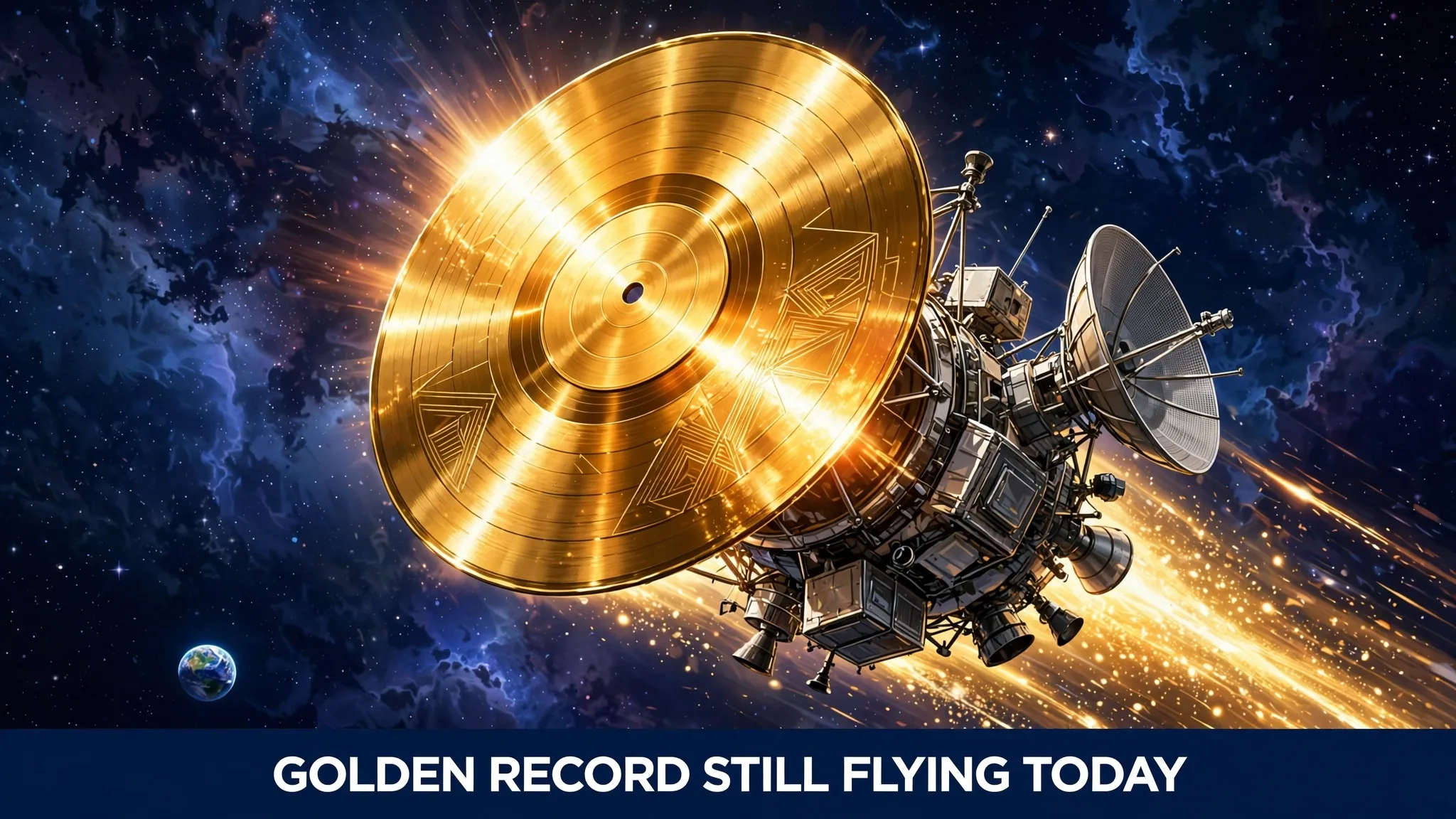
Bolted to the side of each spacecraft was something that had nothing to do with studying planets: a twelve-inch record, made of copper and coated in gold. There are two copies of this record in space, one on each Voyager. Everything else on the spacecraft — the cameras, the instruments, the computers — was made for science. The record was made for a completely different reason: just in case, one day, somebody out there finds it.
Think of it the way NASA does: a message in a bottle, thrown into an endless ocean. Only this ocean is space itself, and the bottle will drift through it for an almost unthinkable length of time.
The Impossible Job: Put Earth On One Record
Somebody had to decide what this message would say. Imagine the task. You have one record. On it, you must somehow fit a whole planet — its lands and oceans, its animals, its peoples, its music, its feelings — so that a stranger who knows nothing about us might understand who we were.
NASA gave this job to a small team chaired by the astronomer Carl Sagan of Cornell University. Around him gathered a remarkable little group: Frank Drake, who looked after the technical side; Ann Druyan, the creative director; Timothy Ferris, who produced the record; Jon Lomberg, who handled the pictures; and Linda Salzman, who organised the spoken greetings. They had limited space, limited time, and one very large question — what are the most important things about Earth?
They chose carefully, and kindly. They wanted the record to be a friendly greeting, so they left out war and fighting. They tried to speak for the whole planet, not for one country or one culture. What they built, piece by piece, is described below.
Hello In Fifty-Five Languages
The record begins with voices. People speak short greetings in fifty-five different languages, one after another. The very first is Akkadian, a language that was spoken in ancient Sumer about six thousand years ago. The last is Wu, a living Chinese dialect. Between them comes a parade of human tongues, old and new, from every corner of the world, each speaker free to say their greeting in their own way.
The English greeting was given by a child: six-year-old Nick Sagan, Carl Sagan’s son, who welcomed any listeners on behalf of the children of planet Earth.
Hidden beneath the greetings, if you listen closely, there is singing of another kind. The team mixed the song of humpback whales quietly behind the human voices — a recording made off the coast of Bermuda in 1970 by biologist Roger Payne. The idea was both practical and poetic: if the whale song makes no sense to whoever finds the record, it does no harm; and if it does make sense to them, then Earth’s other great singers will be heard too.
Alongside the spoken greetings, the record carries printed messages from two leaders of that time: the President of the United States, Jimmy Carter, and the Secretary-General of the United Nations, Kurt Waldheim.
The Sounds Of Home
Next comes a section the team called the sounds of Earth: a short journey through the noises of our planet. There is surf breaking on a shore, wind, and thunder. There are birds and whales and other animals. There are footsteps and laughter, a heartbeat, and the ordinary sounds of human life — including two of the smallest and sweetest sounds we make.
One of them was surprisingly hard to capture: a kiss. The team tried again and again — some attempts were too quiet, some too loud, some did not sound honest. In the end, the kiss that flew into space was one that Timothy Ferris planted on Ann Druyan’s cheek.
Ann Druyan also gave the record something nobody had ever sent anywhere: her own brain waves. She sat for an hour connected to a machine that records the electrical activity of the brain, thinking carefully about the history of Earth and the story of human life. Her thoughts were squeezed into about one minute of sound. Just days earlier, she and Carl Sagan had agreed to marry — and she later admitted that a few thoughts about falling in love slipped in among all the science. So somewhere between the stars, moving away from us forever, is the recorded mind of a woman quietly thinking about love.
Ninety Minutes Of Music, And Pictures Hidden In Sound
Most of the record is music: ninety minutes of it, chosen from many cultures and many ages. There are Eastern and Western classical pieces and ethnic music from around the world — among them a Georgian chorus called “Tchakrulo” and, flying in the same grooves, Chuck Berry’s rock-and-roll classic “Johnny B. Goode”. Sagan defended the rock song against those who thought it too young and wild with a simple argument: there are plenty of young people on this planet.
The record also holds 115 pictures — but you cannot simply look at them. They are encoded into the record’s grooves as analogue signals, like sound, and the instructions explain how to turn them back into images. The pictures show our science and our bodies: the structure of DNA, diagrams of human anatomy, how babies are born. They show our world: landscapes, the Taj Mahal, the Golden Gate Bridge, people eating and drinking, Olympic sprinters racing, children, homes and cities. It is a family album for an entire species.
And how would a finder play any of this? The team thought of that too. Each record travels inside a protective aluminium jacket, together with a cartridge and a needle. On the jacket, instructions drawn in simple symbols explain where the spacecraft came from and how the record should be played — slowly, at sixteen and two-thirds turns per minute. No words, because the finders will not read our languages. Just pictures, mathematics, and hope.
Built To Outlive Everything We Know
Why gold? Because the record had to survive a journey longer than any journey ever taken. In the emptiness of space there is almost nothing to wear a record away — no rain, no air, no rust — only the slow touch of cosmic radiation. NASA calculates that, at the rate gold is eroded in space, these records will last more than a billion years.
Stop and feel that number. A billion years is longer than humans have existed, longer than almost everything on Earth’s surface will last. Mountains rise and wash away in less time. The spacecraft carrying the record will fall silent within years. Its makers are already gone or growing old. Nations will change beyond recognition. But the record, if NASA’s estimate holds, will still be out there, still playable, still carrying a kiss and a whale song and a child saying hello.
Where The Records Are Now
After finishing their tours of the planets, the two Voyagers kept going, out past everything, toward the edge of the Sun’s influence — the great bubble of solar wind that surrounds our solar system. In 2012, Voyager 1 crossed that boundary and entered interstellar space, the space between the stars. In 2018, Voyager 2 followed it out. They are the only spacecraft ever to have flown there, and they remain the most distant human-made objects from Earth.
They still call home, but very faintly and very slowly. Each Voyager has about three million times less memory than a modern mobile phone and sends data tens of thousands of times more slowly than a home internet connection — yet, incredibly, engineers on Earth still listen, and still answer.
The calls cannot go on forever. The spacecraft are powered by generators that turn the heat of decaying plutonium into electricity, and that heat fades a little every year. To stretch what remains, the Voyager team has switched off heaters and systems once thought essential. One by one, the instruments will fall quiet. Some year not far from now, the last whisper will arrive, and then there will be silence.
But silence is not the end. The spacecraft will keep flying, and so will the records. NASA points out that it will be about forty thousand years before either Voyager passes anywhere near another star system. After that: millions of years, then hundreds of millions, the golden discs riding their dead spacecraft through the dark — quite possibly still travelling long after Earth itself is gone.
And if, in some unimaginable future, someone does find one — opens the aluminium cover, follows the picture instructions, sets the needle gently into the groove — the first thing they will hear is us: hello, in fifty-five languages, from a small blue world that once looked up at the stars and decided to introduce itself.
Frequently Asked Questions
What exactly is the Golden Record? It is a twelve-inch phonograph record made of gold-plated copper, carried by each of the two Voyager spacecraft launched in 1977. It holds greetings in 55 languages, 90 minutes of music, the sounds of Earth, and 115 pictures encoded in its grooves.
Who decided what went on the record? A small committee chaired by astronomer Carl Sagan. Its members included Frank Drake, Ann Druyan, Timothy Ferris, Jon Lomberg and Linda Salzman, who between them chose the greetings, music, sounds and images.
Where are the Golden Records now? They are still attached to Voyager 1 and Voyager 2, flying through interstellar space. Voyager 1 entered interstellar space in 2012 and Voyager 2 in 2018, and they are the most distant human-made objects from Earth.
How long will the Golden Record last? NASA estimates more than a billion years. Space has almost nothing in it to damage the record, and gold is eroded by cosmic radiation only extremely slowly.
Will aliens really find and play it? Nobody knows. The chance is very small — it will be about 40,000 years before a Voyager passes near another star system. The team knew the odds, and made the record anyway, as a hopeful message about life on Earth.
Are the Voyager spacecraft still working? Yes, but weakly. They still send data to Earth while engineers switch off systems to save their fading power. When the power finally runs out, the spacecraft will fall silent — but the records will keep flying.
Sources
- NASA Science, “Golden Record Contents”: http://science.nasa.gov/mission/voyager/golden-record-contents/
- NASA, “Voyager, NASA’s Longest-Lived Mission, Logs 45 Years in Space”: https://www.nasa.gov/missions/voyager-program/voyager-2/voyager-nasas-longest-lived-mission-logs-45-years-in-space/
- NASA Science, “APOD: 2022 September 9 – Interstellar Voyager”: https://science.nasa.gov/image-article/apod-2022-september-9-interstellar-voyager/
- Smithsonian Magazine, “What Is on Voyager’s Golden Record?”: https://www.smithsonianmag.com/science-nature/what-is-on-voyagers-golden-record-73063839/
- The picture on this page is an original illustration made for Talha M Blog.