How Do Ants Carry Things Heavier Than Themselves?
In this post
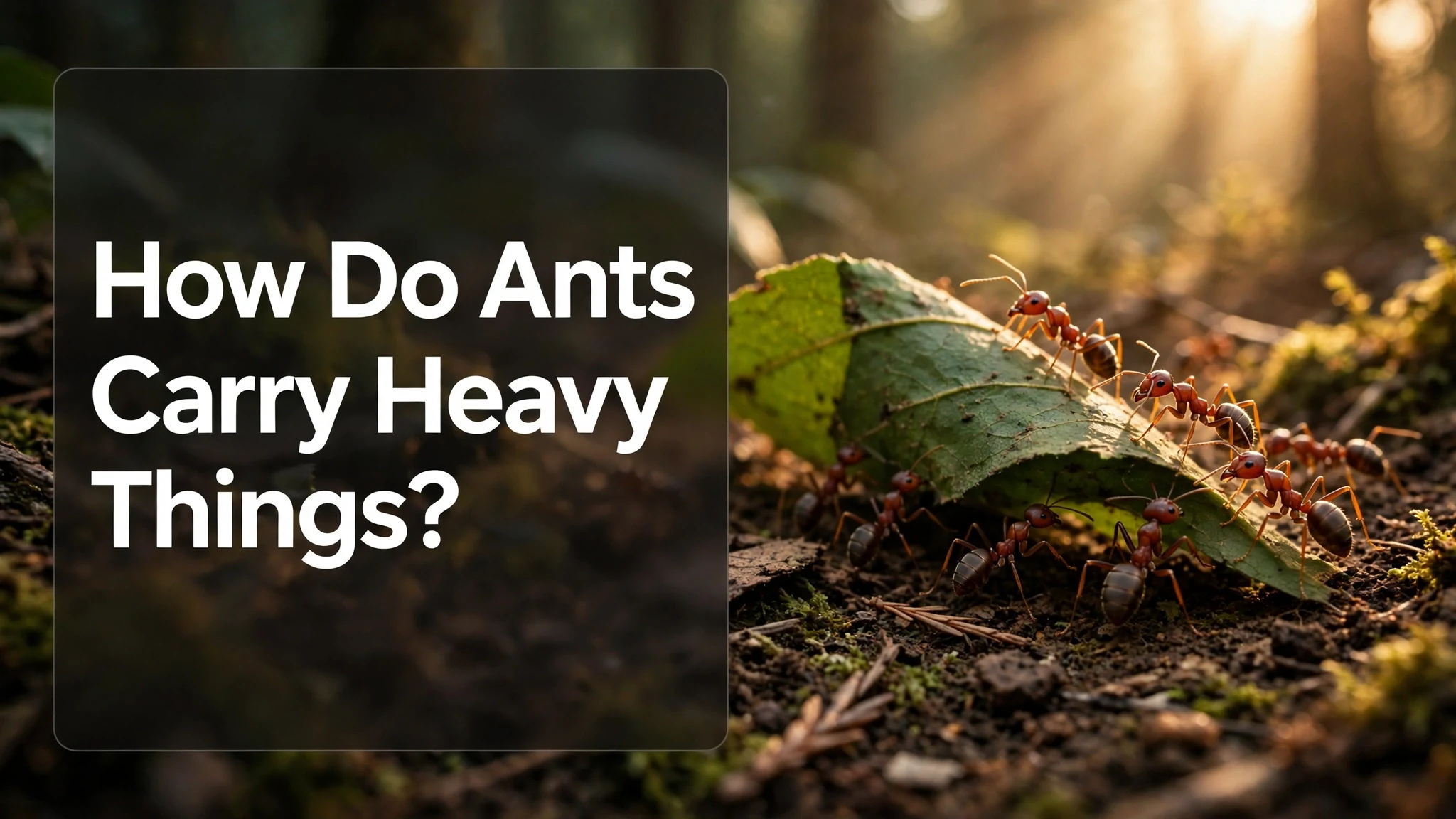
Watch an ant on a path and you may see something that looks impossible. A tiny ant, barely a few millimetres long, is carrying a leaf, a crumb, or a dead insect that is many times its own size. It walks steadily, it does not stop, and it seems unbothered by the weight. If a human did the same, they would be carrying a car. The ant’s strength is real, and it comes from its small size, its muscles, and its body design.
Ants are famous for lifting many times their own weight, and scientists have studied how they do it. This guide explains the physics of being small, the ant’s muscles and exoskeleton, how ants grip and carry, and how teamwork lets a colony move things no single ant could lift.
The Physics of Being Small
An ant is strong for its size because being small changes the rules of strength and weight.
In practice, Strength depends on the cross-section of a muscle, while weight depends on volume, and those two grow at different rates. When an animal gets smaller, its volume shrinks faster than its muscle cross-section, so its strength relative to its weight goes up. That is why small animals are often stronger, pound for pound, than large animals. So the ant’s strength is not a superpower; it is a consequence of being small, and the maths works in its favour. The scent trail is the ant’s road map, and once I followed that idea, a line of ants crossing a pavement stopped looking like chaos and started looking like a motorway.
Look closer and An ant’s body is also light, so it does not need much strength just to move itself. Most of its muscle power can go into carrying a load, rather than into supporting its own weight. A human, by contrast, spends a lot of energy just standing up and walking. So the ant starts with an advantage: it is light, and its muscles are free to work on the load, not on the body. An ant’s strength is not a single muscle; the exoskeleton, the neck, and the jaws work as one, and the way a tiny worker lifts a crumb many times its weight proves the whole body is built for the job.
The key point is that The same rule explains why a flea can jump so far and why a beetle can lift so much. Small animals live in a world where gravity matters less and muscle strength matters more. That world is different from ours, and it is why tiny animals can do things that look impossible to us. So the ant’s feat is a lesson in scale, and it shows that strength is relative, not absolute. Up close, carrying a leaf looks less like a feat of magic and more like a practical use of physics, where being small makes strength, weight for weight, far greater.
Muscles and the Exoskeleton
An ant’s muscles are attached to a hard outer shell, which gives them a strong base to pull against.
What makes this work is that An ant’s body is covered by an exoskeleton, a hard outer shell made of chitin. Muscles attach to the inside of that shell, which gives them a firm anchor. That anchor lets the muscles pull hard without the body bending or collapsing. So the exoskeleton is both armour and a frame, and it makes the ant’s muscles more effective. People watch one ant struggle and miss the colony, yet the trail, the teamwork, and the sharing are what actually move the food home.
Step back for a moment and Ant muscles are also very efficient, and they can work for a long time without tiring quickly. They are built for steady, sustained effort, not for short bursts. An ant can carry a load for a long distance, stopping only to rest briefly. So the ant is a marathon carrier, not a sprinter, and its muscles are tuned for the long haul. One trail packs scouting, carrying, and sharing into a single line of workers, and the colony spends its effort so well that a crumb becomes a feast for thousands.
The surprising part is that The ant’s neck is especially strong, because many ants carry loads with their jaws. The neck muscles hold the load up and steady while the ant walks. That is why you often see an ant carrying a leaf above its head, like a person carrying a box. So the neck is a key part of the system, and it is stronger, relative to its size, than a human neck. Follow the scent from the food to the nest and back again, and the separate ant jobs, scout, carrier, and sharer, fit together like a supply chain with no manager.
Jaws, Grip, and How Ants Carry
Ants carry with their jaws, and their grip is part of the secret.
In practice, An ant’s jaws, called mandibles, are strong, sharp, and able to grip tightly. They can hold a leaf, a seed, or a piece of food without slipping. The mandibles are also tools for cutting, carrying, and defending the colony. So the jaws are a multi-tool, and carrying is only one of their jobs. The scent trail is the ant’s road map, and once I followed that idea, a line of ants crossing a pavement stopped looking like chaos and started looking like a motorway.
Look closer and Ants carry loads in different ways, depending on the size and shape of the load. A small load may be carried in the jaws, while a large load may be dragged backwards. Some ants carry loads above their heads, which helps them balance. So the ant chooses a carrying method that fits the load, and it changes its method if the load is awkward. An ant’s strength is not a single muscle; the exoskeleton, the neck, and the jaws work as one, and the way a tiny worker lifts a crumb many times its weight proves the whole body is built for the job.
The key point is that Ants also use their legs to grip the ground, which gives them traction. Their feet have tiny claws and pads that help them hold onto rough surfaces. That grip is important when the ant is climbing or carrying a heavy load uphill. So the feet are part of the carrying system too, and a good grip is as important as strong muscles. Up close, carrying a leaf looks less like a feat of magic and more like a practical use of physics, where being small makes strength, weight for weight, far greater.
Teamwork: When One Ant Is Not Enough
Some loads are too big for one ant, and then ants work together.
What makes this work is that When an ant finds a large piece of food, it may call other ants to help, using scent signals. Other ants follow the scent trail to the food and join in carrying it. Together, they can move a load that no single ant could lift. So the colony’s strength is not in one ant, but in many ants working together, and the scent trail is the call for help. People watch one ant struggle and miss the colony, yet the trail, the teamwork, and the sharing are what actually move the food home.
Step back for a moment and Team carrying is not always smooth. Ants may pull in different directions at first. But they adjust, and they often manage to move the load in the right direction. Scientists have found that ants can coordinate without a leader, by following simple rules. So the teamwork is self-organised, and it emerges from many small decisions, not from a boss ant giving orders. One trail packs scouting, carrying, and sharing into a single line of workers, and the colony spends its effort so well that a crumb becomes a feast for thousands.
The surprising part is that Some ant species are especially good at team carrying, and they can move large insects or seeds together. They may lift the load together, or drag it in a line, like a team pulling a rope. That cooperation lets the colony use food sources that would be useless to a single ant. So teamwork expands what the colony can eat, and it is a key reason ants are so successful. Follow the scent from the food to the nest and back again, and the separate ant jobs, scout, carrier, and sharer, fit together like a supply chain with no manager.
How Much Can an Ant Really Lift?
The famous claim is that ants can lift 50 times their own weight, but the real number varies.
In practice, Different species can lift different amounts, and the number depends on the ant’s size, species, and the load. Some ants can lift 10 to 50 times their body weight, while others lift less. The 50-times figure is often quoted, but it is not true for every ant. So the famous number is a headline, not a rule, and the real story is more varied. The scent trail is the ant’s road map, and once I followed that idea, a line of ants crossing a pavement stopped looking like chaos and started looking like a motorway.
Look closer and Scientists test ant strength by giving ants weights to carry and by measuring their neck muscles. They have found that the neck joint is a key limit, because it must support the load. In one study, a species of ant could lift about 100 times its weight with its neck, but it could not walk with that much. So the maximum lift and the practical carrying load are different, and the ant’s everyday strength is less than its laboratory maximum. An ant’s strength is not a single muscle; the exoskeleton, the neck, and the jaws work as one, and the way a tiny worker lifts a crumb many times its weight proves the whole body is built for the job.
The key point is that An ant’s strength also depends on its job in the colony. Worker ants that forage are stronger carriers than ants that stay inside the nest. Soldier ants may be stronger still, but their job is defence, not carrying. So strength is matched to the job, and the colony has different ants for different tasks. Up close, carrying a leaf looks less like a feat of magic and more like a practical use of physics, where being small makes strength, weight for weight, far greater.
Ants, Trails, and the Colony’s Food System
Carrying is not just about strength. It is about getting food back to the colony, where it feeds the queen and the young.
What makes this work is that Ants leave scent trails as they walk, which other ants follow to find food. When an ant finds food, it lays a stronger trail on its way back, which attracts more ants. That trail system lets the colony exploit a food source quickly and efficiently. So the ant’s carrying is part of a larger system, and the trail is the colony’s map. People watch one ant struggle and miss the colony, yet the trail, the teamwork, and the sharing are what actually move the food home.
Step back for a moment and The food an ant carries is shared in the nest, through a process called trophallaxis. Ants pass liquid food from mouth to mouth, sharing it with other ants, larvae, and the queen. That sharing means one ant’s load can feed many ants. So the load is not just for the carrier; it is for the whole colony, and the colony’s success depends on sharing. One trail packs scouting, carrying, and sharing into a single line of workers, and the colony spends its effort so well that a crumb becomes a feast for thousands.
The surprising part is that Ants also store food in the nest, in chambers and in the bodies of special worker ants. Those stores help the colony survive when food is scarce. The carrying you see on a path is the first step in that storage system. So a single ant with a leaf is part of a food chain that ends in a full nest, and the colony’s survival depends on many such trips. Follow the scent from the food to the nest and back again, and the separate ant jobs, scout, carrier, and sharer, fit together like a supply chain with no manager.
What Ants Teach Us About Strength
Ants show that strength is not only about size, and that design and teamwork matter as much as muscle.
In practice, An ant’s strength comes from its small size, its exoskeleton, its muscles, and its grip. No single part explains it; it is the combination that makes the ant strong. That combination is a result of evolution, which has tuned the ant’s body for its life. So the ant is a reminder that strength is a system, not a single muscle, and that the whole body matters. The scent trail is the ant’s road map, and once I followed that idea, a line of ants crossing a pavement stopped looking like chaos and started looking like a motorway.
Look closer and Ants also show that teamwork can do what no individual can do. A colony can move, build, and defend in ways that a single ant cannot. That is why ants are found almost everywhere on Earth, and why they are so successful. So the ant’s lesson is not just about lifting; it is about working together, and about how a group can be stronger than its parts. An ant’s strength is not a single muscle; the exoskeleton, the neck, and the jaws work as one, and the way a tiny worker lifts a crumb many times its weight proves the whole body is built for the job.
The key point is that Engineers study ants to design robots and materials that are strong for their weight. They look at how ants grip, carry, and coordinate, and they try to copy those ideas. That research may lead to small robots that can lift and carry in places humans cannot go. So the ant’s strength is not just a curiosity; it is an inspiration, and it may help us build better machines. Up close, carrying a leaf looks less like a feat of magic and more like a practical use of physics, where being small makes strength, weight for weight, far greater.
My Take:
I have watched ants for years, and I still stop when I see one carrying a leaf bigger than itself. It looks like a joke, until you realise the ant is serious. It is not showing off. It is doing its job, and it is doing it well. That is what I like about ants. They do not complain about the weight. They pick it up, they walk, and they keep going until they get home. There is a kind of dignity in that, even in an animal smaller than a grain of rice.
I think the physics answer is the most satisfying, because it explains the mystery without magic. Small animals are stronger for their size because volume shrinks faster than muscle, and that is a fact, not a trick. It reminds me that many things that look impossible are just maths we have not thought about. The physics of being small is the idea I keep returning to, because it turns a familiar sight, an ant with a leaf, into a lesson about how size changes the rules. Ants are no longer just insects to me; they are a model of work without a boss, and I find myself thinking about that model whenever I see a team struggling.
The teamwork part is the one I think about most. One ant cannot move a large insect, but ten ants can, and they do it without a leader. That is a powerful idea: a group can solve a problem that defeats every individual, if the group can coordinate. For me, the honest test for an ant carrying a heavy load is simple. Ant talk that is clever without being useful gets set aside, and I follow the trail instead. I trust an ant explanation when it lets me predict the trail, like knowing more ants will arrive once a scout finds food, and this piece kept making those predictions come true. That is the kind of ant detail I would share with a child watching a pavement trail, so the line of ants becomes a story about cooperation rather than a pest to step on.
I also like that ants share their food. An ant does not eat its load alone. It brings it back and shares it mouth to mouth with the colony. That sharing is the reason the colony works, and it is a contrast to the way we often think about strength as a solo achievement. Understanding ants took me longer than a glance, because the colony’s work is spread across many small bodies, and no single ant shows you the whole picture. For me, learning about an ant carrying a heavy load was not one dramatic moment. A scout here, a carrier there, a sharer passing food mouth to mouth, and the separate jobs gradually added up to a system I could finally see. Simple ant questions no longer feel naive to me, because asking how much one can lift led me to the physics, the jaws, and the teamwork all at once.
The 50-times claim taught me to be careful with famous numbers. It is quoted everywhere, yet it is not true for every ant, and the real number depends on species and conditions. I now ask, for any famous fact, which animal, which test, and which conditions, because the answer is usually more interesting than the headline. If a friend asked about ants, I would tell them to watch the trail, not the single ant, because the trail is where the colony’s thinking happens. Ask what happens when the trail is broken, who gains when food is shared, and what a lost scout costs, and the ant world gains a set of trade-offs. My old view of ants was a line of identical workers, and the varied, specialised colony that replaced it arrived quietly and has stayed with me since.
If I could design a robot, I would copy the ant’s feet and jaws. The grip, the neck, and the exoskeleton are all simple ideas that work together. That is good engineering: not one clever part, but a set of parts that fit each other and do the job. Learning about ants has made me less quick to judge small things, because an animal I barely noticed turns out to run a food system more reliable than many human ones. The more I learn about ants, the less comfortable I feel with the idea that size equals importance, and I am glad to have that idea challenged. Watching ants twice pays off, because the first look sees a line and the second sees a colony sharing food. I would rather keep one ant image clearly, a worker carrying a crumb bigger than itself up a wall, than memorise ten ant facts that fade by next week.
The lesson I take from ants is about doing the job in front of you. An ant does not worry about the size of the leaf. It picks it up and walks. I think we could all use a little of that: less worry about how big the task looks, and more steady walking towards home. If I could keep one ant idea, it would be the sharing, because food passed mouth to mouth shows a colony that feeds itself as one body, not as rivals. Writing about ants in my own words exposed my gaps, especially where I had repeated the fifty-times claim without checking what it really meant.
Going back to the physics section, I saw how much of the ant story rests on a single fact, that volume grows faster than strength, and how much follows from it. The lifting claim everyone quotes is less revealing than the jaws behind it, gripping and adjusting with every step, which is where the ant’s real skill lives. That quiet jaw work reassures me, because it shows that impressive results can come from small, well-designed parts working together, day after day.
The muscles and exoskeleton section changed how I talk about ants, because it gave me a body to describe instead of a vague idea of strength. Now I start by asking how an ant’s body is built, then I show the trail in action, and only then do I say what I think the colony means. Tools first, conclusion second: that way the listener can check my reasoning against the ant’s body instead of trusting my summary. It also leaves room for pushback, and an ant discussion that allows a different opinion is far more useful than one that simply asserts a fact.
Thinking about jaws and grip at the end, I spotted a thread running through the whole piece that I had missed the first time I read it. Strength, sharing, and letting the trail guide the work kept recurring, in the muscles, in the teamwork, and in the colony’s food system. Those ideas are useful far beyond ants, which is why I intend to revisit this piece rather than reading it once and setting it aside. I will watch the next ant trail I find with fresh attention, expecting the second look to reveal something the first one hid.
Frequently Asked Questions
How much weight can an ant lift?
It varies by species, but many ants can lift 10 to 50 times their own body weight. Some can lift even more in a laboratory test, but the practical carrying load while walking is usually less than the maximum.
Why are ants so strong for their size?
Being small helps, because muscle strength falls more slowly than body weight as size shrinks. Ants also have a hard exoskeleton, strong neck muscles, and a good grip, which all help them carry heavy loads.
Do ants work together to carry heavy things?
Yes, ants team up to move heavy food. When one ant finds a large piece of food, it lays a scent trail that brings other ants to help. Together, they can move loads that no single ant could lift, by lifting or dragging it as a team.
How do ants carry leaves?
Ants grip leaves with their strong jaws, called mandibles, and often carry them above their heads. Their neck muscles hold the load steady, and their feet grip the ground for traction.
What do ants do with the food they carry?
Ants carry food back to the nest, where it is shared with other ants, larvae, and the queen through mouth-to-mouth sharing. Some food is also stored for times when food is scarce.
Can an ant lift a human?
No, not in the way people imagine. An ant can lift many times its own weight, but it is still tiny. The comparison is about relative strength, not absolute strength, and a human is far too heavy for any ant.