How Do Giraffes Sleep? Explained Simply
In this post
A giraffe is the tallest land animal on Earth, with a neck longer than a person is tall, and legs that look too thin for its body. Sleeping should be hard for such an animal. Lying down takes time, getting up takes time, and a sleeping giraffe is vulnerable to lions. Yet giraffes do sleep, and they do it in a way that fits their tall, exposed life. They sleep little, they nap often, and they can sleep standing up or lying down.
This guide explains how long giraffes sleep, how they lie down, what deep sleep looks like for a giraffe, and why they sleep so much less than other animals. It also explains what happens in a zoo, where giraffes feel safer and sleep longer.
The Short Answer: Very Little, in Short Naps
Giraffes are famous for sleeping less than almost any other mammal, often only a few hours a day.
In practice, Adult giraffes in the wild sleep for about 30 minutes to two hours in total each day, in short naps. That is far less than a lion, which may sleep 20 hours, or a human, which sleeps about eight. The naps are usually only a few minutes long, and they are spread through the day and night. So the giraffe’s sleep is broken into pieces, not one long night, and it adds up to very little. The short standing nap is the giraffe’s compromise with danger, and once I understood that, the animal’s restless nights stopped looking like a defect and started looking like a survival plan.
Look closer and Giraffes in zoos sleep longer than wild giraffes, sometimes four to six hours a day. That difference shows how much safety matters: when a giraffe feels safe, it sleeps more. In the wild, the risk of predators keeps sleep short, because a sleeping giraffe is an easy target. So the giraffe’s short sleep is not a fixed rule; it is a response to danger, and it changes when danger goes away. A giraffe’s sleep is not a single habit; the standing naps, the folded-neck lie-down, and the herd watch all work together, and the way a zoo giraffe sleeps longer proves safety, not laziness, sets the limit.
The key point is that Young giraffes, called calves, sleep more than adults. A calf may sleep for several hours a day, often lying down with its mother nearby. That extra sleep helps it grow, and its mother protects it while it sleeps. So the sleep pattern changes with age, and the young get more rest because they need it and because they are guarded. Up close, sleeping so little looks less like a flaw and more like a practical trade, where eating leaves all day leaves almost no time for rest.
Sleeping Standing Up
Giraffes can sleep while standing, and they often do, especially for light naps.
What makes this work is that When a giraffe sleeps standing up, it stays upright, with its eyes closed and its head held up or slightly lowered. Its legs lock, a little like a horse’s legs, so it does not fall over. That standing sleep is light, and the giraffe can wake quickly if it hears danger. So standing sleep is a compromise: the giraffe rests, but it stays ready to run. People pity the giraffe for its short sleep and miss the point, yet the folded neck, the quick naps, and the watching herd are what let such a tall, gentle animal survive at all.
Step back for a moment and Standing sleep is common during the day, when giraffes are also feeding and watching. They may doze for a few minutes, then wake, look around, and doze again. That pattern lets them rest without losing track of the herd or the surroundings. So the day is a series of small naps, not one long sleep, and the giraffe is never fully out for long. One day of giraffe life packs sixteen hours of eating, a few minutes of deep sleep, and constant vigilance into a single animal, and the giraffe spends its rest so carefully that a short nap has to do the work of a night.
The surprising part is that Horses also sleep standing up, and they use a similar locking system in their legs. That system is called a stay apparatus, and it lets the animal stand with almost no muscle effort. Giraffes use a similar idea, although their legs and necks are much longer. So standing sleep is not unique to giraffes; it is a trick shared by tall, grazing animals that need to stay ready. Follow the nap from the standing doze to the folded-neck sleep to the herd’s watch, and the separate pieces join into one story about resting while staying ready to run.
Lying Down: The Deep Sleep Pose
For deep sleep, a giraffe must lie down, and that is a careful, vulnerable act.
In practice, To lie down, a giraffe folds its legs underneath its body and lowers itself to the ground. That movement takes time and effort, because the giraffe is tall and heavy. Getting up again also takes time, which is why a lying giraffe is vulnerable. So lying down is a commitment, and the giraffe only does it when it feels safe enough. The short standing nap is the giraffe’s compromise with danger, and once I understood that, the animal’s restless nights stopped looking like a defect and started looking like a survival plan.
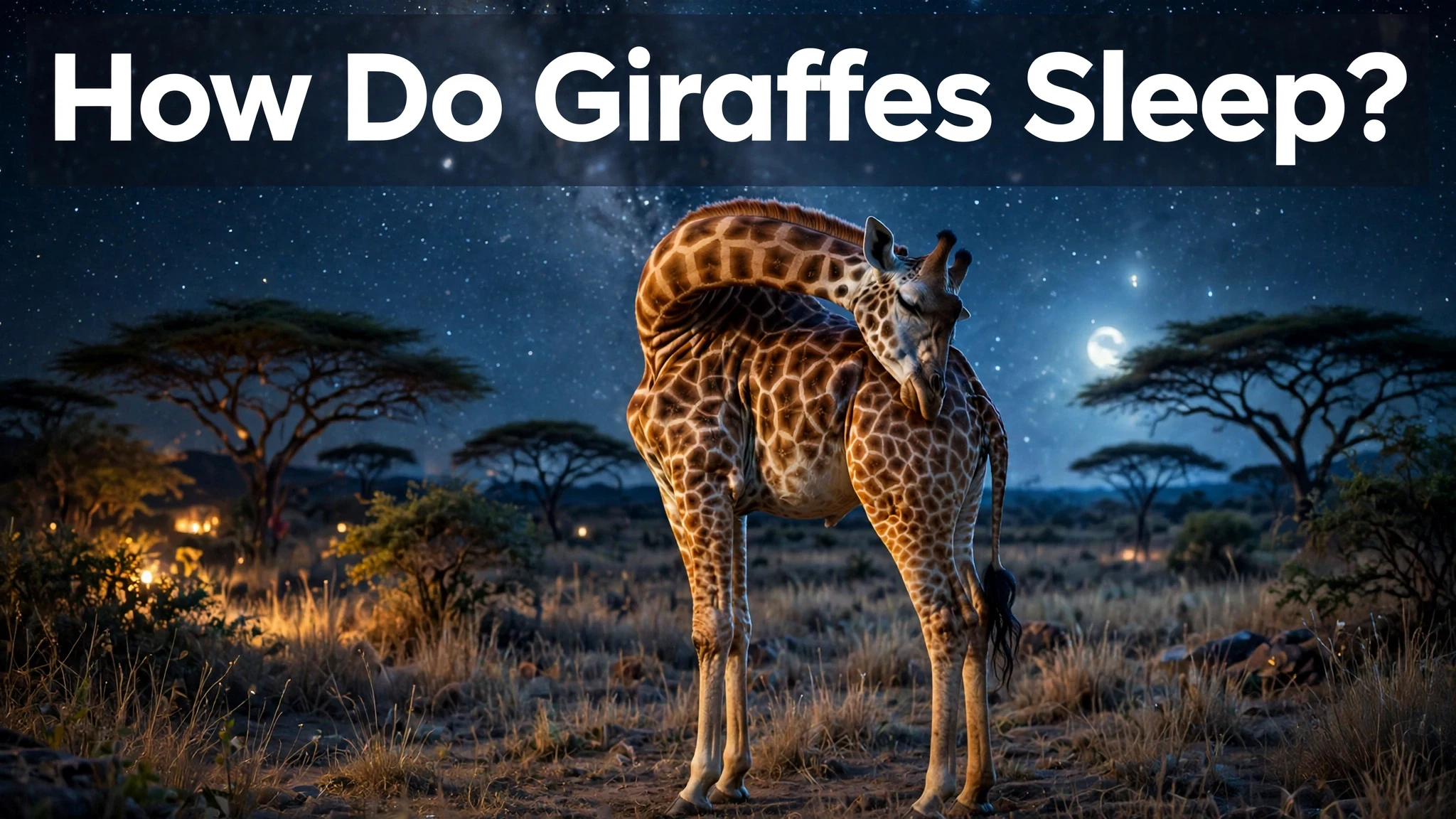
Look closer and When a giraffe is in deep sleep, it often folds its neck back, resting its head on its own back or hip. That pose looks uncomfortable, yet it is the giraffe’s deep sleep position. The head rests on the body, the eyes are closed, and the giraffe is fully asleep. So the folded neck is a sign of deep sleep, and it is one of the most recognisable giraffe poses. A giraffe’s sleep is not a single habit; the standing naps, the folded-neck lie-down, and the herd watch all work together, and the way a zoo giraffe sleeps longer proves safety, not laziness, sets the limit.
The key point is that Deep sleep usually lasts only a few minutes at a time, even when the giraffe is lying down. A giraffe may have several short deep-sleep episodes in a night, adding up to less than an hour. That is far less deep sleep than a human gets, and it is a reminder of how different giraffe sleep is. So even when a giraffe lies down, it does not stay in deep sleep for long, and it wakes often. Up close, sleeping so little looks less like a flaw and more like a practical trade, where eating leaves all day leaves almost no time for rest.
Why Giraffes Sleep So Little
The main reason is predators. A sleeping giraffe is easy prey, so it sleeps as little as it can.
What makes this work is that Lions are the main predator of giraffes, and they hunt at night and at dawn. A giraffe that is lying down and asleep cannot run away quickly. By sleeping little and in short naps, the giraffe reduces the time it is vulnerable. So short sleep is a survival choice, and it is paid for with less rest. People pity the giraffe for its short sleep and miss the point, yet the folded neck, the quick naps, and the watching herd are what let such a tall, gentle animal survive at all.
Step back for a moment and Giraffes also need a lot of time to eat, because they eat leaves from trees, which are low in energy. They may spend 16 to 20 hours a day feeding, which leaves little time for sleep. That feeding time is essential, because a giraffe needs a huge amount of food to support its large body. So the giraffe’s day is a trade-off between eating and sleeping, and eating wins, because food is survival too. One day of giraffe life packs sixteen hours of eating, a few minutes of deep sleep, and constant vigilance into a single animal, and the giraffe spends its rest so carefully that a short nap has to do the work of a night.
The surprising part is that Giraffes may also need less sleep than other animals because of their brain and body. Scientists are still studying why some animals need more sleep than others. It may be that giraffes have a brain that can rest in short bursts, or that their sleep needs are simply lower. So the full answer is not yet known, and the giraffe’s short sleep remains a puzzle that scientists are still working on. Follow the nap from the standing doze to the folded-neck sleep to the herd’s watch, and the separate pieces join into one story about resting while staying ready to run.
How Giraffes Stay Safe While They Sleep
Giraffes do not sleep alone. They rely on the herd, on watchfulness, and on their size.
In practice, Giraffes live in loose herds, and while some sleep, others stay awake and watch. That shared watching means the herd is never fully asleep at once. If one giraffe spots danger, it alerts the others, and they can all run. So the herd is a safety system, and sleep is shared in turns, like a night watch. The short standing nap is the giraffe’s compromise with danger, and once I understood that, the animal’s restless nights stopped looking like a defect and started looking like a survival plan.
Look closer and A giraffe’s size is also a defence. An adult giraffe is tall and strong, and it can kick hard. A lion is less likely to attack a large, alert giraffe than a small, sleeping one. That is why calves, which are smaller, are more vulnerable, and why they sleep near their mothers. So size helps, but it is not enough on its own, and the herd’s watchfulness is still essential. A giraffe’s sleep is not a single habit; the standing naps, the folded-neck lie-down, and the herd watch all work together, and the way a zoo giraffe sleeps longer proves safety, not laziness, sets the limit.
The key point is that Giraffes also choose where to sleep carefully, often in open areas where they can see predators coming. They avoid dense bushes where a lion could hide. That choice of sleeping place is part of their safety plan. So the giraffe’s sleep is not just about time; it is about place, company, and watchfulness, all working together. Up close, sleeping so little looks less like a flaw and more like a practical trade, where eating leaves all day leaves almost no time for rest.
Giraffe Sleep in Zoos: Longer and Deeper
In zoos, where there are no lions and food is provided, giraffes sleep more, and scientists can study them closely.
What makes this work is that Zoo giraffes may sleep for four to six hours a day, which is much more than wild giraffes. They also have longer deep-sleep episodes, and they lie down more often. That difference shows how much of wild sleep is shaped by danger, not by the giraffe’s body alone. So the zoo is a kind of experiment, and it tells us what giraffes would do if they felt safe. People pity the giraffe for its short sleep and miss the point, yet the folded neck, the quick naps, and the watching herd are what let such a tall, gentle animal survive at all.
Step back for a moment and In zoos, giraffes also sleep at night more than during the day, which is closer to a human pattern. In the wild, their sleep is spread through day and night, because they must eat and watch at all hours. That change in timing is another sign that safety changes sleep. So the giraffe’s sleep is flexible, and it adapts to the place where the giraffe lives. One day of giraffe life packs sixteen hours of eating, a few minutes of deep sleep, and constant vigilance into a single animal, and the giraffe spends its rest so carefully that a short nap has to do the work of a night.
The surprising part is that Studying zoo giraffes helps scientists understand wild giraffes, but it also has limits. A zoo giraffe is not a wild giraffe, and its sleep may not be the same. Scientists must be careful not to assume that zoo sleep is natural sleep. So the zoo gives us clues, but the wild is the real test, and both are needed to understand the full picture. Follow the nap from the standing doze to the folded-neck sleep to the herd’s watch, and the separate pieces join into one story about resting while staying ready to run.
What Giraffe Sleep Teaches Us
Giraffe sleep is a reminder that sleep is not the same for every animal, and that it is shaped by life, not just by biology.
In practice, Some animals sleep a lot, some sleep a little, and both can be healthy for that animal. A giraffe’s short sleep is not a sign of illness; it is a sign of adaptation. That is a useful correction to the idea that all animals need the same amount of sleep. So sleep is not one rule; it is many rules, each fitted to a different life. The short standing nap is the giraffe’s compromise with danger, and once I understood that, the animal’s restless nights stopped looking like a defect and started looking like a survival plan.
Look closer and Giraffes also show that sleep can be broken into pieces and still work. Their naps add up to a total, even though no single nap is long. That is different from human sleep, which is usually one long block, but it works for giraffes. So the giraffe’s sleep is a different design, and it is a reminder that there are many ways to rest. A giraffe’s sleep is not a single habit; the standing naps, the folded-neck lie-down, and the herd watch all work together, and the way a zoo giraffe sleeps longer proves safety, not laziness, sets the limit.
The key point is that Watching a giraffe sleep, with its neck folded back, is a quiet moment. It is a sign that the animal feels safe, even for a few minutes. That safety is precious in the wild, and it is something we should protect by protecting giraffe habitats. So the giraffe’s sleep is not just a curiosity; it is a measure of how safe its world is, and a reason to keep that world safe. Up close, sleeping so little looks less like a flaw and more like a practical trade, where eating leaves all day leaves almost no time for rest.
My Take:
I find giraffe sleep both sad and impressive. Sad, because an animal that tall and that gentle gets so little rest, and impressive, because it manages to live well on so little. A giraffe does not complain about its short sleep. It naps standing up, it lies down for a few minutes when it feels safe, and it gets on with eating and watching. There is a kind of toughness in that, and also a kind of trust, because it relies on the herd to watch while it rests.
I think the herd watch is the most human part of the story. Giraffes take turns sleeping while others stay awake, which is exactly what people do on a night watch. It reminds me that rest is not just an individual need; it is a shared responsibility, and a group can rest better than a person alone. The herd watch is the part I keep returning to, because giraffes take turns sleeping while others stay awake, and that shared duty feels surprisingly human to me. Giraffe sleep is no longer a sad fact for me; it is a lesson in resting under pressure, and I think about that lesson whenever I am tired and cannot afford a full night.
The folded-neck pose is the image I cannot forget. A giraffe resting its head on its own back looks uncomfortable, yet it is deep sleep. It is a reminder that comfort is relative, and that an animal’s body finds a way to rest even when the pose looks impossible to us. For me, the honest test for a giraffe sleeping is simple. A giraffe explanation that is clever but empty gets put down, and I watch the herd instead. I trust a giraffe explanation when it lets me predict the animal, like knowing a giraffe in a safe zoo will sleep longer, and this piece kept making that sort of prediction. That is the kind of giraffe detail I would share with a friend at a zoo, so the tall animal dozing on its feet becomes a story about safety rather than a curiosity.
I also think the zoo comparison is important, because it shows how much danger shapes sleep. A giraffe that feels safe sleeps two or three times as long as a wild one. That is a clear, measurable difference, and it tells us that sleep is not just biology; it is also a measure of safety. Understanding giraffe sleep took me longer than I expected, because the answer is not one habit but a whole set of trade-offs between eating, resting, and staying safe. For me, learning about a giraffe sleeping was not one dramatic moment. A short nap here, a folded neck there, a herd mate standing guard, and the separate habits gradually added up to a system I could finally picture. I am more patient now with simple questions about giraffes, because asking why they sleep so little led me to leaves, energy, and predators all at once.
The eating trade-off stayed with me too. A giraffe spends most of its day eating, because leaves are low in energy, and that leaves little time for sleep. It is a reminder that every animal’s day is a budget, and sleep is only one item in that budget, competing with food and safety. If a friend asked about giraffes, I would tell them to watch the herd, not the single animal, because the herd is where the sleep plan actually happens. Ask what eating costs in sleep, who gains when one giraffe stays awake, and what a deep sleep risks, and the giraffe’s day turns into a careful budget. My old view of giraffes was a gentle giant that barely sleeps, and the careful, budgeted rest that replaced it is calmer and far more impressive to me.
If I visited a zoo, I would watch the giraffes at night, if I could. I would want to see how long they lie down, and whether they fold their necks back. That is a small, quiet observation, but it would tell me more about giraffe life than a dozen photos. Learning about giraffes has made me slower to pity animals, because a short sleep I once called sad turns out to be a well-judged response to danger. The more I learn about giraffe sleep, the less sure I feel about measuring an animal’s life by human standards, and that feels like progress. Watching a giraffe twice pays off, because the first look sees height and the second sees a herd taking turns to sleep. I would rather keep one giraffe image clearly, the folded neck resting on its own back, than memorise ten sleep facts that will fade by next month.
The lesson I take from giraffes is about rest in difficult conditions. A giraffe does not wait for perfect conditions to rest. It rests in short naps, when it can, where it can. I think we could learn from that: rest does not always need a perfect night, and a short, honest rest is better than no rest at all. If I could keep one giraffe idea, it would be the short nap, because it shows that rest does not always need perfect conditions, and a little rest is better than none. Explaining giraffe sleep from memory, without copying the text, exposed my sentimentality, above all where I had called their sleep sad without weighing the trade-offs.
Going back to the opening section about very little sleep in short naps, I saw how a single number, a few minutes of deep sleep a day, shapes the whole story. The headline about giraffes is less revealing than the herd watch, one animal awake while another sleeps, which is where the trust in the story lives. That quiet watch reassures me, because it shows that safety can be shared, and that sharing the watch is a skill worth learning from giraffes.
The standing-up section changed how I talk about giraffes, because it gave me a concrete posture to describe instead of a vague idea of tiredness. Now I start by asking how a giraffe can sleep standing up, then I describe the folded-neck pose, and only then do I say what the sleep means to me. Body first, interpretation second: that way the listener meets the giraffe before meeting my opinion about it. It also leaves room for disagreement, and a giraffe conversation that welcomes a second view is far better than one that simply repeats a sad story.
Thinking about the lying-down pose at the end, I saw a pattern across the whole piece that I had missed when I first read the piece. Naps, herd watch, and the zoo comparison all pointed the same way: rest when you can, watch when you must, and revise what you thought you knew. Those ideas apply well beyond giraffes, which is why I will revisit this piece instead of reading it once and forgetting it. I will watch the next giraffe I see with new attention, looking for the folded neck, and expecting that second look to show me something I missed.
Frequently Asked Questions
How long do giraffes sleep each day?
Wild adult giraffes sleep for about 30 minutes to two hours in total each day, in short naps. Zoo giraffes sleep longer, often four to six hours, because they feel safer.
Do giraffes sleep standing up or lying down?
Both. Giraffes often sleep lightly while standing, and they lie down for deep sleep, folding their neck back so their head rests on their body.
Do giraffes sleep at night?
Giraffes sleep in short naps through both day and night in the wild. In zoos, they sleep more at night, which suggests their wild pattern is shaped by the need to eat and watch for predators.
Why do giraffes sleep so little?
The main reason is predators, especially lions. A sleeping giraffe is vulnerable, so it sleeps as little as it can. Giraffes also need many hours to eat leaves, which leaves little time for sleep.
How do baby giraffes sleep?
Calves sleep more than adults, often lying down near their mother for several hours a day. Their mother protects them while they sleep, and that extra sleep helps them grow.
Can a giraffe fall over while sleeping standing up?
Very rarely. Giraffes lock their legs when they sleep standing up, which helps them stay upright. They are light sleepers in that position and wake quickly if they feel unsteady or sense danger.