How Do Camels Survive in the Desert? Explained Simply
In this post
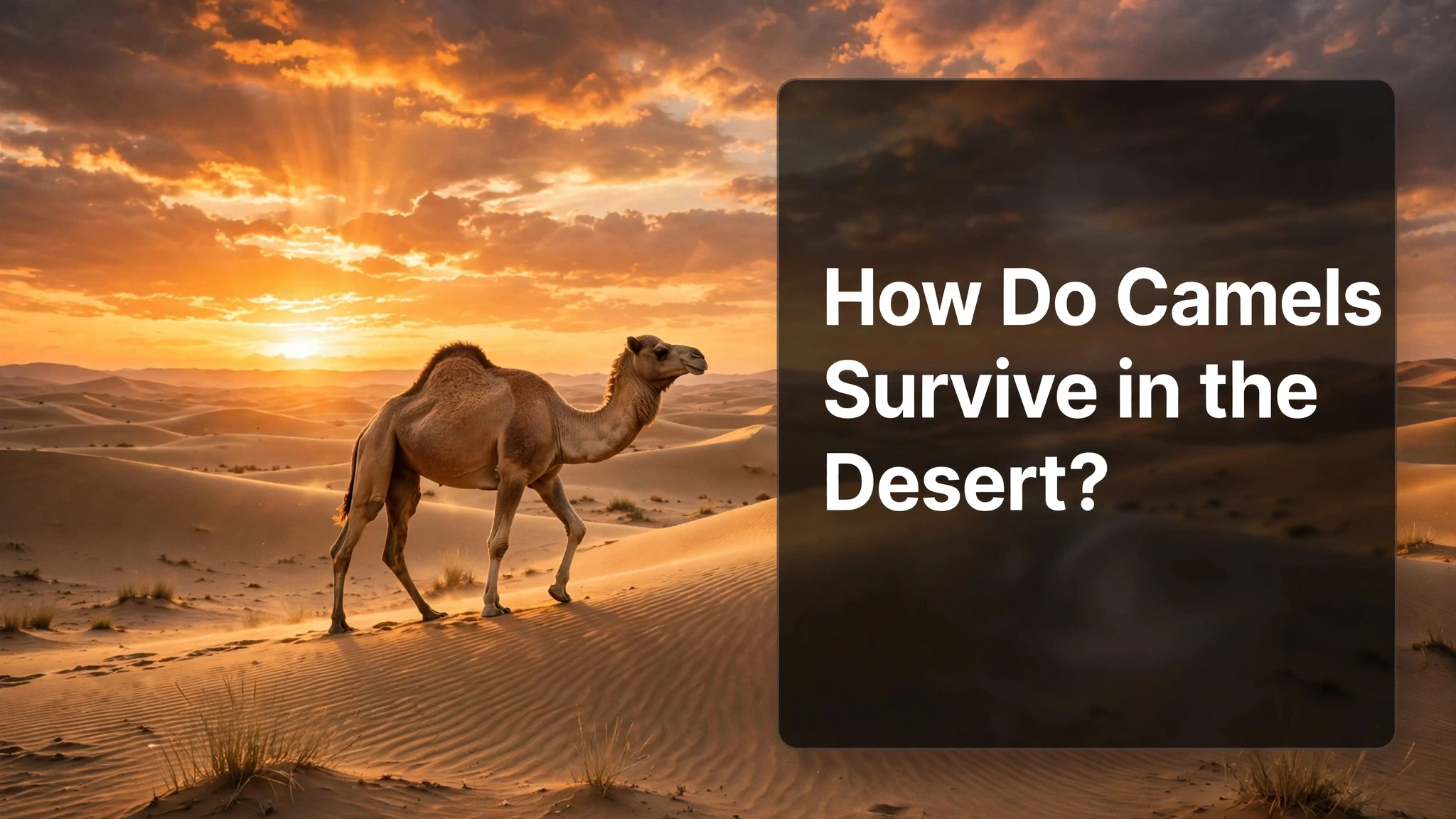
A camel walking across a desert looks calm, almost slow, yet the desert around it is one of the hardest places on Earth to live. The air can be hotter than a kitchen oven, the ground can burn bare feet, and water can be days away. A camel does not fight the desert. It is built for it, from its hump to its eyelashes, and every part of its body helps it save water, lose heat, and keep going.
Camels are often called ships of the desert, and the name fits. They carry people and goods across sand seas, and they can go for days without drinking. This guide explains the famous hump, the real story about water, how camels handle heat, and how their feet, nose, and eyes cope with sand and sun.
The Hump: Fat, Not Water
The most famous fact about camels is also the most misunderstood. The hump stores fat, not water.
In practice, A camel’s hump is a store of fat, which the camel can use as food when it cannot find any. When the camel uses that fat, the hump shrinks and may flop to one side. When it eats well again, the hump fills up and stands upright. So the hump is a lunchbox, not a water tank, and its size tells you how well fed the camel has been. The fat packed into the hump is the camel’s fuel tank, and once I grasped that, the animal’s strange silhouette stopped looking like a deformity and started looking like a design.
Look closer and Fat is useful in the desert because it is energy that can be carried without water. A camel can live off its hump for days or weeks when food is scarce. The fat also helps the camel’s body, because breaking down fat releases a small amount of water inside the body. So the hump does help with water in an indirect way, but it is not a tank you can open and drink from. A camel’s hump is not a water bag; it is a store of fat, a shade, and a reserve all at once, and the way it shrinks and refills proves it earns its place on the animal’s back.
The key point is that Dromedary camels have one hump, while Bactrian camels have two. The two-humped camel lives in the cold deserts of Central Asia, where winters are freezing. Both types use their humps in the same way, as a store of fat for hard times. So the number of humps tells you where the camel comes from, not how much water it can carry. Up close, a camel crossing sand looks less like a stubborn beast and more like a slow, well-planned machine for turning sparse food into long distance.
Water: How Camels Really Manage It
Camels can go for days without drinking, but they do not do it by magic. They lose less water and they replace it fast.
What makes this work is that A camel can drink a huge amount of water in a short time, sometimes more than 100 litres in ten minutes. That water goes into its stomach and bloodstream quickly, and the camel’s red blood cells can swell without breaking. Most animals would be harmed by drinking that fast, but a camel’s blood is built for it. So the camel’s trick is not only going without water; it is refilling very fast when water appears. Travellers often stare at the hump and forget the feet, yet the wide, soft pads are what keep the whole animal from sinking into the dunes.
Step back for a moment and Camels also lose less water than other animals, because they sweat less and their urine is very concentrated. Their kidneys save water by making urine that is thick and dark, with little water in it. Their dung is also dry, so almost no water is wasted there. So the camel’s body is careful with every drop, and it wastes water only where it must. One desert crossing packs water-saving, heat-tolerance and rough-food eating into a single animal, and the camel spends its energy so carefully that a day’s walk costs it very little.
The surprising part is that A camel can lose a large share of its body water and still survive. Most mammals die if they lose about 15 percent of their body water, but a camel can lose about 25 percent and recover. That tolerance is one of the camel’s greatest advantages in the desert. So the camel does not need to stay perfectly hydrated; it can get dry and then recover, which is a different and tougher way to live. Trace the hump to the kidneys to the wide feet, and the camel’s separate tricks join into one story about fitting a body to a place that forgives nothing.
Heat: A Body That Lets Its Temperature Rise
Most animals keep their body temperature steady. A camel lets its temperature rise and fall with the day.
In practice, A camel’s body temperature can rise during the hot day and fall at night, by several degrees. That rise means the camel does not need to sweat as much to stay cool. Sweating uses water, so by letting its temperature rise, the camel saves water. So the camel treats its body like a storage heater, warming up in the day and cooling down at night. The fat packed into the hump is the camel’s fuel tank, and once I grasped that, the animal’s strange silhouette stopped looking like a deformity and started looking like a design.
Look closer and The camel’s thick coat also helps, which surprises many people. The coat insulates the camel from the hot sun, like a blanket that keeps heat out. A shaved camel actually loses more water than a coated one, because the sun hits its skin directly. So the fur is not a burden in the heat; it is a shield, and removing it makes things worse. A camel’s hump is not a water bag; it is a store of fat, a shade, and a reserve all at once, and the way it shrinks and refills proves it earns its place on the animal’s back.
The key point is that Camels also rest during the hottest part of the day, lying down in the shade if they can find it. They face into the sun to reduce the area of body exposed to it. That simple behaviour, turning to face the sun, reduces heat gain without using any water. So the camel’s heat plan is a mix of body design and behaviour, and both parts matter. Up close, a camel crossing sand looks less like a stubborn beast and more like a slow, well-planned machine for turning sparse food into long distance.
Feet, Nose, and Eyes: Built for Sand
The desert is not just hot and dry. It is full of sand, and the camel’s body is built to cope with it.
What makes this work is that A camel’s feet are wide and flat, with two toes that spread out on the sand. Those wide feet stop the camel sinking into soft sand, like snowshoes on snow. The feet have thick, tough soles that protect them from hot ground. So the camel walks on sand the way we walk on a beach in wide shoes, spreading its weight so it does not sink. Travellers often stare at the hump and forget the feet, yet the wide, soft pads are what keep the whole animal from sinking into the dunes.
Step back for a moment and A camel’s nose can close its nostrils to keep sand out, and it can trap moisture from its breath. When it breathes out, the cool nose catches water from the air before it escapes. That trapped water is then breathed in again, which saves a surprising amount over a day. So the nose is both a sand filter and a water saver, doing two jobs at once. One desert crossing packs water-saving, heat-tolerance and rough-food eating into a single animal, and the camel spends its energy so carefully that a day’s walk costs it very little.
The surprising part is that A camel has long eyelashes and a third eyelid that protects its eyes from sand. The eyelashes are thick and double-rowed, which keeps sand and sun out of the eyes. The third eyelid is a thin, clear cover that can wipe sand away without blocking sight. So the camel’s eyes are protected by three layers, which is what you need when the wind can throw sand at you for hours. Trace the hump to the kidneys to the wide feet, and the camel’s separate tricks join into one story about fitting a body to a place that forgives nothing.
Food: Eating What Others Cannot
Desert plants are dry, salty, and thorny, yet camels can eat them.
In practice, Camels eat thorny bushes, dry grass, and salty plants that other animals refuse. Their mouths are tough, with a split upper lip that helps them pick leaves from thorny branches. They can eat plants that would hurt a horse or a cow. So the camel’s diet is wide, and it can find food where other animals would go hungry. The fat packed into the hump is the camel’s fuel tank, and once I grasped that, the animal’s strange silhouette stopped looking like a deformity and started looking like a design.
Look closer and Camels can also eat a lot at once when food is available, storing the energy as fat in the hump. They graze while they walk, taking small bites from many plants. That slow, steady eating suits a desert, where food is spread out and never in one place. So the camel is a patient eater, and patience is a survival skill in a place where meals are never guaranteed. A camel’s hump is not a water bag; it is a store of fat, a shade, and a reserve all at once, and the way it shrinks and refills proves it earns its place on the animal’s back.
The key point is that Salt is another problem in the desert, because many desert plants are salty. Camels can drink salty water that would make other animals sick. Their kidneys can handle the salt, and they can eat salty plants without harm. So the camel can use water and food that other animals must avoid, which gives it more choices in a hard place. Up close, a camel crossing sand looks less like a stubborn beast and more like a slow, well-planned machine for turning sparse food into long distance.
Camels and People: A Partnership
Camels have carried people across deserts for thousands of years, and that partnership shaped both sides.
What makes this work is that Camels were domesticated thousands of years ago, and they became the main transport across the deserts of Arabia, North Africa, and Central Asia. They carried trade goods, water, and people, and they made long desert journeys possible. Without camels, many desert trade routes would not have existed. So the camel is not just a desert animal; it is a piece of human history, and a reason deserts could be crossed at all. Travellers often stare at the hump and forget the feet, yet the wide, soft pads are what keep the whole animal from sinking into the dunes.
Step back for a moment and People still use camels for transport, milk, meat, and wool in many desert regions. Camel milk is rich and can be stored, and camel wool is warm and strong. In some places, camels are also used for tourism, giving visitors a slow, close view of the desert. So the camel remains a working animal, not a museum piece, and its value is still practical. One desert crossing packs water-saving, heat-tolerance and rough-food eating into a single animal, and the camel spends its energy so carefully that a day’s walk costs it very little.
The surprising part is that Camels also need care, even though they are tough. They need water, food, and rest, and they can get sick if they are overworked. A good camel owner knows when to rest the animal and when to let it drink its fill. So the partnership works best when people respect the camel’s limits, and do not treat toughness as if it meant the animal needs nothing. Trace the hump to the kidneys to the wide feet, and the camel’s separate tricks join into one story about fitting a body to a place that forgives nothing.
What a Camel Cannot Do
Camels are tough, but they are not invincible, and knowing their limits matters.
In practice, A camel cannot go forever without water. It can go for days, sometimes more than a week, but it must drink eventually. In very hot weather, a camel may need water every few days, not every few weeks. The exact time depends on the heat, the work, and the food. So the camel’s endurance is real, but it has a limit, and that limit is set by the desert itself. The fat packed into the hump is the camel’s fuel tank, and once I grasped that, the animal’s strange silhouette stopped looking like a deformity and started looking like a design.
Look closer and Camels can also suffer from heat and from cold. Bactrian camels cope with freezing winters, but dromedary camels are less suited to cold. A camel that is wet and cold can lose heat fast, because its coat is made for dry heat. So the camel is specialised, not universal, and each type fits its own desert best. A camel’s hump is not a water bag; it is a store of fat, a shade, and a reserve all at once, and the way it shrinks and refills proves it earns its place on the animal’s back.
The key point is that Young camels are more vulnerable than adults. They need their mother’s milk and protection, and they cannot travel as far. A young camel that is separated from its mother in the desert is in serious danger. So the camel’s toughness is something it grows into, and the young depend on care, just like any other animal. Up close, a camel crossing sand looks less like a stubborn beast and more like a slow, well-planned machine for turning sparse food into long distance.
My Take:
I have always liked camels, not because they are pretty, but because they are honest about what they are. A camel does not pretend the desert is easy. It carries its food on its back, it lets its body heat rise, it closes its nose against the sand, and it keeps walking. There is no drama in that. There is just a set of small, sensible answers to a set of hard problems, and together those answers add up to survival.
I think the hump myth is the best place to start, because almost everyone gets it wrong. People say the hump holds water, and the truth is more interesting: it holds fat, and fat is food. That correction matters, because it teaches us to check the famous fact, not just repeat it. The hump myth is what I keep returning to, because almost everyone I know gets it wrong, and correcting one wrong idea about camels opened the door to all the others. Camels are no longer a trivia answer for me; they are a way of thinking about scarcity, and I find myself applying that thinking to my own spending and planning.
The water story is the one that impresses me most. A camel can lose a quarter of its body water and recover, which would kill most animals. That is not a small difference. It is a different way of being alive, and it makes me respect the animal more than any single record or number. For me, the honest test for a camel surviving the desert is simple. When camel talk is clever but empty, I set it aside and think about the water the animal actually saves. An idea about camels earns my keep when it lets me foresee the animal, like knowing it will drink a huge amount after a long dry stretch, and this guide kept doing that. That is the kind of camel detail I would pass to a friend planning a desert trip, so the animal stops being a cartoon and becomes a serious piece of engineering.
I also like the idea of letting body temperature rise. We are taught to keep everything steady, yet the camel saves water by letting its temperature move with the day. It is a reminder that the best solution is not always the most controlled one; sometimes it is the most flexible one. Understanding a camel properly took me longer than a quick read, because each adaptation, from the nostrils to the temperature swing, deserves its own slow look. For me, learning about a camel surviving the desert was not one dramatic moment. A wide foot here, a closed nostril there, a rising body temperature in the afternoon, and the separate facts gradually assembled themselves into a coherent animal. I am more patient now with simple questions about camels, because asking why the hump is not full of water led me to the far more interesting answer about fat.
The feet are my favourite detail, because they are so simple. Wide feet spread the weight, so the camel does not sink, just like snowshoes. It is a school-level physics idea, applied by evolution, and it works every day without anyone thinking about it. If a friend asked me about camels, I would tell them to start with the water, not the hump, because the water story is where the real ingenuity hides. Ask what a camel loses in a day without drinking, who gains from its tough diet, and what its slow pace costs, and the desert begins to look like a ledger, not a wasteland. My old picture of a camel was a ship of the desert from a storybook, and the real animal that replaced it is quieter, tougher, and far more interesting.
If I travelled by camel, I would want to learn its pace. Camels walk slowly and steadily, and they do not rush, which is a good pace for a desert. I think we could learn from that pace: steady, patient, and unhurried, even when the journey is long. Learning about camels has taught me to be less certain about animals I have never lived beside, because the desert rewards a different kind of cleverness than I expected. The more I study camels, the less I trust easy labels like stubborn or ugly, and I am happier without those labels. Camels repay careful watching, because a first glance sees a hump and a longer look sees a whole desert system. I would rather remember one camel image well, the animal kneeling to let a rider mount, than memorise a list of desert facts that will fade by next month.
The lesson I take from camels is about using what you have. A camel does not ask the desert to change. It changes itself, in small ways, until it fits. That is a useful way to think about hard places in our own lives too: adapt where you can, save what is scarce, and keep moving. If I could take one camel lesson away, it would be the rising body temperature, because it shows that sometimes the best way to cope is to bend instead of fighting. Writing about camels in my own words revealed how much I had been repeating the water myth without checking it, which was embarrassing and useful at once.
Going back to the hump section, I realised how much of the camel’s story hangs on a single misunderstanding, and how much changes once that misunderstanding is cleared. The headline fact about camels is not the teacher; the quiet work of the kidneys, saving every drop, is what actually keeps the animal alive. That quiet kidney work reassures me, because it proves that survival in a hard place depends on small, repeated savings rather than one grand gesture.
The water section changed how I discuss camels with other people, because it gave me numbers I could quote instead of a myth I had inherited. Now I begin by asking how much water a camel can lose and survive, then I describe the recovery, and only then do I draw a wider lesson from it. Hearing the camel’s achievement first lets the listener judge my opinion afterwards, and that sequence is the fairer one. It also leaves room for disagreement, and a desert conversation that welcomes a second view is far better than a monologue about camels.
Thinking about the heat section last, I noticed a pattern I had missed: the camel keeps solving the same problem, water, in a different way in every part of its body. Saving water, tolerating heat, and eating thorny food kept appearing together, each one supporting the others, until the camel felt like a single, coherent answer. Those ideas apply well beyond deserts, which is why this piece deserves another reading from me rather than a single, hurried pass. I will watch the next camel I see, in a photograph or in life, with new eyes, and I expect that second look to show me something I missed the first time.
Frequently Asked Questions
What is inside a camel’s hump?
Fat. The hump stores fat that the camel uses as food when it cannot find any. When the fat is used, the hump shrinks, and when the camel eats well again, it fills up.
How long can a camel go without water?
It depends on heat and work, but a camel can often go for several days without drinking, sometimes more than a week in cooler conditions. It must drink eventually, and it can drink a huge amount very fast.
Do camels store water in their humps?
No, that is a common myth. The hump stores fat, not water. Camels save water by sweating less, making concentrated urine, and tolerating water loss that would harm other animals.
Why do camels have wide feet?
Wide, flat feet spread the camel’s weight over soft sand, so it does not sink. The feet also have thick soles that protect them from hot ground.
How many humps does a camel have?
Dromedary camels have one hump and live in hot deserts. Bactrian camels have two humps and live in cold deserts in Central Asia.
Can camels drink salty water?
Yes, camels can drink salty water and eat salty plants that other animals cannot. Their kidneys can handle the salt, which gives them more food and water choices in the desert.