How Do Mushrooms Grow in Forests
In this post
- The mushroom is only the tip of the fungus
- Spores: how a forest gets seeded with fungi
- Mycelium: the hidden network under your feet
- Why forests are perfect mushroom homes
- Partners, recyclers, and sometimes parasites
- The seasons of fruiting: why timing matters
- Edible, poisonous, and lookalikes: a safety warning
- What mushrooms do for the whole forest
- My Take:
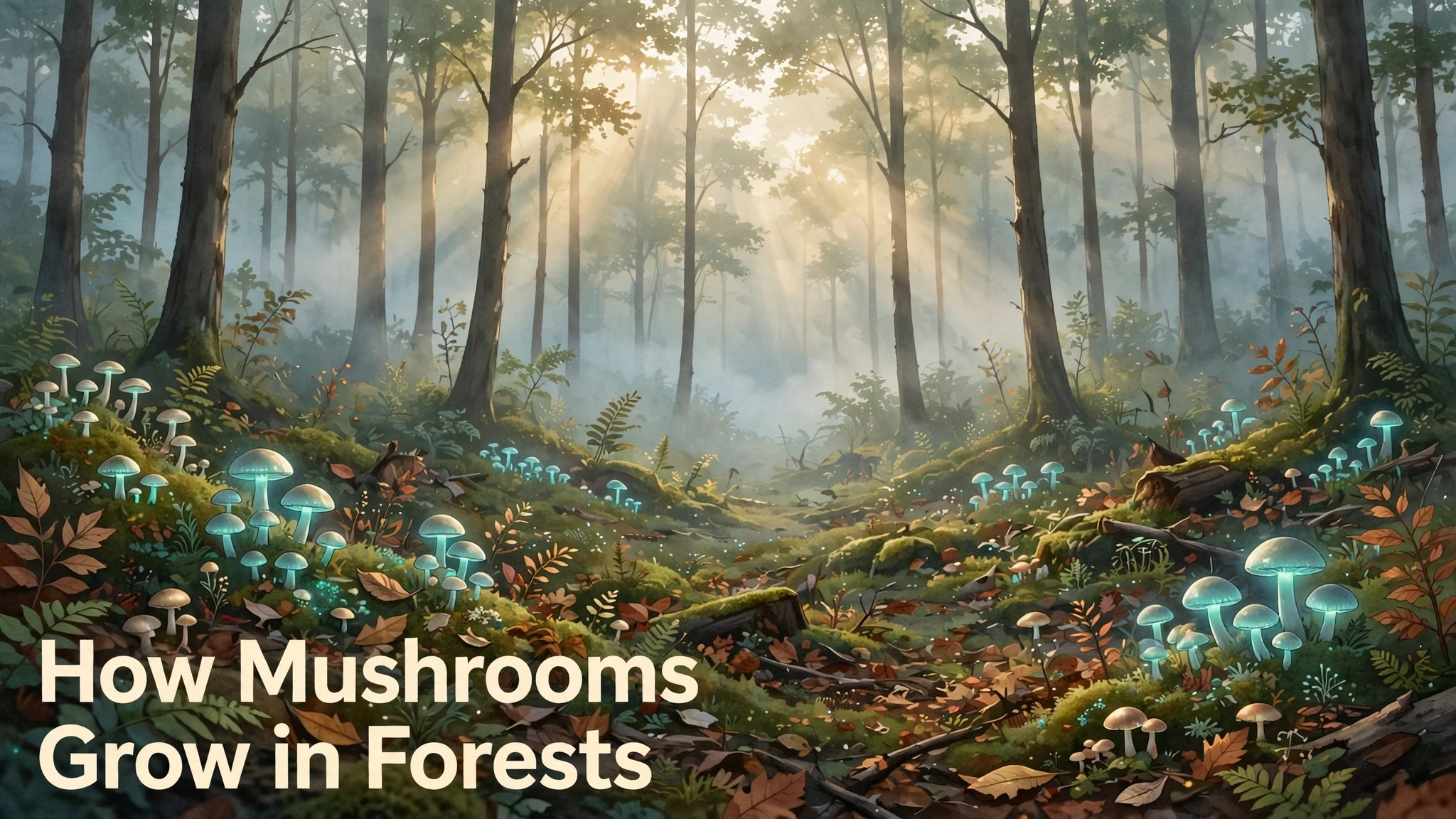
Walk through a forest after rain and the ground seems to change overnight. Yesterday there was only leaf litter and damp soil. Today, small caps push through the moss, clusters crowd around a fallen log, and a pale ring of mushrooms circles an old tree. It looks sudden, almost like magic. In reality, the mushroom you see is only the last, brief chapter of a much longer story that has been unfolding underground for weeks, months, or even years.
Mushrooms are not plants. They do not make food from sunlight, they have no leaves, and they do not grow from seeds. They are the fruiting bodies of fungi, a kingdom of life as different from plants as animals are. The main body of the fungus usually lives hidden in soil or wood, and what we call a mushroom is its reproductive structure, grown to release spores into the air. Understanding that single fact changes how you look at every forest walk: the forest floor is not empty ground, it is a living web, and mushrooms are its visible signals.
This guide explains, step by step, how mushrooms grow in forests, what they need, why they appear in some places and not others, and what they quietly do for trees, soil, and the whole woodland.
The mushroom is only the tip of the fungus
Think of an apple tree. The apple is not the tree; it is the fruit the tree produces for a short season. A mushroom works in a similar way. The real organism is mostly out of sight, made of fine threads called hyphae that spread through soil, leaf litter, or dead wood. Together, those threads form a network called mycelium. When conditions are right, the mycelium gathers resources and builds a mushroom above the surface, or sometimes on the side of a log, to reproduce.
That is why mushrooms can seem to appear so fast. The heavy work of gathering nutrients has already been done underground. The mushroom itself is largely water, which is why a wet spell often triggers a sudden flush: the fungus can inflate its fruiting bodies quickly once moisture is available. Some mushrooms last only a day or two, softening and collapsing as soon as their spores are shed. Others, especially woody bracket fungi on trees, can persist for months or years, adding a new layer of growth each season.
Size is also misleading. A tiny mushroom no bigger than a fingernail can belong to a mycelium stretching metres through the soil. At the other extreme, some forest fungi are among the largest organisms on Earth by area, with a single connected mycelium covering many hectares, even though only scattered mushrooms ever show above ground. So when you pick, photograph, or simply admire a mushroom, remember you are looking at a doorway, not the whole house.
Spores: how a forest gets seeded with fungi
A mushroom’s main job is reproduction, and its tool is the spore. Spores are microscopic cells, far smaller than seeds, and a single large mushroom cap can release millions or even billions of them. They drift on air currents, ride on rain splash, stick to insects, or travel in the fur and droppings of animals. Most spores never land anywhere useful. They dry out, are eaten, or fall on ground where they cannot grow. But fungi play a numbers game: with so many spores released, a few will land in exactly the right place.
For a spore to start growing, it needs moisture, a suitable temperature, and food. In a forest, that food is usually dead plant material, living tree roots, or other organic matter. When a spore germinates, it sends out a thread of hyphae. If that thread meets a compatible partner thread, the two can join and form a new mycelium capable of producing mushrooms. Without a compatible mate, many fungi cannot complete the cycle, which is one reason not every spore becomes a mushroom.
Some fungi also spread without spores, simply by growing outward through soil or wood, year after year. That is how fairy rings form: a mycelium grows outward from a single starting point in all directions, and mushrooms fruit at the growing edge, making a circle that widens slowly over time. Old stories blamed such rings on dancing fairies. The real explanation, a spreading underground network, is stranger and more impressive.
Mycelium: the hidden network under your feet
If spores are the seeds of the fungal world, mycelium is its body, its stomach, and its transport system all in one. Hyphae are thin tubes that branch and fuse, exploring soil grain by grain. They release enzymes outside their cells that break down tough materials such as wood, leaves, and other dead matter into smaller molecules, which the fungus then absorbs. This is very different from how animals eat, and it is why fungi are so good at recycling: they digest their food externally, in place.
In forest soil, mycelium also moves nutrients around. A network can draw sugars, minerals, and water from one patch and deliver them to another, including to a developing mushroom. This underground movement helps explain why mushrooms often appear in clusters or lines: they are fruiting from the same connected network, following the shape of the food source below, such as a buried root or a decaying log hidden under leaves.
The scale of these networks can be hard to grasp. In a single handful of healthy forest soil there may be kilometres of hyphae, belonging to many different fungi. They weave between soil particles, around roots, and through rotting wood, forming a living mesh that also helps hold soil together and improves its structure. When people walk off paths and compact forest soil, or when heavy machinery churns it up, that mesh can be damaged, and mushroom fruiting in that spot may drop for years. The visible mushroom is fragile; the network beneath it is both vast and surprisingly easy to disturb.
Why forests are perfect mushroom homes
Forests offer fungi almost everything they need in one place: shade, moisture, food, and shelter from wind and harsh sun. The canopy keeps the forest floor cool and damp, slowing evaporation. Fallen leaves, twigs, dead trees, and stumps provide a constant supply of organic matter. Tree roots provide living partners. And the soil itself, built up over centuries of fallen material, holds water like a sponge.
Moisture is the most important trigger. Most forest mushrooms need damp conditions to grow and to release spores successfully, which is why autumn in temperate forests, and wet seasons in tropical forests, bring the greatest displays. Temperature matters too: too cold, and growth slows to a halt; too hot and dry, and the delicate fruiting bodies shrivel before they can shed spores. That is why the same forest can look bare of mushrooms in a dry summer and crowded with them after a week of autumn rain.
Different fungi prefer different corners of the forest. Some fruit on the ground in open clearings, some hide under dense leaf litter, some grow only on dead beech or oak wood, and some appear only near the roots of a particular tree species. Forest type matters as well: a pine plantation, a mixed broadleaf wood, and a tropical rainforest each host very different fungal communities, because the trees, the soil chemistry, and the climate are different. This variety is part of the pleasure of looking for mushrooms: learning to read a forest means learning which fungi belong to which trees and soils.
Partners, recyclers, and sometimes parasites
Not all forest fungi do the same job, and their roles explain much of their growth pattern. The three broad roles are decomposers, partners, and parasites, and many forests need all three.
Decomposer fungi, sometimes called saprotrophs, feed on dead material. They break down fallen leaves, dead branches, and stumps, returning nutrients to the soil. Without them, forests would slowly bury themselves under undecomposed litter, and nutrients would stay locked away in dead wood instead of feeding new growth. When you see mushrooms on a rotting log, you are usually watching this recycling work in progress, and the log itself may be soft, crumbling, and full of mycelium inside.
Partner fungi, called mycorrhizal fungi, form a close relationship with living tree roots. The fungus wraps around or enters the fine roots and greatly extends the tree’s reach for water and minerals, especially phosphorus. In return, the tree supplies the fungus with sugars it made by photosynthesis. This trade is so widespread that most forest trees depend on it, and seedlings often grow poorly without their fungal partners. Many of the most prized edible forest mushrooms, such as chanterelles and porcini, are mycorrhizal, which is one reason they are hard to farm: they need a living tree partner, not just a pot of soil.
Parasitic fungi feed on living trees or other organisms, sometimes weakening or killing them. Some are serious forest pests, while others attack only trees that are already stressed or damaged. Even parasites have an ecological role, opening gaps in the canopy when a tree dies and creating dead wood for decomposers. A healthy forest is not a place without parasites; it is a place where all these roles stay in rough balance.
The seasons of fruiting: why timing matters
A mycelium can live in soil or wood for years without ever producing a mushroom. Fruiting is expensive, and fungi only invest in it when conditions favour spore survival and dispersal. For many temperate forest fungi, that moment comes in autumn, when temperatures cool, rains return, and the soil is still warm enough for growth. Spring brings a second, smaller flush for some species, and a few hardy fungi fruit through mild winters.
Tropical forests follow a different rhythm, tied to wet and dry seasons rather than cold winters. In very wet rainforests, some fungi fruit almost year-round, while others wait for a particular combination of rain and temperature. In dry forests, fruiting may be confined to a few weeks after the first heavy rains, and the mushrooms must grow, release spores, and collapse quickly before the ground dries again.
Day length, soil temperature, and even the state of the host tree can act as cues. For mycorrhizal fungi, fruiting often follows the tree’s own seasonal cycle, when the tree is sending sugars down to its roots. For decomposers, fruiting may follow the decay stage of the wood: early colonists appear on fresh dead wood, different species take over as the wood softens, and late species fruit on well-rotted material that earlier fungi have already partly broken down. This succession means that returning to the same log over several years can reveal a changing cast of mushrooms, each suited to a different stage of decay.
Edible, poisonous, and lookalikes: a safety warning
Forests tempt foragers, but mushroom identification is a skill where mistakes can be serious. This article is general information only, not a foraging guide, and no mushroom should be eaten based on a photograph, an app, or a general description alone. Many edible species have poisonous lookalikes that differ only in small details such as spore colour, the shape of the stem base, or the presence of a ring or cup. Some poisonous mushrooms cause stomach illness, while a small number can cause liver or kidney failure and can be fatal.
The safest rules are simple and worth repeating. Never eat a wild mushroom unless an experienced local expert has identified it in person for that exact specimen. Do not rely on old folk tests, such as whether a mushroom peels, stains, or is eaten by animals, because none of those tests reliably separates safe from dangerous species. Keep a sample and a photograph if anyone becomes ill after eating a wild mushroom, and seek medical help immediately. Children and pets should also be kept from tasting unknown fungi.
That warning should not stop anyone from enjoying mushrooms. Photographing, sketching, and learning to identify fungi by sight, smell, habitat, and spore print is a rewarding hobby, and many local mycology groups run guided walks where beginners can learn safely. The goal is appreciation first: a forest full of mushrooms is a sign of a living, recycling ecosystem, whether or not any of them end up in a kitchen.
What mushrooms do for the whole forest
Step back from a single mushroom and the bigger picture comes into focus. Fungi are the forest’s recyclers, its root extensions, and its connectors. Decomposers unlock nutrients from dead wood and leaves. Mycorrhizal partners help trees absorb water and minerals and, in return, receive sugars. Some research suggests that mycorrhizal networks can even link trees of different species, moving resources between them, although how much this matters in a natural forest, and under what conditions, is still an active area of study and should not be overstated.
Fungi also feed forest wildlife. Slugs, insects, squirrels, deer, and wild pigs eat mushrooms, and in doing so they spread spores further in their droppings. Birds and small mammals shelter in rotting logs softened by fungi. Even after a mushroom collapses, its nutrients return to the soil, feeding the next generation of plants and fungi. Remove fungi from a forest, and the whole system would slow, clog, and starve: dead material would pile up, trees would struggle to find minerals, and soil would lose much of its living structure.
That is why protecting forest fungi matters even for people who never notice them. Old, undisturbed forests with plenty of dead wood, varied tree species, and uncompacted soil tend to host the richest fungal communities. Planting a single species of tree in neat rows, clearing all dead wood, or draining wet woodland all reduce fungal diversity. A forest managed only for timber, with every fallen log removed, may look tidy, but it has lost much of its hidden workforce. The mushrooms we admire are, in the end, a health check: where they fruit abundantly and diversely, the forest below is usually alive and working well.
My Take:
The most important correction in this post is the simplest one: a mushroom is not the organism, it is the fruit. I think most people still picture fungi the way they picture plants, as something that grows up from a seed in one spot. The real organism is a network, often invisible, sometimes vast, and built for patience rather than display. That changes the moral of the story. If you trample soil, clear dead wood, or drain a woodland, you are not just removing this year’s mushrooms. You may be damaging a network that took years to build and that the trees themselves rely on.
My second judgement is about the partnership between trees and fungi, which I think is still undervalued in how we talk about forests. We praise trees for cleaning air and storing carbon, and rightly so, but a tree without its mycorrhizal partners is like a shop with no supply roads. The fungus extends the root system, finds water and minerals the tree cannot reach, and receives sugars in return. Planting trees without protecting the soil life beneath them is therefore only half a job. A restoration project that trucks in saplings but compacts the soil, removes all dead wood, and plants a single species should not be surprised when growth is slow and fungal diversity stays low.
I also think the foraging fashion around wild mushrooms needs a calmer voice. Social media makes finding a rare edible look like a treasure hunt, and the pressure to eat what you find is real. But the lookalike problem is not a minor detail; it is the central danger. Some of the most dangerous species look ordinary, even beautiful, and folk tests do not work. My rule is blunt: admire freely, photograph eagerly, and eat only what a trusted local expert has identified in person. A forest walk that ends with knowledge and photographs is a success, not a failure because nothing went into a basket.
Finally, I would argue that fungi deserve a place in how we judge forest health, alongside birds, trees, and mammals. A tidy forest with no dead wood and no mushrooms is not a healthy forest; it is a forest whose recycling system has been stripped out. The presence of many different mushrooms, on logs, on soil, and near tree roots, tells us that decay, partnership, and renewal are all happening. If we want forests that survive drought, disease, and climate change, we should protect the quiet workers underground as carefully as we protect the trees above them. The mushroom is the signal. The mycelium is the story.
A third judgement concerns how we manage forests for fungi, not just for trees. Traditional forestry often treats dead wood as waste to be cleared and soil as a surface to drive over. From a fungal point of view, that is like clearing a city’s warehouses and roads and then wondering why trade collapses. Fallen logs are not litter; they are fungal habitat, food, and nurseries for the next generation of fruiting bodies. Leaving a proportion of dead wood standing and lying, protecting wet hollows, and keeping heavy machines off sensitive soil are cheap, practical steps that pay back in soil health, tree growth, and biodiversity. A forest that looks a little messier to a human eye is often a forest that is working properly underneath.
I also think mushroom science offers a useful lesson about what we cannot see and therefore undervalue. For centuries, people judged forests by what stood above ground: tall trees, birdsong, deer. The fungal network was invisible, so it was ignored in plans, budgets, and textbooks. Modern DNA sampling has changed that picture, revealing thousands of fungal species in a single woodland, many of them unknown to science until recently. That should make us cautious about other invisible systems we still dismiss, from soil microbes to deep ocean life. Absence of evidence, in ecology, has repeatedly turned out to be evidence of our own limited tools, not evidence that nothing important is there.
There is a cultural angle too. Mushrooms appear in folklore all over the world as magical, dangerous, or otherworldly, from fairy rings to tales of toadstools. Those stories, while not science, captured something true: fungi appear suddenly, in circles, in places where nothing seemed to be growing, and they can nourish or poison with little outward warning. I think good science writing should respect that sense of wonder rather than flatten it. Explaining mycelium does not remove the magic; it replaces a small mystery with a larger one, a living web underfoot that connects trees, recycles death into life, and fruits only when the moment is right.
My final point is about patience. A mushroom hunter who returns to the same wood year after year learns a fungal calendar: which species follow the first autumn rains, which prefer beech over oak, which logs are still productive and which are spent. That patience is the opposite of instant gratification, and it is increasingly rare. Yet it is exactly the attitude forests need from us. Fungi work on timescales of years and decades, not days. If we want their benefits, clean soil, healthy trees, and the quiet recycling that keeps a woodland alive, we must learn to think on their timescale, protect the ground we cannot see, and leave enough of the forest alone for the network to do its work.
In the end, the test I would set for any forest plan is simple: does it leave room for the network? If a plan protects trees but destroys soil structure, removes every fallen log, and drains every damp hollow, it has protected the visible part of the forest while starving its foundation. Conversely, a plan that keeps varied tree species, retains dead wood, limits soil compaction, and gives mycelium time to recover after disturbance will usually reward that patience with richer fruiting, healthier trees, and more resilient soil. Mushrooms are not a side show in that picture. They are the evidence that the foundation is intact, and when they return in diversity after a period of care, they are telling us, in their quiet way, that the forest is healing.
Frequently Asked Questions
How long does it take for a mushroom to grow in a forest? The visible mushroom can grow very fast, sometimes overnight or within a few days, because the mycelium has already gathered nutrients underground. The full organism, however, may have been growing in soil or wood for months or years before it fruits.
Do mushrooms grow from seeds? No. Mushrooms grow from spores, which are microscopic reproductive cells released by the fruiting body. Unlike seeds, spores carry very little stored food, so most of them fail unless they land in moist, suitable material.
Why do mushrooms appear after rain? Rain supplies the water that fruiting bodies are mostly made of, and damp air helps spores survive and spread. Many fungi wait for wet conditions before investing energy in mushrooms, which is why flushes often follow rainy spells.
What is mycelium and where is it? Mycelium is the main body of a fungus, made of branching threads called hyphae. It lives hidden in soil, leaf litter, or wood, and the mushroom is only its short-lived reproductive structure.
Can the same fungus produce mushrooms in the same place every year? Yes, often. A mycelium living in soil or a log can fruit repeatedly in favourable seasons, sometimes for many years, which is why mushroom hunters return to the same spots. Drought, soil disturbance, or loss of the host tree can end that pattern.
Are all forest mushrooms safe to touch? Touching a mushroom is generally considered low risk, but tasting or eating an unknown mushroom is not safe. Identification for eating must be done by an experienced expert for that exact specimen, and anyone who becomes ill after eating a wild mushroom should seek medical help immediately.