How Do Polar Bears Stay Warm? Explained Simply
In this post
A polar bear lives in a place where the temperature can fall to minus 40 degrees, where the wind can cut through clothing in minutes, and where the sea is frozen for much of the year. Yet the bear swims in icy water, walks on snow, and sleeps in a snow den, without shivering all the time. It does not stay warm by magic. It stays warm because its body is built like a winter coat, with layers that trap heat, and because it behaves in ways that save heat.
This guide explains the famous white fur, the black skin underneath, the thick layer of fat, the large paws, and the small ears that lose less heat. It also explains how polar bears hunt on sea ice, and why a warming Arctic is a serious threat to them.
Two Layers of Fur: The Winter Coat
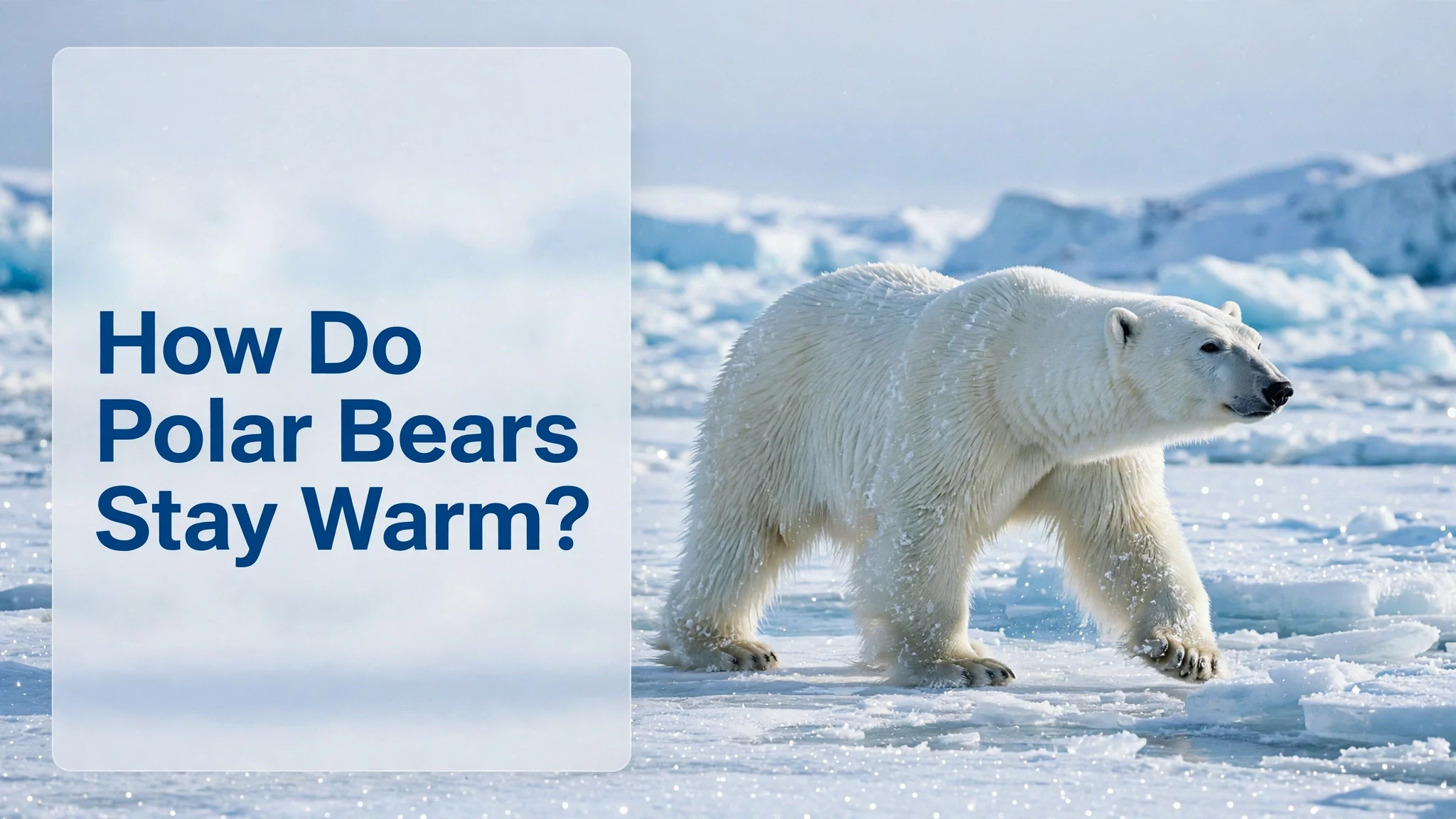
A polar bear’s fur is not one layer. It is two, and together they trap a layer of warm air next to the skin.
In practice, The outer fur is made of long, hollow guard hairs, which are white and look like a thick coat. Those hairs are hollow, which helps them trap air and insulate the bear. Underneath is a dense, woolly underfur, which is even better at trapping warm air. So the fur is a double coat, and the air trapped between the hairs is the real insulation, not the hair itself. The hollow guard hairs are the polar bear’s first defence, and once I learned that, the white coat stopped looking like simple camouflage and started looking like a winter coat with a secret.
Look closer and The fur is also oily, which helps it shed water when the bear swims. After a swim, the bear shakes itself dry, and the water runs off the oily fur. That matters because wet fur loses heat fast, and a bear that stayed wet in the Arctic would get cold quickly. So the oil is part of the warmth system, and it keeps the insulation working even after a swim. A polar bear’s warmth is not one trick; the hollow hairs, the black skin, and the thick fat work together, and the way a mother fasts for months in a snow den proves the whole system is built for endurance.
The key point is that Polar bear fur looks white, but each hair is actually clear and hollow. The white appearance comes from light scattering off the hollow hairs, like snow. That white colour also helps the bear blend into snow and ice, which helps it hunt seals. So the fur is both a coat and camouflage, and its colour is a trick of light, not a pigment. Up close, staying warm on ice looks less like a miracle and more like a set of practical layers, each one trapping heat that the Arctic wind is trying to steal.
Black Skin and a Layer of Fat
Under the white fur, a polar bear has black skin and a thick layer of fat, and both help it stay warm.
What makes this work is that A polar bear’s skin is black, which absorbs heat from the sun. When sunlight passes through the clear fur and hits the black skin, the skin warms up. That solar heating is a small but useful bonus, especially on a sunny Arctic day. So the bear is black underneath white, and that combination turns sunlight into warmth. People picture a white bear on white ice and think of camouflage, yet the black skin underneath is what actually soaks up the sun, and that detail changes the whole picture.
Step back for a moment and Under the skin is a layer of fat, sometimes more than 10 centimetres thick. That fat is insulation, like a wetsuit, and it also stores energy for times when food is scarce. A well-fed bear has a thick fat layer, while a hungry bear has a thin one. So the fat is both a coat and a pantry, and its thickness tells you how well the bear has been eating. One Arctic winter packs fur, fat, small ears, and huge paws into a single bear, and the animal spends its warmth so carefully that a seal meal has to last for weeks.
The surprising part is that The fat layer is especially important when the bear swims, because water steals heat faster than air. A bear swimming in icy water loses heat quickly, yet its fat and fur slow that loss. After a swim, the bear must dry off and warm up again, which is why it shakes and rolls in snow. So the fat is the bear’s main defence in water, and it is what lets the bear hunt seals in the sea. Trace the heat from the sun to the black skin to the fat layer, and the separate parts of the bear, fur, skin, and body shape, join into one coherent answer to the cold.
Small Ears, Short Tail, and a Compact Body
A polar bear’s body shape is also designed to lose as little heat as possible.
In practice, Polar bears have small ears and a short tail, which lose less heat than large ears or a long tail would. That is a general rule in cold climates: small, round shapes lose less heat than long, thin ones. Arctic foxes also have small ears, for the same reason. So the bear’s small ears are not a flaw; they are a heat-saving design, and they fit the Arctic. The hollow guard hairs are the polar bear’s first defence, and once I learned that, the white coat stopped looking like simple camouflage and started looking like a winter coat with a secret.
Look closer and A polar bear’s body is large and compact, which also helps it stay warm. A large body has less surface area for its volume than a small body, so it loses heat more slowly. That is why polar bears are the largest land carnivores, and why their size is an advantage in the cold. So the bear’s size is part of its warmth, and being big is a good strategy in a cold place. A polar bear’s warmth is not one trick; the hollow hairs, the black skin, and the thick fat work together, and the way a mother fasts for months in a snow den proves the whole system is built for endurance.
The key point is that The bear’s nose is also designed to warm the air it breathes in. Cold air is warmed in the nose before it reaches the lungs, which saves heat. That warming also helps the bear smell seals under the ice, because warm air carries scent better. So the nose is both a heater and a hunter’s tool, and it does two jobs at once. Up close, staying warm on ice looks less like a miracle and more like a set of practical layers, each one trapping heat that the Arctic wind is trying to steal.
Paws Built for Ice and Snow
A polar bear’s paws are large, furry, and strong, and they help it walk, swim, and hunt on ice.
What makes this work is that A polar bear’s paws can be 30 centimetres across, which spreads its weight over snow and ice. That wide base stops the bear sinking into soft snow, like snowshoes. The paws also have fur on the soles, which gives grip on slippery ice. So the paws are snowshoes and ice grips in one, and they let the bear move safely on a surface that would be treacherous for other animals. People picture a white bear on white ice and think of camouflage, yet the black skin underneath is what actually soaks up the sun, and that detail changes the whole picture.
Step back for a moment and The claws are short and sharp, which helps the bear grip ice and catch seals. They are also useful for digging into snow to make a den. A mother bear digs a den in a snowdrift, where she gives birth and raises her cubs. So the claws are tools for walking, hunting, and building a home, and they are used all year. One Arctic winter packs fur, fat, small ears, and huge paws into a single bear, and the animal spends its warmth so carefully that a seal meal has to last for weeks.
The surprising part is that Polar bears are strong swimmers, and their paws act as paddles. They can swim for hours, and they have been known to swim long distances between ice floes. That swimming is tiring and it loses heat, so bears prefer to walk on ice when they can. So the paws are versatile, but the bear still prefers ice to water, because ice is warmer and safer. Trace the heat from the sun to the black skin to the fat layer, and the separate parts of the bear, fur, skin, and body shape, join into one coherent answer to the cold.
Hunting on Sea Ice: Food Is Warmth
Staying warm is not just about fur and fat. It is also about food, because food is fuel for heat.
In practice, Polar bears hunt seals, which are rich in fat and energy. A single seal can provide enough food for a bear for days. The bear waits by a seal’s breathing hole in the ice, or it stalks seals on the ice. So the hunt is patient, and the bear’s white camouflage helps it get close without being seen. The hollow guard hairs are the polar bear’s first defence, and once I learned that, the white coat stopped looking like simple camouflage and started looking like a winter coat with a secret.
Look closer and When a bear eats a seal, it eats the fat first, which is the most energy-rich part. That fat replenishes the bear’s own fat layer, which keeps it warm. A bear that cannot hunt, because the sea ice has melted, will lose weight and get cold. So food and warmth are linked: without seals, the bear cannot stay fat, and without fat, it cannot stay warm. A polar bear’s warmth is not one trick; the hollow hairs, the black skin, and the thick fat work together, and the way a mother fasts for months in a snow den proves the whole system is built for endurance.
The key point is that Polar bears can go for weeks or months without food, living off their fat stores. That fasting is hardest in summer, when the sea ice melts and seals are hard to reach. A bear that fasts too long becomes thin, weak, and cold. So the bear’s fat is a savings account, and summer is the time when it must live off its savings. Up close, staying warm on ice looks less like a miracle and more like a set of practical layers, each one trapping heat that the Arctic wind is trying to steal.
Mothers, Cubs, and Snow Dens
Mother polar bears give birth in snow dens, which are warm, sheltered places for cubs.
What makes this work is that A pregnant female digs a den in a snowdrift in autumn, then enters it and gives birth in winter. The den is a small cave in the snow, which traps warm air and protects the cubs from wind. Inside the den, the temperature can be much warmer than outside. So the snow den is a natural igloo, and it is the cubs’ first home. People picture a white bear on white ice and think of camouflage, yet the black skin underneath is what actually soaks up the sun, and that detail changes the whole picture.
Step back for a moment and Cubs are born tiny, blind, and helpless, weighing less than a kilogram. They drink their mother’s rich milk, which is high in fat, and they grow quickly. By spring, they are strong enough to leave the den and walk on the ice with their mother. So the den is a nursery, and the mother’s milk is the fuel that turns a tiny cub into a strong young bear. One Arctic winter packs fur, fat, small ears, and huge paws into a single bear, and the animal spends its warmth so carefully that a seal meal has to last for weeks.
The surprising part is that The mother does not eat while she is in the den, living off her fat stores. That fast can last for months, and it is one of the longest fasts of any mammal. When she emerges in spring, she is thin and hungry, and she must hunt quickly. So the mother’s sacrifice is part of the cubs’ survival, and it shows how much a polar bear’s life depends on fat. Trace the heat from the sun to the black skin to the fat layer, and the separate parts of the bear, fur, skin, and body shape, join into one coherent answer to the cold.
A Warming Arctic: Why Polar Bears Are at Risk
Polar bears are built for cold and ice, and a warming Arctic threatens the very things they depend on.
In practice, Sea ice is melting earlier in spring and forming later in autumn, which shortens the hunting season. Bears have less time to hunt seals and build up fat, and more time to fast on land. That means thinner bears, fewer cubs, and more bears that do not survive. So the loss of ice is not just a change in scenery; it is a loss of food, warmth, and life. The hollow guard hairs are the polar bear’s first defence, and once I learned that, the white coat stopped looking like simple camouflage and started looking like a winter coat with a secret.
Look closer and Some bears are now spending more time on land, eating berries, eggs, and even rubbish. Those foods are less rich than seals, and they do not replace seal fat. A bear that eats berries cannot build up the fat it needs for winter. So the bear’s diet is changing, but the new foods are not good enough, and the bear is getting thinner. A polar bear’s warmth is not one trick; the hollow hairs, the black skin, and the thick fat work together, and the way a mother fasts for months in a snow den proves the whole system is built for endurance.
The key point is that Protecting polar bears means protecting sea ice, which means reducing the warming that melts it. That is a global task, and it depends on cutting the emissions that warm the planet. It also means protecting denning areas and reducing disturbance from ships and industry. So the polar bear’s future is tied to our choices, and its warmth, which once seemed invincible, now depends on a cold Arctic that is disappearing. Up close, staying warm on ice looks less like a miracle and more like a set of practical layers, each one trapping heat that the Arctic wind is trying to steal.
My Take:
I have never seen a polar bear in the wild, and I probably never will. Yet I think about them often, because they are a reminder that warmth is not just about a heater. It is about a body, a coat, a layer of fat, and a way of living that fits a place. A polar bear does not fight the cold. It is built for it, and it lives in it, and it hunts in it. That is a different kind of toughness from ours, and it deserves respect.
I think the black skin under white fur is the most surprising detail. A bear that looks white is black underneath, and that black skin absorbs heat from the sun. It is a clever, hidden design, and it reminds me that the most important parts of a thing are often the ones you cannot see. The black skin under white fur is the detail I keep turning over, because a bear that looks white is black underneath, and that reversal still delights me. Polar bears have become, for me, a reminder that warmth is not just about fur; it is about layers, food, and a body shaped by ice.
The fat layer is the part I think about most, because it is both a coat and a pantry. A bear’s fat keeps it warm and feeds it when food is scarce, which is two jobs in one. That is efficient design, and it shows how nature packs several functions into one part of the body. For me, the honest test for a polar bear staying warm is simple. Polar bear explanations that are clever but empty get dropped, and I think about the ice instead. I trust a polar bear explanation when it lets me predict the bear, like knowing it will hunt at the edge of the sea ice, and this piece kept predicting well. A polar bear detail like that is one I would mention to a friend who loves winter, so the bear on the ice feels like an engineer, not just a postcard.
I also like the small ears, because they are a simple idea with a clear reason. Small ears lose less heat, so Arctic animals have small ears, and that is a rule you can see in foxes and bears alike. It is a reminder that evolution follows simple physics, and that simple rules can explain a lot. Grasping polar bear warmth took me longer than a quick read, because each layer, fur, skin, fat, and paws, deserves to be understood on its own. For me, learning about a polar bear staying warm was not one dramatic moment. A hollow hair here, a layer of fat there, a small ear that loses little heat, and the separate adaptations gradually assembled into a single, warm animal. Simple questions about polar bears feel less naive to me now, because asking why the fur looks white led me to the black skin and the hollow hairs beneath it.
The snow den is the image that stays with me. A mother bear digs a cave in snow, gives birth inside it, and fasts for months while her cubs grow. That is a remarkable act of care, and it makes the bear’s toughness feel less like strength and more like love. If a friend asked about polar bears, I would tell them to start with the ice, because the ice explains the hunting, and the hunting explains the fat. Ask what melting ice does to a hunt, who gains when a seal appears, and what a fast costs a mother, and the bear’s warmth becomes a story about food, not just fur. My old picture of polar bears was a white animal on white snow, and the layered, black-skinned animal that replaced it is far more interesting to think about.
The warming Arctic is the part that worries me. Polar bears are built for ice, and the ice is melting, which means their food, their hunting, and their dens are all at risk. It is a clear, measurable problem, and it is one we can see happening in our lifetime, which makes it harder to ignore. Learning about polar bears has made me more cautious about first impressions, because the whitest animal I know turns out to be black underneath. The more I study polar bears, the less I trust a simple colour as an explanation, and that scepticism feels like a useful habit to keep. Polar bears repay a second look, because the first sees white fur and the second sees black skin underneath. One picture stays with me: a mother bear in a snow den, fasting for months while her cubs grow, and that image says more than any list of facts.
The lesson I take from polar bears is about fitting the place you live in. A polar bear fits the Arctic perfectly, from its fur to its fat to its paws. I think we should ask the same question about our own lives: do we fit the place we live in, or are we fighting it, and what would change if we adapted instead? If I could keep one polar bear lesson, it would be fitting the place you live in, because the bear fits the Arctic from its fur to its fat to its paws. When I tried to explain polar bears without the guide, the fuzzy part showed up fast: how the hollow hairs actually trap heat.
Going back to the fur section, I noticed how much of the bear’s story hangs on two layers, and how a single layer alone would never be enough. The famous white coat is not the most instructive part; the black skin beneath it, soaking up what little sun there is, teaches more about survival. That black skin gives me a quiet reassurance, because it shows that nature’s best solutions are often hidden under the surface, out of sight.
The black skin and fat section changed how I discuss polar bears, because it gave me a surprising fact to lead with instead of a familiar picture. I begin now by asking what colour a polar bear really is, then I describe the fat layer, and only then do I draw a wider lesson. Leading with the surprising colour lets the listener feel the puzzle first, and that seems a better way to start than with my conclusion. It also leaves space for the listener to push back, and a polar bear conversation that allows pushback is far livelier than a lecture.
Small ears and a compact body, considered at the end, revealed a pattern I had missed: the bear keeps solving heat loss in a different way in every part of its body. Fur, fat, and the mother’s snow den all pointed the same way: keep warm, hunt on ice, and revise your first guess when the evidence says otherwise. Those ideas help with more than polar bears, which is why I intend to read this piece again rather than filing it away. I will look at the next polar bear photograph with fresh eyes, checking the paws and ears first, and expecting the second look to show me more.
Frequently Asked Questions
How do polar bears stay warm in the Arctic?
Polar bears stay warm with two layers of fur that trap air, black skin that absorbs sun, a thick layer of fat, and a large, compact body with small ears that lose little heat.
Is polar bear fur really white?
Polar bear fur looks white, but each hair is actually clear and hollow. The white appearance comes from light scattering off the hollow hairs, like snow. Under the fur, the skin is black.
Do polar bears get cold in water?
Polar bears can get cold in water, because water steals heat faster than air. Their fat and oily fur slow heat loss, and after swimming they shake dry and warm up again.
How thick is a polar bear’s fat layer?
A polar bear’s fat layer can be more than 10 centimetres thick. It insulates the bear and stores energy for times when food is scarce, such as summer when sea ice melts.
Why do polar bears have black skin?
Black skin absorbs heat from the sun. Sunlight passes through the clear fur and warms the black skin, which gives the bear a small but useful amount of extra warmth.
Are polar bears in danger from climate change?
Yes, polar bears are in real danger from melting sea ice. Sea ice is melting earlier and forming later, which shortens the hunting season for seals. Bears have less time to build up fat, which affects their health and their cubs.